ICSE Class 8 Physics Chapter 2 Notes
Are you searching for ICSE Class 8 Physics Physical Quantities and Measurement Notes PDF Download? You are in the right place. Here you will get easy and well-explained notes on Physical Quantities and Measurement for ICSE Class 8 students. These notes are prepared according to the latest syllabus and are useful for revision, homework, and exam preparation.
Study Support by Rohit Academy
Rohit Academy offers expert-curated ICSE Class 8 Physics Study Materials including ICSE Measurements and Experimentation Chapter Notes, diagrams, and key formulas for better understanding.
You can also visit :
| ☛ ICSE Class 8 Physics Chapter 2: Physical Quantities and Measurement Selina Solutions |
| ☛ ICSE Class 8 Physics |
| ☛ ICSE Class 8 Chemistry |
| ☛ ICSE Class 8 Mathematics |
| ☛ ICSE Class 8 Biology |
Physical Quantities and Measurement Notes ICSE Class 8
Introduction to Density
- Every body has:
⦿ A certain mass
⦿ A definite volume - Different substances may have:
⦿ Equal masses but different volumes
⦿ Equal volumes but different masses - To compare substances, we use density.
Definition of Density
Density of a substance is the mass per unit volume.
Density \(=\frac{\operatorname{Mass}}{Volume}\)
Meaning of Density
- A substance with high density has particles packed closely together.
- A substance with low density has particles loosely packed.
Examples
1. Equal Mass but Different Volume
1 kg cotton occupies more space than 1 kg iron.
Reason: Cotton is less dense.
2. Equal Volume but Different Mass
1 cm3 iron has more mass than 1 cm3 wood.
Reason: Iron is denser.
Units of Density
- S.I. Unit: kg m–3 (kilogram per cubic metre)
- C.G.S. Unit: g cm–3 (gram per cubic centimetre)
Relation Between Units
- 1 g cm–3 = 1000 kg m–3
- 1 kg m–3 = 10–3 g cm–3
Examples of Density
- Density of water = 1 g cm–3
- Density of iron = 7.8 g cm–3
- Density of milk = 1.03 g cm–3
***Note
The density of brass is 8.4 g cm–3 means 1 cm3 of brass has a mass of 8.4 g.
Important Facts
1. Density does not depend on shape
If shape changes, density remains same.
2. Effect of Temperature
Most substances expand on heating.
So:
⦿ Volume increases
⦿ Density decreases
On cooling:
⦿ Volume decreases
⦿ Density increases
Exception: Water
- Water contracts from 0°C to 4°C
- Hence density increases.
- Water has maximum density at 4°C
1000 kg m–3
Determination of Density of a Regular Solid
A regular solid has a definite shape such as cube, cuboid, cylinder or sphere.
Steps:
Step 1: Measure Mass
Use a beam balance to measure mass (M).
Step 2: Measure Volume
Use formulas according to shape:
- Cube: V = (side)3
- Cuboid: V = length × breadth × height
- Sphere: V = × π × (radius)3
- Cylinder: V = π × (radius)2 × h
Step 3: Calculate Density
Density \(=\frac{\operatorname{Mass}}{Volume}\)
Example of Regular Solid
- Mass of iron cube = 210 g
- Side = 3 cm
- Volume, V = 33 = 27 cm3
- Density \(=\frac{\operatorname{Mass}}{Volume}=\frac{210}{27}\ =\) 7.78 gm cm–3
Determination of Density of an Irregular Solid
Irregular solids do not have fixed geometrical shape.
Examples:
- Stone
- Coin
- Metal piece
Use water displacement method.
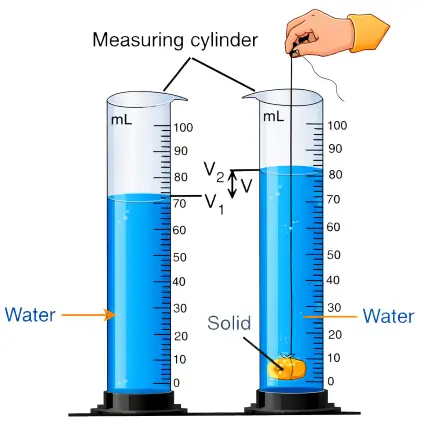
Steps:
1. Measure mass
Let mass = M
2. Take water in measuring cylinder
Initial level = V1
3. Put solid completely in water
Final level = V2
4. Volume of solid
V = V2 –V1
5. Density
\(d=\frac{M}{V}\)
Eureka Can Method
- Fill Eureka can till overflow stops.
- Put solid inside.
- Collect overflow water.
- Measure collected water volume.
That volume = volume of solid.
Determination of Density of a Liquid
Steps:
- Take a measuring cylinder and measure a known volume of liquid, say V.
- Measure the mass of empty cylinder = m1.
- Measure the mass of cylinder with liquid = m2.
- Mass of liquid = m2 – m1.
- Density of liquid = \(\frac{m_2\ -\ m_1}{V}\)
Example of Liquid
- Mass of empty beaker = 20 g
- Mass of beaker + milk = 71.5 g
- Volume of milk, V= 50 cm3
Mass of milk, M = 71.5 – 20 = 51.5 g
Density, d \(=\frac{M}{V}=\frac{71.5}{51.5}=\) 1.03 g cm–3
Density Bottle
- A density bottle is used to determine density or relative density of liquids accurately.
- Usually available in 25 mL or 50 mL capacity.
Method:
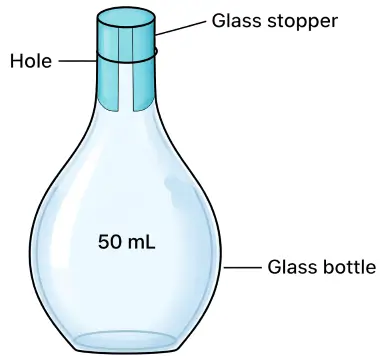
- Measure mass of empty bottle = m1
- Fill with water and measure mass = m2
- Fill with given liquid and measure mass = m3
- Mass of equal volume of water = m2 − m1
- Mass of equal volume of liquid = m3 – m1
∴ Density of liquid \(=\ \frac{m_3\ -\ m_1}{m_2\ -\ m_1}\)
Then density can be calculated.
Relative Density
Relative density is the ratio of density of a substance to density of water.
R. D. \(=\frac{Density\ of\ \operatorname{substance}}{Density\ of\ water}\)
Since density of water = 1 g cm–3
Relative density = numerical value of density in g cm–3.
Example:
If density of iron = 7.8 g cm–3
Then relative density = \(\frac{7.8}{1}\) = 7.8
Unit of Relative Density
Relative density has no unit because it is a ratio of two similar quantities.
***Note
The statement Relative density of aluminium is 2.7 means aluminium is 2.7 times as dense as water.
- If the Relative Density of an object is greater than 1, it will sink in water. If it is less than 1, it will float.
Density and Relative Density of Some Common Substances
| Substance | Density (g cm–3) | Density (kg m–3) | Relative Density |
| Cork | 0.25 | 250 | 0.25 |
| Ice | 0.92 | 920 | 0.92 |
| Aluminium | 2.7 | 2700 | 2.7 |
| Iron | 7.8 | 7800 | 7.8 |
| Alcohol | 0.8 | 800 | 0.8 |
| Water | 1.0 | 1000 | 1.0 |
Differences between density and relative density:
| Density | Relative Density |
| Density is defined as the mass per unit volume of a substance. | Relative density of a substance is the ratio of the density of the substance to the density of water. |
| SI unit = kg m–3 | No unit |
Density in Different States of Matter
For most substances:
- Density of solid > density of liquid > density of gas
- Exception: Water
Ice density = 0.917 g cm–3
Water density = 1 g cm–3 Therefore, ice floats on water.
Floating and Sinking
When a body is placed in liquid:
- Some objects float.
- Some objects sink.
Examples:
- Cork floats on water.
- Iron nail sinks in water.
Reason
- If density of body < density of liquid
Object floats.
- If density of body > density of liquid
Object sinks.
Principle of Floatation
When a body is completely or partially immersed in liquid, two forces act on it.
Force 1: Weight (W)
- Acts vertically downward
- Tends to sink the body
Force 2: Buoyant Force (FB)
- Acts vertically upward
- Also called upthrust
Cases of Floating and Sinking
Case 1: Weight > Buoyant Force
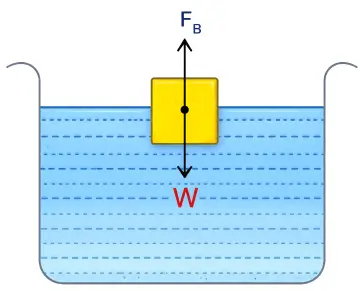
- W > FB
- Resultant force acts downward.
- The body sinks to the bottom.
- This happens when:
Density of body > density of liquid
Case 2: Weight = Buoyant Force
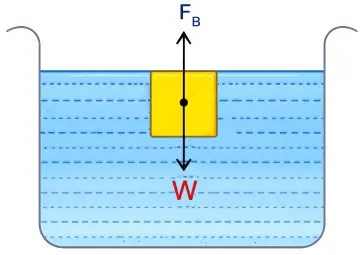
- W = FB
- Resultant force = zero
- The body floats just below the surface.
- This happens when:
Density of body = density of liquid
Case 3: Weight < Buoyant Force
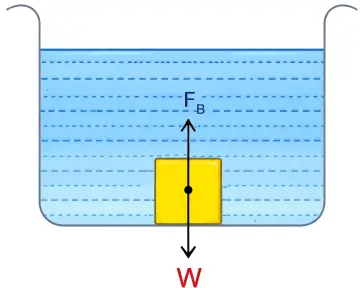
- W < FB
- Resultant force acts upward.
- The body floats partially above the surface.
- This happens when:
Density of body < density of liquid
Law of Floatation
A floating body displaces a liquid whose weight is equal to the weight of the body.
Weight of displaced liquid = weight of body
This is called Law of Floatation.
Applications of Floatation
- Iron Ships: An iron needle is solid and has density greater than water, so it sinks.
- A ship is hollow and contains air, so its average density becomes less than water. Therefore it floats.
- It is easier to swim in sea water than in river water because sea water contains dissolved salts and is denser than river water. Therefore, sea water exerts greater buoyant force, making swimming easier.
- Submarines: A submarine is a vessel that can travel under water.
- To dive: tanks are filled with water, increasing density, so it sinks.
- To rise: water is forced out and tanks filled with air, decreasing density, so it floats upward.
- Icebergs: Most part of an iceberg remains below the water surface because ice is only slightly less dense than sea water.
- Ships may collide with the hidden underwater portion, making icebergs dangerous.
- Hot Air Balloons: Hydrogen or Helium gases are less dense than air, creating an upward buoyant force that lifts the balloon.
- Whales: They use an organ called a swim bladder. By filling it with air, they decrease their density to rise to the surface.
ICSE Class 8 Physics Physical Quantities and Measurement Notes PDF Download
Students looking for ICSE Class 8 Physics Physical Quantities and Measurement Notes PDF Download can use these notes for quick revision. These notes help to understand concepts in a simple language and score better marks in exams.
Why These Notes are Helpful?
- Easy language
- Important definitions
- Exam-oriented content
- Quick revision notes
- Useful for homework and tests
Conclusion
These ICSE Class 8 Physics Physical Quantities and Measurement Notes PDF Download are very useful for every Class 8 student. Learn the concepts regularly and practice questions for better results.
Stay connected for more ICSE notes, solutions, and study materials.
ICSE Class 8 Physics Notes
| ☛ ICSE Class 8 Physics Chapter 1 – Matter Notes |
| ☛ ICSE Class 8 Physics Chapter 2 – Physical Quantities and Measurement Notes |
| ☛ ICSE Class 8 Physics Chapter 3 – Force and Pressure Notes |
| ☛ ICSE Class 8 Physics Chapter 4 – Energy Notes |
| ☛ ICSE Class 8 Physics Chapter 5 – Light Energy Notes |
| ☛ ICSE Class 8 Physics Chapter 6 – Heat Transfer Notes |
| ☛ ICSE Class 8 Physics Chapter 7 – Sound Notes |
| ☛ ICSE Class 8 Physics Chapter 8 – Electricity Notes |
Official Website:
Students can visit the official CISCE website for more details and updates.