ICSE Matter Notes Class 8
Are you searching for ICSE Class 8 Physics Matter Notes PDF Download? You are in the right place. Here you will get complete and easy notes on the chapter Matter for ICSE Class 8 students. These notes are useful for exams, revision, homework, and quick learning. Students looking for ICSE Class 8 Physics Matter Notes PDF Download can use this article as a complete study guide.
Study Support by Rohit Academy
Rohit Academy offers expert-curated ICSE Class 8 Physics Study Materials including ICSE Matter Chapter Notes, diagrams, and key formulas for better understanding.
You can also visit :
| ☛ ICSE Class 8 Physics Chapter 1: Matter Selina Solutions |
| ☛ ICSE Class 8 Physics |
| ☛ ICSE Class 8 Chemistry |
| ☛ ICSE Class 8 Mathematics |
| ☛ ICSE Class 8 Biology |
Physics Matter Notes for Class 8 ICSE
Matter
- Matter is anything that has mass and occupies space.
- Examples: Iron, Wood, Book, Water, Oil, air, oxygen etc.
Composition of Matter
- Matter is made up of tiny particles called molecules.
- A molecule:
○ Can exist independently
○ Possesses all properties of the substance
Types of Molecules
- Monoatomic: Single atom (e.g., helium, argon)
- Diatomic: Two atoms (e.g., hydrogen, oxygen)
- Polyatomic: More than two atoms (e.g., water, ammonia)
Characteristics of Molecules
1. Molecules are very small
● Size ≈ 10–10 m
● Cannot be seen even with a microscope
2. Molecules have spaces between them
● Space is called intermolecular space
3. Molecules are in constant motion
● Solids → Vibrate at fixed position
● Liquids → Move within container
● Gases → Move freely in all directions
4. Molecules attract each other
● This force is called intermolecular force
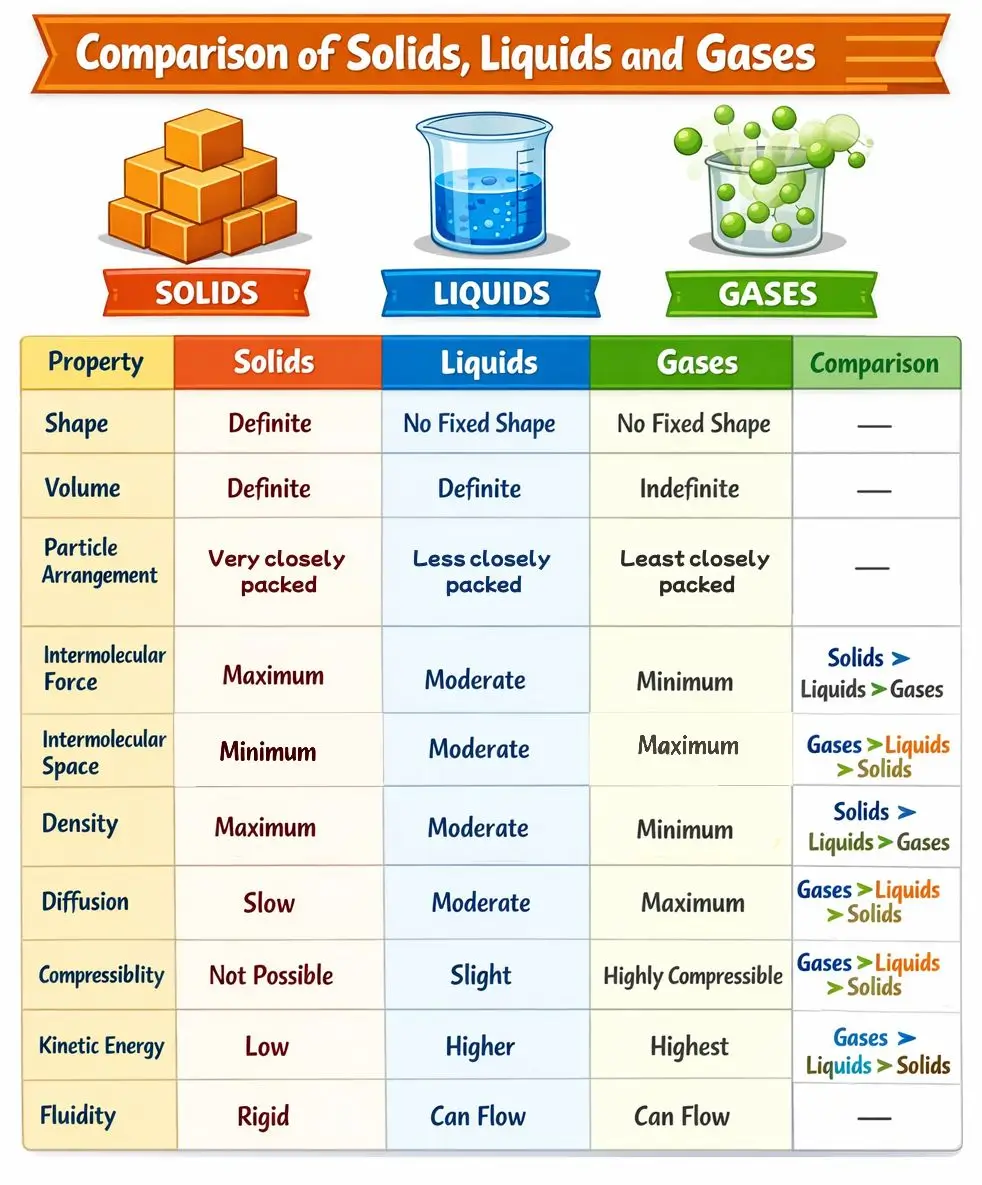
● Least in gases, more in liquids, maximum in solids
Types of Molecular Forces
- Force of Cohesion: Attraction between molecules of the same substance.
- Force of Adhesion: Attraction between molecules of different substances.
States of Matter
Three States:
- Solid
- Liquid
- Gas
Molecular Model
1. Solid
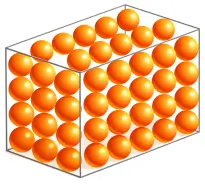
In solids, molecules are very closely packed and arranged in a fixed, orderly pattern.
❖ Molecular Characteristics:
- Intermolecular force: Very strong
- Space between molecules: Very small
- Movement: Only vibrate about fixed positions
- Arrangement: Regular and fixed
- Properties: Definiteshape and definite volume.
2. Liquid
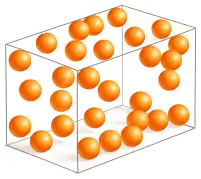
In liquids, molecules are close together but not fixed. They can move and slide past each other.
❖ Molecular Characteristics:
- Intermolecular force: Moderate
- Space between molecules: More than solids
- Movement: Free to move (flow)
- Arrangement: Irregular
- Properties: No definite shape (takes container shape), but definite volume.
3. Gas
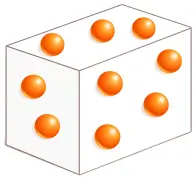
In gases, molecules are far apart and move freely and rapidly in all directions.
❖ Molecular Characteristics:
- Molecular Arrangement: Molecules are very far apart.
- Structure: No ordered structure.
- Movement: Molecules move fast, randomly, and in all directions.
- Forces: Intermolecular forces are negligible.
- Space between molecules: Maximum
- Properties: No definite shape and no definite volume
Change of State
The process by which a substance changes from one state (solid, liquid, gas) to another at a constant temperature by absorbing or releasing heat is called change of state.
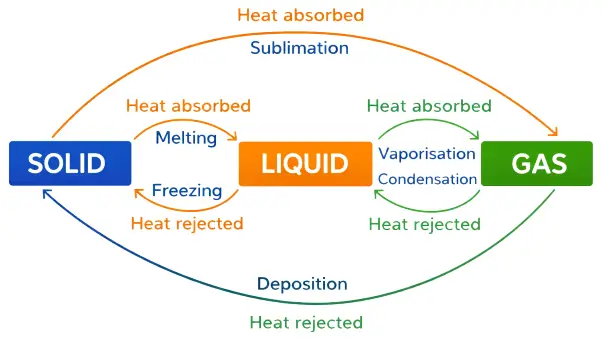
Melting and Melting Point
- Melting: Melting is the process in which a solid changes into a liquid when heated.
- Melting Point: The melting point is the fixed temperature at which a solid converts into a liquid at atmospheric pressure.
- Example: Ice melts into water at 0°C (273 K).
Freezing and Freezing Point
- Freezing (Solidification): Freezing is the process in which a liquid changes into solid on cooling.
- Freezing Point: The freezing point is the temperature at which a liquid begins to convert into a solid when cooled.
- Example: Water freezes into ice at 0°C.
***Note:
For a pure substance, the melting point and freezing point are the same.
Boiling and Boiling Point
- Boiling : The change of a liquid into gas on heating is called boiling (or, vapourisation).
- Boiling point : The temperature at which liquid changes into gas at the atmospheric pressure is called its boiling point.
- Example: Boiling point of water is 100⁰C (373 K).
Condensation
- Condensation is the process in which a gas changes into a liquid on cooling.
- Examples: Formation of water droplets on the outside of a cold glass.
Sublimation
- Sublimation is the process in which a solid directly changes into gas without becoming liquid.
- Example: Dry ice, Ammonium chloride, Iodine, Camphor, Naphthalene.
Deposition
- The process of a gas converting directly into solid is called deposition or solidification
Latent Heat
- During change of state, heat is absorbed or released without any change in temperature. This hidden heat is called latent heat.
Important Point:
- Temperature remains constant during melting/boiling
- Heat is used only to change the state
- Steam at 100°C has more heat than water at 100°C.
Evaporation
Evaporation is the gradual change of a liquid into its vapor at all temperatures (below its boiling point). It is a surface phenomenon and always produces a cooling effect.
Factors Affecting Evaporation
- Temperature: Higher temperature = Faster evaporation.
- Surface Area: Larger exposed area = Faster evaporation.
- Air Flow: Moving air (wind) increases the rate.
- Humidity: Dry air increases evaporation; high humidity decreases it.
- Nature of Liquid: Volatile liquids (like alcohol or spirit) evaporate faster.
Evaporation Causes Cooling
Evaporation causes cooling because liquid particles absorb heat energy from their surroundings to change into vapour.
As a result, the surroundings lose heat and become cooler.
Applications of Evaporation
- Cooling during fever: Wet cloth strips contain water that evaporates from the patient’s forehead. During evaporation, heat is absorbed from the body, which lowers body temperature and helps reduce fever.
- Cooling effect of liquids like acetone/petrol: Substances such as acetone or petrol evaporate quickly from the skin. While evaporating, they absorb heat (latent heat of vaporization) from the palm, producing a cooling sensation.
- Cooling in earthen pots: Earthen pots have tiny pores through which water slowly seeps out and evaporates. This evaporation absorbs heat from the water inside, keeping it cool.
- Body Cooling: Sweating helps maintain body temperature at 37°C (98.6°F) as the evaporation of sweat absorbs heat from the body.
- Tea in a Saucer: A saucer has a larger surface area than a cup, increasing the rate of evaporation and cooling the tea faster.
Differences: Evaporation vs Boiling
| Evaporation | Boiling |
| Occurs at any temperature | Occurs at a fixed temperature (boiling point) |
| It is a slow process | It is a fast process |
| Occurs only at the surface of the liquid | Takes place throughout the liquid |
| No bubbles are formed | Bubbles are formed inside the liquid |
| Causes cooling | Does not cause cooling |
Important Experiments
- Potassium Permanganate Experiment Shows particles are very small and spread in water
- Salt in Water Experiment Shows particles have spaces
- Perfume Spray Shows particles are in motion
ICSE Class 8 Physics Matter Notes PDF Download
Students searching for ICSE Class 8 Physics Matter Notes PDF Download can save this page for revision or convert it into PDF for offline study. These notes are designed in simple language for better understanding.
Conclusion
We hope these ICSE Class 8 Physics Matter Notes PDF Download resources help you in exam preparation. Learn the chapter regularly and revise definitions, properties, and questions for better marks.
For more notes, solutions, and study materials, visit Rohit Academy.
ICSE Class 8 Physics Notes
Official Website:
Students can visit the official CISCE website for more details and updates.