Introduction
Are you searching for ICSE Class 8 Physics Sound Notes? Here you can get clear and easy notes for the Sound chapter in PDF format. These notes are specially designed for ICSE students to help in revision, homework, and exam preparation.
Study Support by Rohit Academy
Rohit Academy offers expert-curated ICSE Class 8 Physics Study Materials including ICSE Sound Chapter Notes, diagrams, and key formulas for better understanding.
You can also visit:
| ☛ ICSE Class 8 Physics Chapter 7: Sound Selina Solutions |
| ☛ ICSE Class 8 Physics |
| ☛ ICSE Class 8 Chemistry |
| ☛ ICSE Class 8 Mathematics |
| ☛ ICSE Class 8 Biology |
Sound Notes ICSE Class 8
Introduction to Sound
Sound is a form of energy that produces the sensation of hearing. It is produced by vibrations in a body.
- Medium Requirement: Sound cannot travel through a vacuum; it requires a medium (solid, liquid, or gas).
- Speed of Sound: Sound travels fastest in solids and slowest in gases.
- Iron: 5000 m/s
- Water: 1500 m/s
- Air: 330 m/s
- Energy Transfer: When a body vibrates, the kinetic energy of the particles changes into potential energy and vice-versa, allowing sound to propagate as energy.
Propagation of Sound in Air
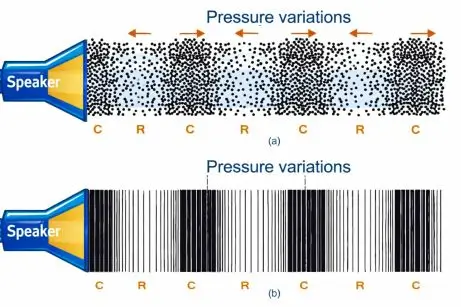
When a source vibrates in air, it sets the surrounding air particles into vibration, producing a longitudinal wave. The process occurs as follows:
- When the vibrating source moves forward, it pushes the nearby air particles closer together, creating a region of high pressure and high density called a compression.
- When the source moves backward, it leaves behind a region of low pressure and low density called a rarefaction.
- These compressions and rarefactions are formed alternately and travel outward through the air.
- The air particles do not move forward with the wave; instead, they vibrate to and fro about their mean positions in the direction of wave propagation.
- The transfer of energy from one particle to the next causes the sound wave to travel through air.
- Thus, a sound wave in air is a longitudinal wave consisting of compressions and rarefactions.
Longitudinal Waves
A wave in which the particles of the medium vibrate in the same direction as the direction of propagation of the wave is called a longitudinal wave.

Terms Related to a Wave
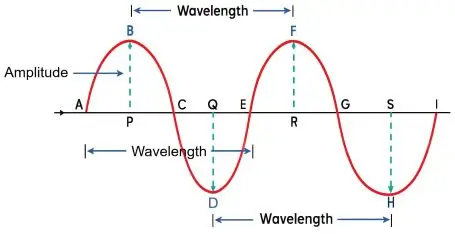
1. Amplitude (a)
- The maximum displacement of the particle from its mean position is called amplitude.
- SI unit: metre (m)
- Determines the loudness of sound
2. Time Period (T)
- The time taken to complete one vibration is called time period.
- SI unit: second (s)
3. Frequency (f)
- The number of vibrations produced in one second is called frequency.
- SI unit: hertz (Hz)
- Determines the pitch of sound
- Higher frequency → higher pitch
- Lower frequency → lower pitch
4. Wavelength (λ)
- The distance between two consecutive compressions or refractions is called Wavelength.
- SI unit: metre (m)
Relation Between Time Period and Frequency
\(f=\frac{1}{t}\)
Where,
- f = frequency
- t = time period
Representation of a Wave
A wave can be represented by two types of graphs:
1. Displacement–Time Graph
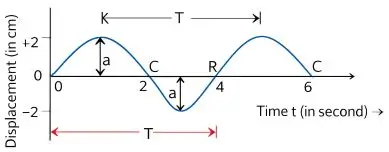
- Shows variation of displacement of a particle with time
- Amplitude is shown on the Y-axis
- Time period is shown on the X-axis
- Helps determine time period and frequency
2. Displacement–Distance Graph
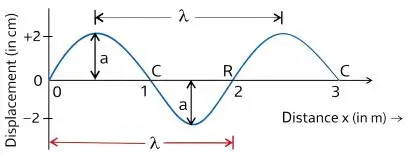
- Shows variation of displacement of particles at different positions
- Amplitude is shown on the Y-axis
- Distance is shown on the X-axis
- Helps determine wavelength
Characteristics of Sound
Two sounds can be distinguished by three characteristics:
- Loudness
- Pitch
- Quality (Timbre)
1. Loudness
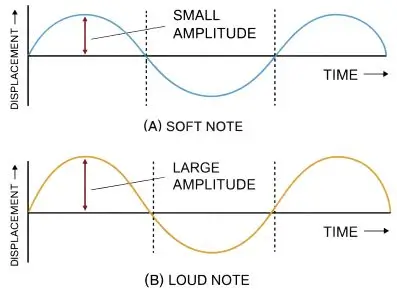
- Loudness is the characteristic of sound by which a loud sound is distinguished from a faint sound, having the same pitch and quality.
- Relationship to Amplitude: Loudness is directly proportional to the square of the amplitude \(\left(L\propto a^2\right)\). If amplitude is doubled, loudness becomes 4 times greater.
- Unit: Measured in decibels (dB).
Factors Affecting Loudness:
- Amplitude: Larger amplitude = louder sound.
- Distance: Fainter as the distance from the source increases.
- Surface Area: Larger vibrating area (e.g., a large drum) produces louder sound.
- Sensitivity of the Ear: Depends on the listener’s hearing health.
Unit of Loudness – Decibel (dB)
- Loudness is measured in decibel (dB)
- Safe Limit: Generally considered to be between 0 to 80 dB.
- Above 120 dB: Causes headache and permanent ear damage (Noise).
- Unpleasant and harmful sound is called noise
2. Pitch
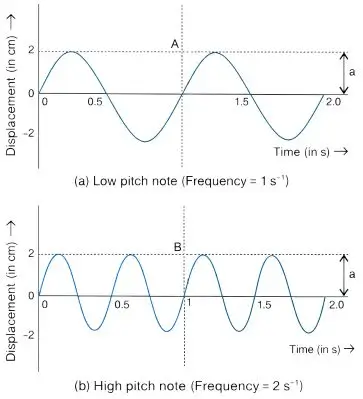
- Pitch is the characteristic of sound that helps us distinguish between a shrill sound and a grave sound.
- Pitch depends only on frequency.
- High frequency → high pitch (shrill sound)
- Low frequency → low pitch (grave sound)
Examples:
- A woman’s voice has a higher frequency (shriller) than a man’s voice.
- A small drum has a higher pitch than a large bass drum.
Change of Pitch in Musical Instruments
(i) Stringed Instruments
Pitch depends on:
- Thickness of string (thinner → higher pitch)
- Tension in string (more tension → higher pitch)
- Length of vibrating string (shorter → higher pitch)
- Examples: Guitar, Sitar, Piano
(ii) Wind Instruments
Pitch depends on the length of vibrating air column.
- Shorter air column → higher pitch
- Longer air column → lower pitch
- Examples: Flute, Shehnai, Bugle
(iii) Membrane Instruments
Pitch depends on:
- Size of membrane (small size → higher pitch)
- Tension of membrane (more tight → higher pitch)
- Examples: Tabla, Drum, Dholak
Monotone
A sound of single frequency is called a monotone.
Tuning Fork
- Produces sound of single frequency
- Used as a standard source of sound
- Made in different frequencies like 256 Hz, 320 Hz, etc.
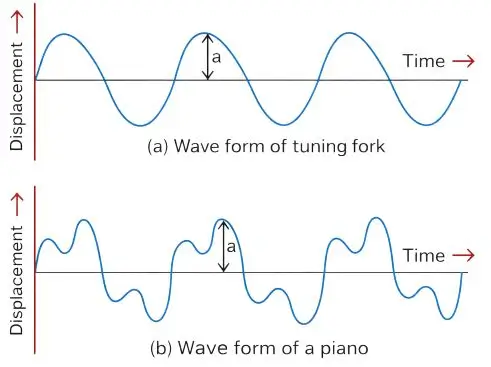
3. Quality (Timbre)
- Quality is the characteristic that helps us distinguish between sounds of same pitch and same loudness produced by different sources.
- Depends on waveform
- Different instruments have different waveforms
ICSE Class 8 Physics Sound Notes PDF Download
Get the complete ICSE Class 8 Physics Sound Notes PDF Download and study anytime on your mobile or computer.
Why Download These Notes?
- Easy language for quick understanding
- Important definitions included
- Exam-oriented short notes
- Helpful diagrams and examples
- Perfect for last-minute revision
Benefits for ICSE Students
These notes are prepared according to the latest ICSE syllabus. Students can use them to score better marks in school tests and final exams.
Conclusion
If you want simple and useful chapter notes, then these ICSE Class 8 Physics Sound Notes are the best study material for you. Download now and start learning easily.
ICSE Class 8 Physics Notes
Official Website:
Students can visit the official CISCE website for more details and updates.