Introduction
Light energy is one of the most interesting topics in ICSE Class 8 Physics. It helps students understand how we see objects, how mirrors work, and how light travels from one place to another. If you are searching for ICSE Class 8 Physics Light Energy Notes PDF Download, you are in the right place.
Our easy-to-understand notes cover all important concepts from the chapter in a simple language. These notes are specially designed for ICSE students to help them prepare for school exams, unit tests, and final examinations.
Study Support by Rohit Academy
Rohit Academy offers expert-curated ICSE Class 8 Physics Study Materials including ICSE Light Energy Chapter Notes, diagrams, and key formulas for better understanding.
You can also visit:
| ☛ ICSE Class 8 Physics Chapter 5: Light Energy Selina Solutions |
| ☛ ICSE Class 8 Physics |
| ☛ ICSE Class 8 Chemistry |
| ☛ ICSE Class 8 Mathematics |
| ☛ ICSE Class 8 Biology |
Light Energy Notes ICSE Class 8
Speed of light in different media
- Speed of light in air \(=\ 3\times{10}^8\ {m\operatorname{s}}^{-1}\)
- Speed of light in water \(=\ 2.25\times{10}^8\ {m\operatorname{s}}^{-1}\)
- Speed of light in glass \(=\ 2\times{10}^8\ {m\operatorname{s}}^{-1}\)
- Speed of light in diamond \(=\ 1.25\times{10}^8\ {m\operatorname{s}}^{-1}\)
Refraction of Light
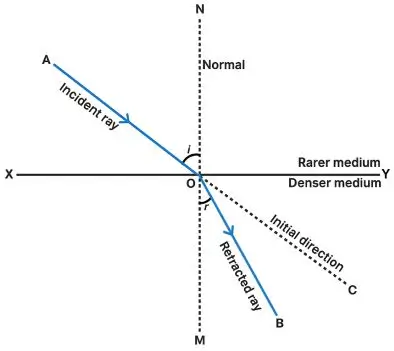
The phenomenon of change in the path of light when it passes from one optically transparent medium to another, is called refraction of light.
TERMS RELATED TO REFRACTION
- Incident Ray : It is incoming ray on the refracting surface.
- Refracted Ray: It is an outgoing ray from the refracting surface.
- Normal: The perpendicular line drawn at the point of incidence on the surface separating the two media.
- Angle of Incidence (i): The angle between the incident ray and the normal.
- Angle of Refraction (r): The angle between the refracted ray and the normal.
Cause of Refraction
- Refraction of light occurs because of this change in the speed of light due to a change in the medium.
- When ray of light passes from an optically rarer medium to an optically denser medium, the speed of light decreases and light bends towards the normal.
- When ray of light passes from an optically denser medium to an optically rarer medium, the speed of light increases and light bends away from the normal.
MEDIUM
A transparent substance in which light travels is known as a medium. Medium can be divided into two types:
- Optically rarer medium : A medium in which the speed of light is more is known as optically rarer medium (or less dense medium). Air is an optically rarer medium as compared to glass and water.
- Optically denser medium : A medium in which the speed of light is less, is known as optically denser medium. Glass is an optically denser medium than air and water.
RULES OF REFRACTION
- Rule 1 : When a light ray travels from a rarer medium to a denser medium, the light ray bends towards the normal. (Trick : RDTN)
\(\anglei<\ \angler\)
- Rule 2 : When a light ray travels from a denser medium to a rarer medium, the light ray bends away from the normal. (Trick : DRAN)
\(\anglei>\ \angler\)

- Rule 3 : When the light ray incident normally to the interface of two medium then it travels in same path , no deviation will be there.
Therefore, \(\anglei=\ \angler=0°\)

CONDITION FOR NO REFRACTION
Refraction will not take place under the following two conditions:
- If the incident ray falls normally (or perpendicularly) to the surface of a glass slab, then there is no bending of the ray of light, and it goes straight.
- When the refractive indices of two media are equal.
LAWS OF REFRACTION (Snell’s Laws)
- The incident ray, the refracted ray, and the normal all lie in the same plane.
- The ratio of sine of angle of incidence to the sine of angle of refraction is always constant for a given pair of media.
\(\frac{sine\ of\ angle\ of\ \operatorname{incidence}}{sine\ of\ angle\ of\ refraction}=constant=\mu\)
\(\frac{sin\operatorname{i}}{sin\ r}=constant=\mu\)
REFRACTIVE INDEX
Refractive index of medium is defined as the ratio of the speed of light in first medium to the speed of light in second medium.
Refractive index is denoted by symbol μ (mew).
\(\mu=\frac{Speed\ of\ light\ in\ first\operatorname{medium}}{Speed\ of\ light\ in\ second\ medium}=\frac{v_1}{v_2}\)
Refractive index of some material media
| Substance (or Medium) | Refractive index (μ) |
| Vacuum / Air (Lowest) | 1.00 |
| Water | 1.33 |
| Glass | 1.5 |
| Diamond (Highest) | 2.41 |
***Note
- No medium has a refractive index less than 1.
- There is no unit of the refractive index.
- Lower Refractive Index (e.g., air) → Speed of light is faster
- Higher Refractive Index (e.g., glass, diamond) → Speed of light is slower
Effects of refraction
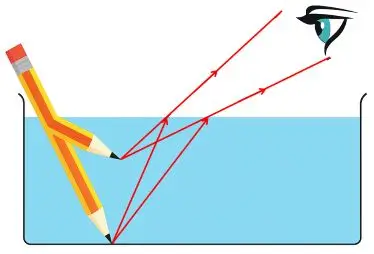
- A pencil (or, stick) partly immersed in water appears bent or broken at the surface of water.
Explanation:
Light rays coming from the immersed part of the pencil bend away from the normal on refraction from water to air.
Thus, the submerged part appears raised, and the pencil looks bent.
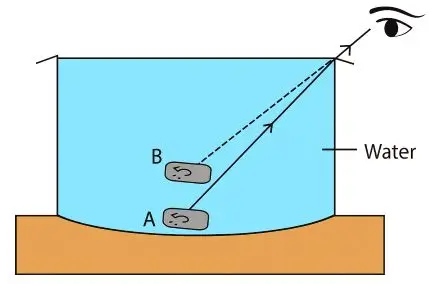
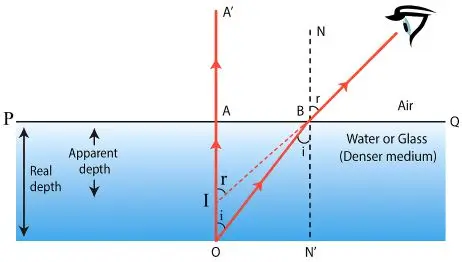
- A coin at the bottom of an empty vessel is not visible. When water is poured in, the coin becomes visible and appears raised.
Explanation: Light rays from the coin bend away from the normal while moving from water to air and reach the observer’s eye.
Hence, the coin appears to be at a higher position than it actually is.
- A pool of water appears to be less deep than it actually is.
Explanation:
A virtual image of the bottom of the pool which is formed by the refraction of light coming from the pool water into the air. And since the image of the bottom of the pool is formed nearer to us, we feel that the pool is less deep.
Early Sunrise and Late Sunset
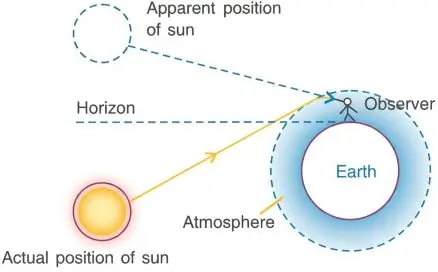
- The sun is visible a few minutes before sunrise and after sunset.
- Reason: Light from the sun is refracted by the earth’s atmosphere.
- The atmosphere acts as layers of air with gradually changing density.
- Due to refraction from denser to rarer layers, the light bends towards the earth, making the sun appear slightly higher than its actual position.
Mirage in a Desert

- A mirage is an optical illusion in deserts where an inverted image of a distant object (like a tree) appears as if it is reflected in water.
- Cause: Refraction of light due to temperature variation in air layers.
○ Hot air near the ground → rarer medium
○ Cool air above → denser medium
- Process:
○ Light from an object (like a tree) travels from denser to rarer layers, bending away from the normal.
○ Eventually, total internal reflection occurs.
○ The eye perceives this reflected ray as if coming from below, forming an inverted image that looks like water on the ground.
Refraction of Light Through a Rectangular Glass Block
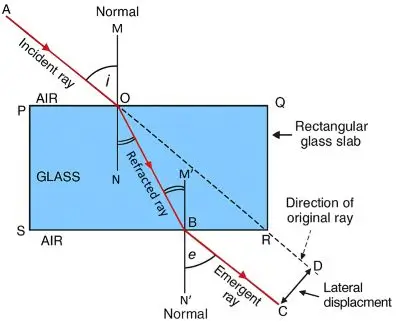
- On passing through a rectangular glass slab, a ray of light suffers two refractions, one while going from air to glass and the other while going from glass to air.
- It bends towards the normal when it enters from air into glass, and away from the normal when it emerges from glass into air.
- Incident Ray (AO) → Ray entering glass
- Refracted Ray (OB) → Ray inside the glass
- Emergent Ray (BC) → Ray leaving the glass
- Emergent ray is parallel to the incident ray.
- Lateral displacement: The perpendicular distance between incident ray and emergent ray is called lateral displacement.
- Angle of incidence = Angle of emergence
[∠ 𝒊 = ∠ 𝒆]
Prism
A prism is a transparent optical object with two triangular faces and three rectangular faces.

Refraction of Light Through a Prism
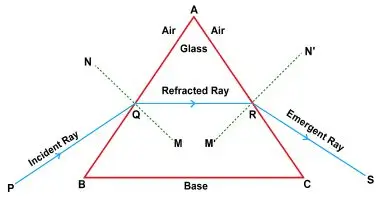
- PQRS is pathway of light through prism.
Different Rays:
- Ray PQ → Incident ray on surface AB
- Ray QR → Refracted ray between surface AB and BC
- Ray RS → Emergent ray at surface AC
- When a ray of light passes through a prism, it undergoes refraction twice:
- At the first face (AB) — Light bends towards the normal (from air to glass).
- At the second face (AC) — Light bends away from the normal (from glass to air).
- Unlike in a glass block, the emergent ray is not parallel to the incident ray due to the inclined surfaces of the prism.
Dispersion of White Light
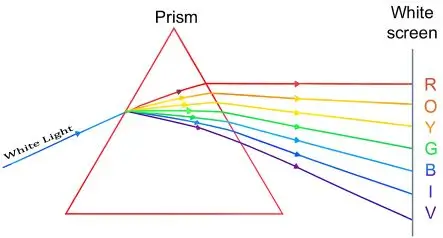
- Dispersion:
Splitting of white light by a prism into its constituent colours is called dispersion. - Spectrum:
The band of colours obtained when white light passes through a prism is called the spectrum. - Order of colours (from base side): Violet, Indigo, Blue, Green, Yellow, Orange, Red (VIBGYOR).
Cause of Dispersion
- The speed of light differs for different colours when traveling through a medium like glass or water.
- In air or vacuum, the speed of all colours is the same.
- In denser media,
○ Speed of violet light is minimum.
○ Speed of red light is maximum. - Hence, each colour is refracted by a different amount, causing separation into a spectrum.
Important Note:
- At the first surface of the prism, both refraction and dispersion take place.
- At the second surface of the prism, only refraction takes place, and no dispersion occurs.
- Red Light → Maximum Speed → Minimum deviation → lowest refractive index
- Violet Light → Maximum Speed → Minimum deviation → lowest refractive index
Spherical Mirror

- Spherical mirrors are parts of a hollow sphere made of glass, silvered on one side and polished on the other.
- The silvered surface reflects light.
- The other surface acts as the reflecting surface.
There are two types of spherical mirrors :-
1. Concave Mirror

- Made by silvering the outer surface of a hollow sphere.
- The inner hollow surface acts as the reflecting surface.
- Also known as a converging mirror because it converges (brings together) light rays.
Properties of a Concave Mirror:
- The reflecting surface is curved inward.
- It is a converging mirror.
- It has a real focus.
- The image formed by a concave mirror is usually real and inverted.
- The image is formed in front of the mirror.
2. Convex Mirror

- Made by silvering the inner surface of a hollow sphere.
- The outer bulging surface acts as the reflecting surface.
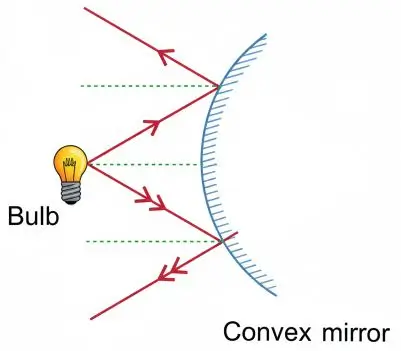
- Also known as a diverging mirror because it diverges (spreads out) light rays.
Properties of Convex mirror:
- The reflecting surface is curved outward.
- It is a diverging mirror.
- It has a virtual focus.
- The image formed by a convex mirror is always virtual, erect, and smaller than the object.
- The image is formed behind the mirror.
Some terms related to a Spherical mirrors


- Pole (P):
The geometric centre of the spherical surface of the mirror is called the pole of the mirror. It is represented by the symbol P. - Centre of curvature (C):
The centre of curvature of a mirror is the centre of the sphere of which the mirror is a part. It is represented by the symbol C.
Lies in front of the mirror for a concave mirror, and behind the mirror for a convex mirror. - Radius of curvature (R):
The distance between the pole (P) and the centre of curvature (C). It is represented by symbol R. - Principal axis:
It is a straight line joining the pole of the mirror to its centre of curvature. - Principal focus (F):
The principal focus (F) is the point on the principal axis where light rays parallel to it meet (concave mirror) or appear to meet (convex mirror) after reflection. - Focal length (f):
The distance between the focus (F) and the pole (p) of the mirror is known as the focal length of the mirror.
Relationship between focal length (f) and radius of curvature (R)
The focal length of a spherical mirror is half of its radius of curvature.
Focal length \(=\frac{1}{2}\times\) Radius of curvature
\(f=\frac{R}{2}\)
Images
An image is a point where at least two light rays either actually meet or appear to meet.
There are two types of images:
1. Real Image:
A real image is formed when light rays actually meet after reflection.
Examples: Image formed on a cinema screen, image formed by a concave mirror.
Characteristics of a Real Image:
(i) It can be obtained on a screen.
(ii) It is always inverted.
(iii) It is formed in front of the mirror.
2. Virtual Image:
A virtual image is formed when light rays appear to meet after reflection.
Examples: Image formed by a convex mirror or a plane mirror.
Characteristics of a Virtual Image:
(i) It cannot be obtained on a screen.
(ii) It is always erect (upright).
(iii) It is formed behind the mirror.
Difference between real image and virtual image
| Real Image | Virtual Image |
| It is formed when light rays actually meet. | It is formed when light rays appear to meet |
| A real image is inverted with respect to the object. | A virtual image is erect (or, upright) with respect to the object. |
| It can be obtained on screen. | It cannot be obtained on screen. |
| Ex : image formed on cinema | Ex : Image formed by convex mirror or plane mirror |
Rules for Ray Diagrams of Spherical Mirrors
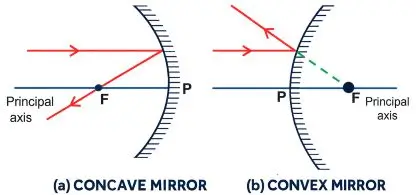
❖ Rule 1 – Ray Parallel to Principal Axis
- In case of concave mirror: A ray parallel to the principal axis, after reflection, passes through the focus (F).
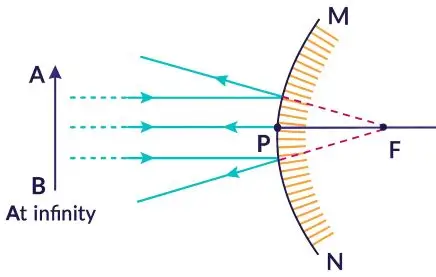
- In case of convex mirror: A ray parallel to the principal axis, after reflection, appears to come from the focus (F).
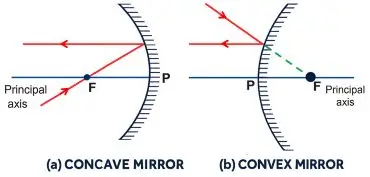
❖ Rule 2 – Ray Passing Through Focus
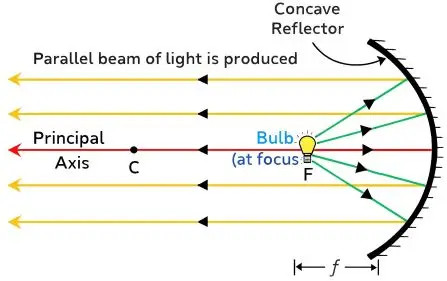
- In case of concave mirror: A ray passing through the focus (F), after reflection, becomes parallel to the principal axis.
- In case of convex mirror: A ray that appears to be going towards the focus (F), after reflection, becomes parallel to the principal axis.
❖ Rule 3 – Ray Passing Through Centre of Curvature
- For both Concave and Convex Mirrors: A ray of light passing through (or directed towards) the centre of curvature (C) is reflected back along the same path.
- This happens because the ray is incident normally on the mirror surface.
- Angle of incidence (i) = Angle of reflection (r) = 0°
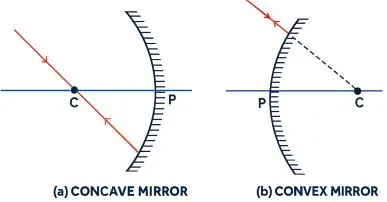
Image formation by concave mirror
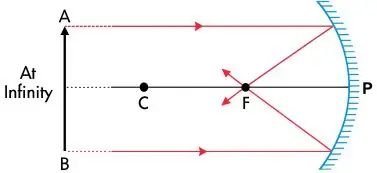
❖ Case I
- Position of object : At Infinity
- Position of image : At the focus (F)
- Nature of image : Real and inverted
- Size of image : Highly diminished (point-sized)
❖ Case II
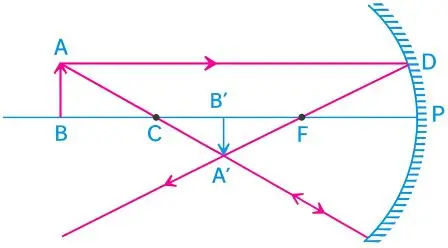
- Position of object : Beyond the Centre of Curvature (C)
- Position of image : Between the centre of curvature (C) and focus (F)
- Nature of image : Real and inverted
- Size of image : Smaller than the object
❖ Case III
- Position of object : At the Centre of Curvature (C)
- Position of image : At the Centre of Curvature (C)
- Nature of image : Real and inverted
- Size of image : Same size as the object

❖ Case IV
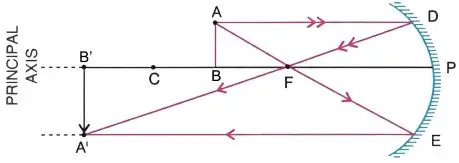
- Position of object : Between the Centre of Curvature (C) and Focus (F)
- Position of image : Beyond the centre of curvature (C)
- Nature of image : Real and inverted
- Size of image : Magnified
❖ Case V
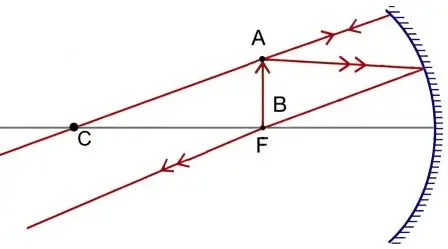
- Position of object : At the Focus (F)
- Position of image : At infinity
- Nature of image : Real and inverted
- Size of image : Highly magnified
❖ Case VI
- Position of object : Between the Pole (P) and Focus (F)
- Position of image : Behind the mirror
- Nature of image : Virtual and erect
- Size of image : Enlarged

Key Points to Remember
- A concave mirror follows the laws of reflection in all cases.
- The nature of the image (real or virtual) depends on the object’s position.
- Virtual images are always erect and magnified, while real images are inverted.
- Concave mirrors are used in shaving mirrors, headlamps, solar furnaces, and dental mirrors.
Image formation by convex mirror
❖ Case I
- Position of object : At infinity
- Position of image : At focus (F), behind the mirror
- Nature of image : Virtual and upright
- Size of image : Highly diminished (point-sized)
❖ Case II
- Position of object : Between infinity and Pole (P)
- Position of image : Between the Pole (P) and Focus (F), behind the mirror
- Nature of image : Virtual and erect
- Size of image : Diminished

Characteristics of Image Formed by a Convex Mirror
- The image is always formed behind the mirror.
- The image is always virtual and erect.
- The image is diminished in size, no matter where the object is placed.
- As the object moves closer to the mirror, the image appears to increase slightly in size but always remains virtual and upright.
- Convex mirrors give a wider field of view, making them suitable for use as rear-view mirrors in vehicles.
***Note
- Remember that in all the above cases, the laws of reflection are obeyed.
- If a ray of light is incident on a concave or convex mirror along its principal axis, it is reflected back along the same path. In this case, both the angle of incidence and the angle of reflection are zero.
- Concave mirrors can form both real and virtual images depending on the object’s position.
- Convex mirrors always form virtual, erect, and diminished images.
Uses of a Concave Mirror
1. As a shaving mirror:
Forms an enlarged and erect image when the face is close to the mirror.
2. As a reflector in torches, searchlights, and headlights:
When a light source is placed at the focus, the reflected rays become parallel.
3. As a doctor’s head mirror:
Used by ENT specialists to focus light on a small area such as the ear, nose, or throat.
4. In solar furnaces or solar cookers:
Concentrates sunlight at a single point to produce heat.
5. In floodlights:
Used to reflect and project a strong beam of light.
Uses of a Convex Mirror
1. As a rear-view mirror in vehicles:
● Provides a wide field of view of the road behind.
2. As a reflector in street lamps:
● Helps spread light over a larger area.

3. As a security or vigilance mirror:
● Used in shops and parking areas to monitor wide spaces.
Differences between Concave and Convex Mirror
| Concave mirror | Convex mirror |
| Its reflecting surface is curved inwards. | Its reflecting surface is curved outwards. |
| It is a converging mirror. | It is a diverging mirror. |
| It has a real focus which lies in front of it. | It has a virtual focus which lies behind it. |
| Can form both real and virtual images depending on the position of the object | It always forms a virtual, erect, and diminished image. |
| It is used as a rear-view mirror. | It is used as a shaving mirror, in torches and searchlights, solar furnaces, and by dentists. |
Download ICSE Class 8 Light Energy Notes PDF
Get the complete ICSE Class 8 Physics Light Energy Notes PDF Download and start your preparation today. These notes are ideal for scoring high marks in exams.
Benefits for Students
These notes save time and make learning easier. Students can revise the chapter quickly before exams and understand difficult concepts clearly. Diagrams and examples make the chapter more interesting.
Conclusion
These ICSE Class 8 Physics Light Energy Notes PDF Download are highly useful for students preparing for school exams. Download the notes and start learning chapter-wise concepts in a smart way. Regular practice and revision will help you score excellent marks in Physics.
ICSE Class 8 Physics Notes
Official Website:
Students can visit the official CISCE website for more details and updates.