Introduction
Physics is one of the most important subjects in ICSE Class 8, and Chapter 2 Physical Quantities and Measurement forms the foundation of scientific learning. Understanding this chapter helps students learn about units, measurements, errors, and different physical quantities used in everyday life. If you are searching for ICSE Class 8 Physics Chapter 2 Physical Quantities and Measurement Selina Solutions, this article will help you with clear explanations and step-by-step answers.
Importance of Chapter 2 Physical Quantities and Measurement
This chapter introduces students to the concept of measuring physical quantities such as length, mass, time, temperature, and volume. It also explains standard units like metre, kilogram, and second. Students learn why measurement is necessary in science and how accurate measurements help in experiments.
By practicing Selina Solutions for Class 8 Physics Chapter 2, students can strengthen their concepts and prepare well for school exams.
You can also visit:
| ☛ ICSE Class 8 Physics Chapter 2: Physical Quantities and Measurement Notes |
| ☛ ICSE Class 8 Physics |
| ☛ ICSE Class 8 Chemistry |
| ☛ ICSE Class 8 Mathematics |
| ☛ ICSE Class 8 Biology |
(A) Multiple Choice Type : Chapter 2 Physical Quantities and Measurement
Question 1
Choose the correct answer from the multiple choices given below.
Question 1(a)
The correct relation is:
(i) Density = Mass x Volume
(ii) Mass = Density x Volume
(iii) Volume = Density x Mass
(iv) Density = Mass + Volume
Answer:
(ii) Mass = Density × Volume
Explanation:
We know:
Density = \(\frac{\operatorname{Mass}}{Volume}\)
Mass = Density × Volume
Question 1(b)
The relative density of alcohol is 0.8. Its density is:
(i) 0.8 (ii) 800 kg m–3
(iii) 800 g cm–3 (iv) 0.8 kg m–3
Answer:
(ii) 800 kg m–3
Explanation:
Relative density = \(\frac{Density\ of\operatorname{alcohol}}{Density\ of\ water}\)
Density of water = 1000 kg m–3
So,
0.8 = Density of alcohol/ 1000 kg m–3
Density of alcohol = 0.8×1000 = 800 kg m–3
Question 1(c)
A block of wood of density 0.8 g cm–3 has a volume of 60 cm–3. The mass of block is:
(i) 60.8 g (ii) 75 g
(iii) 48 g (iv) 0.013 g
Answer:
(iii) 48 g
Explanation:
Density = \(\frac{Mass}{Volume}\)
⇒ 0.8 = \(\frac{Mass}{60}\)
⇒ Mass = 0.8 × 60
⇒ Mass = 48 g
Question 1(d)
The density of aluminium is 2.7 g cm–3 and that of brass is 8.4 g cm–3. The correct statement is:
(i) Equal masses of aluminium and brass have equal volumes.
(ii) The mass of a certain volume of brass is more than the mass of equal volume of aluminium.
(iii) The volume of a certain mass of brass is more than the volume of equal mass of aluminium.
(iv) Equal volumes of aluminium and brass have equal masses.
Answer:
(ii) The mass of a certain volume of brass is more than the mass of equal volume of aluminium.
Explanation:
Brass has higher density than aluminium.
So for equal volumes:
Mass of brass > Mass of aluminium
Question 1(e)
A density bottle has a marking 25 mL on it. It means that:
(i) the mass of density bottle is 25 g.
(ii) the density bottle will store 25 mL of any liquid in it.
(iii) the density bottle will store 25 mL of water, but more volume of liquid denser than water.
(iv) the density bottle will store 25 mL of water, but more volume of a liquid lighter than water.
Answer:
(ii) the density bottle will store 25 mL of any liquid in it.
Explanation:
25 mL marking means the bottle has a fixed volume capacity of 25 mL, regardless of the liquid filled.
Question 1(f)
The correct statement is:
(i) The buoyant force on a body is equal to the volume of the liquid displaced by it.
(ii) The buoyant force on a body is equal to the volume of the body.
(iii) The buoyant force on a body is equal to the weight of the liquid displaced by it.
(iv) The buoyant force on a body is always equal to the weight of the body.
Answer:
(ii) The buoyant force on a body is equal to the weight of the liquid displaced by it.
Explanation:
According to Archimedes’ Principle, buoyant force equals the weight of liquid displaced.
Question 1(g)
A piece of wood floats on water. The buoyant force on wood will be:
(i) Zero
(ii) more than the weight of the wood piece.
(iii) equal to the weight of the wood piece.
(iv) less than the weight of the wood piece.
Answer:
(iii) equal to the weight of the wood piece.
Explanation:
For a floating body:
Buoyant Force = Weight of Body
So wood floats when upthrust equals its weight.
Question 1(h)
The weight of a body is more than the buoyant force experienced by it, due to a liquid. The body will:
(i) sink
(ii) float with its some part outside the liquid.
(iii) float just below the surface of liquid.
(iv) float with whole of its volume above the surface of liquid.
Answer:
(i) sink
Explanation:
If weight > buoyant force, downward force is greater, so body sinks.
Assertion Reason Type : Chapter 2 Physical Quantities and Measurement
Question 1(i)
Assertion (A) : In order to come to surface of water, whales fill their swim bladder with water.
Reason (R) : A body floats when the density of the body is less than the density of the liquid.
(1) Both A and R are true and R is the correct explanation of A
(2) Both A and R are true and R is not the correct explanation of A
(3) Assertion is true but reason is false
(4) Assertion is false but reason is true
Answer:
(4) Assertion is false but reason is true
Explanation:
- Assertion is false: Whales do not have a swim bladder. Swim bladders are found in many bony fish, not in mammals like whales. Whales rise to the surface by swimming upward and controlling buoyancy mainly through lungs and body movement.
- Reason is true: A body floats when its average density is less than the density of the liquid.
Fill in the blanks
Question 2
Fill in the blanks:
(a) 1 kg is the mass of …………… mL of water at 4°C.
(b) Mass = density x …………… .
(c) The S.I. unit of density is …………… .
(d) Density of water is …………… kg m–3.
(e) 1 g cm–3 = …………… kg m–3.
(f) The density of a body which sinks in water is …………… than 1000 kg m–3.
(g) A body sinks in a liquid A, but floats in a liquid B. The density of liquid A is …………… than the density of liquid B.
(h) A body X sinks in water, but a body Y floats on water. The density of the body X is …………… than the density of body Y.
(i) The buoyant force experienced by a body when floating in salt-water is …………… that when floating in pure water.
(j) The apparent weight of a body floating in a liquid is …………… .
Answer:
(a) 1 kg is the mass of 1000 mL of water at 4°C.
(b) Mass = density x volume.
(c) The S.I. unit of density is kg m–3.
(d) Density of water is 1000 kg m–3.
(e) 1 g cm–3 = 1000 kg m–3.
(f) The density of a body which sinks in water is more than 1000 kg m–3.
(g) A body sinks in a liquid A, but floats in a liquid B. The density of liquid A is less than the density of liquid B.
(h) A body X sinks in water, but a body Y floats on water. The density of the body X is more than the density of body Y.
(i) The buoyant force experienced by a body when floating in salt-water is equal to that when floating in pure water.
(j) The apparent weight of a body floating in a liquid is zero.
True or False : Chapter 2 Physical Quantities and Measurement
Question 3
Write true or false for each statement:
(a) Equal volumes of two different substances have equal masses.
(b) The density of a piece of brass will change by changing its size or shape.
(c) The density of a liquid decreases with increase in its temperature.
(d) Relative density of water is 1.0.
(e) Relative density of a substance is expressed in g cm–3.
(f) When a body is immersed in a liquid, the buoyant force experienced by the body is equal to the volume of the liquid displaced by it.
(g) If a body floats in different liquids, different volumes of the body get submerged in different liquids, but in each liquid the weight of the liquid displaced by the submerged part of body remain the same.
(h) A body experiences the same buoyant force when it floats or sinks in water.
(i) A body floats in a liquid when its weight becomes equal to the weight of the liquid displaced by its submerged part.
(j) A body while floating, sinks deeper in a liquid of low density than in a liquid of high density.
Answer:
(a) False
Correct Statement: Equal volumes of two different substances have different masses.
(b) False
Correct Statement: The density of a piece of brass will not change by changing its size or shape.
(c) True
(d) True
(e) False
Correct Statement: Relative density has no unit.
(f) False
Correct Statement: When a body is immersed in a liquid, the buoyant force experienced by the body is equal to the weight of the liquid displaced by the immersed part of the body.
(g) True
(h) False
Correct Statement: The buoyant force experience by the body is different when floating or sinking in water.
(i) True
(j) True
Match the Columns : Chapter 2 Physical Quantities and Measurement
Question 4
Match the following:
| Column A | Column B |
| (a) kg m–3 | (i) relative density |
| (b) No unit | (ii) sinks in alcohol |
| (c) Relative density | (iii) floats on water |
| (d) Iron | (iv) density |
| (e) Wood | (v) density bottle |
Answer:
| Column A | Column B |
| (a) kg m–3 | (iv) density |
| (b) No unit | (i) relative density |
| (c) Relative density | (v) density bottle |
| (d) Iron | (ii) sinks in alcohol |
| (e) Wood | (iii) floats on water |
(B) Short Answer Type Questions : Chapter 2 Physical Quantities and Measurement
Question 1
Define the term density of a substance.
Answer:
Density is defined as the mass per unit volume of a substance.
Density = \(\frac{\operatorname{Mass}}{Volume}\)
Question 2
Name the S.I. unit of density. How is it related to g cm–3.
Answer:
The S.I. unit of density is kg m–3 (kilogram per cubic metre).
1 g cm–3 = 1000 kg m–3.
Question 3
The density of brass is 8.4 g cm–3. What do you mean by this statement?
Answer:
It means that 1 cm3 of brass has a mass of 8.4 g.
Question 4
Arrange the following substances in order of their increasing density:
Iron, Cork, Brass, Water, Mercury.
Answer:
Cork < Water < Iron < Brass < Mercury
Question 5
How does the density of a liquid (or gas) vary with temperature?
Answer:
When temperature increases, the density decreases because volume increases on heating.
Question 6
A given quantity of a liquid is heated. Which of the following quantity will vary and how?
(a) mass
(b) volume
(c) density
Answer:
(a) Mass remains constant.
(b) Volume increases due to expansion on heating.
(c) Density decreases because mass remains same but volume increases.
Question 7
Define the term relative density of a substance.
Answer:
Relative density of a substance is the ratio of the density of the substance to the density of water.
R.D. = \(\frac{Density\ of\ the\ \operatorname{substance}}{Density\ of\ water}\)
Question 8
What is the unit of relative density?
Answer:
Relative density has no unit because it is a ratio of two similar quantities.
Question 9
Explain the meaning of the statement ‘Relative density of aluminium is 2.7’.
Answer:
It means aluminium is 2.7 times as dense as water.
Question 10
State the law of floatation?
Answer:
A floating body displaces a liquid whose weight is equal to the weight of the body.
Question 11
For a floating body, how is its weight related to the buoyant force?
Answer:
For a floating body, its weight is equal to the buoyant force acting on it.
Weight of body = Buoyant force
The upward buoyant force balances the downward weight, so the body floats.
(C) Long Answer Type Questions : Chapter 2 Physical Quantities and Measurement
Question 1
Describe an experiment to determine the density of the material of a coin.
Answer:
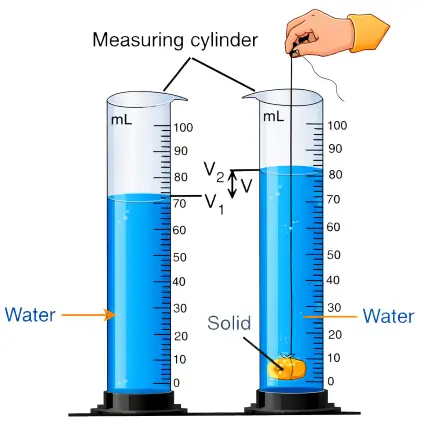
- Measure the mass of the coin using a balance. Let it be m.
- Take water in a measuring cylinder and note the initial volume V1.
- Drop the coin into the water completely.
- Note the final volume V2.
- Volume of coin = V2 – V1 cm3.
- Density of coin =
Question 2
Describe an experiment to determine the density of a liquid.
Answer:
- Take a measuring cylinder and measure a known volume of liquid, say V.
- Measure the mass of empty cylinder = m1.
- Measure the mass of cylinder with liquid = m2.
- Mass of liquid = m2 − m1.
- Density of liquid = \(\frac{m_2\ -\ m_1}{v}\)
Question 3
What is a density bottle? How is it used to find the density of a liquid?
Answer:
A density bottle is a small glass bottle of known fixed volume with a stopper having a hole.
Method:
- Measure mass of empty bottle = m1.
- Fill with water and measure mass = m2.
- Fill with given liquid and measure mass = m3.
- Mass of equal volume of water = m2 – m1.
- Mass of equal volume of liquid = m3 – m1.
∴ Density of liquid = \(\frac{m_3\ -\ m_1}{m_2\ -\ m_1}\)
Then density can be calculated.
Question 4
Distinguish between density and relative density.
Answer:
| Density | Relative Density |
| Density is defined as the mass per unit volume of a substance. | Relative density of a substance is the ratio of the density of the substance to the density of water. |
| SI unit = kg m–3 | No unit |
Question 5
How does the density of a body and that of a liquid determine whether the body will float or sink into that liquid?
Answer:
- If density of body less than density of liquid → body floats.
- If density of body greater than density of liquid → body sinks.
- If equal → body remains suspended.
Question 6
Explain why an iron needle sinks in water, but a ship made of iron floats on water.
Answer:
An iron needle is solid and has density greater than water, so it sinks. A ship is hollow and contains air, so its average density becomes less than water. Therefore it floats.
Question 7
It is easier to swim in sea water than in river water. Explain the reason.
Answer:
Sea water contains dissolved salts, so it is denser than river water.
Hence sea water exerts greater buoyant force, making swimming easier.
Question 8
Icebergs floating on sea water are dangerous for ships. Explain the reason.
Answer:
Most part of an iceberg remains below the water surface because ice is only slightly less dense than sea water.
Ships may collide with the hidden underwater portion, making icebergs dangerous.
Question 9
Explain why it is easier to lift a stone under water than in air.
Answer:
Under water, the stone experiences an upward buoyant force equal to the weight of displaced water.
So its apparent weight decreases, making it easier to lift.
Question 10
What is a submarine? How can it be made to dive in water and come to the surface of water?
Answer:
A submarine is a vessel that can travel under water.
- To dive: tanks are filled with water, increasing density, so it sinks.
- To rise: water is forced out and tanks filled with air, decreasing density, so it floats upward.
Question 11
A balloon filled with hydrogen rises in air. Explain the reason.
Answer:
Since the density of hydrogen gas is less than that of air, the buoyant force acting on the balloon by air is greater than the weight of the balloon. Therefore, a net upward force acts on the balloon and it rises in air.
(D) Think and Answer : Chapter 2 Physical Quantities and Measurement
Question 1
A cork piece floats on water surface while an iron nail sinks in it. Explain the reason.
Answer:
The density of cork is less than the density of water, so it floats on the water surface. But the density of an iron nail is greater than the density of water, so it sinks in water.
Question 2
Which of the following will sink or float on water? (Density of water = 1 g cm–3)
(a) Body A having density 500 kg m–3
(b) Body B having density 2520 kg m–3
(c) Body C having density 1100 kg m–3
(d) Body D having density 0.85 g cm–3
Answer:
(a) Body A will float on water because its density (500 kg m–3) is less than the density of water (1000 kg m–3).
(b) Body B will sink in water because its density (2520 kg m–3) is greater than the density of water (1000 kg m–3).
(c) Body C will sink in water because its density (1100 kg m–3) is greater than the density of water (1000 kg m–3).
(d) Body D will float on water because its density (0.85 g cm–3) is less than the density of water (1 g cm–3).
Question 3
The density of water is 1.0 g cm–3. The density of iron is 7.8 g cm–3. The density of mercury is 13.6 g cm–3. Answer the following:
(a) Will a piece of iron float or sink in water?
(b) Will a piece of iron float or sink in mercury?
Answer:
(a) A piece of iron will sink in water because the density of iron (7.8 g cm–3) is greater than the density of water (1.0 g cm–3).
(b) A piece of iron will float in mercury because the density of iron (7.8 g cm–3) is less than the density of mercury (13.6 g cm–3).
Question 4
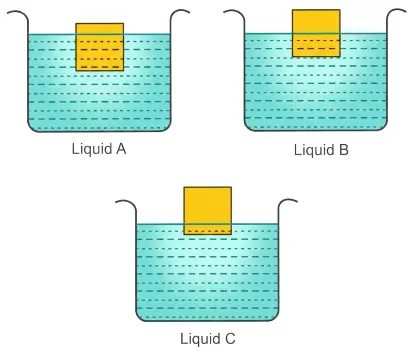
The diagram given below shows a body floating in three different liquids A, B and C at different levels.
(a) In which liquid does the body experience the greatest buoyant force?
(b) Which liquid has the least density?
(c) Which liquid has the highest density?
Answer:
(a) The body experiences the same buoyant force in liquids A, B, and C because the body is floating in all three liquids, so the buoyant force is equal to its weight in each case.
(b) Liquid A has the least density because the body is immersed the most in it.
(c) Liquid C has the highest density because the body is immersed the least in it.
Question 5
Why does a piece of ice float on water?
Answer:
A piece of ice floats on water because the density of ice is less than the density of water. Therefore, the buoyant force can balance its weight before it gets fully submerged.
Question 6
An egg sinks in fresh water, but floats in a strong salt solution. Give reason.
Answer:
An egg sinks in fresh water because its density is greater than the density of fresh water. It floats in a strong salt solution because the density of the salt solution becomes greater than the density of the egg, so the buoyant force supports it.
Question 7
A ship submerges more as it sails from sea water to river water. Give reason.
Answer:
A ship submerges more in river water because river water is less dense than sea water. Therefore, the ship has to displace more water to get enough buoyant force to balance its weight, so it sinks deeper.
Question 8
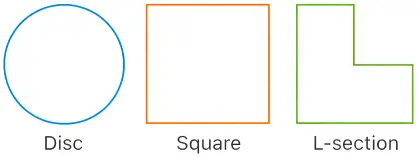
Three different shapes of the same mass are cut from a sheet of iron as shown in the figure given below. Identify the shape with the highest density. Give reason.
Answer:
All three shapes — disc, square, and L-section — have the same density.
Reason:
Density is a property of the material and does not depend on the shape or size of the object. Since all three pieces are cut from the same sheet of iron, they are made of the same material, so their density remains the same.
(E) Numericals : Chapter 2 Physical Quantities and Measurement
Question 1
The density of air is 1.28 g litre–1. Express it in:
(a) g cm–3
(b) kg m–3
Solution:
Given density of air = 1.28 g litre–1
(a) In g cm–3
Since 1 litre = 1000 cm3
1.28 g litre–1 = \(\frac{1.28}{1000}\) g cm–3 = 0.00128 g cm–3
(b) In kg m–3
Since 1 g litre–1 = 1 kg m–3 Therefore, 1.28 g litre⁻¹ = 1.28 kg m–3
Question 2
The dimensions of a hall are 10 m x 7 m x 5 m. If the density of air is 1.11 kg m–3, find the mass of air in the hall.
Solution:
Given,
Dimensions of hall = 10 m × 7 m × 5 m
Density of air = 1.11 kg m–3
Volume of hall = length × breadth × height
= 10 × 7 × 5
= 350 m3
Mass of air = Density × Volume
= 1.11 × 350
= 388.5 kg
∴ Mass of air in the hall = 388.5 kg
Question 3
The density of aluminium is 2.7 g cm–3. Express it in kg m–3.
Solution:
Given,
density of aluminium = 2.7 g cm–3
We know that:
1 g cm–3 = 1000 kg m–3
Therefore,
Density of aluminium in kg m–3 = 2.7 x 1000
= 2700 kg m–3
Question 4
The density of alcohol is 600 kg m–3. Express it in g cm–3.
Solution:
Given,
density of alcohol = 600 kg m–3
We know that:
1000 kg m–3 = 1 g cm–3
Therefore,
Density of Alcohol in g cm–3 = \(\frac{600}{1000}\) g cm–3 = 0.6 g cm–3
Question 5
A piece of zinc of mass 438.6 g has a volume of 86 cm3. Calculate the density of zinc.
Solution:
Given:
Mass of zinc = 438.6 g
Volume of zinc = 86 cm3
Density = Mass ÷ Volume = 438.6 ÷ 86 = 5.1 g cm–3
∴ Density of zinc = 5.1 g cm–3
Question 6
A piece of wood of mass 150 g has a volume of 200 cm3. Find the density of wood in
(a) C.G.S. unit
(b) S.I. unit
Solution:
Mass of wood = 150 g
Volume of wood = 200 cm3
Density of wood = ?
(a) C.G.S. unit of density is g cm–3.
Density of wood = Mass ÷ Volume = 150 ÷ 200 = 0.75 g cm3
So, density of wood = 0.75 g cm–3
(b) S.I. unit of density is kg m–3.
Density of wood in kg m–3 = 0.75 × 1000 = 750 kg m–3
So, density of wood = 750 kg m–3
Question 7
Calculate the volume of wood of mass 6000 kg if the density of wood is 0.8 g cm–3.
Solution:
Mass of wood = 6000 kg Density of wood = 0.8 g cm–3 = 800 kg m–3
Volume of wood = \(\frac{Mass}{Density}=\frac{6000}{800}\) = 7.5 m3
∴ Volume of wood = 7.5 m3
Question 8
Calculate the density of a solid from the following data:
(a) Mass of solid = 72 g
(b) Initial volume of water in measuring cylinder = 24 mL
(c) Final volume of water when solid is completely immersed in water = 42 mL
Solution:
Mass of solid = 72 g
Volume of solid = Final volume of water − Initial volume of water = 42 − 24 = 18 mL
Density of solid \(=\frac{\operatorname{Mass}}{Volume}=\frac{72}{18}\) = 4.0 g cm–3
So, density of solid = 4.0 g cm–3
Question 9
The mass of an empty density bottle is 21.8 g, when filled completely with water it is 41.8 g and when filled completely with liquid it is 40.6 g. Find:
(a) the volume of density bottle.
(b) the relative density of liquid.
Solution:
Mass of empty density bottle (M₁) = 21.8 g
Mass of bottle with water (M₂) = 41.8 g Mass of bottle with liquid (M₃) = 40.6 g
(a) Mass of water in bottle = M₂ − M₁ = 41.8 − 21.8 = 20 g
Since density of water = 1 g cm–3,
Volume of density bottle = 20 cm3 (or 20 mL)
(b) Mass of liquid in bottle = M₃ − M₁ = 40.6 − 21.8 = 18.8 g
Relative density of liquid
Relative density = Mass of liquid ÷ Mass of equal volume of water = 18.8 ÷ 20 = 0.94
So, relative density of liquid = 0.94
Question 10
From the following observations, calculate the density and relative density of a brine solution.
Mass of empty density bottle = 22 g
Mass of bottle + water = 50 g
Mass of bottle + brine solution = 54 g
Solution:
Mass of empty density bottle (M₁) = 22 g
Mass of bottle + water (M₂) = 50 g
Mass of bottle + brine solution (M₃) = 54 g
Mass of water in bottle
= M₂ − M₁
= 50 − 22
= 28 g
Since density of water = 1 g cm–3,
Volume of density bottle = 28 cm3
Mass of brine solution in bottle = M₃ − M₁ = 54 – 22 = 32 g
Density of brine solution
Density \(=\frac{\operatorname{Mass}}{Volume}\)
= 1.14 g cm–3
So, density of brine solution = 1.14 g cm–3
Relative density of brine solution
Relative density = Mass of brine solution ÷ Mass of equal volume of water
= 32 ÷ 28
= 1.14
So, relative density of brine solution = 1.14
Question 11
The mass of an empty density bottle is 30 g, it is 75 g when filled completely with water and 65 g when filled completely with a liquid. Find:
(a) Volume of density bottle,
(b) Density of liquid and
(c) Relative density of liquid.
Solution:
Mass of empty density bottle (M₁) = 30 g
Mass of bottle filled with water (M₂) = 75 g
Mass of bottle filled with liquid (M₃) = 65 g
(a) Volume of density bottle
Mass of water in bottle = M₂ − M₁ = 75 – 30 = 45 g
Since density of water = 1 g cm–3,
Volume of density bottle = 45 cm3 (or 45 mL)
(b) Density of liquid
Mass of liquid in bottle = M₃ − M₁ = 65 – 30 = 35 g
Density of liquid = Mass ÷ Volume = 35 ÷ 45 = 0.77 g cm–3
So, density of liquid = 0.77 g cm–3
(c) Relative density of liquid
Relative density of liquid = Mass of liquid ÷ Mass of equal volume of water
= 35 ÷ 45
= 0.77
So, relative density of liquid = 0.77
ICSE Class 8 Physics Physical Quantities and Measurement Selina Solutions PDF Download
Download ICSE Class 8 Physics Physical Quantities and Measurement Selina Solutions PDF with chapter-wise solved answers, explanations, and free study resources for easy exam preparation.
Why Choose Selina Solutions?
Selina Solutions are highly recommended for ICSE students because they provide accurate answers in simple language. The solutions help students:
- Understand textbook questions easily
- Learn correct answer-writing format
- Practice numericals step by step
- Revise important concepts quickly
- Score higher marks in exams
Benefits of Studying Online Solutions
Using ICSE Class 8 Physics Chapter 2 Physical Quantities and Measurement Selina Solutions online saves time and gives instant access to answers. Students can revise anytime and anywhere.
Exam Preparation Tips
- Learn all SI units and symbols.
- Practice conversions regularly.
- Understand definitions clearly.
- Solve textbook exercises daily.
- Revise diagrams and examples.
Conclusion
Chapter 2 Physical Quantities and Measurement is the base of Physics. Mastering this chapter will make future topics easier. With the help of ICSE Class 8 Physics Chapter 2 Physical Quantities and Measurement Selina Solutions, students can understand concepts better and perform excellently in exams. Keep practicing regularly and stay confident.
ICSE Class 8 Physics Selina Solutions
The Selina Concise Physics Class 8 book includes the following chapters:
Official Website:
Students can visit the official CISCE website for more details and updates.