Introduction
Electricity is one of the most important chapters in ICSE Class 8 Physics. It helps students understand electric current, conductors, insulators, circuits, cells, batteries, and safety measures used in daily life. If you are searching for easy and well-structured study material, these ICSE Class 8 Physics Electricity Notes are perfect for quick revision and exam preparation.
Our notes are prepared according to the latest ICSE syllabus and explained in simple language so every student can understand the concepts easily. These notes cover all important topics such as electric current, symbols of circuit components, series and parallel combinations, uses of fuse, and precautions while handling electricity.
Study Support by Rohit Academy
Rohit Academy offers expert-curated ICSE Class 8 Physics Study Materials including ICSE Electricity Chapter Notes, diagrams, and key formulas for better understanding.
You can also visit:
| ☛ ICSE Class 8 Physics Chapter 8: Electricity Selina Solutions |
| ☛ ICSE Class 8 Physics |
| ☛ ICSE Class 8 Chemistry |
| ☛ ICSE Class 8 Mathematics |
| ☛ ICSE Class 8 Biology |
Section (A) : Household Electricity
Electricity
- Electricity is a form of energy used in homes, industries and transport.
- It is produced in power stations and supplied to homes through transmission lines.
- Electricity is of two types:
- Current electricity
- Static electricity
- Electric current is the flow of electric charges (electrons) through a conductor.
FLOW OF ELECTRIC CURRENT
- Electric current flows from: Positive terminal → Negative terminal
- Electron flow is opposite to current flow.
Direct Current (D.C.)
- Direct current is the electric current that flows in one direction only and whose magnitude remains constant with time.
- Sources: Electric cells, batteries, and solar cells.
Alternating Current (A.C.)
- Alternating current is the electric current that changes its magnitude and direction periodically.
- Indian India, the domestic A.C. supply has a frequency of 50 Hz and a potential difference of 220 V.
- Sources: Power stations and generators.
Potential Difference (V)
- The work done in moving a unit charge from one point to another.
- (V\ =\frac{W}{Q}\)
Where,- W = Electrical energy (joule)
- V = Potential difference (volt)
- Q = Electric charge (coulomb)
- S.I. Unit: volt (V) OR, J S–1
Electric Current
- The rate of flow of electric charges is called electric current.
- \(I=\ \frac{Q}{t}\)
Where,- I = Electric current (Ampere)
- Q = Electric charge (coulomb)
- t = time taken (second)
- S.I. unit: Ampere OR, C S–1
Electrical Energy (W)
- The total work done by a source in maintaining a current (I) in a circuit for time (t).
- S. I. unit : Joule (J)
- 𝐖 (𝐨𝐫, 𝐄) = 𝐐𝐕 = 𝐕𝐈𝐭
Where,- W = Electrical Energy (in joule)
- V = voltage (in volt)
- I = current (in ampere)
- t = time (in second)
Power (P)
- Electric power is the rate at which electrical energy is consumed per unit time.
- \(\mathbf{P}=\ \frac{\mathbf{W}}{\mathbf{t}}=\frac{\mathbf{VQ}}{\mathbf{t}}=\mathbf{VI}\)
Where,- P = Power (in watt)
- W = Energy consumed (in joule)
- V = Voltage (in volt)
- I = Current (in ampere)
- Unit of power = watt (W)
watt = 1 volt × 1 ampere
- 1 kW = 1000 watt
Transmission of Electric Power
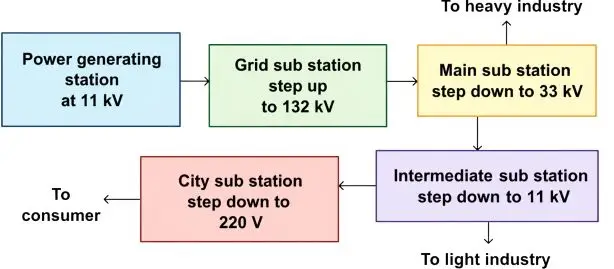
Electricity is generated at 11 kV and stepped up to 132 kV for long distance transmission to reduce energy loss. It is then stepped down back to 220 V for household use.
Household Electricity Supply
- Electricity in homes:
- Potential difference: 220 V
- Frequency of A.C.: 50 Hz
- Domestic wiring consists of three wires:
| Wire | Colour | Voltage | Purpose |
| Live (or, Phase) | Red or Brown | 220 V | Carries current from source to appliance |
| Neutral | Black or Light Blue | 0 V | Provides the return path for current |
| Earth | Green or Yellow | 0 V | A safety wire connected to the metal body of appliances to prevent electric shocks. |
SERIES AND PARALLEL CONNECTION
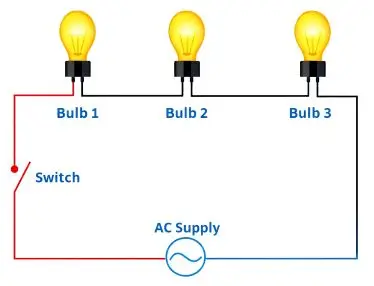
Series Connection
- Appliances share voltage
- If one device fails, all stop working
- Not used in household wiring
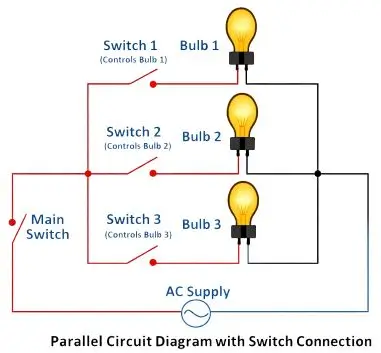
Parallel Connection
- Each appliance gets full voltage
- Appliances work independently
- Used in homes
Advantages of parallel connection over series:
- Each appliance gets the same voltage (220 V).
- Every appliance has its own separate switch.
- If one appliance stops working, it does not affect the operation of the others.
Electric Meter (kWh meter)
- A kWh meter is used to measure the amount of electrical energy consumed in a house or building in kilowatt hours (kWh), which is the unit used for calculating the electricity bill.
- It is fixed at the point where the main supply enters the house, usually on a wall outside the house or near the main switch board.
- Energy consumed = Final reading − Initial reading
Commercial Unit of Electrical Energy
- Commercial Unit: The Kilowatt hour (kWh), also known as the B.O.T. (Board of Trade) unit.
- Electrical energy is measured in kilowatt hour (kWh).
- 1 kWh = energy consumed by a 1 kW appliance in 1 hour
Relationship between 1 kWh and joule
1 kWh = 1 k W × 1 hour
= 1000 W × 1 hour
= 1000 J s−1 × 3600 s
= 3600000 J
= 3.6 × 10⁶ J1 kWh = 3.6 × 10⁶ joules
Power Rating of Appliances
- Power rating indicates the electrical power consumed by an appliance.
- Example:
The rating 60 W – 150 V means that when the appliance is connected to a 150 V supply, it consumes 60 W of electrical power. - Safe current formula: \(I\ =\ \frac{\operatorname{P}}{V}\)
Calculation of Electrical Energy
- E = P × t
Where,- E = Electrical energy (joule, J)
- P = Power (watt, W)
- t = Time (second, s)
- Energy (in kWh) \(=\ \frac{Power\ (W)\ \times\ Time\ (h)\ }{1000}\)
Energy (kWh) = Power (kW) × Time (h) - Cost of electricity = Electrical energy consumed (in kWh) × Rate per unit
Switch
- A switch is a device used to open or close a circuit.
- The switch is connected in the live wire so that when it is switched off, the supply of current to the appliance is cut off.
Electric Fuse (Safety Device)
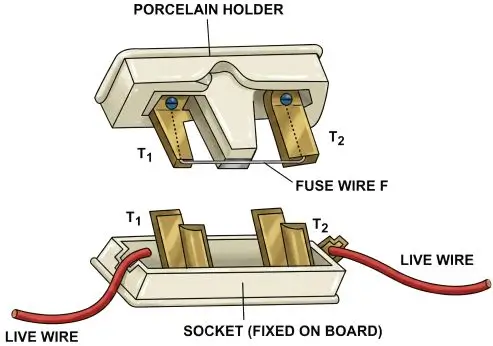
- A fuse is a safety device used to protect circuits from excessive current.
- Made of an alloy of lead and tin.
- Characteristics:
- Low melting point
- High resistance
- Connection: Always connected in series with the Live wire.
- Function: Melts and breaks the circuit during short-circuiting or overloading and protects the wiring or appliances from damage and fire.
Current Rating of Fuse
- The current rating of a fuse wire is directly proportional to its thickness.
- Thin fuse wire → Low current
- Thick fuse wire → High current
- Example:
- 5 A (eg., bulb, TV) → thin fuse wire
- 15 A (eg., heater, iron) → thick fuse wire
Miniature Circuit Breaker (MCB)
- An M.C.B. is a safety device used in electrical circuits to protect wiring and appliances from overload and short circuit.
- M.C.B.s are commonly used in household distribution boards instead of traditional fuse wires.
Why M.C.B. is superior to a fuse wire:
- Faster and safer: It works more quickly and reliably than a fuse, providing better protection to electrical wiring and appliances.
- Automatic operation: It automatically trips and cuts off the current when excess current flows.
- Reusable: After tripping, it can be reset by switching it on again, whereas a fuse wire must be replaced.
Earthing of Appliances
- The metallic body of appliances is connected to the earth wire.
- If leakage current occurs, current flows to earth instead of passing through the human body.
This prevents electric shock.
Hazards of Electricity
- Short Circuiting: Occurs when a naked live wire touches a neutral wire, leading to excessive current and fire.
- Overloading: Connecting too many appliances to a single socket.
- Earthing: Essential for appliances with metallic bodies (toasters, irons) to prevent fatal electric shocks if insulation fails.
Precautions While Using Electricity
- Do not touch switches with wet hands.
- Ensure proper earthing of appliances.
- Do not repair appliances while they are in use.
- Use properly insulated wires.
- Switch off appliances when not in use.
Section (B) : Static Electricity
What is Static Electricity?
- Static electricity is the electricity produced when electric charges remain at rest.
- Example:
When a plastic comb is rubbed with dry hair, it becomes electrically charged due to friction. The charged comb attracts small bits of paper by electrostatic force.
Charging by Friction
- When two objects are rubbed together, electrons transfer from one object to another.
- One object becomes positively charged and the other becomes negatively charged.
- Examples
- Glass rod rubbed with silk → Glass rod becomes positive
- Ebonite rod rubbed with fur → Ebonite rod becomes negative
Types of Electric Charges
There are two kinds of charges:
- Positive charge
- Negative charge
Rule:
- Like charges repel each other
- Unlike charges attract each other
Transfer of Electrons
- Charging occurs due to transfer of electrons.
- Object that loses electrons → Positive charge.
- Object that gains electrons → Negative charge.
- Examples:
- When a glass rod is rubbed with silk, some free electrons move from the glass rod to the silk. As the glass rod loses electrons, it becomes positively charged. The silk gains the same number of electrons and therefore becomes negatively charged by an equal amount.
- When an ebonite rod is rubbed with fur, electrons are transferred from the fur to the ebonite rod. The ebonite rod gains electrons and becomes negatively charged. The fur loses electrons and becomes positively charged by an equal amount.
Conservation of Charge
- Charge is neither created nor destroyed. When two objects are rubbed, they acquire equal and opposite charges. The net charge of the system remains zero.
This is called conservation of charge.
Structure of an Atom
- An atom contains:
- Protons → Positive charge
- Electrons → Negative charge
- Neutrons → No charge
- Normally: Number of protons = Number of electrons
So, the atom is electrically neutral.
Conductors and Insulators
Conductors:
- Materials that allow electric current to pass through them easily.
- Have a large number of free electrons.
- They cannot be charged by rubbing.
- Used for making wires and electrical connections.
Insulators:
- Materials that do not allow electric current to pass through them easily.
- Few free electrons.
- They can be charged by rubbing.
- Used for covering wires and providing safety.
- Examples: Rubber, plastic, glass, wood.
Methods of Charging a Conductor
There are two primary ways to charge a conductor:
1. Charging by Conduction
- Charged body touches the conductor.
- Charge is shared.
- Both bodies get the same type of charge.
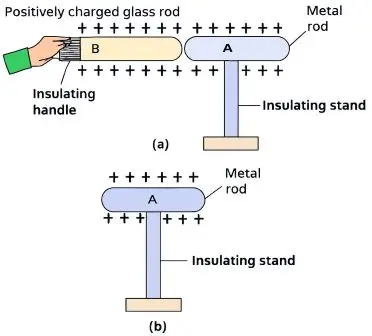
2. Charging by Induction
- No touching is required.
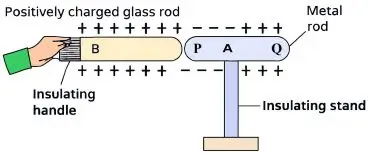
- Charged body is brought near.
- An opposite charge is induced at the near end of the conductor, while the far end gets a charge of the same type.
Difference Between Conduction and Induction
| Conduction | Induction |
| Requires contact | No contact needed |
| Charge is shared | Charge is not shared |
| Same type of charge obtained | Opposite charge obtained |
Electroscope
An electroscope is a device used to detect:
- Presence of charge
- Nature of charge
Types of Electroscope
- Pith Ball Electroscope
- Gold Leaf Electroscope
Pith Ball Electroscope
Construction:
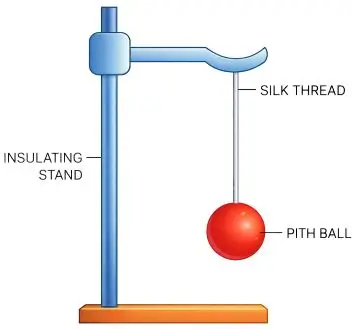
- A small pith ball suspended by a silk thread.
- Fixed to an insulating stand.
Working:
- When a charged body is brought near, charge is induced on the pith ball.
- If the ball gets same charge, it repels.
- If it gets opposite charge, it attracts.
Use:
- To detect whether a body is charged or uncharged.
Gold Leaf Electroscope
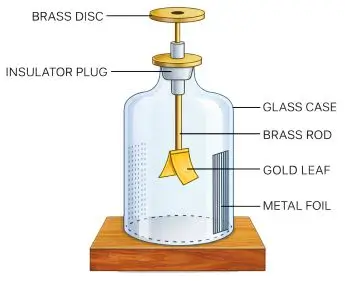
Construction:
- A metal rod with a metal disc at the top.
- Two thin gold leaves attached at the lower end.
- The rod passes through an insulating cork into a glass case.
Working:
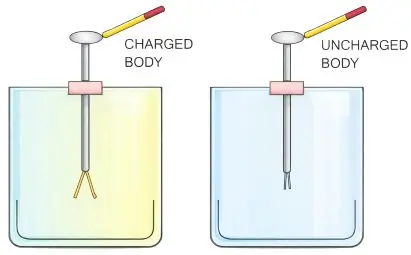
- When a charged object is brought near or touched, charge flows to the leaves.
- Both leaves get same type of charge.
- Leaves repel and diverge.
- More charge → greater divergence.
Testing Charge Using Electroscope
- Leaves diverge → Body is charged
- No divergence → Body is uncharged
To detect type of charge:
- Increase in divergence → Same charge
- Decrease in divergence → Opposite charge
Uses:
- To detect charge.
- To compare magnitude of charge.
Important Points
- Like charges repel, unlike charges attract (principle used).
- Divergence of leaves shows presence of charge.
- Greater divergence indicates greater charge.
Atmospheric Electricity and Lightning
During a thunderstorm:
- Clouds become charged due to friction.
- A spark between cloud and earth is called lightning.
Lightning can:
- Kill humans and animals
- Damage buildings
- Cause fire
Safety Measures During Lightning
- Do not stand under trees or near tall buildings.
- Move to a safe place such as a house or building.
- Sit inside a car or bus and keep windows and doors closed.
- Do not carry umbrellas or metallic objects.
- Switch off and unplug electrical appliances and avoid wired phones.
- Avoid bathing or touching running water or metal taps.
- Stay away from windows and balconies with metal railings.
- Squat low if caught in open ground.
Lightning Conductor
A lightning conductor is a device which is used to protect buildings from damage due to lightning.
Construction
- It consists of a long metal rod (usually copper) fixed at the top of a building.
- The lower end is connected to a metal plate buried deep in the ground.
Working
- When a charged cloud passes over a building, opposite charge is induced on the spikes of the conductor.
- If lightning strikes, the conductor provides a safe path for electric charge to flow to the earth.
- This prevents current from passing through the building, protecting it from damage.
Advantages / Benefits:
- Protects buildings from fire and structural damage.
- Ensures safety of people inside the building during thunderstorms.
Download ICSE Class 8 Physics Electricity Notes PDF
Get the complete ICSE Class 8 Physics Electricity PDF Download and start your preparation today. These notes are ideal for scoring high marks in exams.
Why Download These Notes?
- Easy explanations in simple language
- Covers complete ICSE syllabus
- Helpful for revision and exams
- Free PDF download
- Useful for Selina book students
Download now and start learning Electricity in an easy way.
Conclusion
These ICSE Class 8 Physics Electricity Notes PDF Download are highly useful for students preparing for school exams. Download the notes and start learning chapter-wise concepts in a smart way. Regular practice and revision will help you score excellent marks in Physics.
ICSE Class 8 Physics Notes
Official Website:
Students can visit the official CISCE website for more details and updates.