Introduction
Looking for ICSE Class 8 Physics Force and Pressure Notes PDF Download? You are in the right place. Here you can get easy and well-structured notes for ICSE Class 8 Physics Chapter Force and Pressure. These notes are specially prepared for students who want quick revision, clear concepts, and exam preparation material.
What You Will Learn in Force and Pressure
In this chapter, students learn the basic concepts of force, pressure, and their applications in daily life. Important topics included are:
- Meaning of Force
- Types of Forces
- Contact Forces and Non-contact Forces
- Effects of Force
- Pressure and its Formula
- Factors Affecting Pressure
- Atmospheric Pressure
- Applications of Pressure in Daily Life
Study Support by Rohit Academy
Rohit Academy offers expert-curated ICSE Class 8 Physics Study Materials including ICSE Force and Pressure Chapter Notes, diagrams, and key formulas for better understanding.
You can also visit:
| ☛ ICSE Class 8 Physics Chapter 3: Force and Pressure Selina Solutions |
| ☛ ICSE Class 8 Physics |
| ☛ ICSE Class 8 Chemistry |
| ☛ ICSE Class 8 Mathematics |
| ☛ ICSE Class 8 Biology |
Force and Pressure Notes ICSE Class 8
Force
Force is a push or pull acting on a body which can change or tends to change its state of rest or motion, shape, or size.
Unit of Force
- SI unit: newton (N)
- CGS unit: dyne (dyn)
1 N = 105 dyne - Gravitational Unit: kgf
1 kgf = 10 N (approximately)
1 kgf = 9.8 N (exact)
Definition of 1 Newton
One newton is the force which, when applied on a mass of 1 kg, increases its speed by 1 m/s every second.
Effects of Force
A force can produce the following effects:
1. Change State of Rest
A stationary body can start moving.
Example:
A football starts moving when kicked.
2. Change State of Motion
A moving body can stop or slow down.
Example:
A fielder catches a ball and stops it.
3. Change Speed of Body
Force can increase or decrease speed.
Example:
⦿ Push on swing increases speed
⦿ Brakes reduce speed of car
4. Change Direction of Motion
Force can change the direction of a moving object.
Example:
A hockey stick changes direction of ball.
5. Change Shape or Size
Force can deform non-rigid bodies.
Example:
⦿ Stretching rubber band increases length
⦿ Squeezing toothpaste tube changes shape
Effect of force Rigid and Non-Rigid Bodies
- On a rigid body:
A force can change only the state of rest or motion of the body, but not its shape or size. - On a non-rigid body:
A force can change the shape or size of the body, along with changing its state of motion.
Turning Effect of Force
When force acts on a body pivoted at a point, it produces turning effect.
Examples:
- Door rotates about hinges
- Wheel rotates about axle
Factors Affecting Turning Effect
1. Magnitude of Force
Greater the force, greater the turning effect.
2. Perpendicular Distance from Pivot
Greater the distance from pivot, greater the turning effect.
Examples:
- To open or shut a door, we apply the force at the free end of it because larger perpendicular distance, less force is needed to open or shut the door.
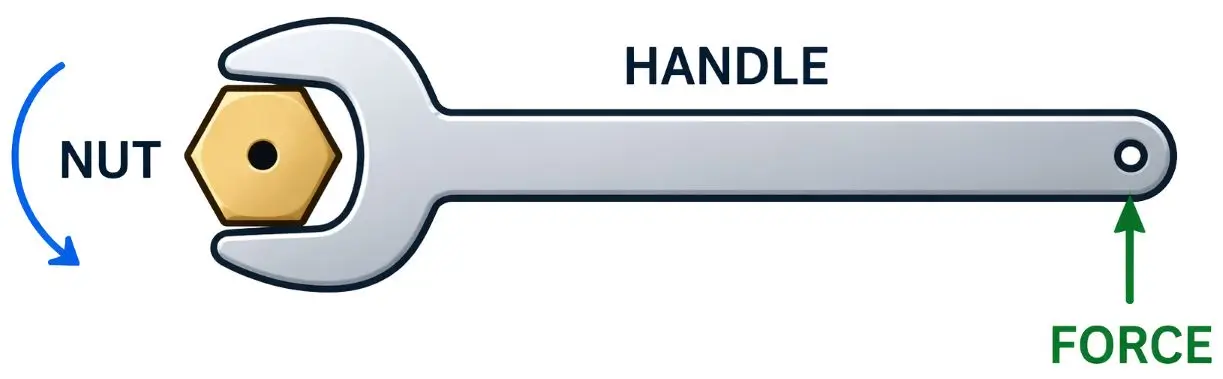
- A spanner (or wrench) has a long handle to produce larger turning moment so that nut can easily be turned with a less force

- The stone of a hand flour grinder is provided with a handle near its rim so that a small force can rotate it easily about the central pivot.
- It is easier to turn a steering wheel of large diameter than a small one because the force acts at a greater distance from the centre, producing a larger turning effect.
- A potter turns his wheel by applying force through a stick near the rim of the wheel.
Applying force near the rim increases the distance from the axis, giving a greater turning effect and making the wheel rotate easily.
Moment of Force (Torque)
The moment of force is equal to the product of the magnitude of the force and the perpendicular distance of the force from the pivoted point.
Formula
Moment of Force = Force × Perpendicular Distance from Pivot
Symbol:
M = F × d
Units of Moment of Force
- S.I. Unit: N m (newton-metre).
- C.G.S. Unit: dyne cm
- Note : 1 N m = 107 dyne cm
Direction of Rotation
- Anticlockwise moment: Taken as positive (+).
- Clockwise moment: Taken as negative (–).
Thrust
When the force acts normal (perpendicular) to a surface, it is called thrust.
Examples:
- Book placed on table exerts thrust
- Person standing on floor exerts thrust
Units of Thrust
Same as force:
- Newton (N)
- kgf
- gf
EFFECT OF THRUST
The effect of thrust depends on the area of contact.
- Smaller area → Greater effect of thrust
- Larger area → Smaller effect of thrust
Examples
1. Standing on Sand
◉ When you stand on loose sand, your feet sink deeper.
◉ When you lie down, you sink less.
Reason:
The same thrust acts on a smaller area while standing and on a larger area while lying down.
2. Hammering a Nail
⦿ A nail with its flat end on wood does not penetrate easily.
⦿ A nail with its sharp end penetrates easily.
Reason:
The same thrust acts on a smaller area at the sharp end.
Pressure
Pressure is defined as the thrust acting per unit area.
Formula
Pressure \(=\frac{\operatorname{Thrust}}{Area}\)
\(P=\ \frac{F}{A}\)
Meaning
- Greater thrust on same area → More pressure
- Smaller thrust on same area → Less pressure
- Same thrust on smaller area → More pressure
- Same thrust on larger area → Less pressure
❖ SI Unit of Pressure : N m2 or pascal (Pa).
1 Pascal
Pressure produced when force of 1 newton acts on area of 1 m2.
Relation
⇒ 1 Pa = 1 N/m2
⇒ 1 kPa = 1000 Pa
⇒ 1 atm = 76 cm Hg = 1.013 × 10⁵ Pa
Factors Affecting Pressure
1. Area of Surface
⦾ Smaller area → Greater pressure
⦾ Larger area → Less pressure
2. Magnitude of Thrust
Greater thrust → Greater pressure
1. Dependence of Pressure on Area
For the same thrust:
- Smaller area → More pressure
- Larger area → Less pressure
Example: Standing on Sand
- Standing: feet cover smaller area → more pressure → sink more
- Lying down: body covers larger area → less pressure → sink less
Example: Sharp Pin and Nail
- Sharp pin enters wood easily because tip area is very small.
- Nail with broad tip does not enter easily.
2. Dependence of Pressure on Thrust (Force)
Pressure also depends on the magnitude of thrust.
For the same surface area:
- Greater thrust → More pressure
- Smaller thrust → Less pressure
Example: Thin Boy and Fat Boy on Bed
- A thin boy standing on bricks placed on a bed exerts less pressure.
- A fat boy standing on the same bricks exerts more pressure due to greater weight.
Conclusion: Greater thrust on the same area produces more pressure.
EXAMPLES OF PRESSURE IN DAILY LIFE
(A) Decrease in Area Increases Pressure
1. Nail / Board Pin
The pointed end has a very small area, so it exerts more pressure and enters wood or wall easily.
2. Cutting Tools
Examples: Knife, Blade, Axe, Scissors, Pliers Sharp edges have small contact area, so they produce more pressure and cut easily.
3. Pointed Heels
Pointed heels have less area of contact, so they exert more pressure on the ground and sink in mud easily.
(B) Increase in Area Decreases Pressure
1. Heavy Trucks Have Many Tyres
Heavy trucks have 6 to 8 tyres instead of 4 tyres.
Reason: More tyres increase contact area and reduce pressure on the road.
2. Camel Walks Easily on Sand
Reason: Broad feet increase area and reduce pressure on sand.
3. Skis Used on Snow
Reason: Large area of skis reduces pressure and prevents sinking.
4. Army Tanks Use Broad Tracks
Reason: Broad tracks increase area and reduce pressure on the ground.
5. Wide Foundations of Buildings
Reason: Large area reduces pressure on soil and prevents sinking.
6. Porter Wears Turban
Reason: Turban increases area of contact on head and reduces pressure.
7. Broad Straps of Bags
Reason: Broad straps increase contact area and reduce pressure on shoulders.
8. Wooden Sleepers Under Railway Tracks
Reason: Sleepers spread force over a larger area and reduce pressure on ground.
DIFFERENCE BETWEEN THRUST AND PRESSURE
| Thrust | Pressure |
| Thrust is the force acting perpendicular to a surface. | Pressure is thrust acting per unit area. |
| It does not depend on area. | It depends on area. |
| SI unit is newton (N). | SI unit is pascal (Pa) or N/m2. |
Liquid Pressure
Liquids exert pressure due to their weight.
Liquids exert pressure:
- At bottom of container
- On side walls
- In all directions
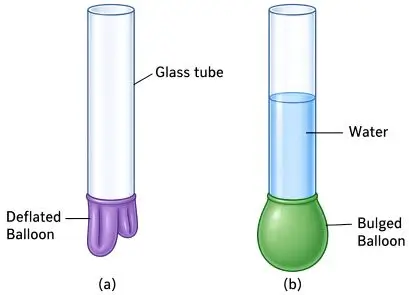
1. Liquid Exerts Pressure at the Bottom
When water is poured into a glass tube closed at the lower end with a balloon, the balloon bulges outward. This shows that liquid exerts pressure at the bottom of the container.
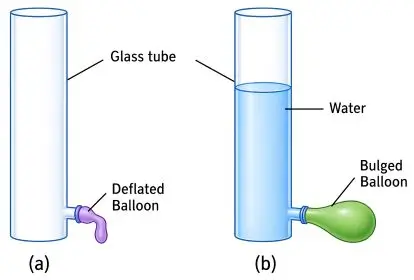
2. Liquid Exerts Pressure Sideways
When a balloon is tied to a side hole of a glass tube and water is poured into it, the balloon bulges outward.
This proves that liquids exert pressure on the walls of the container.
3. Liquid Exerts Pressure in All Directions
If holes are made in a balloon filled with water, water comes out from all holes in different directions. This shows that liquid exerts pressure in all directions.

Factors Affecting Liquid Pressure
The pressure at a point in a liquid depends on two factors:
1. Height of Liquid Column
Liquid pressure increases with the height of the liquid column above the point.
Activity:
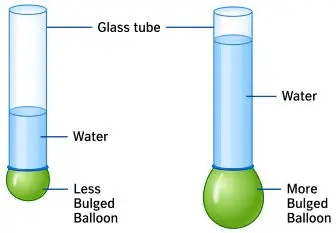
Take a glass tube open at both ends and tie a balloon at the lower end.
- Pour some water → balloon bulges.
- Add more water → balloon bulges more.
Conclusion:
Greater the height of liquid column, greater is the pressure exerted.
So, liquid pressure increases with depth.
2. Density of Liquid
Liquid pressure increases with increase in density of the liquid.
Activity:
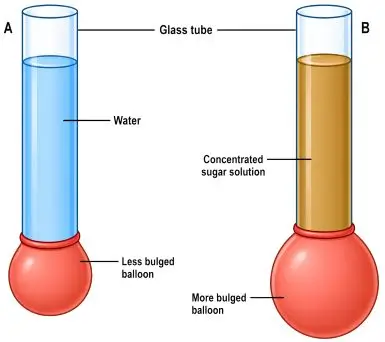
Two identical tubes A and B are taken.
- Tube A contains water.
- Tube B contains concentrated sugar solution of same height.
The balloon tied to tube B bulges more.
Conclusion:
Denser liquids exert more pressure than lighter liquids.
Consequences of Liquid Pressure
- Thickness of Walls of a Dam is Increased Towards the Bottom
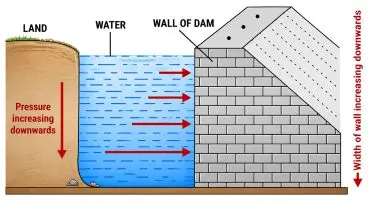
Pressure in a liquid increases with depth. Therefore, the lower part of a dam experiences greater pressure than the upper part.
Hence, the wall of a dam is made thicker at the bottom to withstand high pressure.
- Deep Sea Divers Wear Special Suits Because liquid pressure is very high underwater.
Atmospheric Pressure
Air also has weight and exerts pressure on Earth.
This pressure is called atmospheric pressure.
Standard Atmospheric Pressure
- 76 cm of mercury column
- 760 mm Hg
- 1 atm = 1.013 × 10⁵ Pa
Demonstration of Atmospheric Pressure
1. Glass and Postcard Experiment

Procedure:
- Fill a glass completely with water.
- Cover its mouth with a postcard.
- Invert the glass carefully.
- Remove your hand from the postcard.
Observation:
The postcard does not fall and water remains in the glass.
Reason:
Atmospheric pressure acts upward on the postcard and supports it.
2. Crushing Can Experiment
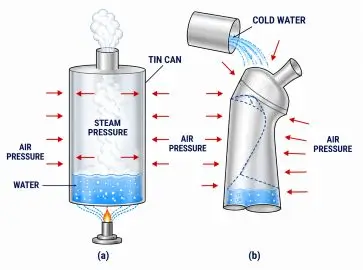
Procedure:
- Take a thin metal can with stopper.
- Fill it partly with water.
- Heat it until steam comes out.
- Close the stopper.
- Pour cold water on the can.
Observation:
The can collapses inward.
Reason:
- Steam drives out most air from the can.
- On cooling, steam condenses and creates partial vacuum inside.
- Outside atmospheric pressure becomes greater than inside pressure.
- Hence, the can gets crushed.
Atmospheric Pressure Decreases with Height
As altitude increases, air pressure decreases.
Examples:
- Mountains have lower pressure
- Nose bleeding at high altitude may occur
Examples in Daily Life Showing Atmospheric Pressure
1. Drinking with a Straw
When we suck air from the straw:
◉ Air pressure inside the straw decreases.
◉ Atmospheric pressure on the drink pushes the liquid upward into the straw and then into the mouth.
2. Balloon Bulges on Blowing Air
When air is blown into a balloon, it bulges due to the pressure exerted by the air filled inside it.
3. Fountain Pen Gets Filled
Ink enters a fountain pen due to atmospheric pressure.
4. Water is Drawn from a Well
Water is drawn up by a water pump because atmospheric pressure acts on the water surface.
5. Syringe Gets Filled
When the plunger is pulled up:
◉ Pressure inside decreases.
◉ Atmospheric pressure pushes the liquid into the syringe.
6. Rubber Suckers Stick to Wall
Rubber suckers remain attached to kitchen or bathroom walls due to atmospheric pressure acting from outside.
7. Taking Oil from a Sealed Tin
If only one hole is made, oil does not come out easily.
If another hole is made:
◉ Air enters through one hole.
◉ Oil comes out through the other hole easily.
8. Lizards Move on Walls
Lizards can move and stay on walls because their feet act like suction pads and atmospheric pressure presses them against the wall.
9. Astronauts and Mountaineers Wear Special Suits
At high altitudes, atmospheric pressure is low.
Therefore, astronauts and mountaineers wear special suits for protection.
10. Nose Bleeding at High Altitudes
At high altitudes:
◉ Atmospheric pressure outside decreases.
◉ Internal body pressure remains nearly same.
This pressure difference may cause nose bleeding.
Download ICSE Class 8 Force and Pressure Notes PDF
Students searching for ICSE Class 8 Physics Force and Pressure Notes PDF Download can use these notes for free study support. Save the PDF and revise anytime on mobile or computer.
Why Download These Notes?
These ICSE Class 8 Physics Force and Pressure Notes PDF are useful because:
- Simple language for easy understanding
- Important definitions and formulas included
- Helpful for last-minute revision
- Based on latest ICSE syllabus
- Useful for school exams and unit tests
Conclusion
If you want the best ICSE Class 8 Physics Force and Pressure Notes PDF Download, these notes are perfect for quick learning and exam preparation. Keep visiting for more ICSE study materials, chapter notes, and PDF resources.
ICSE Class 8 Physics Notes
Official Website:
Students can visit the official CISCE website for more details and updates.