Introduction
If you are searching for ICSE Class 8 Physics Energy Notes PDF Download, you are in the right place. These notes are specially prepared for ICSE Class 8 students to help them understand important concepts of Energy in a simple and easy language. With well-structured explanations, formulas, and key points, these notes are perfect for revision and exam preparation.
Study Support by Rohit Academy
Rohit Academy offers expert-curated ICSE Class 8 Physics Study Materials including ICSE Energy Chapter Notes, diagrams, and key formulas for better understanding.
You can also visit:
| ☛ ICSE Class 8 Physics Chapter 4: Energy Selina Solutions |
| ☛ ICSE Class 8 Physics |
| ☛ ICSE Class 8 Chemistry |
| ☛ ICSE Class 8 Mathematics |
| ☛ ICSE Class 8 Biology |
Energy Notes ICSE Class 8
Work
Work is said to be done only when a force applied to a body causes a change in its position (motion) or a change in its size/shape.
Essential Conditions for Work:
- A force must act on the body.
- The force must produce motion (displacement) or a change in shape.
Mathematical Formula
The work done by a force is equal to the product of the force applied and the distance moved in the direction of the force:
Work done = Force × Displacement
Or, W = F × d
Units of Work
- S.I. Unit: Joule (J) or Newton meter (Nm).
- Definition of 1 Joule: One joule of work is done when a force of 1 Newton moves a body by a distance of 1 metre in the direction of the force
1 joule = 1 newton × 1 metre
Or, 1 J = 1 Nm - Larger Units: 1 kilojoule (kJ) = 103 J;
1 Megajoule (MJ) = 106 J
Examples of Work Done
- Lifting a box
- Pulling a cart
- Climbing stairs
- Pedalling a bicycle
- Stretching a rubber band
- Compressing a spring
Examples of No Work Done
- Pushing a wall that does not move
- Holding luggage on the head while standing
- Carrying luggage on a horizontal road against gravity
- Motion in a circular path where force is perpendicular to motion
Factors Affecting Work Done
Work done depends on:
- Magnitude of force applied
Greater force → More work - Distance moved in the direction of force
Greater displacement → More work
Special Case: Zero Work
Work done is zero even if a force is acting, if:
- No Displacement: Pushing a stationary wall
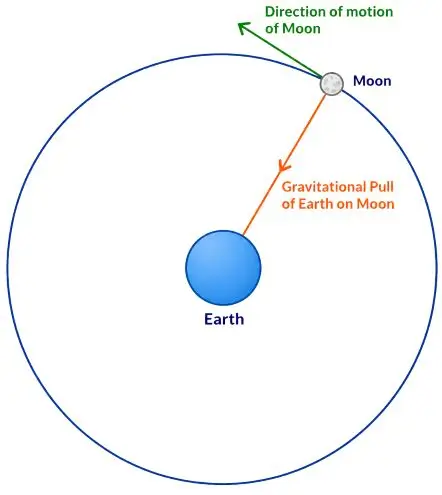
- Perpendicular Motion: If the force is perpendicular (90°) to the direction of motion.
Example: A coolie carrying a load on his head while walking on a flat platform (the force of gravity is downward, but motion is horizontal).
Example: Earth revolving around the sun (gravitational force is perpendicular to the motion).
Energy
Energy is the capacity to do work.
Unit of Energy
● SI unit = joule (J)
Mechanical Energy
Mechanical energy is energy possessed due to:
● Position or state of rest
● State of motion
It is of two types:
1. Potential Energy
2. Kinetic Energy
Potential Energy
Potential energy is the energy possessed by a body due to its position or state of rest.
Examples:
- Water stored in dam
- Stone kept at height
- Stretched bow
- Compressed spring
- Wound watch spring
Gravitational Potential Energy
When a body is raised to a height, work is done against gravity. This work is stored as potential energy.
Formula: P. E. = mgh
Where:
● m = mass
● g = acceleration due to gravity
● h = height
Factors Affecting Potential Energy
- Mass of body
More mass → More P.E. - Height above ground
More height → More P.E.
Elastic P.E.
Energy stored in a compressed spring or a stretched bow.
Kinetic Energy
Kinetic energy is the energy possessed by a body due to its motion.
Examples:
- Moving car
- Rolling ball
- Bullet fired from gun
- Flowing water
- Swinging pendulum
- Flying bird
Formula of Kinetic Energy
K. E. \(=\frac{1}{2}{mv}^2\)
Where:
- m = mass
- v = speed
Factors Affecting Kinetic Energy
- Mass of body
More mass → More K.E. - Speed of body
More speed → Much more K.E.
***Note
- If the mass of a body is doubled, its kinetic energy also becomes double (when velocity remains constant).
- If the velocity of a body is doubled, its kinetic energy becomes four times (when mass remains constant).
Difference Between Potential Energy and Kinetic Energy
| Potential Energy | Kinetic Energy |
| Due to position or rest | Due to motion |
| Stored energy | Energy in action |
| Depends on height/shape | Depends on speed |
| Example: water in dam | Example: flowing water |
Conversion of Potential Energy into Kinetic Energy
Examples
- Falling Stone
● At top → Potential Energy maximum
● While falling → Converts into Kinetic Energy
When a stone is dropped from a height, its potential energy decreases and kinetic energy increases. - Roller Coaster
● At highest point → PE maximum
● At lowest point → KE maximum - Swinging Pendulum
● At ends → PE maximum
● At center → KE maximum - Bow and Arrow
Stretched bow stores PE which changes to KE of arrow. - Hydroelectricity
Water stored in a dam (P.E.) falls onto a turbine, converting into K.E., which then generates electricity.
***Note
Mechanical energy converts to other forms (heat, sound, etc.) generally through motion, so it changes through kinetic energy, not directly through potential energy.
Law of Conservation of Mechanical Energy
Energy can neither be created nor destroyed; it only changes from one form to another.
In absence of friction:
Potential Energy + Kinetic Energy remains constant
P. E. + K. E. = Constant
Different Forms of Energy
- Mechanical energy
- Heat energy
- Light energy
- Sound energy
- Electrical energy
- Chemical energy
- Nuclear energy
- Solar energy
Examples of Transformation of Energy
| Energy Conversion | Example |
| Mechanical → Electrical | Dynamo, Generator |
| Electrical → Mechanical | Fan, Mixer, Grinder |
| Electrical → Heat | Heater, Iron, Toaster |
| Electrical → Sound | Loudspeaker, Bell |
| Sound → Electrical | Microphone |
| Light → Chemical | Photosynthesis |
| Electrical → Light | Bulb |
| Light → Electrical | Solar Cell |
| Heat → Mechanical | Steam Engine |
| Mechanical → Heat | Friction |
Degradation of Energy:
During transformation, some energy is often lost to the surroundings as heat due to friction. This “non-useful” energy is called the degraded form of energy.
Power
Power is defined as the rate of doing work.
Formula: \(P\ =\ \frac{\operatorname{W}}{t}\)
Where:
- P = Power
- W = Work done
- t = Time taken
***Note
Less time taken to do the same work means more power.
Unit of Power
- S.I. Unit: Watt (W).
- 1 Watt: Defined as 1 Joule of work done in 1 second (1 W = 1 J/s).
- Larger Units:
◉ 1 kilowatt (kW) = 1000 W
◉ 1 Megawatt (MW) = 106 W
◉ 1 H.P.= 746 W
Difference Between Work and Power
| Work | Power |
| Product of force and displacement | Rate of doing work |
| Does not depend on time | Depends on time |
| Unit = Joule | Unit = Watt |
| Work | Power |
Difference Between Energy and Power
| Energy | Power |
| Capacity to do work | Rate of using energy |
| Does not depend on time | Depends |
| Unit = Joule | Unit = Watt |
| Energy | Power |
Quick Revision
- Work = Force × Distance
- Unit of Work / Energy = Joule
- Energy = Capacity to do work
- P.E. = mgh
- K.E. = \(\frac{1}{2}{mv}^2\)
- Power = \(\frac{Work}{Time}\)
- Unit of Power = Watt
Download ICSE Class 8 Energy Notes PDF
Students searching for ICSE Class 8 Physics Energy Notes PDF Download can use these notes for free study support. Save the PDF and revise anytime on mobile or computer.
Why Download PDF Notes?
PDF notes are useful because:
- Easy to read anytime
- Can study offline
- Quick revision before exam
- Printable for hard copy use
Conclusion
These ICSE Class 8 Physics Energy Notes PDF Download are highly useful for students preparing for school exams. Download the notes and start learning chapter-wise concepts in a smart way. Regular practice and revision will help you score excellent marks in Physics.
ICSE Class 8 Physics Notes
Official Website:
Students can visit the official CISCE website for more details and updates.