Introduction
Light is one of the most important forms of energy that helps us see objects around us. In ICSE Class 8 Physics Chapter 5 Light Energy, students learn about the nature of light, luminous and non-luminous objects, reflection, regular and diffused reflection, shadows, eclipses, and the human eye. To help students understand each concept clearly, we provide ICSE Class 8 Physics Chapter 5 Light Energy Selina Solutions with accurate answers in simple language.
These solutions are designed according to the latest ICSE syllabus and are useful for homework, exam preparation, and quick revision. Students can easily practice textbook questions and improve their confidence in Physics.
Benefits of Selina Solutions for Class 8 Physics
Using Selina Solutions Class 8 Physics Chapter 5 Light Energy helps students in many ways:
- Simple and step-by-step answers
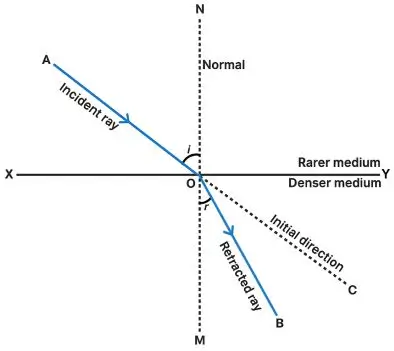
- Covers all textbook exercises
- Useful for school exams and unit tests
- Helps in quick revision before exams
- Improves conceptual understanding
Study Support by Rohit Academy
Rohit Academy offers expert-curated ICSE Class 8 Physics Study Materials including ICSE Light Energy Chapter Notes, diagrams, and key formulas for better understanding.
You can also visit:
| ☛ ICSE Class 8 Physics Chapter 5: Light Energy Notes |
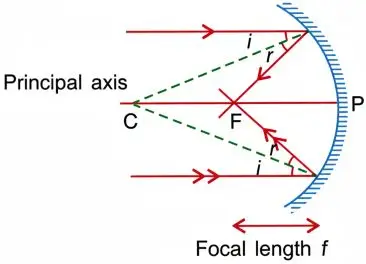
| ☛ ICSE Class 8 Physics |
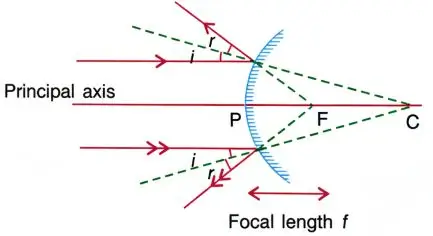
| ☛ ICSE Class 8 Chemistry |
| ☛ ICSE Class 8 Mathematics |
| ☛ ICSE Class 8 Biology |
(A) Multiple Choice Type
Question 1
Choose the correct answer from the multiple choices given below.
Question 1(a)
The speed of light in air or vacuum is:
(i) 3 x 10⁸ m s–1
(ii) 2.25 x 10⁸ m s–1
(iii) 332 m s–1
(iv) 2.0 x 10⁸ m s–1
Answer:
(i) 3 x 10⁸ m s–1
Explanation:
Speed of light in vacuum (and approximately in air) is 3 x 10⁸ m/s.
Question 1(b)
A ray of light moving from an optically rarer to a denser medium:
(i) bends away from the normal
(ii) bends towards the normal
(iii) remains undeviated
(iv) None of the above
Answer:
(ii) bends towards the normal
Explanation:
When light goes from a rarer medium (like air) into a denser medium (like glass or water), its speed decreases and the ray refracts towards the normal.
Question 1(c)
The angle between the normal and refracted ray is called:
(i) angle of deviation
(ii) angle of incidence
(iii) angle of refraction
(iv) angle of emergence
Answer:
(iii) angle of refraction
Explanation:
The angle between the normal and the refracted ray is called the angle of refraction.
Question 1(d)
The property of splitting of white light into its seven constituent colours is known as:
(i) rectilinear propagation
(ii) refraction
(iii) reflection
(iv) dispersion
Answer:
(iv) dispersion
Explanation:
Splitting of white light into seven constituent colours is called dispersion.
Question 1(e)
The seven colours in the spectrum of sunlight in order are represented as:
(i) VIBGYOR (ii) VIGYBOR (iii) BIVGYOR (iv) RYOBIVG
Answer:
(i) VIBGYOR
Explanation:
Standard order of colours in the visible spectrum from violet to red is Violet, Indigo, Blue, Green, Yellow, Orange, Red → V I B G Y O R.
Question 1(f)
A ray of light passing through the centre of curvature of a spherical mirror, after reflection:
(i) passes through the focus
(ii) passes through the pole
(iii) becomes parallel to the principal axis
(iv) retraces its own path
Answer:
(iv) retraces its own path
Explanation: A ray passing through the centre of curvature of a spherical mirror strikes the mirror normally and is reflected back along the same path (it retraces its own path).
Question 1(g)
If the radius of curvature of a concave mirror is 20 cm, its focal length is:
(i) 10 cm (ii) 20 cm (iii) 40 cm (iv) 80 cm
Answer:
(i) 10 cm
Explanation:
For a spherical mirror,
focal length, \(f=\frac{R}{2}\)
Given radius, R = 20 cm
So, (f=\frac{R}{2}=\frac{20}{2}\=\)10 cm
Question 1(h)
The image formed by a convex mirror is:
(i) erect and diminished
(ii) erect and enlarged
(iii) inverted and diminished
(iv) inverted and enlarged
Answer:
(i) erect and diminished
Explanation:
A convex mirror always forms a virtual, erect, and diminished image of any object placed in front of it.
Question 1(i)
The image formed by a concave mirror is of the same size as the object, if the object is placed:
(i) at the focus
(ii) between the pole and the focus
(iii) between the focus and the centre of curvature
(iv) at the centre of curvature
Answer:
(iv) at the centre of curvature
Explanation:
A concave mirror forms an image of the same size as the object when the object is placed at the centre of curvature (object and image both at R).
Question 1(j)
A convex mirror is used:
(i) as a shaving mirror
(ii) as a head mirror by a dentist
(iii) as a rear view mirror by a driver
(iv) as a reflector in torch
Answer:
(iii) as a rear view mirror by a driver
Explanation:
Convex mirrors give a wide field of view and produce erect, diminished images – so they’re used as rear-view mirrors in vehicles.
Assertion Reason Type
Question 2
The following questions are Assertion–Reason based questions. Choose the answer based on the codes given below.
Question 2(a)
Assertion (A) : If a white light is passed through a prism, it splits into different colours.
Reason (R) : White light is a mixture of colours.
(i) Both A and R are true and R is the correct explanation of A
(ii) Both A and R are true and R is not the correct explanation of A
(iii) Assertion is true but reason is false
(iv) Assertion is false but reason is true
Answer:
(ii) Both A and R are true and R is not the correct explanation of A
Explanation:
The Assertion is true: when white light passes through a prism, it splits into its constituent colours due to dispersion, as different colours travel at different speeds in glass and are refracted by varying amounts.
The Reason is also true: white light is indeed a mixture of seven spectral colours — violet, indigo, blue, green, yellow, orange, and red.
However, simply stating that white light is a mixture of colours does not explain why the prism causes the colours to separate. The actual reason lies in the wavelength-dependent refractive index of the prism material. Therefore, while both the Assertion and Reason are true, the Reason is not the correct explanation of the Assertion.
Question 2(b)
Assertion (A) : The bottom of a pond appears shallower than its actual depth.
Reason (R) : Light rays from the bottom of the pond bend towards the normal as they pass from water to air.
(i) Both A and R are true and R is the correct explanation of A
(ii) Both A and R are true and R is not the correct explanation of A
(iii) Assertion is true but reason is false
(iv) Assertion is false but reason is true
Answer:
(iii) Assertion is true but Reason is false.
Explanation:
The bottom of a pond does appear shallower than its actual depth (assertion true). This happens because when light travels from water (optically denser) into air (optically rarer) it bends away from the normal, not towards it. Because the emergent rays bend away, the apparent origin of those rays (the virtual image of the bottom) is shifted upward, so the pond looks shallower. The reason statement given said the rays bend towards the normal on going from water to air, which is incorrect.
Question 2(c)
Assertion (A) : A concave mirror can form both real and virtual images.
Reason (R) : The type of image formed by a concave mirror depends on the position of the object relative to the mirror’s focal point.
(i) Both A and R are true and R is the correct explanation of A
(ii) Both A and R are true and R is not the correct explanation of A
(iii) Assertion is true but reason is false
(iv) Assertion is false but reason is true
Answer:
(i) Both A and R are true and R is the correct explanation of A
Explanation:
Assertion (A) is true because a concave mirror can form both real and virtual images depending on the position of the object relative to its focal point. Reason (R) is true because a concave mirror forms a virtual image when the object is placed close to the mirror, between its pole and focus, and forms a real image when the object is placed at the focus or beyond it.
Therefore, the reason clearly explains the assertion, as the nature of the image formed by a concave mirror depends on the object’s position with respect to its focal point.
Question 2(d)
Assertion (A) : Convex mirrors are used as a vigilance mirror.
Reason (R) : Convex mirrors form magnified images.
(i) Both A and R are true and R is the correct explanation of A
(ii) Both A and R are true and R is not the correct explanation of A
(iii) Assertion is true but reason is false
(iv) Assertion is false but reason is true
Answer:
(iii) Assertion is true but reason is false.
Explanation:
Convex mirrors are used as vigilance or rear-view mirrors because:
- They give a wide field of view.
- They always form diminished, erect, and virtual images, not magnified ones.
Fill in the blanks
Question 3
Fill in the blanks:
(a) Water is optically …………… than air.
(b) Air is optically …………… than glass.
(c) When a ray of light travels from water to air, it bends …………… the normal.
(d) When a ray of light travels from air to glass, it bends …………… the normal.
(e) Refractive index of water is 4/3, so the apparent depth is …………… of the real depth.
(f) The splitting of white light into its constituent colours is called …………… .
(g) A …………… mirror is obtained on silvering the outer surface of a part of a hollow glass sphere.
(h) Radius of curvature of a spherical mirror is …………… its focal length.
(i) The angle of incidence for a ray of light passing through the centre of curvature of a spherical mirror is …………… .
(j) A …………… mirror always forms a virtual image.
(k) A concave mirror forms a virtual image for an object placed …………… .
Answer:
(a) Water is optically denser than air.
(b) Air is optically rarer than glass.
(c) When a ray of light travels from water to air, it bends away from the normal.
(d) When a ray of light travels from air to glass, it bends towards the normal.
(e) Refractive index of water is 4/3, so the apparent depth is 3/4th of the real depth.
(f) The splitting of white light into its constituent colours is called dispersion.
(g) A concave mirror is obtained on silvering the outer surface of a part of a hollow glass sphere.
(h) Radius of curvature of a spherical mirror is two times its focal length.
(i) The angle of incidence for a ray of light passing through the centre of curvature of a spherical mirror is 0°.
(j) A convex mirror always forms a virtual image.
(k) A concave mirror forms a virtual image for an object placed between its pole and focus.
True or False
Question 4
Write true or false for each statement:
(a) Water is optically denser than glass.
(b) A ray of light when passes from glass to air, bends towards the normal.
(c) The speed of light is more in glass than in water.
(d) The depth of a pond when seen from above appears to be less.
(e) Light travels at a lower speed in water than in air.
(f) Light travels in the same straight line path while passing through different media.
(g) The angle formed between the normal and the refracted ray is known as the angle of incidence.
(h) At the point of incidence, a line drawn at right angles to the surface, separating the two media, is called the normal.
(i) Image is formed by a mirror due to refraction of light.
(j) Rays of light incident parallel to the principal axis pass through the focus after reflection from a concave mirror.
(k) A convex mirror is used as a shaving mirror.
(l) The focal length of a convex mirror is equal to its radius of curvature.
(m) A concave mirror converges the light rays, but a convex mirror diverges them.
(n) A virtual image formed by a spherical mirror is always erect and situated behind the mirror.
Answer:
(a) False
Correct Statement : Water is optically rarer than glass.
(b) False
Correct Statement : A ray of light when passes from glass to air, bends away from the normal.
(c) False
Correct Statement : The speed of light is less in glass than in water.
(d) True
(e) True
(f) False
Correct Statement : The direction of light changes from its initial path when passing through different media.
(g) False
Correct Statement : The angle formed between the normal and the refracted ray is known as the angle of refraction.
(h) True
(i) False
Correct Statement : Image is formed by a mirror due to reflection of light.
(j) True
(k) False
Correct Statement : A concave mirror is used as a shaving mirror.
(l) False
Correct Statement : The focal length of a convex mirror is half of its radius of curvature.
(m) True
(n) True
Match the Columns
Question 5
Match the following:
| Column A | Column B |
| (a) White light | (i) convex mirror |
| (b) Refraction | (ii) concave mirror |
| (c) Virtual images | (iii) refraction |
| (d) Real images | (iv) spectrum |
| (e) Prism | (v) ray of light from glass to air |
Answer:
| Column A | Column B |
| (a) White light | (iv) spectrum |
| (b) Refraction | (v) ray of light from glass to air |
| (c) Virtual images | (i) convex mirror |
| (d) Real images | (ii) concave mirror |
| (e) Prism | (iii) refraction |
(B) Short Answer Type Questions
Question 1
State the speed of light in:
(a) air
(b) water and
(c) glass.
Answer:
(a) The speed of light in air is 3 x 10⁸ m s–1.
(b) The speed of light in water is 2.25 x 10⁸ ms–1
(c) The speed of light in glass is 2 x 10⁸ m s–1
Question 2
How does the speed of light determine the optical density of a medium?
Answer:
The speed of light determines optical density because a medium in which light travels slower is optically denser, and a medium in which light travels faster is optically rarer.
Question 3
Which is optically denser: water or air? Give reason.
Answer:
Water is optically denser than air because the speed of light in water is less than in air.
Question 4
Out of air and glass, which is optically rarer? Give reason.
Answer:
Air is optically rarer than glass because the speed of light in air is greater than in glass.
Question 5
What do you understand by refraction of light?
Answer:
The change in the direction of the path of light, when it passes from one transparent medium to another transparent medium, is called refraction of light.
Question 6
Define the following terms:
(a) Incident ray
(b) Refracted ray
(c) Angle of incidence
(d) Angle of refraction
Answer:
(a) Incident ray : It is incoming ray on the refracting surface.
(b) Refracted ray : It is an outgoing ray from the refracting surface.
(c) Angle of incidence : The angle between the incident ray and the normal is called the angle of incidence (i).
(d) Angle of refraction : The angle between the refracted ray and the normal is called the angle of refraction (r).
Question 7
A ray of light falls normally on a glass slab. What is the angle of incidence?
Answer:
When a ray of light falls normally on a glass slab the angle between incident ray and normal is 0°. So, the angle of incidence is 0°.
Question 8
A ray of light travels from a rarer medium to a denser medium. How will it bend?
Answer:
When a ray of light travels from a rarer medium to a denser medium, it bends towards the normal because the speed of light decreases in denser medium.
Question 9
A ray of light travels from a denser medium to a rarer medium. How will it bend?
Answer:
When a ray of light travels from a denser medium to a rarer medium, it bends away from the normal because the speed of light increases in the rarer medium.

Question 10
What do you mean by the term dispersion?
Answer:
The splitting of white light into its constituent colours while passing through a prism is called dispersion of light.
Question 11
What do you understand by the term spectrum? Name the various colours present in the spectrum of sunlight.
Answer:
The band of colours obtained on the screen by dispersion of white light is called spectrum. The various colours present in the spectrum of sunlight are violet, indigo, blue, green, yellow, orange and red (VIBGYOR).
Question 12
State the two laws of reflection of light.
Answer:
The two laws of reflection of light are:-
- The incident ray, the normal ray and the reflected ray, all lie in the same plane.
- The angle of incidence i is equal to the angle of reflection r.
Angle of incidence, ∠i = Angle of reflection, ∠r
Question 13
What is a spherical mirror?
Answer:
A spherical mirror is made by silvering a part of a hollow glass sphere. The surface on which silvering is done is called the silvered surface and the reflection of light takes place from the other surface known as the reflecting surface.

Question 14
How is a spherical mirror used to converge a beam of light at a point? Name the type of mirror used.
Answer:
The mirror used is a concave mirror. The beam of light is incident parallel to the principal axis of the concave mirror. After reflection, the beam converges to a point called the focus of the concave mirror.
Question 15
How is a spherical mirror used to diverge a beam of light from a point? Name the type of mirror used.
Answer:
The mirror used is a convex mirror. The beam of light is incident parallel to the principal axis of the convex mirror. After reflection, the beam of light diverges and appear to meet at a point called the focus of the convex mirror.
Question 16
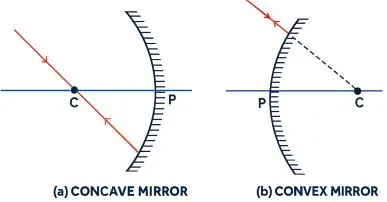
State the direction of incident ray which after reflection from a spherical mirror gets reflected along its own path. Give a reason.
Answer:
An incident ray passing through the centre of curvature (C) of a spherical mirror gets reflected along its own path.
Reason: At the centre of curvature, the ray strikes the mirror normally (perpendicular to the surface), so the angle of incidence is 0°. Hence, it retraces its path after reflection.
Question 17
How is the focal length of a spherical mirror related to its radius of curvature?
Answer:
The focal length of a spherical mirror is half of its radius of curvature.
Focal length \(=\frac{1}{2}\times\) Radius of curvature
Question 18
Name the mirror which always forms an erect and virtual image. What is the size of the image as compared to that of the object?
Answer:
Convex mirror always forms an erect and virtual image. The size of the image is always smaller than that of the object.
Question 19
Name the mirror which forms an erect, virtual and enlarged image of an object. What is the position of object relative to the mirror?
Answer:
Concave mirror forms an erect, virtual and enlarged image of an object. The object should be placed between the pole (P) and the focus (F) of the concave mirror.
Question 20
What is a real image? Name the mirror which can be used to obtain the real image of an object. What should be the position of the object relative to the mirror?
Answer:
A real image is an image formed when the reflected rays actually meet at a point. It can be obtained on a screen.
Concave mirror is used to obtain the real image of an object.
Position of object: The object must be placed beyond the focus (F) of the concave mirror (i.e., between focus and infinity).
Question 21
State two uses of a concave mirror.
Answer:
The two uses of a concave mirror are:
(i) Concave mirrors are used as shaving mirrors to see a large image of the face.
(ii) Concave mirrors are used by dentists to see the large images of the teeth of patients.
Question 22
State two uses of a convex mirror.
Answer:
The two uses of a convex mirror are:
(i) It is used as a rear view mirror.
(ii) Used in shops as security mirror.
Question 23
Name the kind of mirror used to obtain:
(a) a real and enlarged image,
(b) a virtual and enlarged image,
(c) a real and diminished image, and
(d) a virtual and diminished image.
Answer:
(a) A real and enlarged image: concave mirror (object between C and F gives real & enlarged).
(b) A virtual and enlarged image: concave mirror (object between P and F).
(c) A real and diminished image: concave mirror (object beyond C gives real and diminished).
(d) A virtual and diminished image: convex mirror (always virtual, erect and diminished).
(C) Long Answer Type Questions
Question 1
Describe an experiment to show that a light ray bends when it passes from one transparent medium into another transparent medium.
Answer:
Aim:
To show that a light ray bends when it passes from one transparent medium into another (refraction of light).
Materials Required:
- A glass tumbler (or beaker)
- Water
- A pencil (or a straight stick)
Procedure:
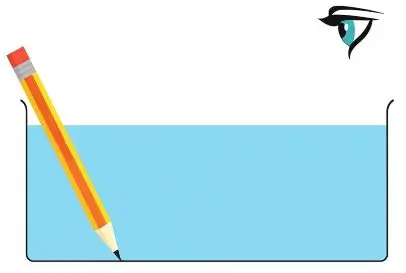
- Take an empty glass tumbler and place a pencil in it.
- Observe the pencil from the side of the tumbler — it looks straight.
- Now, slowly pour water into the tumbler while the pencil remains inside.
- Look at the pencil again from the side of the glass.
Observation:
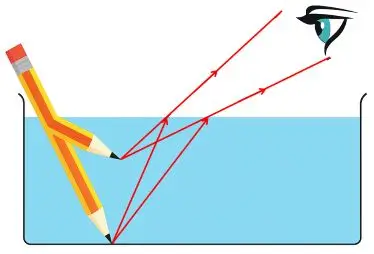
The pencil now appears bent or broken at the surface of the water. The part of the pencil inside the water looks displaced from the part above the water.
Conclusion:
The pencil appears bent because light rays coming from the pencil inside the water bend when they pass from water (a denser medium) into air (a rarer medium) before reaching the eye.
This bending of light at the boundary between two transparent media is called refraction of light.
Question 2
Draw a ray diagram to show that the depth of a vessel containing water when seen from above appears to be less than its real depth.
Answer:
The ray diagram showing the apparent depth of a vessel full of water is given below:
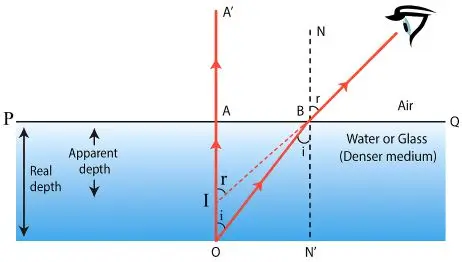
- AO — Real depth
- AI — Apparent depth
Question 3
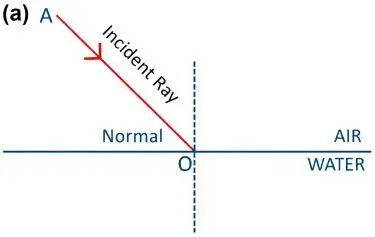
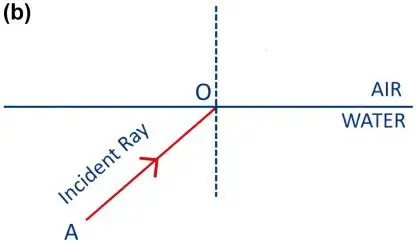
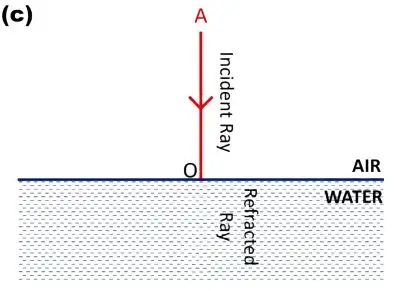
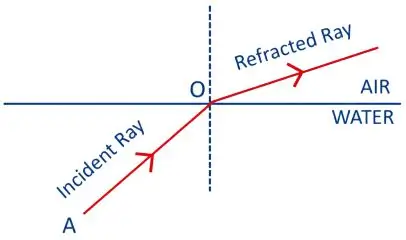
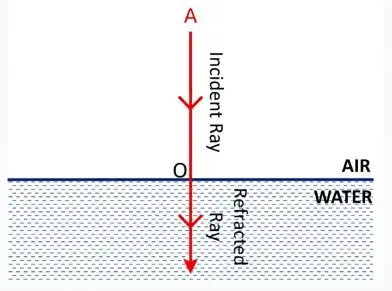
The diagram given below shows a ray of light AO falling on a surface separating two media. Draw the refracted ray in each, case.
Answer:
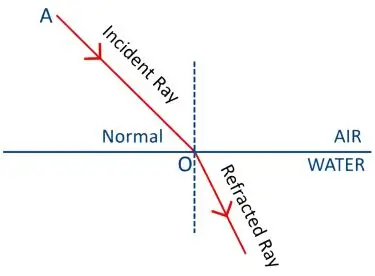
(a) When light ray AO passes from air (rarer medium) to water (denser medium), it bends towards the normal as shown below.
(b) When light ray AO travels from water (denser medium) to air (rarer medium), it bends away from the normal as shown in the diagram below.
(c) When light ray AO is incident normally to the surface, it passes undeviated as shown in the figure below.
Question 4
Draw a diagram showing the refraction of a light ray from water to glass. Label on it the incident ray, the angle of incidence (i), and the angle of refraction (r).
Answer:
Below figure shows the refraction of a light ray from water to glass:
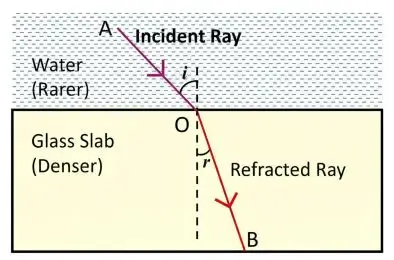
- AO — incident ray
- ∠i — angle of incidence
- ∠r — angle of refraction
Question 5
The diagram below shows a ray of light AO falling on a rectangular glass slab PQRS. Complete the diagram till the ray of light emerges out of the slab. Label on the diagram the incident ray, the refracted ray and the emergent ray.
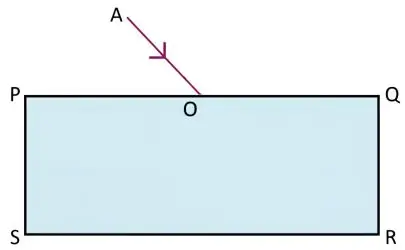
Answer:
The completed diagram showing the ray of light till it emerges out of the slab is given below :
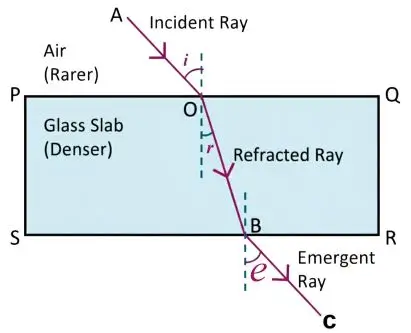
- AO — incident ray
- OB — refracted ray
- BC — emergent ray
Question 6
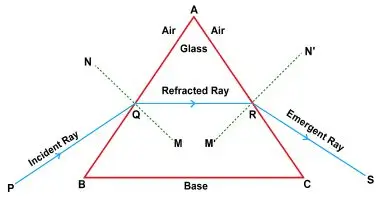
What is a prism? Draw a ray diagram to show the refraction of a light ray through a prism.
Answer:
A transparent refracting medium which is bounded by five plane surfaces and having a triangular cross section is known as prism.

The refraction of a light ray through a prism is shown below.
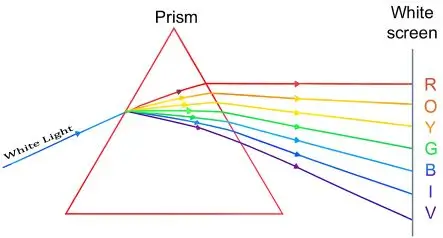
Question 7
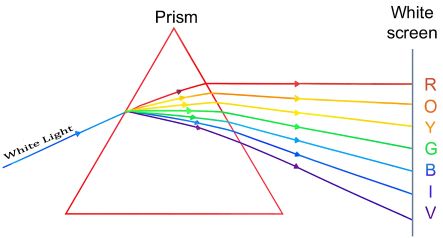
A ray of white light falls on a prism. Draw a ray diagram to show that the prism disperses the white light.
Answer:
Dispersion of a white light into its constituent colours by a prism is shown in the below figure.
Question 8
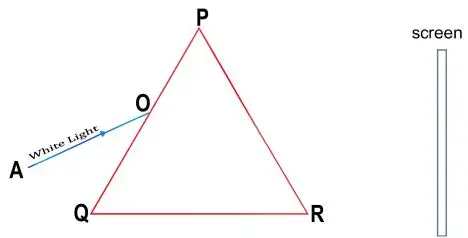
In below figure, AO is the ray of white light falling on a prism PQR. Complete the diagram till the light emerges out from the prism and falls on the screen.
Answer:
White light splits up into seven constituent colours after passing through a prism. These seven colours VIBGYOR arranged from bottom to top are seen on the screen.
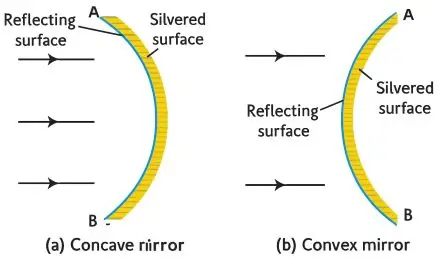
Question 9
State the two kinds of spherical mirrors and distinguish them with the aid of proper diagrams.
Answer:
The two kinds of spherical mirrors are:
(i) Concave mirror
(ii) Convex mirror
Distinction between Concave and Convex Mirrors
| Concave Mirror | Convex Mirror |
| The reflecting surface is curved inward, like the inside of a spoon. | The reflecting surface is curved outward, like the back of a spoon. |
| Converging mirror – it brings parallel rays of light to a focus. | Diverging mirror – it spreads parallel rays of light outward. |
| Can form real or virtual images, depending on the position of the object. | Always forms a virtual, erect, and diminished image. |
| Used in shaving mirrors, headlights, solar furnaces, etc. | Used as rear-view mirrors in vehicles and security mirrors. |
Figure of concave and convex mirror is shown below:
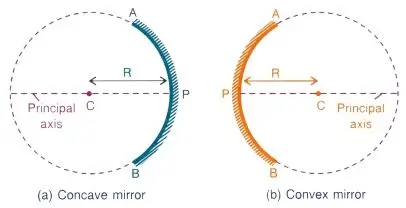
Question 10
Explain the following terms:
(a) Pole
(b) Centre of curvature
(c) Radius of curvature
(d) Principal axis
Show them on separate diagrams for each of the concave and convex mirrors.
Answer:
(a) Pole : The geometric centre of the spherical surface of the mirror is called the pole of the mirror. It is represented by the symbol P.
(b) Centre of curvature : The centre of curvature of a mirror is the centre of the sphere of which the mirror is a part. It is represented by the symbol C.
(c) Radius of curvature : The radius of curvature of a mirror is the radius of the sphere of which the mirror is a part. It is represented by symbol R.
(d) Principal axis : It is a straight line joining the pole of the mirror to its centre of curvature.
Question 11
What do you understand by the focus and focal length of a spherical mirror? Show them on separate diagrams for each of a concave mirror and a convex mirror.
Answer:
The focus (F) of a concave mirror is the point on its principal axis where light rays that fall parallel to the axis converge or meet after being reflected from the mirror.
In the case of a convex mirror, the focus (F) is the point on the principal axis from which the light rays seem to diverge or appear to come after reflection.
The distance between the focus and the pole of the mirror is known as the focal length of the mirror.
Question 12
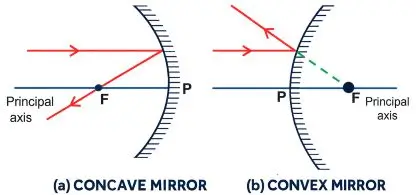
Draw suitable diagrams to illustrate how a beam of light incident parallel to the principal axis is reflected by:
(a) a concave mirror and
(b) a convex mirror.
Answer:
(a) A beam of light incident parallel to the principal axis of a concave mirror, after reflection meets at a point called focus of the mirror.

(b) A beam of light incident parallel to the principal axis of a convex mirror, after reflection appears to meet at a point called focus of the convex mirror.

Question 13
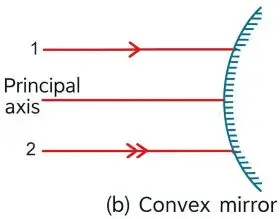
The diagrams given below show two parallel rays 1 and 2 incident on:
(a) a concave mirror,
(b) a convex mirror.
Draw the reflected rays and mark the focus by the symbol F.
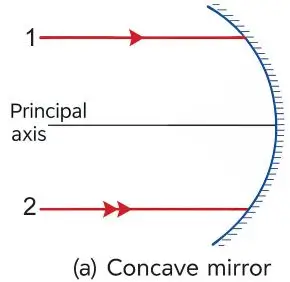
Answer:
The completed diagrams with focus marked are shown below :
- C — Centre of curvature,
- F — Focus,
- P — Pole
Question 14
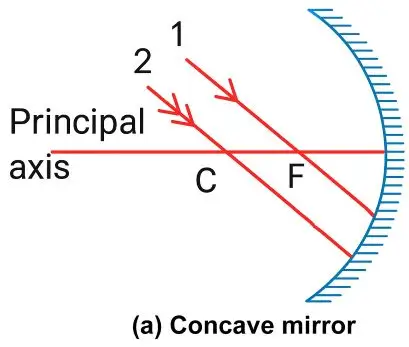
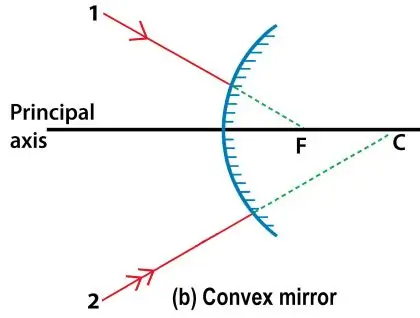
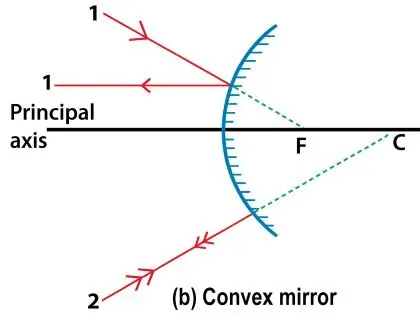
Complete the following diagrams given below by drawing the reflected rays for the incident rays 1 and 2 if F is the focus and C is the centre of curvature.
Answer:
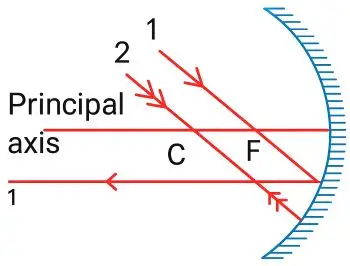
(a) Concave mirror:
- Ray 1: A ray of light passing through the focus (F) of a concave mirror is reflected parallel to the principal axis.
- Ray 2: A ray of light passing through the centre of curvature (C) of a concave mirror is reflected back along the same path.
(b) Convex mirror:
- Ray 1: A ray of light that appears to pass through the focus (F) of a convex mirror is reflected parallel to the principal axis.
- Ray 2: A ray of light that is directed toward the centre of curvature (C) of a convex mirror is reflected back along the same path.
Question 15
Which are the two convenient rays that are chosen to construct the image formed by a spherical mirror for a given object? Explain with the help of suitable ray diagrams.
Answer:
Two convenient rays for constructing spherical mirror image formation are:
1. Ray parallel to the principal axis:
A ray of light incident parallel to the principal axis is reflected through the focus (F) in a concave mirror, or it appears to come from the focus (F) in a convex mirror after reflection.
2. Ray passing through the centre of curvature (C):
A ray passing through the centre of curvature reflected back along the same path.
Because the angle of incidence is zero, the angle of reflection is also zero.
Question 16
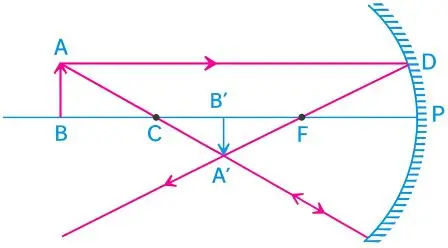
Draw a ray diagram to show the formation of the image of an object placed beyond the centre of curvature of a concave mirror. State the position, size and nature of the image.
Answer:
- Position of image : between the centre of curvature (C) and focus (F)
- Nature of image : Real and inverted
- Size of image : smaller than object (or, Diminished)
Question 17
Draw a ray diagram to show the formation of the image of an object placed at the centre of curvature of a concave mirror. State the position, size and nature of the image.
Answer:
- Position of image : At centre of curvature, ‘C’
- Nature of image : Real and inverted
- Size of image : Same size as that of object

Question 18
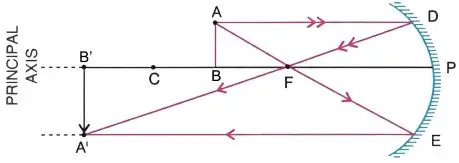
Draw a ray diagram to show the formation of image of an object placed between the focus and centre of curvature of a concave mirror. State the position, size and nature of the image.
Answer:
- Position of image : Beyond centre of curvature (C)
- Nature of image : Real and inverted
- Size of image : Bigger than object (or, Enlarged)
Question 19
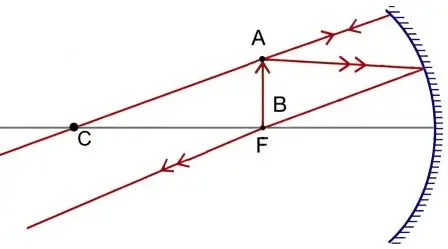
Draw a ray diagram to show the formation of image of an object placed between the pole and focus of a concave mirror. State the position, size and nature of the image.
Answer:
- Position of the image : Behind the mirror
- Size of the image : Larger than the object (magnified)
- Nature of the image : Virtual and erect
Question 20
Draw a ray diagram to show the formation of the image of an object placed on the principal axis of a convex mirror. State the position, size and nature of the image. What happens to the image as the object is moved away from the mirror?
Answer:
- Position of the image : Behind the mirror, between the pole (P) and the focus (F)
- Size of the image : Smaller (diminished) than the object.
- Nature of the image : Virtual and erect.

As the object moves farther from a convex mirror, the image remains virtual and erect, but becomes smaller in size and forms closer to the focus (F) behind the mirror.
Difference between the two images:
| Mirror Type | Concave mirror | Convex mirror |
| Nature of Image | Virtual, erect | Virtual, erect |
| Size of Image | Magnified | Diminished |
| Position of Image | Behind the mirror | Behind the mirror (near focus) |
Question 22
How can a concave mirror be used to obtain a virtual image of an object? Draw a diagram to illustrate your answer.
Answer:
The object should be placed between the pole and focus of the concave mirror to obtain a virtual image of the object.

Question 23
A driver uses a convex mirror as a rear view mirror. Explain the reason with the help of a ray diagram.
Answer:
A driver uses a convex mirror as a rear-view mirror because it gives a wider field of view than a plane mirror. This means the driver can see more of the road and vehicles behind. Although the image formed by a convex mirror is smaller and virtual, it is upright and helps the driver clearly observe traffic coming from behind — making driving safer.

(D) Think and Answer
Question 1(a)
Explain the following:
A coin placed at the bottom of a vessel appears to be raised when water is poured in the vessel.
Answer:
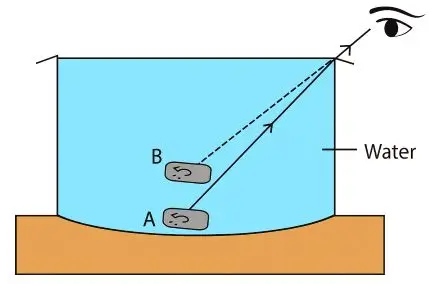
The coin at the bottom of a vessel appears raised when water is poured in because of refraction of light. Light rays from the coin bend as they pass from water to air, making them appear to come from a point higher than the coin’s actual position. Hence, the coin looks closer to the surface (raised) than it really is.
Question 1(b)
Explain the following:
A straight stick partly dipped in water obliquely, appears to be bent at the surface of water.
Answer:
When a pencil is partly dipped in water at an angle, the light rays coming from the portion under water pass from water (a denser medium) into air (a rarer medium). As they do so, they bend away from the normal due to refraction of light. Because of this bending, the submerged part of the pencil appears to be raised and does not line up with the part above the water. This makes the pencil look bent or broken at the water’s surface, even though it is actually straight.
Question 1(c)
Explain the following:
The sun is seen before the sunrise and after the sunset.
Answer:
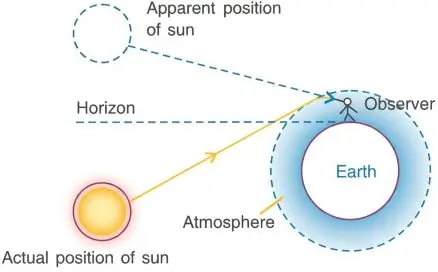
We can see the Sun a little before it actually rises and even after it has set because of a phenomenon called atmospheric refraction. When sunlight passes through the Earth’s atmosphere, it bends due to the varying density of air layers. This bending makes the light from the Sun reach our eyes even when the Sun itself is just below the horizon.
So, the Sun appears slightly higher than its true position, letting us see it for a few minutes before sunrise and after sunset.
Question 2
What is a mirage? Give a reason for its formation.
Answer:
A mirage is an optical illusion seen mostly on hot days, when it appears as if there is water on the road at a distance.

Reason:
A mirage forms due to the refraction of light through layers of air having different temperatures and densities. On a hot day, the air near the ground is hotter and less dense than the air above it. Light from the sky bends (refracts) while passing through these layers, and our eyes see a reflected image of the sky on the ground, which looks like water.
Question 3
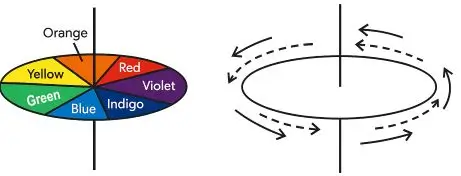
You are given a disc divided into seven sectors with colours violet, indigo, blue, green, yellow, orange and red in them. What would be its colour when it is rotated rapidly?
Answer:
When the disc with violet, indigo, blue, green, yellow, orange, and red sections is spun quickly, it looks white.
This happens because all the seven colours blend together so fast that our eyes can’t see them separately — they mix to form white light.
Question 4
State the kind of mirror used:
(a) by a dentist, and
(b) as a street light reflector.
Answer:
(a) By a dentist – Concave mirror (to get a magnified, upright image of the teeth)
(b) As a street light reflector – Convex mirror (to spread light over a wide area)
Download ICSE Class 8 Physics Chapter 5 Light Energy Selina Solutions
Students looking for accurate and easy solutions can use these notes for daily study. Practice regularly and revise diagrams for better marks.
Why Study Light Energy Carefully?
Light is a basic concept in Physics and many higher classes topics depend on it. If students understand reflection, shadows, and eclipses properly in Class 8, future chapters become easier.
Conclusion
ICSE Class 8 Physics Chapter 5 Light Energy Selina Solutions are the best study material for students who want to score high marks in Physics. Learn all concepts clearly, solve textbook questions, and strengthen your preparation with easy explanations.
ICSE Class 8 Physics Selina Solutions
The Selina Concise Physics Class 8 book includes the following chapters:
Official Website:
Students can visit the official CISCE website for more details and updates.