Introduction
Students searching for ICSE Class 8 Physics Chapter 3 Force and Pressure Selina Solutions can find complete and easy explanations here. Chapter 3 is an important part of the ICSE Class 8 Physics syllabus because it teaches the basic concepts of force, pressure, and their uses in daily life.
With the help of Selina Solutions, students can understand textbook questions easily, prepare for exams, and improve their problem-solving skills.
Study Support by Rohit Academy
Rohit Academy offers expert-curated ICSE Class 8 Physics Study Materials including ICSE Force and Pressure Chapter Notes, diagrams, and key formulas for better understanding.
You can also visit:
| ☛ ICSE Class 8 Physics Chapter 3: Force and Pressure Notes |
| ☛ ICSE Class 8 Physics |
| ☛ ICSE Class 8 Chemistry |
| ☛ ICSE Class 8 Mathematics |
| ☛ ICSE Class 8 Biology |
(A) Multiple Choice Type
Question 1
Choose the correct answer from the multiple choices given below.
Question 1(a)
S.I. unit of moment of force is:
(i) N (ii) N cm
(iii) kgf m (iv) N m
Answer:
(iv) N m
Explanation:
Moment of force = Force × Perpendicular distance from pivot
S.I. unit = Newton × metre = N m
Question 1(b)
To obtain a given moment of force for turning a body, the force needed can be decreased by:
(i) applying the force at the pivoted point.
(ii) applying the force very close to the pivoted point.
(iii) applying the force farthest from the pivoted point.
(iv) none of the above.
Answer:
(iii) applying the force farthest from the pivoted point
Explanation:
Moment = Force × Distance from pivot
If distance increases, less force is needed.
Question 1(c)
The unit of thrust is:
(i) kgf (ii) kg
(iii) g (iv) ms–1
Answer:
(i) kgf
Explanation:
Thrust is a force acting normally on a surface.
Unit of force can be kgf or Newton.
Question 1(d)
The unit of pressure is:
(i) N x m (ii) kgf
(iii) N m–2 (iv) kgf m2
Answer:
(iii) N m–2
Explanation:
Pressure = Force / Area
Unit = Newton / metre2 = N m–2 or Pascal (Pa)
Question 1(e)
The pressure and thrust are related as:
(i) Pressure = Thrust
(ii) Pressure = Thrust x Area
(iii) Pressure = Thrust/Area
(iv) Pressure = Area/Thrust
Answer:
(iii) Pressure = Thrust / Area
Explanation:
Pressure is thrust acting per unit area.
Question 1(f)
A body weighing 5 kgf, placed on a surface of area 0.1 m2, exerts a thrust on the surface equal to:
(i) 50 kgf (ii) 5 kgf
(iii) 50 kgf m–2 (iv) 5 kgf m–2
Answer:
(ii) 5 kgf
Explanation:
Thrust = Weight of body acting downward
So thrust = 5 kgf
Question 1(g)
The feet of lizards act like:
(i) moving pads (ii) drilling pads
(iii) suction pads (iv) none of the above
Answer:
(iii) suction pads
Explanation:
Lizards can climb walls because their feet have pads that help them stick due to pressure difference.
Question 1(h)
Pressure exerted by a liquid is due to its:
(i) weight (ii) mass
(iii) volume (iv) area
Answer:
(i) weight
Explanation:
Liquid pressure is caused by the weight of liquid above that point.
Question 1(i)
Pressure inside a liquid increases with:
(i) increase in depth. (ii) decrease in depth.
(iii) decrease in density. (iv) none of the above.
Answer:
(i) increase in depth
Explanation:
More depth means more liquid above, so greater pressure.
Question 1(j)
The atmospheric pressure at sea level is nearly:
(i) 10 Pa (ii) 100,000 Pa
(iii) 100 Pa (iv) 10,000 Pa
Answer:
(ii) 100,000 Pa
Explanation:
At sea level, the atmospheric pressure is 100,000 Pa which is 76 cm of mercury column.
Question 1(k)
Nose bleeding may occur at a high altitude because:
(i) the atmospheric pressure decreases.
(ii) the oxygen content of atmosphere decreases.
(iii) the atmospheric pressure increases.
(iv) there are strong air currents at the high altitude.
Answer:
(i) the atmospheric pressure decreases
Explanation:
At high altitude, outside air pressure becomes low. Blood pressure inside nose capillaries may become greater, causing them to burst and bleed.
Assertion Reason Type
Question 2
The following questions are Assertion-Reason based questions. Choose the answer based on the codes given below.
Question 2(a)
Assertion (A) : A force when applied on a body changes its mass.
Reason (R) : Force is the cause which changes the size or shape of the body.
(i) Both A and R are true and R is the correct explanation of A
(ii) Both A and R are true and R is not the correct explanation of A
(iii) Assertion is true but reason is false
(iv) Assertion is false but reason is true
Answer:
(iv) Assertion is false but reason is true
Explanation:
- Force cannot change the mass of a body. Mass remains constant.
- Force can change the shape, size, speed, or direction of a body.
So, Assertion is false, but Reason is true.
Question 2(b)
Assertion (A) : In heavy container trucks, more number of tyres are used to reduce the pressure on the ground.
Reason (R) : Larger the surface area, less is the pressure for the same thrust.
(i) Both A and R are true and R is the correct explanation of A
(ii) Both A and R are true and R is not the correct explanation of A
(iii) Assertion is true but reason is false
(iv) Assertion is false but reason is true
Answer:
(i) Both A and R are true and R is the correct explanation of A
Explanation:
Pressure = Thrust / Area
- Heavy trucks exert large thrust due to weight.
- More tyres increase contact area with the ground.
- Increased area reduces pressure.
Therefore both statements are true, and Reason correctly explains Assertion.
Question 2(c)
Assertion (A) : Camels can walk easily in deserts without their feet sinking in sand.
Reason (R) : Camels have large broad feet with a wide base, thus increasing the pressure exerted on sand.
(i) Both A and R are true and R is the correct explanation of A
(ii) Both A and R are true and R is not the correct explanation of A
(iii) Assertion is true but reason is false
(iv) Assertion is false but reason is true
Answer:
(iii) Assertion is true but reason is false
Explanation:
A camel has broad feet that spread its weight over a larger area. Since pressure is inversely proportional to area, the pressure exerted on the sand becomes less. This prevents the camel’s feet from sinking into the sand. Therefore, the Assertion is correct. The Reason is false because broad feet reduce the pressure on the sand, not increase it.
Fill in the blanks
Question 3
Fill in the blanks:
(a) 1 kgf = …………… N (nearly).
(b) Moment of force = …………… x distance of force from the point of turning.
(c) In a door, handle is provided …………… from the hinges.
(d) The unit of thrust is …………… .
(e) Thrust is the …………… force acting on a surface.
(f) Pressure is the thrust acting on a surface of …………… area.
(g) The unit of pressure is …………… .
(h) Pressure is reduced if …………… increases.
(i) Pressure in a liquid …………… with the depth.
(j) The atmospheric pressure on earth surface is nearly …………… .
Answer:
(a) 1 kgf = 10 N (nearly).
(b) Moment of force = force x distance of force from the point of turning.
(c) In a door, handle is provided farthest from the hinges.
(d) The unit of thrust is Newton.
(e) Thrust is the normal force acting on a surface.
(f) Pressure is the thrust acting on a surface of unit area.
(g) The unit of pressure is Pascal.
(h) Pressure is reduced if surface area increases.
(i) Pressure in a liquid increases with the depth.
(j) The atmospheric pressure on earth surface is nearly 105 Pa.
True or False
Question 4
Write true or false for each statement:
(a) The S.I. unit of force is kgf.
(b) A force always produces both the linear and turning motions.
(c) Moment of force = force x perpendicular distance of force from the pivoted point.
(d) Less force is needed when applied at a farther distance from the pivoted point.
(e) For a given thrust, pressure is more on a surface of large area.
(f) The pressure on a surface increases with an increase in the thrust on the surface.
(g) A man exerts same pressure on the ground whether he is standing or he is lying.
(h) It is easier to hammer a blunt nail into a piece of wood than a sharply pointed nail.
(i) The S.I. unit of pressure is pascal.
(j) Water in a lake exerts pressure only at its bottom.
(k) A liquid exerts pressure in all directions.
(l) Gases exert pressure in all directions.
(m) The atmospheric pressure is nearly 105 Pa.
(n) Higher we go, greater is the air pressure.
Answer:
(a) False
Correct Statement : The S.I. unit of force is newton.
(b) False
Correct Statement : A force can produce either linear motion or turning motion.
(c) True
(d) True
(e) False
Correct Statement : Pressure is defined as thrust per unit area. Hence, for a given thrust, pressure is less on a surface of large area.
(f) True
(g) False
Correct Statement : A man exerts more pressure while standing than lying on the ground as area of contact is less in case of standing as compared to lying on the ground.
(h) False
Correct Statement : In case of blunt nail, the thrust exerted on hammering acts on a larger area so less pressure acts on the piece of wood making it difficult to hammer the nail.
(i) True
(j) False
Correct Statement : Water in a lake exerts pressure in all directions.
(k) True
(l) True
(m) True
(n) False
Correct Statement : Higher we go, lesser is the air pressure.
Match the Columns
Question 5
Match the following:
| Column A | Column B |
| (a) Camel | (i) broad and deep foundation |
| (b) Truck | (ii) broad feet |
| (c) Knife | (iii) six or eight tyres |
| (d) High building | (iv) sharp cutting edge |
| (e) Thrust | (v) atm |
| (f) Moment of force | (vi) N |
| (g) Atmospheric pressure | (vii) N m |
Answer:
| Column A | Column B |
| (a) Camel | (ii) broad feet |
| (b) Truck | (iii) six or eight tyres |
| (c) Knife | (iv) sharp cutting edge |
| (d) High building | (i) broad and deep foundation |
| (e) Thrust | (vi) N |
| (f) Moment of force | (vii) N m |
| (g) Atmospheric pressure | (v) atm |
(B) Short Answer Type Questions
Question 1
Define force. State its S.I. unit.
Answer:
Force is a push or pull acting on a body which can change or tends to change its state of rest or motion, shape, or size.
The S.I. unit of force is newton (N).
Question 2
State two effects of a force when applied on a body.
Answer:
Two effects of a force are:
- It can change the state of rest or motion of a body.
- It can change the shape or size of a body.
Question 3
How does the effect of a force differ when it is applied on
(a) a rigid body
(b) a non-rigid body?
Answer:
(a) On a rigid body:
A force can change only the state of rest or motion of the body, but not its shape or size.
(b) On a non-rigid body:
A force can change the shape or size of the body, along with changing its state of motion.
Question 4
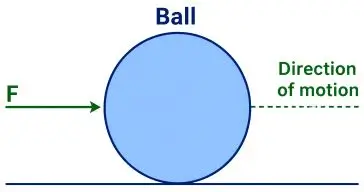
State the effect of force F in each of the following diagrams (a) and (b).

Answer:
(a) In figure (a), when a force F is applied on the ball, it starts moving in a straight line in the direction of the force and continues to move in that direction. This is called linear motion.
(b) In figure (b), when a force F is applied on the wheel pivoted at a point, it turns the wheel in the anticlockwise direction about its axis of rotation, producing turning motion.
Question 5
Define the term moment of force.
Answer:
The moment of force is equal to the product of the magnitude of the force and the perpendicular distance of the force from the pivoted point.
Question 6
State the S.I. unit of moment of force.
Answer:
The S.I. unit of moment of force is newton metre (N m).
Question 7
State two factors which affect moment of force.
Answer:
The moment of force depends on:
- Magnitude of the force applied
- Perpendicular distance of the force from the pivoted point
Question 8
Write the expression for the moment of force about a given axis of rotation.
Answer:
Moment of force = Force × Perpendicular distance from the axis of rotation
Question 9
State one way to decrease the moment of a given force about a given axis of rotation.
Answer:
Decrease the perpendicular distance of the force from the axis of rotation.
Question 10
State one way to obtain greater moment of a given force about a given axis of rotation.
Answer:
Increase the perpendicular distance of the force from the axis of rotation.
Question 11
What do you mean by the clockwise and anti-clockwise moment of force?
Answer:
If a force tends to rotate a body in the clockwise direction, it produces a clockwise moment.
If it tends to rotate a body in the anti-clockwise direction, it produces an anti-clockwise moment.
Question 12
What is thrust?
Answer:
The force acting normally (perpendicularly) on a surface is called thrust.
Question 13
State the unit of thrust.
Answer:
The unit of thrust is newton (N).
Question 14
On what factors does the effect of thrust on a surface depend?
Answer:
The effect of thrust depends on:
- Magnitude of thrust
- Area of contact of the surface
Question 15
Define the term pressure and state its unit.
Answer:
Pressure is defined as the thrust acting per unit area.
Pressure \(=\frac{\operatorname{Thrust}}{Area}\)
Its S.I. unit is pascal (Pa) or N m–2.
Question 16
How is thrust related to pressure?
Answer:
Pressure is equal to thrust divided by area.
Pressure \(=\frac{\operatorname{Thrust}}{Area}\)
Question 17
Name two factors on which the pressure on a surface depends.
Answer:
Pressure depends on:
- Thrust applied
- Area of contact
Question 18
Why is the bottom part of the foundation of a building made wider?
Answer:
The bottom part is made wider to increase the area of contact and reduce pressure on the ground.
Question 19
It is easier to cut with a sharp knife than with a blunt one. Explain.
Answer:
A sharp knife has a smaller edge area, so it produces greater pressure for the same force and cuts easily.
Question 20
A gum bottle rests on its base. If it is placed upside down,
(i) How does the thrust change?
(ii) How does the pressure change?
Answer:
(i) The thrust remains the same.
(ii) The pressure increases because the area of contact decreases.
Question 21
State two factors on which the pressure at a point in a liquid depends.
Answer:
Pressure at a point in a liquid depends on:
- Height of the liquid column
- Density of the liquid
Question 22
What do you mean by atmospheric pressure?
Answer:
The thrust on unit area of the earth surface due to the column of air is called the atmospheric pressure.
Question 23
We do not feel uneasy even under the enormous atmospheric pressure. Give a reason.
Answer:
We do not feel uneasy because the atmospheric pressure is balanced by the pressure of fluids inside our body.
Question 24
Write the numerical value of the atmospheric pressure on the earth surface in pascal.
Answer:
Atmospheric pressure at the earth’s surface is 1.013 × 10⁵ Pa.
(C) Long Answer Type Questions
Question 1
Explain the following:
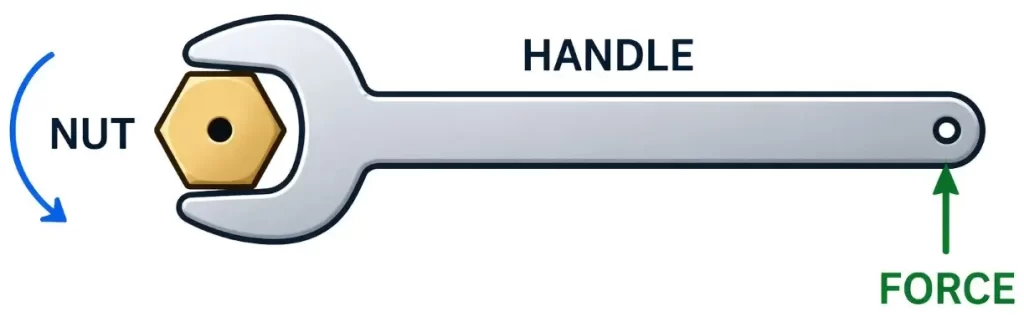
(a) The spanner (or wrench) has a long handle.
(b) The steering wheel of a vehicle is of large diameter.
(c) The hand flour grinder is provided with a handle near the rim.
(d) It is easier to open the door by pushing it at its free end.
(e) A potter turns his wheel by applying a force through the stick near the rim of wheel.
Answer:
(a) A long handle increases the distance from the pivot (nut), so a small force can produce a greater turning effect. Hence, it becomes easier to tighten or loosen the nut.
(b) A large diameter increases the radius of the wheel, so less force is needed to turn it easily.
(c) The handle is fixed near the rim to increase the distance from the axis of rotation, producing a larger turning effect with less effort.
(d) The free end is farthest from the hinges (pivot), so applying force there produces maximum turning effect and the door opens easily.
(e) Applying force near the rim increases the distance from the axis, giving a greater turning effect and making the wheel rotate easily.
Question 2
Explain the following:
(a) Wooden sleepers are used below the rails.
(b) A tall building has wide foundations.
Answer:
(a) Wooden sleepers increase the area of contact between the rails and the ground. This reduces pressure on the ground and prevents the rails from sinking.
(b) Wide foundations provide a larger area of contact with the ground. This reduces the pressure exerted by the building and gives better stability.
Question 3
Describe an experiment to show that a liquid exerts pressure at the bottom of the container in which it is kept.
Answer:
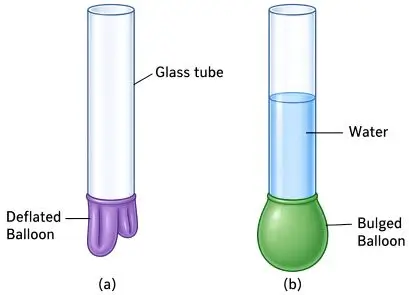
Take a glass tube and tie a balloon tightly over its lower end. Hold the tube vertically as shown in the figure. Now pour some water into the tube.
Observation:
After some time, the balloon at the lower end bulges outward.
Conclusion:
The balloon bulges because the column of water exerts pressure on the bottom of the tube. The force acting on the balloon is equal to the weight of the water column, called thrust.
Pressure \(=\ \frac{\operatorname{Thrust}}{Area}=\frac{W}{A}\)
where W is the weight of the water column and A is the area of the balloon.
Hence, a liquid exerts pressure at the bottom of the container in which it is kept.
Question 4
Describe a suitable experiment to demonstrate that a liquid exerts pressure sideways also.
Answer:
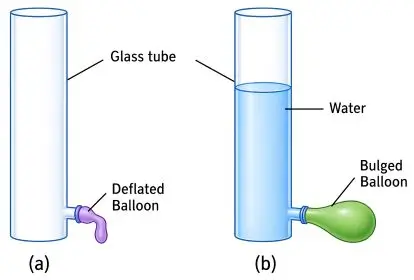
- Take a glass tube closed at one end and having a small opening on its side near the bottom.
- Tie a deflated balloon tightly over the side opening.
- Hold the tube vertically upright.
- Pour some water into the tube.
Observation:
After some time, the balloon bulges outward.
Conclusion:
The balloon bulges because the water exerts pressure on the sides of the tube. Hence, a liquid exerts pressure sideways also.
Question 5
Describe an experiment to show that the liquid pressure at a point increases with the increase in height of the liquid column above that point.
Answer:
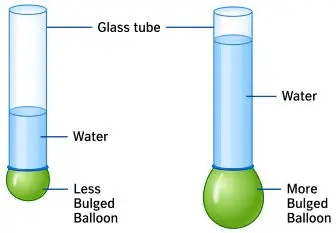
- Take a glass tube open at both ends and hold it vertically.
- Tie a balloon tightly over its lower end.
- Pour some water into the tube. The balloon starts bulging outward.
- Add more water into the tube. The balloon bulges out more.
Observation:
The balloon bulges more when more water is added to the tube.
Conclusion:
As the height of the water column increases, the pressure exerted on the balloon also increases. Hence, liquid pressure at a point increases with the increase in height of the liquid column above that point.
Question 6
Describe a simple experiment to show that at a given depth, a liquid exerts same pressure in all directions.
Answer:

- Take a balloon and fill it with water.
- Tie the mouth of the balloon tightly.
- Make small holes in the balloon by inserting pins at several places in different directions.
Observation:
Water comes out through all the holes in every direction.
Conclusion:
This shows that at a given depth, a liquid exerts the same pressure in all directions.
Question 7
Describe an experiment to show that liquid pressure depends on the density of liquid.
Answer:
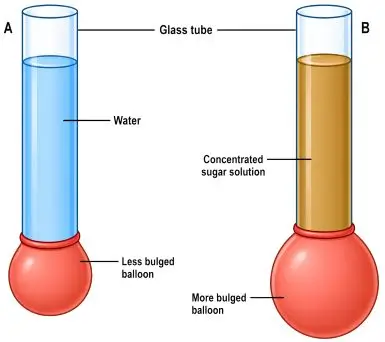
- Take two identical glass tubes open at both ends and mark them A and B.
- Hold both tubes vertically and tie balloons tightly over their lower ends.
- Pour water into tube A.
- Pour concentrated sugar solution into tube B so that the height of the liquid in both tubes is the same.
Observation:
The balloon attached to tube B bulges out more than the balloon attached to tube A.
Conclusion:
Since the concentrated sugar solution is denser than water, it exerts greater pressure. Hence, liquid pressure depends on the density of the liquid.
Question 8
Describe a simple experiment to illustrate that air exerts pressure.
Answer:

- Take a glass filled with water up to the brim and place a postcard over its mouth.
- Press the postcard with one hand and carefully invert the glass upside down.
- Gently remove the hand supporting the postcard.
Observation:
The postcard does not fall and the water remains in the glass.
Conclusion:
The postcard remains in position because atmospheric pressure acts upward on it from outside the glass and balances the downward pressure due to the water. Hence, air exerts pressure.
Question 9
Describe the crushing tin can experiment. What do you conclude from this experiment?
Answer:
Crushing tin can experiment:
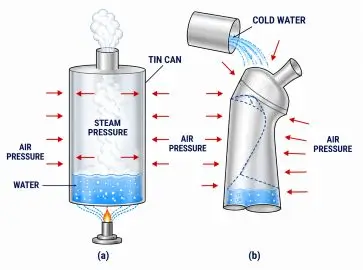
- Take an empty tin can containing a small quantity of water.
- Heat the can until the water boils and steam fills the can.
- Remove the can from the flame and quickly close its mouth tightly.
- Pour cold water over the can or place it in cold water.
Observation:
The tin can gets crushed suddenly.
Conclusion:
When the steam inside the can cools, it condenses into water and the pressure inside the can decreases. The atmospheric pressure outside the can becomes greater than the pressure inside and crushes the can. This shows that air exerts pressure.
Question 10
Give reasons for the following:
(a) A balloon collapses when air is removed from it.
(b) Water does not run out of a dropper unless its rubber bulb is pressed.
(c) Two holes are made in a sealed oil tin to take out oil from it.
Answer:
(a) When air is removed from the balloon, the pressure inside decreases. The atmospheric pressure outside becomes greater and presses the balloon inward, causing it to collapse.
(b) When the rubber bulb is not pressed, atmospheric pressure outside balances the pressure of water inside the dropper. Hence, water does not flow out. When the bulb is pressed, pressure inside increases and water comes out.
(c) One hole allows oil to flow out, while the other hole allows air to enter the tin. This maintains atmospheric pressure inside the tin and helps the oil to flow out smoothly.
Question 11
How does the atmospheric pressure change with altitude?
Answer:
Atmospheric pressure decreases with increase in altitude. Therefore, as we go higher, the atmospheric pressure becomes less.
(D) Think and Answer
Question 1
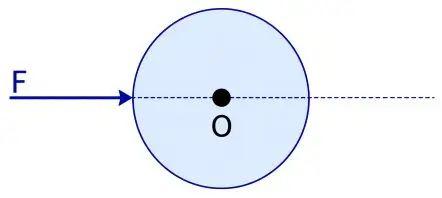
In figure below, a force F is applied in a direction passing through the pivoted point O of the body. Will the body rotate? Give reason to support your answer.
Answer:
No, the body will not rotate.
Reason: The line of action of the force passes through the pivoted point O. Therefore, the perpendicular distance between the pivot and the line of action of the force is zero.
Hence, the moment of force (torque) is:
Moment = Force × Perpendicular distance
= F × 0 = 0
Since the turning effect is zero, the body will not rotate.
Question 2
When does a man exert more pressure on the floor: while standing or while walking?
Answer:
A man exerts more pressure on the surface while walking than while standing because, during walking, only one foot is in contact with the floor, so the area of contact is smaller. While standing, both feet are in contact with the floor, providing a larger surface area. Since pressure is inversely proportional to surface area, the pressure exerted while walking is greater than that exerted while standing.
Question 3
Why do camels or elephants have broad feet?
Answer:
Camels and elephants have broad feet so that their weight is spread over a larger area. This reduces the pressure exerted on the ground.
- Camels: Broad feet prevent them from sinking into soft desert sand.
- Elephants: Broad feet help support their heavy body weight and prevent sinking into muddy or soft ground.
Question 4
A sharp pin works better than a blunt pin. Explain the reason.
Answer:
A sharp pin works better than a blunt pin because the tip of a sharp pin has a much smaller surface area of contact. Since pressure is inversely proportional to area, the same force produces greater pressure at the sharp tip. Therefore, it can pierce materials more easily than a blunt pin.
Question 5
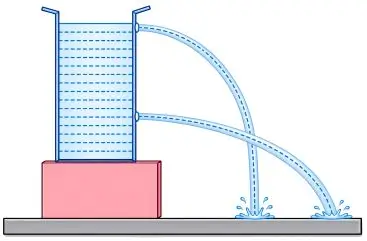
Which fact about liquid pressure does the diagram in figure below illustrate?
Answer:
The diagram illustrates that liquid pressure increases with depth.
Reason: Water coming out from the lower hole flows farther than water from the upper hole. This shows that pressure is greater at greater depth below the surface of the liquid.
Question 6
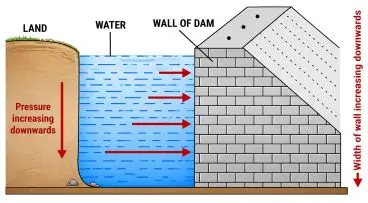
A dam has broader walls at the bottom than at the top. Give a reason.
Answer:
A dam has broader walls at the bottom than at the top because water pressure increases with depth. The lower part of the dam experiences greater pressure and force from the water, so thicker and stronger walls are needed at the bottom to withstand this pressure.
Question 7
Sea-divers wear specially designed swim-suit. Why?
Answer:
Sea-divers wear specially designed swim-suits because water pressure increases with depth. At great depths, the pressure of water is very high, so these suits protect the body from excessive pressure and help the divers move safely underwater.
(E) Numericals
Question 1
Find the moment of force of 20 N about an axis of rotation at a distance of 0.5 m from the force.
Solution:
Given,
Force, F = 20 N
Distance, d = 0.5 m
Moment of force = Force × Distance
= 20 × 0.5
= 10 N m
Therefore, the moment of force is 10 N m.
Question 2
The moment of a force of 25 N about a point is 2.5 N m. Find the perpendicular distance of force from that point.
Solution:
Given:
Force, F = 25 N
Moment of force = 2.5 N m
Perpendicular distance \(=\frac{Moment\ of\operatorname{force}}{Force}=\frac{2.5}{25}\ =\ 0.1\ m\)
Therefore, the perpendicular distance of the force from the point is 0.1 m.
Question 3
A spanner of length 10 cm is used to unscrew a nut by applying a minimum force of 5.0 N. Calculate the moment of force required.
Solution:
Given:
Force, F = 5.0 N
Length of spanner = 10 cm = 0.1 m
Moment of force = Force × Perpendicular distance
= 5.0 × 0.1
= 0.5 N m
Therefore, the moment of force required is 0.5 N m.
Question 4
A wheel of diameter 2 m can be rotated about an axis passing through its centre by a moment of force equal to 2.0 N m. What minimum force must be applied on its rim?
Solution:
Given:
Moment of force = 2.0 N m
Diameter of wheel = 2 m
Radius of wheel \(=\frac{Diameter}{2}=\frac{2}{2}=1\ m\)
Moment of force = Force × Radius
Force \(=\frac{Moment\ of\operatorname{force}}{Radius}=\frac{2.0}{1}=2\ N\)
Therefore, the minimum force required on the rim is 2 N.
Question 5
A normal force of 200 N acts on an area 0.02 m2. Find the pressure in pascal.
Solution:
Given:
Force, F = 200 N
Area, A = 0.02 m2
Pressure \(=\frac{\operatorname{Force}}{Area}=\frac{200}{0.02}\) = 10000 Pa
Therefore, the pressure is 10000 pascal.
Question 6
Find the thrust required to exert a pressure of 50,000 Pa on an area of 0.05 m2.
Solution:
Given:
Pressure, P = 50,000 Pa
Area, A = 0.05 m2
Thrust = Pressure × Area
= 50,000 × 0.05
= 2500 N
Therefore, the thrust required is 2500 N.
Question 7
Find the area of a body which experiences a pressure of 50,000 Pa by a thrust of 100 N.
Solution:
Given:
Pressure, P = 50,000 Pa
Thrust, F = 100 N
Area \(=\frac{\operatorname{Thrust}}{Pressure}=\frac{100}{50000}\)= 0.002 m2
Therefore, the area of the body is 0.002 m².
Question 8
Calculate the pressure in pascal exerted by a force of 300 N acting normally on an area of 30 cm2.
Solution:
Given:
Force, F = 300 N
Area = 30 cm2 = \(\frac{30}{10000}\) = 0.003 m2
Pressure \(=\frac{\operatorname{Force}}{Area}=\frac{300}{0.003}=\) 100000 Pa
Therefore, the pressure exerted is 100000 pascal.
Question 9
How much thrust will be required to exert a pressure of 20,000 Pa on an area of 1 cm2 ?
Solution:
Given:
Pressure, P = 20,000 Pa
Area = 1 cm2 \(=\frac{1}{10000}\) m2
Thrust = Pressure × Area
= 20,000 ×\(\frac{1}{10000}\)
= 2 N
Therefore, the thrust required is 2 N.
Question 10
The base of a container measures 15 cm x 20 cm. It is placed on a table top. If the weight of the container is 60 N, what is the pressure exerted by the container on the table top?
Solution:
Given:
Length = 15 cm = 0.15 m
Breadth = 20 cm = 0.20 m
Weight (Force) = 60 N
Area of base = Length × Breadth = 0.15 × 0.20 = 0.03 m2
Pressure \(=\frac{\operatorname{Force}}{Area}=\frac{60}{0.03}\) = 2000 Pa
Therefore, the pressure exerted by the container on the table top is 2000 pascal.
Question 11
Calculate the pressure exerted on a surface of 0.5 m2 by a thrust of 100 kgf.
Solution:
Given:
Thrust = 100 kgf = 100 × 10 = 1000 N
Area = 0.5 m2
Pressure \(=\frac{\operatorname{Thrust}}{Area}=\frac{1000}{0.5}\) = 2000 Pa
Therefore, the pressure exerted is 2000 pascal.
Question 12
A boy weighing 60 kgf stands on a platform of dimensions 2.5 cm x 0.5 cm. What pressure in pascal does he exert?
Solution:
Given:
Thrust = 60 kgf = 60 × 10 = 600 N
[∵ 1 kgf = 10 N]
Area = 2.5 cm × 0.5 cm
= 1.25 cm2
\(=\frac{1.25}{10000}\)
= 0.000125 m2
Pressure \(=\frac{\operatorname{Thrust}}{Area}=\frac{600}{0.000125}=\) 48,00,000 Pa
Therefore, the pressure exerted is 48,00,000 Pa or 4.8 × 10⁵ Pa.
Question 13
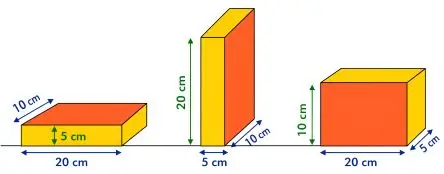
Figure below shows a brick of weight 2 kgf and dimensions 20 cm x 10 cm x 5 cm placed in three different positions on the ground. Find the pressure exerted by the brick in each case.
Solution:
First case:
Thrust = Weight = 2 kgf
Area = 20 cm × 10 cm = 200 cm2
Pressure \(=\frac{\operatorname{Thrust}}{Area}=\frac{2}{200}=\) 0.01 kgf cm–2
So, the pressure exerted by the brick in the first figure is 0.01 kgf cm–2.
Second case:
Thrust = Weight = 2 kgf
Area = 5 cm × 10 cm = 50 cm2
Pressure \(=\frac{\operatorname{Thrust}}{Area}=\frac{2}{50}=\) 0.04 kgf cm–2
So, the pressure exerted by the brick in the second figure is 0.04 kgf cm–2.
Third case:
Thrust = Weight = 2 kgf
Area = 20 cm × 5 cm = 100 cm2
Pressure \(=\frac{\operatorname{Thrust}}{Area}=\frac{2}{100}=\) 0.02 kgf cm–2
So, the pressure exerted by the brick in the third figure is 0.02 kgf cm–2.
ICSE Class 8 Physics Force and Pressure Selina Solutions PDF Download
Download ICSE Class 8 Physics Force and Pressure Selina Solutions PDF with chapter-wise solved answers, explanations, and free study resources for easy exam preparation.
Why Use Selina Solutions for Chapter 3?
Selina Solutions ICSE Class 8 Physics Chapter 3 are useful because they provide:
- Simple language explanations
- Correct textbook answers
- Step-by-step solutions
- Better concept clarity
- Quick revision help
- Strong exam preparation
Exam Preparation Tips
To score high marks in this chapter:
- Learn all definitions carefully
- Remember formulas
- Practice textbook exercises
- Solve previous year questions
- Revise examples from daily life
Conclusion
ICSE Class 8 Physics Chapter 3 Force and Pressure Selina Solutions are the best resource for students who want to understand concepts clearly and score better marks. This chapter builds the foundation for future Physics topics, so students should study it carefully and practice all questions regularly.
ICSE Class 8 Physics Selina Solutions
The Selina Concise Physics Class 8 book includes the following chapters:
Official Website:
Students can visit the official CISCE website for more details and updates.