Introduction
Are you searching for ICSE Class 8 Physics Chapter 4 Energy Selina Solutions? You are at the right place. In this article, we provide complete and easy-to-understand Selina solutions for Chapter 4 Energy. These solutions help students prepare for school exams, homework, and quick revision.
The chapter explains important concepts such as work, energy, power, kinetic energy, potential energy, and energy conversion. Practicing these questions improves problem-solving skills and builds a strong foundation in Physics.
Study Support by Rohit Academy
Rohit Academy offers expert-curated ICSE Class 8 Physics Study Materials including ICSE Energy Chapter Notes, diagrams, and key formulas for better understanding.
You can also visit:
| ☛ ICSE Class 8 Physics Chapter 4: Energy Notes |
| ☛ ICSE Class 8 Physics |
| ☛ ICSE Class 8 Chemistry |
| ☛ ICSE Class 8 Mathematics |
| ☛ ICSE Class 8 Biology |
(A) Multiple Choice Type
Question 1
Choose the correct answer from the multiple choices given below.
Question 1(a)
The S.I. unit of work is:
(a) second (b) metre
(c) joule (d) newton
Answer:
(c) joule
Explanation:
The S.I. unit of work is joule (J).
Work = Force × Displacement.
1 joule = work done when 1 newton force moves a body through 1 metre.
Question 1(b)
No work is done by a force if the body:
(a) moves in the direction of force
(b) does not move
(c) moves in opposite direction
(d) none of these
Answer:
(b) does not move
Explanation:
Work is done only when displacement takes place. If the body does not move, displacement = 0.
So, Work = Force × 0 = 0.
Question 1(c)
Two coolies A and B do some work in time 1 minute and 2 minute respectively. The power spent is:
(a) same by both coolies
(b) is more by coolie A than by B
(c) is less by coolie A than by B
(d) nothing can be said
Answer:
(b) is more by coolie A than by B
Explanation:
Power \(=\frac{Work}{Time}\)
Both do same work, but A takes less time (1 minute).
Less time means more power.
Question 1(d)
The expression of power P is:
(a) P = mgh (b) P = \(\frac{1}{2}\)mv2
(c) P = F x d (d) P = F x \(\frac{d}{t}\)
Answer:
(d) P = F x \(\frac{d}{t}\)
Explanation:
Power \(=\frac{Work}{Time}\)
Since Work = Force × Distance
So, Power = F × \(\frac{d}{t}\)
Question 1(e)
1 H.P. is equal to:
(a) 1 W (b) 1 J
(c) 764 J (d) 746 W
Answer:
(d) 746 W
Explanation:
1 Horsepower (H.P.) = 746 watt
Question 1(f)
When a boy doubles his speed, his kinetic energy becomes:
(a) half (b) double
(c) four times (d) no change
Answer:
(c) four times
Explanation:
Kinetic Energy = ½ mv²
If speed becomes double:
KE = ½ m(2v)² = ½ m × 4v² = 4 times
Question 1(g)
A boy lifts a luggage from height 2 m to 4 m. The potential energy will become:
(a) half (b) double
(c) one-third (d) one-fourth
Answer:
(b) double
Explanation:
Potential Energy = mgh
Height increases from 2 m to 4 m (double), so PE also doubles.
Question 1(h)
Whenever mechanical energy changes to other forms, it is always in the form of …………… energy and not in the form of …………… energy.
(a) potential, kinetic (b) heat, potential
(c) kinetic, potential (d) potential, heat
Answer:
(c) kinetic, potential
Explanation:
Mechanical energy converts to other forms (heat, sound, etc.) generally through motion, so it changes through kinetic energy, not directly through potential energy.
Question 1(i)
1 kWh is equal to :
(a) 746 Н.Р. (b) 3.6 x 10⁻⁶ J
(c) 3.6 Ј (d) 3.6 x 10⁶ J
Answer:
(d) 3.6 × 10⁶ J
Explanation:
1 kWh = 1000 watt × 3600 second
= 3,600,000 J
= 3.6 × 10⁶ J
Assertion Reason Type
Question 2
The following questions are Assertion-Reason based questions. Choose the answer based on the codes given below.
Question 2(a)
Assertion (A) : The power spent in doing a work remains the same, even if the same work is done in a lesser time.
Reason (R) : The power spent by a source depends on the time taken by the source to do that work.
(i) both A and R are true and R is the correct explanation of A
(ii) Both A and R are true and R is not the correct explanation of A
(iii) Assertion is true but reason is false
(iv) Assertion is false but reason is true
Answer:
(iv) Assertion is false but reason is true
Explanation:
Power \(=\frac{Work}{Time}\)
If same work is done in less time, power increases. So Assertion is false.
Reason is true because power depends on time.
Question 2(b)
Assertion (A) : When a ball is dropped from a height, its kinetic energy decreases and potential energy increases.
Reason (R) : The total mechanical energy remains conserved during the fall, if we ignore air resistance.
(i) both A and R are true and R is the correct explanation of A
(ii) Both A and R are true and R is not the correct explanation of A
(iii) Assertion is true but reason is false
(iv) Assertion is false but reason is true
Answer:
(iv) Assertion is false but reason is true
Explanation:
When a ball falls, kinetic energy increases and potential energy decreases. So Assertion is false.
Reason is true because total mechanical energy remains constant (ignoring air resistance).
Fill in the blanks
Question 3
Fill in the blanks:
(a) Work is said to be done by a force only when …………… .
(b) Work done = Force x …………… .
(c) The energy of a body is its capacity to do …………… .
(d) The S.I. unit of energy is …………… .
(e) The potential energy of a body is due to its …………… and kinetic energy of a body is due to its ……………
(f) Gravitational potential energy U = mass x force of gravity on unit mass x …………… .
(g) Kinetic energy = 1/2 x mass x …………… .
(h) Power P = …………… / time taken.
(i) The S.I. unit of power is …………… .
(j) 1 H.P. = …………… W.
Answer:
(a) Work is said to be done by a force only when the body moves.
(b) Work done = Force x distance moved in the direction of force.
(c) The energy of a body is its capacity to do work.
(d) The S.I. unit of energy is joule .
(e) The potential energy of a body is due to its state of rest or position and kinetic energy of a body is due to its state of motion.
(f) Gravitational potential energy U = mass x force of gravity on unit mass x vertical height.
(g) Kinetic energy = 1/2 x mass x (speed)2.
(h) Power P = Work done by the body / time taken.
(i) The S.I. unit of power is watt (W).
(j) 1 H.P. = 746 W.
True or False
Question 4
Write true or false for each statement:
(a) A coolie does no work against the force of gravity while carrying a luggage on a plane road.
(b) The energy stored in water of a dam is kinetic energy.
(c) The energy of a flying kite is kinetic energy.
(d) Work done by a boy depends on the time in which he does work.
(e) Power spent by a body depends on the time for which it does work.
Answer:
(a) True
(b) False
Correct Statement : The energy stored in water of a dam is potential energy.
(c) True
(d) False
Correct Statement : Work done by a boy depends on the magnitude of force applied and distance moved by the body in the direction of force.
(e) True
Match the Columns
Question 5
Match the following:
| Column A | Column B |
| (a) A stone at a height | (i) power |
| (b) A moving ball | (ii) joule |
| (c) Energy | (iii) work done in 1 sec |
| (d) Power | (iv) potential energy |
| (e) watt | (v) kinetic energy |
Answer:
| Column A | Column B |
| (a) A stone at a height | (iv) Potential energy |
| (b) A moving ball | (v) Kinetic energy |
| (c) Energy | (ii) joule |
| (d) Power | (iii) work done in 1 sec |
| (e) watt | (i) power |
(B) Short Answer Type Questions
Question 1
Define work.
Answer:
Work is said to be done when a force causes displacement in a body.
Question 2
When does a force perform work?
Answer:
A force performs work when it moves a body through some distance in the direction of force.
Question 3
State two conditions when no work is done by a force.
Answer:
- When there is no displacement.
- When displacement is perpendicular to force.
Question 4
In which of the following cases is work being done:
(a) A boy pushing a heavy rock
(b) A boy climbing up the stairs
(c) A coolie standing with a box on his head
(d) A girl moving on the road.
Answer:
(a) No
(b) Yes
(c) No
(d) Yes
Question 5
Write the expression for work done by a force.
Answer:
Work = Force × Displacement
W = F × d
Question 6
State the S.I. unit of work and define it.
Answer:
S.I. unit is joule (J).
1 joule is the work done when 1 newton force moves a body by 1 metre.
Question 7
State two factors on which the work done on a body depends.
Answer:
- Magnitude of force
- Displacement produced
Question 8
Define the term energy.
Answer:
Energy is the capacity to do work.
Question 9
State the S.I. unit of energy.
Answer:
The S.I. unit of energy is joule(J).
Question 10
Define 1 joule of energy.
Answer:
1 joule of energy is the energy required to do 1 joule of work.
Question 11
How is work related to energy?
Answer:
Work done is equal to energy transferred.
Question 12
What are the two kinds of mechanical energy?
Answer:
- Potential energy
- Kinetic energy
Question 13
What is potential energy? State its unit.
Answer:
Potential energy of a body is the energy possessed by it due to its state of rest or position. Its unit is joule (J).
Question 14
Give one example of a body that has potential energy, in each of the following:
(a) due to its position at a height,
(b) due to its elongated stretched state.
Answer:
(a) Water stored in tank at height
(b) Stretched rubber band
Question 15
A bucket full of water is on the first floor of your house and another identical bucket with same quantity of water is kept on the second floor. Which of the two has greater potential energy?
Answer:
Bucket on the second floor has greater potential energy.
Question 16
Write the expression for the gravitational potential energy explaining the meaning of the symbols used?
Answer:
Gravitational potential energy is given by:
U = mgh
where:
● m = mass of the body
● g = acceleration due to gravity
● h = height of the body above the ground level
Question 17
Define the term kinetic energy. Give one example of a body which possess kinetic energy.
Answer:
Kinetic energy is the energy possessed by a moving body.
Example: Moving car.
Question 18
State two factors on which the kinetic energy of a moving body depends.
Answer:
- Mass of body
- Speed of body
Question 19
Two toy cars A and B of masses 200 g and 500 g respectively are moving with the same speed. Which of the two has greater kinetic energy?
Answer:
Car B (500 g), because it has greater mass.
Question 20
A cyclist doubles his speed. How will his kinetic energy change: increase, decrease or remain the same?
Answer:
It increases four times.
Question 21
Write the expression for the kinetic energy of a body explaining the meaning of the symbols used.
Answer:
The kinetic energy of a body is given by:
K.E. = \(\frac{1}{2}\)mv2
where:
● m = mass of the body
● v = speed of the body
Question 22
A ball of mass m is moving with a speed v. What is its kinetic energy?
Answer:
Kinetic energy of ball (K.E.) = \(\frac{1}{2}\) mv2
Where,
● m is mass of the ball and
● v is speed of the ball.
Question 23
Name the form of energy stored in a wound up spring of a watch.
Answer:
Potential energy
Question 24
Name the type of energy (kinetic or potential) possessed by the following:
(a) A moving cricket ball.
(b) A stone at rest on the top of a building.
(c) A compressed spring.
(d) A moving bus.
(e) A bullet fired from a gun.
(f) Water flowing in a river.
(g) A stretched rubber band.
Answer:
(a) Moving cricket ball – Kinetic
(b) Stone on top of building – Potential
(c) Compressed spring – Potential
(d) Moving bus – Kinetic
(e) Bullet fired from gun – Kinetic
(f) Water flowing in river – Kinetic
(g) Stretched rubber band – Potential
Question 25
State the energy changes in the following while in use:
(a) An electric bulb
(b) An electric oven
(c) A loudspeaker
(d) A microphone
(e) An electric motor
(f) A wind mill
Answer:
(a) Electric bulb – Electrical to Light + Heat
(b) Electric oven – Electrical to Heat
(c) Loudspeaker – Electrical to Sound
(d) Microphone – Sound to Electrical
(e) Electric motor – Electrical to Mechanical
(f) Wind mill – Wind energy to Electrical energy
(C) Long Answer Type Questions
Question 1
State two factors on which the potential energy of a body at a certain height above the ground depends.
Answer:
The potential energy of a body depends on:
- Mass of the body
- Height of the body above the ground
Question 2
Two bodies A and B of masses 10 kg and 20 kg respectively are at the same height above the ground. Which of the two has greater potential energy?
Answer:
Body B has greater potential energy because it has greater mass.
Question 3
A body of mass m is moved from ground to a height h. If force of gravity on mass of 1 kg is g newton, find:
(a) the force needed to lift the body,
(b) the work done in lifting the body and
(c) the potential energy stored in the body.
Answer:
(a) Force needed to lift the body = mg newton
(b) Work done in lifting the body = mgh joule
(c) Potential energy stored in the body = mgh joule
Question 4
Can a body possess energy even when it is not in motion? Explain your answer with an example.
Answer:
Yes, a body can possess energy even when it is not in motion. It may have potential energy due to its position or shape.
Example: Water stored in a dam has potential energy.
Question 5
Give an example to show the conversion of potential energy to kinetic energy when put in use.
Answer:
When a stone is dropped from a height, its potential energy changes into kinetic energy while falling.
Question 6
State the energy changes that occur in a watch spring while it unwinds.
Answer:
When a watch spring unwinds, its elastic potential energy changes into kinetic energy.
(D) Think and Answer
Question 1
A coolie is moving on a road with a luggage on his head. Does he perform work against the force of gravity? Give reason for your answer.
Answer:
No, he does not perform work against the force of gravity because the displacement is horizontal while the force of gravity acts vertically downward. Since displacement is perpendicular to the force, no work is done against gravity.
Question 2
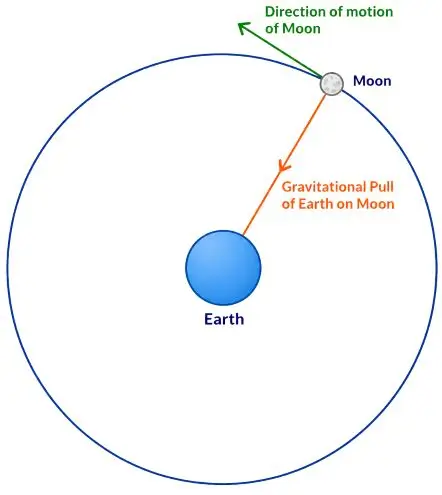
The moon is revolving around the earth in a circular path. How much work is done by the moon?
Answer:
Work done by the moon is zero because the force of attraction exerted by the earth on the moon acts perpendicular to the direction of motion of the moon.
Question 3
Give reasons for the following:
(a) No work is done if a man is pushing against a wall.
(b) Hammer drives a nail into the wood only when it is lifted up and then struck.
(c) A horse and a dog are running with the same speed. Which one of them has more kinetic energy than the other?
(d) A teacher moving around in the class is doing work but a child standing and reading a book is not doing any work.
Answer:
(a) No work is done because the wall does not move, so displacement is zero.
(b) When lifted, the hammer gains potential energy. On striking, this energy changes into kinetic energy which drives the nail into the wood.
(c) The horse has more kinetic energy because it has greater mass.
(d) The teacher is doing work because there is displacement. The child is not doing work because there is no displacement.
Question 4
Name the form of energy to which potential energy can change.
Answer:
Potential energy can change into kinetic energy.
Question 5
Is it practically possible to convert a form of energy completely into another useful form? Give reason.
Answer:
No, it is not practically possible because some energy is always lost in the form of heat, sound, friction, etc.
Question 6
In a shopping mall, while standing on an escalator you move from level 1 to 30 metre high level 4. What is the work done by you?
Answer:
The work done by you is zero because you are only standing on the escalator and not applying any force yourself.
(E) Numericals
Question 1
A force of 30 N acts on a body and moves it through a distance of 5 m in the direction of force. Calculate the work done by the force.
Solution:
Given:
Force (F) = 30 N
Distance moved (d) = 5 m
Work done (W) = ?
Work done = Force × Distance
W = 30 × 5 = 150 J
Therefore, the work done by the force is 150 J.
Question 2
A man lifts a mass of 20 kg to a height of 2.5 m. Assuming that the force of gravity on 1 kg mass is 10 N, find the work done by the man.
Solution:
Given:
Mass (m) = 20 kg
Height (h) = 2.5 m
Force of gravity on 1 kg = 10 N
Force applied = Weight of the body
= Mass × Gravity = 20 × 10 = 200 N
Work done = Force × Distance
= 200 × 2.5 = 500 J
Therefore, the work done by the man is 500 J.
Question 3
A body when acted upon by a force of 10 kgf moves to a distance 0.5 m in the direction of force. Find the work done by the force. Take 1 kgf = 10 N.
Solution:
Given:
1 kgf = 10 N
10 kgf = 10 x 10 = 100 N
So, Force (F) = 100 N
Distance (d) = 0.5 m
Work done (W) = ?
Work done = Force x distance = 100 x 0.5 = 50 J
Therefore, the work done by the force is 50 J.
Question 4
Two bodies of same masses are placed at height h and 2h. Compare their gravitational potential energy.
Solution:
Given:
Two bodies have the same mass and are placed at heights h and 2h.
Gravitational potential energy = mgh
For the first body at height h:
PE1 = mgh
For the second body at height 2h:
PE2 = mg(2h) = 2mgh
Therefore,
PE1 : PE2 = mgh : 2mgh = 1 : 2 So, the gravitational potential energies are in the ratio 1 : 2.
Question 5
Find the gravitational potential energy of 2.5 kg mass kept at a height of 15 m above the ground. The force of gravity on mass 1 kg is 10 N.
Solution:
Given:
Mass (m) = 2.5 kg
Height (h) = 15 m
Force of gravity on mass 1 kg = 10 N
Gravitational potential energy (U) = mgh
= 2.5 x 10 x 15
= 375 J
Therefore, the gravitational potential energy of the body is375 J.
Question 6
The gravitational potential energy stored in a box of weight 150 kgf is 1.5 x 10⁴ J. Find the height of the box. Take 1 kgf = 10 N.
Solution:
Given:
Gravitational potential energy (U) = 1.5 x 10⁴ J
= 15000 J
Weight = 150 kgf = 150 x 10 = 1500 N
height h = ?
U = mgh
15000 = 1500 x h
h = \(\frac{15000}{1500}\)
h = 10 m
So height of the box = 10 m.
Question 7
The potential energy of a body of mass 0.5 kg increases by 100 J when it is taken to the top of a tower from the ground. If the force of gravity on 1 kg = 10 N, what is the height of the tower?
Solution:
Given:
Potential energy (U) = 100 J
Mass (m) = 0.5 kg
Force of gravity on 1 kg mass = 10 N
height (h) = ?
U = mgh
100 = 0.5 x 10 x h
h = \(\frac{100}{5}\)
h = 20 m
So height of the tower = 20 m.
Question 8
A body of mass 60 kg is moving with a speed 50 m s–1. Find its kinetic energy.
Solution:
Given:
Mass (m) = 60 kg
Speed (v) = 50 m s–1
Kinetic energy (K.E.) = ?
Kinetic energy \(=\frac{1}{2}mv^2\)
K.E. \(=\frac{1}{2}\times60\times\left(50\right)^2\)
K.E. = 30 × 2500
K.E. = 75000 J
Therefore, the kinetic energy of the body is 75000 J.
Question 9
A truck of mass 1000 kg increases its speed from 36 km h–1 to 72 km h–1. Find the increase in its kinetic energy.
Solution:
Given:
Mass (m) = 1000 kg
Initial speed (u) = 36 km h–1 = 36 × \(\frac{5}{18}\) = 10 m s–1
Final speed (v) = 72 km h–1 = 72 × \(\frac{5}{18}\) = 20 m s–1
Increase in K.E. \(=\frac{1}{2}m\left(v^2-u^2\right)\)
Increase in K.E. \(=\frac{1}{2}\times1000\times\left({20}^2-{10}^2\right)\)
= 500 × (400 − 100)
= 500 × 300
= 150000 J
Therefore, the increase in kinetic energy of the truck is 150000 J.
Question 10
A car is moving with a speed of 15 km h–1 and another identical car is moving with a speed of 30 km h–1. Compare their kinetic energy.
Solution:
Given:
Two identical cars have the same mass.
Speed of first car = 15 km h–1
Speed of second car = 30 km h–1
Kinetic energy = \(\frac{1}{2}\)mv2
Since masses are equal, kinetic energy is directly proportional to the square of speed.
K.E.1 : K.E.2 = (15)2 : (30)2
= 225 : 900
= 1 : 4
Therefore, the kinetic energies of the two cars are in the ratio 1 : 4.
Question 11
A pump raises water by spending 4 x 10⁵ J of energy in 10 s. Find the power of pump.
Solution:
Given:
Energy spent (Work done) = 4 × 10⁵ J
Time (t) = 10 s Power = ?
Power = \(\frac{Work\ done}{time\ taken}\)
= \(\frac{400000}{10}\)
= 40000 W
= 4 x 10⁴ W
Therefore, the power of the pump is 4 × 10⁴ W.
Question 12
It takes 20 s for a girl A to climb up the stairs while girl B takes 15 s for the same job. Compare:
(a) The work done and
(b) The power spent by them.
Solution:
Given:
Girl A takes 20 s to climb the stairs.
Girl B takes 15 s to climb the same stairs.
Since both girls do the same job of climbing the same stairs, the work done by both is equal.
(a) Comparison of work done:
Work done by A : Work done by B = 1 : 1
(b) Comparison of power spent:
Power = \(\frac{Work\ done}{Time}\)
Since work done is same, power is inversely proportional to time.
Power of A : Power of B = \(\frac{1}{20} : \frac{1}{15}\) = 15 : 20 = 3 : 4
Therefore:
(a) Work done = 1 : 1
(b) Power spent = 3 : 4
ICSE Class 8 Physics Energy Selina Solutions PDF Download
Download ICSE Class 8 Physics Energy Selina Solutions PDF with chapter-wise solved answers, explanations, and free study resources for easy exam preparation.
Why Use Selina Solutions?
Selina solutions are very useful because they:
- Give accurate answers
- Use simple language
- Help in exam preparation
- Improve concept clarity
- Save revision time
Exam Preparation Tips
- Learn all formulas properly
- Practice numericals daily
- Understand definitions carefully
- Revise examples of energy conversion
- Solve previous year questions
Conclusion
ICSE Class 8 Physics Chapter 4 Energy Selina Solutions are the best study resource for students who want to score high marks. This chapter is important for future Physics topics, so understand each concept clearly and practice regularly.
ICSE Class 8 Physics Selina Solutions
The Selina Concise Physics Class 8 book includes the following chapters:
Official Website:
Students can visit the official CISCE website for more details and updates.