Introduction
Hydrogen is one of the most important chapters in ICSE Class 8 Chemistry. This chapter explains the preparation, properties, tests, uses, and reactions of hydrogen gas. Students learn laboratory preparation, industrial manufacture, combustion, reducing nature, and applications of hydrogen in daily life and industries. Hydrogen is the lightest and most abundant element in the universe.
If you are searching for ICSE Class 8 Chemistry Chapter 7 Hydrogen Selina Solutions, this article provides complete exercise answers, explanations, important reactions, and exam preparation notes based on the latest ICSE syllabus.
Study Support by Rohit Academy
Rohit Academy offers expert-curated ICSE Class 8 Chemistry Study Materials including ICSE Hydrogen Selina Solutions, diagrams, and key formulas for better understanding.
You can also visit:
| ☛ ICSE Class 8 Chemistry Chapter 7: Hydrogen Notes |
| ☛ ICSE Class 8 Physics |
| ☛ ICSE Class 8 Chemistry |
| ☛ ICSE Class 8 Mathematics |
| ☛ ICSE Class 8 Biology |
(A) Objective Type Questions
Question 1
Choose the correct answer from the multiple choices given below.
Question 1 (i)
Which of the following metals does not react with water or acid to produce hydrogen gas?
(a) Magnesium (b) Iron
(c) Copper (d) Zinc
Answer:
(c) Copper
Explanation:
Copper is a less reactive metal and lies below hydrogen in the reactivity series, so it cannot displace hydrogen from water or dilute acids. Magnesium, iron, and zinc can produce hydrogen under suitable conditions.
Question 1 (ii)
Which of the following compounds is formed along with hydrogen gas when magnesium reacts with steam?
(a) Mg(OH)2 (b) MgO
(c) MgH₂ (d) MgCl2
Answer:
(b) MgO
Explanation:
Magnesium reacts with steam:
Mg + 2H2O (steam) ⟶ MgO + H2
Question 1 (iii)
The gas produced at anode when electrolysis of water is done is:
(a) H2 (b) O2
(c) SO2 (d) None
Answer:
(b) O2
Explanation:
During electrolysis of water:
- Anode (positive electrode): Oxygen gas (O2) is released.
- Cathode (negative electrode): Hydrogen gas (H2) is released.
Question 1 (iv)
Equal volumes of hydrogen and chlorine are exposed to diffused sunlight to prepare:
(a) hydrogen chloride (b) water
(c) sodium hydroxide (d) hydrochloric acid
Answer:
(a) Hydrogen chloride
Explanation:
Hydrogen combines with chlorine in diffused sunlight:
H2 + Cl2 \(\xrightarrow{diffused\ sunlight}\) 2HCl
Question 1 (v)
The metal which reacts with cold water to produce hydrogen is:
(a) magnesium (b) aluminium
(c) calcium (d) iron
Answer:
(c) Calcium
Explanation:
Calcium reacts with cold water: Ca + 2H2O (cold) ⟶ Ca(OH)2 + H2
Question 1 (vi)
In metal reactivity series, the more reactive metals are at:
(a) top (b) bottom
(c) middle (d) none of these
Answer:
(a) Top
Explanation:
The most reactive metals like potassium and sodium are placed at the top, while less reactive metals like copper and gold are at the bottom.
Question 1 (vii)
Hydrogen is responsible for producing:
(a) heat and light (b) hydrogenated oil
(c) fertilizers (d) all of the above
Answer:
(d) All of the above
Explanation:
Hydrogen is used for:
- Producing heat and light (as a fuel)
- Hydrogenation of oils (vanaspati ghee)
- Manufacture of fertilizers (ammonia in Haber process)
Question 1 (viii)
Hydrogen is:
(a) combustible
(b) non-combustible
(c) supporter of combustion
(d) neither supporter nor combustible
Answer:
(a) Combustible
Explanation:
Hydrogen burns in oxygen to form water, so it is combustible, but it does not support combustion like oxygen does.
Question 1 (ix)
Water gas is a mixture of:
(a) carbon monoxide and oxygen
(b) carbon monoxide and hydrogen
(c) hydrogen and oxygen
(d) hydrogen and nitrogen
Answer:
(b) Carbon monoxide and hydrogen
Explanation:
Water gas is produced by passing steam over hot carbon:
C + H2O ⟶ CO + H2
Assertion Reason Type
Question 2
The following questions are Assertion-Reason based questions. Choose the answer based on the codes given below.
Question 2 (i)
Assertion (A): On the earth, hydrogen is mostly found in the form of compounds.
Reason (R): Hydrogen is a highly reactive element.
(a) Both A and R are true and R is the correct explanation of A.
(b) Both A and R are true but R is not the correct explanation of A.
(c) A is true but R is false.
(d) A is false but R is true.
Answer:
(a) Both A and R are true and R is the correct explanation of A.
Explanation:
Hydrogen readily combines with other elements (like oxygen to form water and carbon to form hydrocarbons). Because of this high reactivity, it is mostly found in combined form rather than free state.
Question 2 (ii)
Assertion (A): In the laboratory preparation of hydrogen, granulated zinc is reacted with dilute acid.
Reason (R): Granulated zinc contains copper as an impurity.
(a) Both A and R are true and R is the correct explanation of A.
(b) Both A and R are true but R is not the correct explanation of A.
(c) A is true but R is false.
(d) A is false but R is true.
Answer:
(a) Both A and R are true and R is the correct explanation of A.
Explanation:
Granulated zinc is commonly used because impurities like copper help the reaction proceed more smoothly by setting up local electrochemical action, so hydrogen is evolved steadily.
Question 2 (iii)
Assertion (A): Pure hydrogen burns with a pop sound in air.
Reason (R): Hydrogen forms an explosive mixture with air.
(a) Both A and R are true and R is the correct explanation of A.
(b) Both A and R are true but R is not the correct explanation of A.
(c) A is true but R is false.
(d) A is false but R is true.
Answer:
(a) Both A and R are true and R is the correct explanation of A.
Explanation:
Hydrogen mixes with oxygen in air to form an explosive mixture. When ignited, it burns rapidly producing the characteristic pop sound.
Question 2 (iv)
Assertion (A): Hydrogen is used for the extraction of less reactive metals like copper and lead.
Reason (R): Hydrogen is a good reducing agent.
(a) Both A and R are true and R is the correct explanation of A.
(b) Both A and R are true but R is not the correct explanation of A.
(c) A is true but R is false.
(d) A is false but R is true.
Answer:
(a) Both A and R are true and R is the correct explanation of A.
Explanation:
Hydrogen removes oxygen from metal oxides (reduction), e.g.:
CuO + H2 ⟶ Cu + H2O
Question 2 (v)
Assertion (A): Oxyhydrogen flame is used for cutting and welding metals.
Reason (R): For cutting and welding metals, a low temperature is required.
(a) Both A and R are true and R is the correct explanation of A.
(b) Both A and R are true but R is not the correct explanation of A.
(c) A is true but R is false.
(d) A is false but R is true.
Answer:
(c) A is true but R is false.
Explanation:
Oxyhydrogen flame produces a very high temperature (~2800°C) which is necessary to melt metals. Therefore, high temperature, not low temperature, is required.
Fill in the blanks
(a) Hydrogen is …………… than air.
(b) Hydrogen is …………… soluble in water.
(c) Hydrogen burns with a …………… flame and …………… sound is heard.
(d) A metal …………… hydrogen in the reactivity series gives hydrogen with …………… .
(e) Hydrogen reacts with metal oxides to form …………… and …………… .
(f) Oxidation is the removal of …………… or addition of …………… .
(g) In redox reactions, oxidation and reduction occurs …………… .
Answer:
(a) Hydrogen is lighter than air.
(b) Hydrogen is slightly soluble in water.
(c) Hydrogen burns with a pale blue flame and pop sound is heard.
(d) A metal above hydrogen in the reactivity series gives hydrogen with dilute acids.
(e) Hydrogen reacts with metal oxides to form metal and water.
(f) Oxidation is the removal of hydrogen or addition of oxygen.
(g) In redox reactions, oxidation and reduction occur simultaneously.
True or False
Question 4
Indicate which of the following statements are true and which are false and correct the false statements:
(a) Hydrogen molecule is monovalent.
(b) The removal of hydrogen from a substance is called reduction.
(c) Nitric acid cannot be used to prepare hydrogen by its action on active metals.
(d) The reaction between hydrogen and nitrogen to form ammonia is reversible.
(e) Zinc can liberate hydrogen from water, acid and alkali solution.
(f) Hydrogen is combustible as well as a supporter of combustion.
(g) Hydrogen gas is easily liquefiable.
Answer:
(a) True
(b) False
Correct Statement : The removal of hydrogen from a substance is called oxidation.
(c) True
(d) True
(e) True
(f) False
Correct Statement : Hydrogen is combustible but not a supporter of combustion.
(g) False
Correct Statement : Hydrogen gas is not easily liquefiable.
Match the following
Question 5
Match the statements in Column A with the words in Column B.
| Column A | Column B |
| (a) A metal which reacts with cold water to form hydrogen. | (i) Reduction |
| (b) A gas which is inflammable and a non-supporter of combustion. | (ii) Hydrogenation |
| (c) A process in which vanaspati ghee is prepared from vegetable oils. | (iii) Oxidation |
| (d) The removal of hydrogen or addition of oxygen. | (iv) Sodium |
| (e) The addition of hydrogen or removal of oxygen. | (v) Hydrogen |
Answer:
| Column A | Column B |
| (a) A metal which reacts with cold water to form hydrogen. | (iv) Sodium |
| (b) A gas which is inflammable and a non-supporter of combustion. | (v) Hydrogen |
| (c) A process in which vanaspati ghee is prepared from vegetable oils. | (ii) Hydrogenation |
| (d) The removal of hydrogen or addition of oxygen. | (iii) Oxidation |
| (e) The addition of hydrogen or removal of oxygen. | (i) Reduction |
Question 6
Name the following:
(a) The process in which oxygen is added or hydrogen is removed.
(b) A process by which hydrogen gas is manufactured.
(c) A solid conductor through which current enters or leaves the electrolyte.
(d) The charged particles present in an electrolyte.
(e) A substance which removes oxygen from a compound.
Answer:
(a) Oxidation
(b) Electrolysis of water
(c) Electrode
(d) Ions
(e) Reducing agent
Question 7
Give examples:
(a) Two metals which give hydrogen with cold water.
(b) A metal which liberates hydrogen only when steam is passed over red hot metal.
(c) A metallic oxide which can be reduced into metal by hydrogen.
(d) An electrolyte.
(e) A metal of which an electrode is made.
Answer:
(a) Sodium and Potassium
(b) Iron
(c) Copper(II) oxide (CuO)
(d) Acidulated water
(Other examples: Copper sulphate solution, sodium chloride solution)
(e) Platinum
Question 8
Complete and balance the following equations:
(a) H2 + ……………….. ⟶ 2HCl
(b) H2 + S ⟶ ……………………
(c) Zn + ……………. ⟶ ZnCl2 + H2
(d) CuO + ………….. ⟶ Cu + ………….
(e) Fe + H2O ⟶ …………….. + ……………
(f) K + H2O ⟶ ……………… + ……………
Answer:
(a) H2 + Cl2 ⟶ 2HCl
(b) H2 + S ⟶ H2S
(c) Zn + 2HCl ⟶ ZnCl2 + H2
(d) CuO + H2 ⟶ Cu + H2O
(e) 3Fe + 4H2O ⟶ Fe3O4 + 4H2
(f) 2K + 2H2O ⟶ 2KOH + H2
(B) Short Answer Type Questions
Question 1
Define:
(a) Catalytic hydrogenation
(b) Oxidation
(c) Reduction
(d) Redox reaction
(e) Electrolysis
(f) Electrolyte
Answer:
(a) Catalytic hydrogenation:
The process of adding hydrogen to unsaturated compounds (oils or alkenes) in the presence of a catalyst such as nickel, palladium, or platinum is called catalytic hydrogenation.
(b) Oxidation:
Oxidation is the addition of oxygen or removal of hydrogen from a substance.
(c) Reduction:
Reduction is the removal of oxygen or addition of hydrogen to a substance.
(d) Redox reaction:
A chemical reaction in which oxidation and reduction occur simultaneously is called a redox reaction.
(e) Electrolysis:
Electrolysis is the chemical decomposition of a substance (electrolyte) in molten or aqueous solution by passing electric current through it.
(f) Electrolyte:
A substance which conducts electricity in molten state or in aqueous solution and decomposes during the process is called an electrolyte.
Question 2
How would you show that hydrogen gas is neutral in nature?
Answer:
Hydrogen gas does not change the colour of moist red or blue litmus paper, showing that it is neutral in nature.
Question 3
Give reasons for the following:
(a) Hydrogen can be used as a fuel.
(b) Though hydrogen is lighter than air it cannot be collected by downward displacement of air.
(c) A pop sound is produced when hydrogen gas is burnt.
(d) Helium has replaced hydrogen in weather forecasting balloons.
(e) Nitric acid is not used for the preparation of hydrogen gas.
Answer:
(a) Hydrogen burns in oxygen to produce heat and forms water as the only product, so it is a clean and efficient fuel.
(b) Hydrogen diffuses rapidly and mixes easily with air, forming an explosive mixture, so it is not safe to collect it by displacement of air.
(c) Hydrogen forms an explosive mixture with oxygen in air and burns rapidly, producing a characteristic pop sound.
(d) Although hydrogen is lighter, it is highly inflammable. Helium is non-flammable and safer, so it is preferred.
(e) Nitric acid is a strong oxidising agent and usually produces oxides of nitrogen instead of hydrogen when reacting with metals.
Question 4
The chemical equation given below represents a redox reaction:
PbO + H2 → Pb + H2O
(Lead monoxide) (Lead)
(a) Name the reactant which gets:
(i) reduced (ii) oxidised
(b) Which of the reactants acts as an oxidising agent?
Answer:
(a) (i) Reduced: PbO (ii) Oxidised: H2
(b) PbO acts as the oxidising agent.
(C) Long Answer Type Questions
Question 1
(a) Name a process by which hydrogen gas is manufactured.
(b) Give equations for the reactions.
(c) How is hydrogen separated from carbon dioxide and carbon monoxide?
Answer:
(a) Bosch process
(b) Equations for the reactions of Bosch process are:
1. Formation of water gas:

2. Conversion of carbon monoxide to carbon dioxide:

(c) Carbon dioxide is removed by passing the mixture through water under pressure or alkali solution where CO₂ dissolves.
2KOH + CO2 ⟶ K2CO3 + H2O
Carbon monoxide is removed by passing the gas mixture through ammoniacal cuprous chloride, in which carbon monoxide dissolves, leaving hydrogen behind:
CuCl + CO + 2H2O → CuCl·CO·2H2O
Question 2
Hydrogen is a good reducing agent. What do you understand by the above statement? Explain with the help of copper oxide as an example.
Answer:
A reducing agent is a substance that removes oxygen from another substance.
Example:
CuO + H2 ⟶ Cu + H2O
Here, hydrogen removes oxygen from copper oxide to form copper, hence hydrogen acts as a reducing agent.
Question 3
State four uses of hydrogen.
Answer:
- Hydrogenation of vegetable oils to make vanaspati ghee.
- Manufacture of ammonia (fertilisers).
- Used as a fuel (oxyhydrogen flame, rockets).
- Filling weather balloons (earlier used; now mostly helium).
Question 4
Give three differences between:
(a) Cathode and anode
(b) Cation and anion
Answer:
(a) Differences between Cathode and Anode:
| Cathode | Anode |
| Negative electrode | Positive electrode |
| Reduction takes place | Oxidation takes place |
| Cations move towards it | Anions move towards |
(b) Differences between Cation and Anion:
| Cation | Anion |
| Positively charged ion | Negatively charged ion |
| Moves towards cathode | Moves towards anode |
| Example: Na⁺, H⁺ | Example: Cl⁻, SO₄²⁻ |
Question 5
(a) Name the chemicals required to prepare hydrogen gas in the laboratory.
(b) Give a balanced chemical equation for the reaction.
(c) Draw a neat and well-labelled diagram for the laboratory preparation of hydrogen.
(d) How is hydrogen gas collected? Why?
(e) Give one chemical test for hydrogen.
Answer:
(a) Chemicals required to prepare hydrogen gas in the laboratory:
- Granulated zinc
- Dilute hydrochloric acid (HCl) or dilute sulphuric acid (H2SO4)
(b) Zn + 2HCl ⟶ ZnCl2 + H2 (g)
Zn + H2SO4 ⟶ ZnSO4 + H2 (g)
(c) Diagram for laboratory preparation of hydrogen:
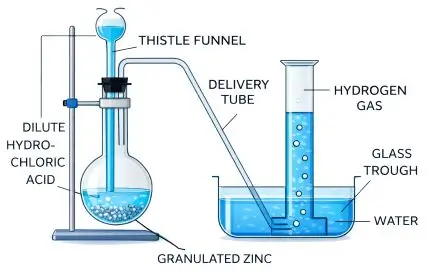
(d) Hydrogen is collected over water (downward displacement of water) because it is almost insoluble in water and forms an explosive mixture with air, so it should not be collected by displacement of air.
(e) Bring a burning splint near the gas; it burns with a pop sound, confirming hydrogen.
Question 6
The diagram given below shows electrolysis of water. Answer the following questions:
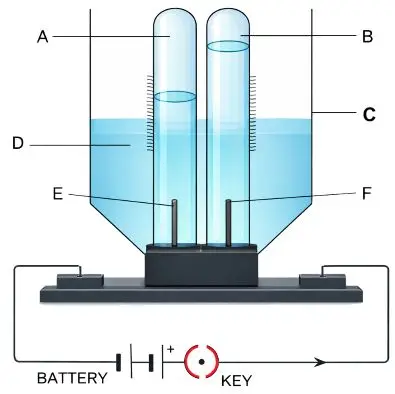
(a) Label A, B, C, D, E and F.
(b) Why is acidulated water used?
(c) What is the ratio by volume for the gases collected?
Answer:
(a) From the electrolysis of water setup:
- A : Hydrogen gas
- B : Oxygen gas
- C : Electrolytic Cell
- D : Acidulated water
- E : Cathode (negative electrode)
- F : Anode (positive electrode)
(b) Pure water is a poor conductor of electricity. A few drops of dilute sulphuric acid are added to increase the conductivity so electrolysis can occur.
(c) The gases collected are hydrogen and oxygen in the ratio 2 : 1 (by volume).
Download ICSE Class 8 Chemistry Chapter 7 Hydrogen Selina Solutions PDF
Students looking for complete ICSE Class 8 Chemistry Chapter 7 Hydrogen Selina Solutions PDF can use these notes for revision, homework, and exam preparation.
Practice all exercise questions regularly to score better marks in ICSE examinations.
Conclusion
ICSE Class 8 Chemistry Chapter 7 Hydrogen Selina Solutions helps students understand preparation, properties, reactions, and uses of hydrogen in a simple way. Practising these solutions regularly improves conceptual understanding and exam performance.
Students should revise equations, definitions, and important reactions for better marks in school tests and ICSE exams.
ICSE Class 8 Chemistry Selina Solutions
The Selina Concise Chemistry Class 8 book includes the following chapters:
Official Website:
Students can visit the official CISCE website for more details and updates.