Introduction
Carbon is one of the most important elements found on Earth. It is present in all living organisms and forms a vast number of compounds. In Chapter 9, Carbon and Its Compounds, students learn about the properties of carbon, its occurrence, allotropes, oxides, and various useful compounds. The ICSE Class 8 Chemistry Chapter 9 Carbon and Its Compounds Selina Solutions help students understand the concepts clearly and prepare effectively for examinations.
Study Support by Rohit Academy
Rohit Academy offers expert-curated ICSE Class 8 Chemistry Study Materials including ICSE Carbon and Its Compounds Selina Solutions, diagrams, and key formulas for better understanding.
You can also visit:
| ☛ ICSE Class 8 Chemistry Chapter 9: Carbon and Its Compounds Notes |
| ☛ ICSE Class 8 Physics |
| ☛ ICSE Class 8 Chemistry |
| ☛ ICSE Class 8 Mathematics |
| ☛ ICSE Class 8 Biology |
Exercise (I) : (A) Objective Type Questions
Question 1
Choose the correct answer from the multiple choices given below.
Question 1(i)
In combined state, carbon occurs as:
(a) coal (b) diamond
(c) graphite (d) petroleum
Answer:
(d) Petroleum
Explanation:
Carbon is in combined form in petroleum because it is chemically combined with hydrogen (hydrocarbons).
Question 1(ii)
A crystalline form of carbon is:
(a) lamp black (b) gas carbon
(c) sugar (d) fullerene
Answer:
(d) Fullerene
Explanation:
Fullerene is a crystalline allotrope of carbon with a definite structure.
Question 1(iii)
Graphite is used to make crucibles because it is:
(a) a good conductor of electricity
(b) a good conductor of heat
(c) soft and slippery
(d) has high melting point
Answer:
(d) Has high melting point
Explanation:
Graphite can withstand very high temperatures, so it is used to make crucibles.
Question 1(iv)
Diamond is used for:
(a) making the electrodes of electric furnaces.
(b) making crucibles for melting metals.
(c) cutting and drilling rocks and glass.
(d) making carbon brushes for electric motors.
Answer:
(c) Cutting and drilling rocks and glass
Explanation:
Diamond is very hard, so it is used for cutting and drilling.
Question 1(v)
Carbon forms innumerable compounds because:
(a) it has four electrons in its outermost shell.
(b) it behaves as a metal as well as a non-metal.
(c) carbon atoms can form long chains.
(d) it combines with other elements to form covalent compounds.
Answer:
(c) Carbon atoms can form long chains
Explanation:
Carbon shows catenation, so it forms a large number of compounds.
Question 2
Fill in the blanks:
(a) …………… is present in both living and non-living things.
(b) The property of an element to exist in two or more forms but in the same physical state is called …………… .
(c) …………… and …………… are the two major crystalline allotropes of carbon.
(d) …………… is the hardest substance that occurs naturally.
(e) The name ‘carbon’ is derived from the Latin word …………… .
Answer:
(a) Carbon is present in both living and non-living things.
(b) The property of an element to exist in two or more forms but in the same physical state is called allotropy.
(c) Diamond and graphite are the two major crystalline allotropes of carbon.
(d) Diamond is the hardest substance that occurs naturally.
(e) The name ‘carbon’ is derived from the Latin word carbo.
Question 3
Write ‘true’ or ‘false’ against the following statements and correct the false ones:
(a) Carbon occurs as carbon dioxide in the atmosphere.
(b) Graphite is the purest form of carbon.
(c) Coloured diamonds are costlier than colourless and transparent diamonds.
(d) Graphite has layers of hexagonal carbon bondings.
(e) Diamond is soluble in all solvents.
Answer:
(a) True
(b) False
Correct statement : Diamond is the purest form of carbon.
(c) False
Correct statement : Colourless and transparent diamonds are costlier than coloured diamonds.
(d) True
(e) False
Correct statement : Diamond is insoluble in all solvents.
Question 4
Give an appropriate term for the following .
(a) Substances whose atoms or molecules are arranged in a definite pattern.
(b) Different forms of an element found in the same physical state.
(c) The property by which atoms of an element link together to form long chain or ring compounds.
Answer:
(a) Crystals
(b) Allotropy
(c) Catenation
Question 5
Name the following.
(a) The hardest naturally occurring substance.
(b) A greyish black non-metal that is a good conductor of electricity.
(c) The third crystalline form of carbon.
Answer:
(a) Diamond
(b) Graphite
(c) Fullerene
Question 6
How many carbon atoms are there in a Buckminster fullerene?
Answer:
Buckminster fullerene contains 60 carbon atoms.
Exercise (I) : (B) Short Answer Type Questions
Question 1
Define the following terms .
(a) Allotropy
(b) Carat
(c) Crystal
(d) Catenation
Answer:
(a) Allotropy is the property of an element to exist in two or more different forms in the same physical state.
(b) The weight of a diamond is expressed in terms of carats, where 1 carat = 0.2 g.
(c) A crystal is a solid substance in which the atoms are arranged in a definite, regular geometric pattern.
(d) Catenation is the property of an element (especially carbon) to form long chains or rings by bonding with atoms of the same element.
Question 2
Answer the following in brief :
(a) Why is graphite a good conductor of electricity but not diamond?
(b) Why is diamond very hard?
(c) What are fullerenes? Name the most common fullerene.
(d) What impurity is present in black diamond?
Answer:
(a) Graphite is a good conductor of electricity because it has free electrons that can move between its layers.
Diamond has no free electrons, so it does not conduct electricity.
(b) Diamond is very hard because each carbon atom is strongly bonded to four other carbon atoms in a rigid three-dimensional structure.
(c) Fullerenes are allotropes of carbon in which carbon atoms are arranged in hollow spheres, tubes, or cages.
The most common fullerene is Buckminster fullerene (C₆₀).
(d) Black diamonds have copper oxide present in them as an impurity.
Exercise (I) : (C) Long Answer Type Questions
Question 1
Give two uses of the following mentioning the property being utilized in the said use.
(a) graphite
(b) diamond
Answer:
(a) Graphite:
- Making electrodes in electric furnaces
- Making crucibles
(b) Diamond
- Cutting and drilling rocks and glass
- Making jewellery
Question 2
Write three differences between graphite and diamond.
Answer:
| Graphite | Diamond |
| 1. Each carbon atom is bonded to three other carbon atoms. | 1. Each carbon atom is bonded to four other carbon atoms. |
| 2. It is soft and slippery. | 2. It is very hard. |
| 3. It is a good conductor of electricity. | 3. It is a bad conductor of electricity. |
Exercise (II) : (A) Objective Type Questions
Question 1
Choose the correct answer from the multiple choices given below.
Question 1(i)
Anthracite is :
(a) an inferior type of coal
(b) a superior type of coal
(c) a cheapest form of coal
(d) none of the above
Answer:
(b) a superior type of coal
Explanation:
Anthracite contains the highest percentage of carbon and produces very little smoke, so it is the best quality coal.
Question 1(ii)
Destructive distillation of coal yields
(a) coal tar (b) coal gas
(c) coke (d) all of the above
Answer:
(d) all of the above
Explanation:
Destructive distillation of coal produces coke, coal tar, and coal gas as main products.
Question 1(iii)
Lamp black is :
(a) an amorphous form of carbon
(b) a crystalline form of carbon
(c) a pure form of carbon
(d) a cluster of carbon atoms
Answer:
(a) an amorphous form of carbon
Explanation:
Lamp black has no definite crystal structure, so it is an amorphous form of carbon.
Question 1(iv)
The process by which decayed plants slowly convert into coal is called:
(a) petrification (b) carbonization
(c) carbonification (d) fermentation
Answer:
(b) carbonization
Explanation:
The slow conversion of dead plants into coal under high pressure and temperature is called carbonization.
Question 1(v)
The purest form of the amorphous carbon is :
(a) wood charcoal (b) sugar charcoal
(c) bone charcoal (d) lamp black
Answer:
(b) sugar charcoal
Explanation:
Sugar charcoal is the purest form of amorphous carbon because it contains very few impurities.
Question 2
Fill in the blanks:
(a) …………… is formed when charcoal is burnt in a limited supply of air.
(b) Coal is a …………… form of carbon.
(c) …………… is the most inferior form of coal.
(d) Wood charcoal is a …………… conductor of heat and electricity.
(e) …………… is used in making black shoe polish.
Answer:
(a) Carbon monoxide is formed when charcoal is burnt in a limited supply of air.
(b) Coal is an amorphous form of carbon.
(c) Peat is the most inferior form of coal.
(d) Wood charcoal is a bad conductor of heat and electricity.
(e) Lamp black is used in making black shoe polish.
Question 3
Write ‘True’ or ‘False’ against the following statements and correct the false ones.
(a) Lamp black is used in making shoe polish.
(b) Coke is obtained by destructive distillation of sugar.
(c) Activated charcoal is a good conductor of electricity.
(d) Wood charcoal is an important constituent of gun powder.
(e) Coal gas is used in the preparation of artificial fertilizers.
Answer:
(a) True
(b) False
Correct statement : Coke is obtained by destructive distillation of coal.
(c) False
Correct statement : Activated charcoal is a bad conductor of electricity.
(d) True
(e) False
Correct statement : Ammoniacal solution is used in the preparation of artificial fertilizers.
Question 4
Match the following:
| Column A | Column B |
| (a) Ivory black | (i) Artificial diamond |
| (b) Lamp black | (ii) Electrodes |
| (c) Gas carbon | (iii) Lubricant |
| (d) Sugar charcoal | (iv) Shoe polish |
| (e) Graphite | (v) Black pigment |
Answer:
| Column A | Column B |
| (a) Ivory black | (v) Black pigment |
| (b) Lamp black | (iv) Shoe polish |
| (c) Gas carbon | (ii) Electrodes |
| (d) Sugar charcoal | (i) Artificial diamond |
| (e) Graphite | (iii) Lubricant |
Question 5
Name the following:
(a) Substances whose atoms or molecules are not arranged in a geometrical pattern.
(b) The best variety of coal.
(c) The purest form of amorphous carbon.
(d) An amorphous form of carbon that that burns without smoke.
(e) Mixture of carbon monoxide and hydrogen.
Answer:
(a) Amorphous substances
(b) Anthracite
(c) Sugar charcoal
(d) Coke
(e) Water gas
Exercise (II) : (B) Short Answer Type Questions
Question 1
Define the following:
(a) Carbonization
(b) Adsorption
(c) Destructive Distillation
Answer:
(a) Carbonization is the slow process by which dead plants get converted into coal under high pressure and temperature in the absence of air.
(b) Adsorption is the process in which molecules of a substance stick to the surface of another substance.
(c) Destructive distillation is the process of heating a substance (like coal) strongly in the absence of air to obtain useful products such as coke, coal tar, and coal gas.
Question 2
Why is wood charcoal used in water filters and gas masks?
Answer:
Wood charcoal is used in water filters and gas masks because it has a strong adsorption property.
It has a porous structure with a large surface area, which helps it adsorb impurities, harmful gases, and bad odours from water and air.
Question 3
Name the products formed when:
(a) wood is burnt in the absence of air.
(b) bone is heated in the absence of air.
(c) diamond is burnt in air at 900°C.
(d) graphite is subjected to high pressure and 3000°C temperature.
Answer:
(a) Wood charcoal, wood tar, wood gas, pyroligneous acid.
(b) Bone charcoal, bone oil, pyridine.
(c) Carbon dioxide
(d) Artificial diamonds
Question 4
Give two uses for each of the following:
(a) Coal
(b) Coke
(c) wood charcoal
(d) sugar charcoal
(e) bone charcoal
(f) lamp black
Answer:
(a) Coal
- Used as a fuel for heating and cooking.
- Used in thermal power plants to produce electricity.
(b) Coke
- Used in the extraction of metals (like iron) as a reducing agent.
- Used for manufacturing steel.
(b) Wood Charcoal
- Used in water filters and gas masks (adsorption property).
- Used as a fuel.
(d) Sugar Charcoal
- Used as a reducing agent in chemical reactions.
- Used for preparing artificial diamonds.
(e) Bone Charcoal
- Used for decolourising sugar solutions.
- Used in water purification.
(f) Lamp Black
- Used in making black shoe polish.
- Used in making printing ink and paints.
Exercise (II) : (C) Long Answer Type Questions
Question 1
What is destructive distillation? What are the products formed due to the destructive distillation of coal?
Answer:
Destructive distillation is the process of heating coal strongly in the absence of air to break it into useful substances.
Products formed from destructive distillation of coal:
- Coke
- Coal tar
- Coal gas
- Ammoniacal solution
Question 2
How is wood charcoal made locally? What other substances are formed in the process?
Answer:
Wood charcoal is prepared by burning wood in a limited supply of air.
- Locally, logs of wood are arranged in a heap with a gap in the centre.
- The pile is covered with wet clay or mud to prevent excess air from entering.
- A few small holes are left at the bottom to allow limited air supply.
- The wood is then set on fire and allowed to burn slowly.
- When the fire dies out, a greyish-black, brittle and porous solid called wood charcoal is left behind.
Other substances formed during the process:
- Wood tar
- Wood gas
- Pyroligneous acid
Question 3
(a) Describe briefly about the formation of coal.
(b) Name four types of coal with the percentage of carbon present in each.
Answer:
(a) Formation of Coal:
Coal was formed millions of years ago from the remains of dead plants buried under the earth.
Over a long period, high temperature and pressure in the absence of air slowly converted the plant material into coal.
This slow process is called carbonization.
(a) Types of Coal and Percentage of Carbon:
- Peat – About 50–60% carbon (lowest quality)
- Lignite – more than 60% carbon
- Bituminous coal – About 70–90% carbon
- Anthracite – About 92–98% carbon (highest quality)
Exercise (IIII) : (A) Objective Type Questions
Question 1
Choose the correct answer from the multiple choices given below.
Question 1(i)
The gas which keeps our earth warm is:
(a) O2 (b) N2
(c) CO2 (d) Ne
Answer:
(c) CO₂
Explanation:
Carbon dioxide is a greenhouse gas that traps heat and keeps the Earth warm.
Question 1(ii)
The acid used in the laboratory preparation of carbon dioxide gas is:
(a) dil. hydrochloric acid
(b) conc. sulphuric acid
(c) dil. sulphuric acid
(d) conc. hydrochloric acid
Answer:
(a) dil. hydrochloric acid
Explanation:
Dilute hydrochloric acid reacts with marble chips (calcium carbonate) to produce carbon dioxide in the laboratory.
Question 1(iii)
The metal which burns in carbon dioxide is:
(a) Iron (b) Magnesium
(c) Aluminium (d) Copper
Answer:
(b) Magnesium
Explanation:
Magnesium continues to burn in carbon dioxide, forming magnesium oxide and carbon.
Question 1(iv)
The substance used in artificial respiration is:
(a) carbon (b) carbon dioxide
(c) carbogen (d) carbonization
Answer:
(c) Carbogen
Explanation:
Carbogen (a mixture of oxygen and carbon dioxide) is used in artificial respiration.
Question 1(v)
The substance which can sublime is :
(a) baking soda (b) marble
(c) lime water (d) dry ice
Answer:
(d) Dry ice
Explanation:
Dry ice (solid carbon dioxide) changes directly from solid to gas, so it sublimes.
Exercise (III) : (B) Short Answer Type Questions
Question 1
Write the balanced chemical equations for the preparation of carbon dioxide by:
(a) heating calcium carbonate.
(b) the action of acetic acid on sodium bicarbonate.
(c) the action of dilute sulphuric acid on sodium bicarbonate.
(d) the action of dilute hydrochloric acid on sodium carbonate.
Answer:
(a) CaCO3 \(\xrightarrow\triangle\) CaO + CO2 (g)
(b) NaHCO3 + CH3COOH ⟶ CH3COONa + H2O + CO2 (g)
(c) NaHCO3 + H2SO4 ⟶ NaHSO4 + H2O + CO2
(d) Na2CO3 + 2HCl ⟶ 2NaCl + H2O + CO2
Question 2
What happens when:
(a) a lit splinter is introduced into a jar containing carbon dioxide?
(b) moist blue litmus paper is placed in a jar containing carbon dioxide?
(c) carbon dioxide is passed through lime water first in small amounts and then in excess?
(d) vinegar is added to baking soda?
(e) a soda water bottle is opened?
Answer:
(a) When a lit splinter is introduced into a jar of carbon dioxide, the flame gets extinguished because carbon dioxide does not support combustion.
(b) When moist blue litmus paper is placed in carbon dioxide, it turns red because carbon dioxide dissolves in water to form carbonic acid.
(c) When carbon dioxide is passed through lime water:
- In small amounts: Lime water turns milky due to formation of calcium carbonate.
Ca(OH)2 + CO2 ⟶ CaCO3 + H2O - In excess: The milkiness disappears because soluble calcium bicarbonate is formed.
CaCO3 + CO2 + H2O ⟶ Ca(HCO3)2
(d) When vinegar is added to baking soda, brisk effervescence occurs due to the formation of carbon dioxide gas.
(e) When a soda water bottle is opened, bubbles of carbon dioxide escape because the pressure inside the bottle decreases.
Question 3
Give reasons for the following:
(a) An excess of carbon dioxide increases the temperature of the earth.
(b) Soda-acid and foam-type of fire extinguishers are not used for extinguishing electrical fires.
(c) Solid carbon dioxide is used for the refrigeration of food.
Answer:
(a) An excess of carbon dioxide increases the temperature of the Earth because CO₂ is a greenhouse gas that traps heat and prevents it from escaping into space.
(b) Soda-acid and foam-type fire extinguishers are not used for electrical fires because they contain water or aqueous solutions, which can conduct electricity and cause electric shock.
(c) Solid carbon dioxide (dry ice) is used for refrigeration because it is extremely cold and changes directly from solid to gas (sublimation), keeping food cool without leaving any liquid behind.
Exercise (III) : (C) Long Answer Type Questions
Question 1
(a) Name the chemicals required for the preparation of carbon dioxide in the laboratory.
(b) Write the balanced chemical equation for the preparation of CO2 in the laboratory.
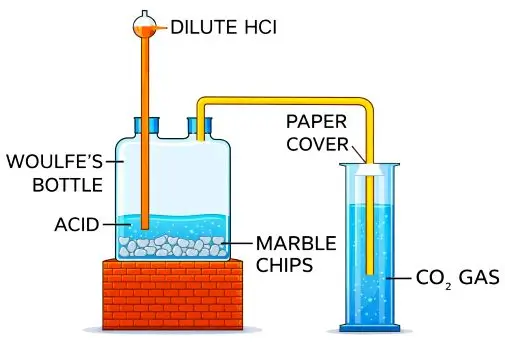
(c) How will you collect CO2 gas in the laboratory?
(d) Draw a labelled diagram for the preparation of CO2 in the laboratory.
(e) Why is sulphuric acid not used for the preparation of carbon dioxide in the laboratory?
(f) Give a chemical test for carbon dioxide.
Answer:
(a) Chemicals required:
- Marble chips (calcium carbonate – CaCO₃)
- Dilute hydrochloric acid (dil. HCl)
(b) Balanced chemical equation:
CaCO₃ + 2HCl → CaCl₂ + H₂O + CO₂
(c) Carbon dioxide is collected by downward displacement of air because it is heavier than air and slightly soluble in water.
(d) Labelled diagram:
(d) Sulphuric acid forms insoluble calcium sulphate (CaSO₄), which coats the marble chips and stops the reaction.
CaCO3 + H2SO4 ⟶ CaSO4 + H2O + CO2 (g)
(e) Carbon dioxide turns lime water milky due to the formation of calcium carbonate.
Ca(OH)2 + CO2 ⟶ CaCO3 + H2O
Question 2
What is a fire extinguisher? What is the substance used in the modern type of fire extinguishers? How is it an improvement over the soda-acid and foam-type fire extinguishers?
Answer:
A fire extinguisher is a device used to put out small fires by spraying a substance that stops burning.
The substance used in modern fire extinguishers is carbon dioxide (CO₂).
It is an improvement over soda-acid and foam-type fire extinguishers because:
- Carbon dioxide does not conduct electricity, so it is safe for electrical fires.
- It does not leave any residue, so it does not damage electrical equipment.
- It quickly cuts off the supply of oxygen and cools the fire.
Question 3
Explain the term ‘greenhouse effect’. What are its benefits? How is it harmful?
Answer:
Greenhouse Effect:
The greenhouse effect is the process by which gases like carbon dioxide (CO₂), methane, and water vapour trap heat in the Earth’s atmosphere and prevent it from escaping into space, thereby warming the Earth.
Benefits of the Greenhouse Effect:
- It keeps the Earth warm enough to support life.
- It maintains a suitable temperature for plants, animals, and humans.
- It prevents extreme temperature differences between day and night.
Harmful Effects (When Excessive):
- Causes global warming (rise in Earth’s temperature).
- Leads to melting of glaciers and polar ice caps.
- Causes rise in sea level.
- Results in climate change, floods, droughts, and extreme weather conditions.
Question 4
(a) State three ways by which carbon dioxide gas is added into the atmosphere.
(b) What steps should be taken to balance carbon dioxide in the atmosphere?
Answer:
(a) The three ways by which carbon dioxide gas is added into the atmosphere are:
- Burning of fossil fuels like coal, petrol, and diesel.
- Respiration by living organisms.
- Decay of plants and animals (decomposition)
(b) The steps taken to balance carbon dioxide in the atmosphere are:
- Plant more trees (afforestation) and prevent cutting of forests (deforestation).
- Reduce the use of fossil fuels and use renewable energy sources like solar and wind energy.
- Control industrial emissions and promote cleaner technologies.
Exercise (IV) : (A) Objective Type Questions
Question 1
Fill in the blanks:
(a) …………… is formed when carbon is burnt in a limited supply of air or oxygen.
(b) Carbon monoxide burns in air with a …………… flame to form carbon dioxide.
(c) Carbon monoxide is a product of …………… combustion.
(d) A mixture of 95% oxygen and 5% carbon dioxide is called ……………
(e) Carbon monoxide is used as a …………… in the extraction of pure metals from their corresponding ores.
Answer:
(a) Carbon monoxide is formed when carbon is burnt in a limited supply of air or oxygen.
(b) Carbon monoxide burns in air with a pale blue flame to form carbon dioxide.
(c) Carbon monoxide is a product of incomplete combustion.
(d) A mixture of 95% oxygen and 5% carbon dioxide is called Carbogen.
(e) Carbon monoxide is used as a reducing agent in the extraction of pure metals from their corresponding ores.
Question 2
The following questions are Assertion-Reason based questions. Choose the answer based on the codes given below.
Question 2(i)
Assertion (A): Carbon can form a large number of compounds, most of which are studied under organic chemistry.
Reason (R): Carbon atoms can form long chains with each other.
(a) Both A and R are true and R is the correct explanation of A.
(b) Both A and R are true but R is not the correct explanation of A.
(c) A is true but R is false.
(d) A is false but R is true.
Answer:
(a) Both A and R are true and R is the correct explanation of A.
Explanation:
Carbon shows catenation, meaning carbon atoms can join with each other to form long chains and rings. Because of this property, carbon forms a very large number of compounds studied in organic chemistry.
Question 2(ii)
Assertion (A): Coal is used as a fuel for domestic purposes and industries.
Reason (R): Coal is an amorphous form of carbon.
(a) Both A and R are true and R is the correct explanation of A.
(b) Both A and R are true but R is not the correct explanation of A.
(c) A is true but R is false.
(d) A is false but R is true.
Answer:
(b) Both A and R are true but R is not the correct explanation of A.
Explanation:
Coal is used as a fuel because it produces a large amount of heat on burning. Although coal is an amorphous form of carbon, this is not the reason for its use as a fuel.
Question 2(iii)
Assertion (A): Diamond and graphite are crystalline allotropes of carbon.
Reason (R): Both diamond and graphite are good conductors of electricity and are used as gems.
(a) Both A and R are true and R is the correct explanation of A.
(b) Both A and R are true but R is not the correct explanation of A.
(c) A is true but R is false.
(d) A is false but R is true.
Answer:
(c) A is true but R is false.
Explanation:
Diamond and graphite are crystalline allotropes of carbon, which is correct. However, both are not good conductors of electricity—only graphite conducts electricity, while diamond does not. Also, graphite is not used as a gem.
Question 2(iv)
Assertion (A): The value of diamond decreases with an increase in the impurities.
Reason (R): Colourless, transparent diamonds are the costliest.
(a) Both A and R are true and R is the correct explanation of A.
(b) Both A and R are true but R is not the correct explanation of A.
(c) A is true but R is false.
(d) A is false but R is true.
Answer:
(a) Both A and R are true and R is the correct explanation of A.
Explanation:
Pure diamonds are colourless and transparent, which makes them more valuable. The presence of impurities gives colour and reduces clarity, decreasing their value.
Question 2(v)
Assertion (A): Pencil leads are made up of graphite.
Reason (R): Graphite leaves a black mark on paper.
(a) Both A and R are true and R is the correct explanation of A.
(b) Both A and R are true but R is not the correct explanation of A.
(c) A is true but R is false.
(d) A is false but R is true.
Answer:
(a) Both A and R are true and R is the correct explanation of A.
Explanation:
Pencil leads are made of graphite because its layers are soft and easily rub off onto paper, leaving a black mark.
Question 2(vi)
Assertion (A): Carbon dioxide is used in fire extinguishers.
Reason (R): CO2 gas is a non supporter of combustion, which cuts off the supply of oxygen to fire.
(a) Both A and R are true and R is the correct explanation of A.
(b) Both A and R are true but R is not the correct explanation of A.
(c) A is true but R is false.
(d) A is false but R is true.
Answer:
(a) Both A and R are true and R is the correct explanation of A.
Explanation:
Carbon dioxide does not support combustion. It forms a layer over the fire and cuts off the supply of oxygen, which helps extinguish the fire.
Question 2(vii)
Assertion (A): Carbon monoxide is an extremely poisonous gas.
Reason (R): The gas is formed due to incomplete combustion of carbon.
(a) Both A and R are true and R is the correct explanation of A.
(b) Both A and R are true but R is not the correct explanation of A.
(c) A is true but R is false.
(d) A is false but R is true.
Answer:
(b) Both A and R are true but R is not the correct explanation of A.
Explanation:
Carbon monoxide is extremely poisonous because it combines with haemoglobin in blood to form carboxyhaemoglobin, preventing oxygen transport. Although it is produced by incomplete combustion, this does not explain why it is poisonous.
Exercise (IV) : (B) Short Answer Type Questions
Question 1
How is carbon monoxide gas formed? Give a balanced equation for the reaction.
Answer:
Carbon monoxide is formed when carbon burns in a limited supply of oxygen (incomplete combustion).
Balanced equation:
2C + O₂ ⟶ 2CO
Question 2
Give one use of carbon monoxide.
Answer:
Carbon monoxide is used as a reducing agent in the extraction of metals from their ores (for example, in the extraction of iron).
Question 3
Write two remedies for carbon monoxide poisoning.
Answer:
- The affected person should be immediately moved to fresh air.
- The person should be given pure oxygen or carbogen (95% oxygen + 5% carbon dioxide).
Question 4
Complete the chemical equations and balance them.
(a) CuO + CO ⟶
(b) Fe2O3 + CO ⟶
Answer:
(a) CuO + CO \(\xrightarrow\triangle\) Cu + CO₂
(b) Fe₂O₃ + 3CO \(\xrightarrow\triangle\) 2Fe + 3CO₂
Question 5
Match the following:
| Column A | Column B |
| 1. A product of incomplete burning | (a) Hopcolite |
| 2. Nature of carbon monoxide | (b) Combustible gas |
| 3. A compound formed by the combination of haemoglobin and carbon monoxide | (c) Carboxyhaemoglobin |
| 4. A mixture of metallic oxides | (d) Carbon monoxide |
| 5. Carbon monoxide | (e) Highly poisonous |
Answer:
| Column A | Column B |
| 1. A product of incomplete burning | (d) Carbon monoxide |
| 2. Nature of carbon monoxide | (e) Highly poisonous |
| 3. A compound formed by the combination of haemoglobin and carbon monoxide | (c) Carboxyhaemoglobin |
| 4. A mixture of metallic oxides | (a) Hopcolite |
| 5. Carbon monoxide | (b) Combustible gas |
Exercise (IV) : (C) Long Answer Type Questions
Question 1
Explain the poisonous nature of carbon monoxide.
Answer:
Carbon monoxide is highly poisonous because it combines with haemoglobin in the blood to form carboxyhaemoglobin. This compound prevents haemoglobin from carrying oxygen to body tissues. As a result, the body suffers from oxygen deficiency, which can lead to suffocation and death.
Question 2
Why is carbon monoxide called the silent killer?
Answer:
Carbon monoxide is called the silent killer because it is a colourless, odourless and tasteless gas. Since it cannot be detected by human senses, people may inhale it unknowingly, leading to serious poisoning or death.
Question 3
Explain the reducing action of carbon monoxide with a suitable example.
Answer:
Carbon monoxide acts as a reducing agent because it removes oxygen from metal oxides and converts them into pure metals, while itself getting oxidized to carbon dioxide.
Example:
CuO + CO ⟶ Cu + CO₂
In this reaction, copper oxide loses oxygen and is reduced to copper, while carbon monoxide gains oxygen and becomes carbon dioxide.
Download ICSE Class 8 Chemistry Chapter 9 Carbon and Its Compounds Selina Solutions PDF
Students looking for complete ICSE Class 8 Chemistry Chapter 9 Carbon and Its Compounds Selina Solutions PDF can use these notes for revision, homework, and exam preparation.
Practice all exercise questions regularly to score better marks in ICSE examinations.
Conclusion
Chapter 9, Carbon and Its Compounds, introduces students to one of the most significant elements in chemistry. Understanding the properties, allotropes, and compounds of carbon helps students develop a strong scientific foundation. The ICSE Class 8 Chemistry Chapter 9 Carbon and Its Compounds Selina Solutions serve as an excellent study resource for mastering the chapter and achieving success in examinations.
ICSE Class 8 Chemistry Selina Solutions
The Selina Concise Chemistry Class 8 book includes the following chapters:
Official Website:
Students can visit the official CISCE website for more details and updates.