Introduction
Are you searching for ICSE Class 8 Chemistry Chapter 2 Physical and Chemical Changes Selina Solutions? This chapter explains the difference between physical and chemical changes, reversible and irreversible changes, evaporation, boiling, and several daily-life examples. Here you will get easy explanations and detailed answers for better exam preparation.
Study Support by Rohit Academy
Rohit Academy offers expert-curated ICSE Class 8 Chemistry Study Materials including ICSE Physical and Chemical Changes Selina Solutions, diagrams, and key formulas for better understanding.
You can also visit :
| ☛ ICSE Class 8 Chemistry Chapter 2: Physical and Chemical Changes Notes |
| ☛ ICSE Class 8 Physics |
| ☛ ICSE Class 8 Chemistry |
| ☛ ICSE Class 8 Mathematics |
| ☛ ICSE Class 8 Biology |
(A) Multiple Choice Type
Question 1
Choose the correct answer from the multiple choices given below.
Question 1(i)
Which of the following is a non-periodic change?
(a) Change of day and night
(b) Change of seasons
(c) Landslides
(d) Full moon and new moon nights
Answer:
(c) Landslides
Explanation:
Landslides do not occur at regular intervals, so they are non-periodic changes.
Question 1(ii)
Burning of a piece of paper into ash is a:
(a) periodic change
(b) natural change
(c) reversible change
(d) permanent change
Answer:
(d) Permanent change
Explanation:
Burning paper forms ash and gases, and the original paper cannot be obtained again.
Question 1(iii)
Which of the following is a slow change?
(a) Rusting of iron
(b) Burning of wood
(c) Burning of a cracker
(d) Switching on a fan
Answer:
(a) Rusting of iron
Explanation:
Rusting takes a long time to occur, so it is a slow change.
Question 1(iv)
Which of the following is a physical change?
(a) Cooking of food
(b) Formation of curd
(c) A glass cut into pieces
(d) Boiling of eggs
Answer:
(c) A glass cut into pieces
Explanation:
Only the shape and size change, and no new substance is formed.
Question 1(v)
In a chemical change :
(a) a new substance is formed
(b) energy is either released or absorbed
(c) the change is irreversible (d) all of the above
Answer:
(d) All of the above
Explanation:
In a chemical change, a new substance forms, energy may be released or absorbed, and the change is usually irreversible.
Assertion Reason Type
Question 2(i)
Assertion (A): The changes which result in the formation of new substances with entirely different composition and properties are called chemical changes.
Reason (R): Chemical changes are permanent and irreversible.
(a) Both A and R are true and R is the correct explanation of A.
(b) Both A and R are true but R is not the correct explanation of A.
(c) A is true but R is false.
(d) A is false but R is true.
Answer:
(a) Both A and R are true and R is the correct explanation of A.
Explanation:
Assertion (A) is true because a chemical change produces a new substance with different composition and properties. Reason (R) is also true because chemical changes are permanent and irreversible. Since chemical changes form new substances that cannot be changed back easily, R correctly explains A.
Question 2(ii)
Assertion (A): When a change in a substance can be reversed by changing the conditions, it is said to be a reversible and temporary change.
Reason (R): Burning a piece of paper is a reversible change.
(a) Both A and R are true and R is the correct explanation of A.
(b) Both A and R are true but R is not the correct explanation of A.
(c) A is true but R is false.
(d) A is false but R is true.
Answer:
(c) A is true but R is false.
Explanation:
A reversible change can be reversed by changing conditions. Burning paper cannot be reversed, so it is not a reversible change.
Question 2(iii)
Assertion (A): Sublimation of camphor is a physical change.
Reason (R): No new substance is formed.
(a) Both A and R are true and R is the correct explanation of A.
(b) Both A and R are true but R is not the correct explanation of A.
(c) A is true but R is false.
(d) A is false but R is true.
Answer:
(a) Both A and R are true and R is the correct explanation of A.
Explanation:
In sublimation of camphor, no new substance forms, so it is a physical change.
Question 2(iv)
Assertion (A): For rust formation to take place, iron must be exposed to air and water for some time.
Reason (R): Rust is a reddish brown substance formed on the surface of iron.
(a) Both A and R are true and R is the correct explanation of A.
(b) Both A and R are true but R is not the correct explanation of A.
(c) A is true but R is false.
(d) A is false but R is true.
Answer:
(b) Both A and R are true but R is not the correct explanation of A.
Explanation:
Rust forms when iron reacts with air and water, but the reason only describes what rust is, not why it forms.
Question 2(v)
Assertion (A): Burning of a candle is a physical change.
Reason (R): When a candle burns, some of its wax melts and gets solidified on cooling. Also carbon dioxide and water vapour are formed which cannot be recovered easily and converted back into the candle.
(a) Both A and R are true and R is the correct explanation of A.
(b) Both A and R are true but R is not the correct explanation of A.
(c) A is true but R is false.
(d) A is false but R is true.
Answer:
(d) A is false but R is true.
Explanation:
Burning of a candle is mainly a chemical change because carbon dioxide and water vapour are formed.
Fill in the blanks
Question 3
Fill in the blanks:
(a) The process of a liquid changing into a solid is called …………… .
(b) A change which alters the composition of a substance is known as a …………… change.
(c) There is no change in the …………… of the substance during a physical change.
(d) The reaction in which energy is evolved is called …………… .
(e) The process in which a substance in solid state directly changes into …………… is called sublimation.
Answer:
(a) The process of a liquid changing into a solid is called freezing.
(b) A change which alters the composition of a substance is known as a chemical change.
(c) There is no change in the composition of the substance during a physical change.
(d) The reaction in which energy is evolved is called an exothermic reaction.
(e) The process in which a substance in solid state directly changes into vapour (gas) is called sublimation.
Match the following
Question 3
Match the following:
| Column A | Column B |
| (a) Freezing of water | (i) Natural change |
| (b) Change of seasons | (ii) Chemical change |
| (c) Burning of wood | (iii) Physical change |
| (d) Permanent change | (iv) Sublimation |
| (e) Heating of solid camphor | (v) Fast process |
Answer:
| Column A | Column B |
| (a) Freezing of water | (iii) Physical change |
| (b) Change of seasons | (i) Natural change |
| (c) Burning of wood | (v) Fast process |
| (d) Permanent change | (ii) Chemical change |
| (e) Heating of solid camphor | (iv) Sublimation |
Question 4
Name the following:
(a) The solid formed when vapours of a sublimable substance cool down.
(b) The compound formed when magnesium burns in air.
Answer:
(a) Sublimate
(b) Magnesium Oxide (MgO)
Question 5
Write true or false against the following statements and correct the false ones.
(a) Heating of an iron rod is a chemical change.
(b) Condensation of steam is not a chemical change.
(c) Rusting of iron is a fast change.
(d) A physical change is reversible.
(e) There is a change in the mass of a substance in a physical change.
Answer:
(a) False
Correct Statement : Heating of an iron rod is a physical change.
(b) True
(c) False
Correct Statement : Rusting of iron is a slow change.
(d) True
(e) False
Correct Statement : There is no change in the mass of a substance in a physical change.
Question 6
Classify the following changes as a physical or a chemical change:
(a) Drying of wet clothes
(b) Curdling of milk
(c) Butter getting rancid
(d) Boiling of water
(e) Burning of paper
(f) Melting of wax
(g) Burning of coal
(h) Formation of clouds
(i) Rusting of iron
(j) Roasting of potatoes
(k) Formation of alloys
(l) Making of a sugar solution
(m) Glowing of an electric bulb
(n) Manufacture of salt from sea water.
Answer:
(a) Drying of wet clothes – Physical change
(b) Curdling of milk – Chemical change
(c) Butter getting rancid – Chemical change
(d) Boiling of water – Physical change
(e) Burning of paper – Chemical change
(f) Melting of wax – Physical change
(g) Burning of coal – Chemical change
(h) Formation of clouds – Physical change
(i) Rusting of iron – Chemical change
(j) Roasting of potatoes – Chemical change
(k) Formation of alloys – Physical change
(l) Making of a sugar solution – Physical change
(m) Glowing of an electric bulb – Physical change
(n) Manufacture of salt from sea water – Physical change
(B) Short Answer Type Questions
Question 1
Give one example of the following changes:
(a) Natural, non-periodic change
(b) Natural, periodic change
(c) Irreversible, physical change
(d) A chemical change in which energy is absorbed.
(e) A man-made fast change.
(f) A process in which both physical and chemical changes take place simultaneously.
Answer:
(a) Earthquakes
(b) Change of day and night
(c) Breaking of a glass
(d) Photosynthesis
(e) Cooking of food
(f) Burning of candle
Question 2
Define:
(a) Physical change
(b) Chemical change
Answer:
(a) Physical Change:
A physical change is a change in which only the shape, size, or state of a substance changes, but no new substance is formed. The substance remains the same and the change is usually reversible.
Example: Melting of ice into water.
(b) Chemical Change:
A chemical change is a change in which one or more new substances with different properties are formed. This change is usually permanent and irreversible.
Example: Burning of a candle or rusting of iron.
Question 3
(a) Differentiate between Periodic and non-periodic changes.
(b) Differentiate between Reversible and irreversible changes.
(c) Differentiate between Slow and fast changes.
Answer:
(a) Difference between Periodic and Non-periodic Changes:
(b) Difference between Reversible and Irreversible Changes:
| Reversible Changes | Irreversible Changes |
| 1. Changes that can be reversed to obtain the original substance. | 1. Changes that cannot be reversed to get the original substance. |
| 2. Usually temporary changes. | 2. Usually permanent changes. |
| 3. Example: Melting of ice. | 3. Example: Burning of paper. |
(c) Difference between Slow and Fast Changes:
| Slow Changes | Fast Changes |
| 1. Changes that take a long time to occur. | 1. Changes that occur in a short time. |
| 2. The change happens gradually. | 2. The change happens quickly or suddenly. |
| 3. Example: Rusting of iron. | 3. Example: Burning of a matchstick. |
Question 4
Give reasons:
(a) Freezing of water is a physical change.
(b) Evaporation of water is a physical change.
(c) Burning of paper is a chemical change.
(d) Cutting of a cloth piece is a physical change, although it cannot be reversed.
(e) An inflated balloon bursts when brought near a lit bulb.
(f) Sublimation of camphor is a physical change.
Answer:
(a) Freezing of water is a physical change because only the state changes from liquid to solid and no new substance is formed.
(b) Evaporation of water is a physical change because water changes from liquid to vapour and its composition remains the same.
(c) Burning of paper is a chemical change because new substances like ash, carbon dioxide and smoke are formed.
(d) Cutting of a cloth piece is a physical change because only the size and shape change and no new substance is formed.
(e) An inflated balloon bursts near a lit bulb because the heat from the bulb expands the air inside the balloon, causing it to burst.
(f) Sublimation of camphor is a physical change because it changes directly from solid to vapour without forming a new substance.
(C) Long Answer Type Questions
Question 1
State the characteristics of physical changes.
Answer:
Characteristics of Physical Changes:
- No new substance is formed.
- Only the shape, size or state of the substance changes.
- The chemical composition remains the same.
- The change is usually reversible.
- Very little energy is absorbed or released.
Question 2
State the characteristics of chemical changes.
Answer:
Characteristics of Chemical Changes:
- A new substance is formed with different composition and properties.
- The change is permanent and usually irreversible.
- Energy is either released or absorbed (heat, light, etc.).
- There may be change in colour or smell.
- Sometimes gas is evolved or a precipitate is formed.
Question 3
Why is burning of a candle an example of both a physical and a chemical change?
Answer:
When a candle is lighted, it produces carbon dioxide and water vapour as new substances and heat and light are released, which indicates a chemical change. At the same time, the wax of the candle melts and the melted wax solidifies again on cooling, which is a physical change. Therefore, burning of a candle involves both physical and chemical changes.
Question 4
Give four differences between physical and chemical changes.
Answer:
Differences between Physical Change and Chemical Change:
| Physical Change | Chemical Change |
| No new substance is formed | New substance is formed |
| Chemical composition remains the same | Chemical composition changes |
| Temporary and reversible | Permanent and irreversible |
| No change in mass | Usually change in mass |
| Original substance can be obtained back easily | Original substance cannot be obtained easily |
Question 5
Name the terms marked as A, B, C, D and E in the following and state the type of changes.
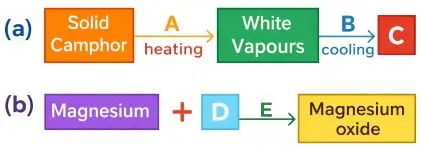
In which of the above changes does a gain in mass take place?
Answer:
- A → Sublimation
- B → Deposition
- C → Solid Camphor
- D → Air
- E → heat
Gain in mass takes place in the second case of Magnesium combining with air (O2) to form Magnesium oxide.
Download ICSE Class 8 Chemistry Chapter 2 Physical and Chemical Changes Selina Solutions PDF
Students looking for complete ICSE Class 8 Chemistry Chapter 2 Physical and Chemical Changes Selina Solutions PDF can use these notes for revision, homework, and exam preparation.
Practice all exercise questions regularly to score better marks in ICSE examinations.
Conclusion
ICSE Class 8 Chemistry Chapter 2 Physical and Chemical Changes Selina Solutions provides a clear understanding of physical changes, chemical changes, evaporation, boiling, and different types of changes. Proper revision of this chapter will help students perform well in school exams and build a strong foundation in Chemistry.
ICSE Class 8 Chemistry Selina Solutions
The Selina Concise Chemistry Class 8 book includes the following chapters:
Official Website:
Students can visit the official CISCE website for more details and updates.