Introduction
Are you looking for ICSE Class 8 Chemistry Chapter 3 Elements, Compounds and Mixtures Selina Solutions? This chapter is one of the most important topics in ICSE Class 8 Chemistry because it explains the difference between elements, compounds, and mixtures, their properties, and examples. Students often get questions from this chapter in school examinations and tests.
In this article, you will get Selina solutions, important notes, definitions, examples, and exam-oriented explanations for Chapter 3.
Study Support by Rohit Academy
Rohit Academy offers expert-curated ICSE Class 8 Chemistry Study Materials including ICSE Elements, Compounds and Mixtures Selina Solutions, diagrams, and key formulas for better understanding.
You can also visit :
| ☛ ICSE Class 8 Chemistry Chapter 3: Elements, Compounds and Mixtures Notes |
| ☛ ICSE Class 8 Physics |
| ☛ ICSE Class 8 Chemistry |
| ☛ ICSE Class 8 Mathematics |
| ☛ ICSE Class 8 Biology |
Exercise (I) — (A) Objective Type Questions
Question 1
Choose the correct answer from the multiple choices given below.
Question 1(i)
The symbol of Beryllium is :
(a) B (b) Ba
(c) Be (d) Br
Answer:
(c) Be
Explanation:
Every element has a chemical symbol. The symbol of Beryllium is Be.
Question 1(ii)
Which of the following is a pair of metalloids ?
(a) Na and Mg (b) B and Si
(c) C and P (d) He and Ar
Answer:
(b) B and Si
Explanation:
Metalloids have properties of both metals and non-metals.
Examples: Boron (B), Silicon (Si), Arsenic, Antimony.
Question 1(iii)
Which of the following properties is not shown by compounds ?
(a) They are heterogeneous.
(b) They are homogeneous.
(c) They have definite molecular formulae.
(d) They have fixed melting and boiling points.
Answer:
(a) They are heterogeneous
Explanation:
Compounds are homogeneous substances with a fixed composition and definite formula.
They also have fixed melting and boiling points.
Question 1(iv)
Which of the following elements has atomicity 4?
(a) Iodine (b) Ozone
(c) Phosphorus (d) Sulphur
Answer:
(c) Phosphorus
Explanation:
Atomicity = number of atoms in one molecule of an element.
Phosphorus has atomicity 4.
Question 1(v)
A molecule is the smallest unit of :
(a) an element
(b) a compound
(c) a mixture
(d) an ion
Answer:
(b) a compound
Explanation:
A molecule is the smallest particle of a compound that can exist independently and shows all the properties of that compound.
Question 1(vi)
Which of the following substances dissolves in carbon disulphide?
(a) Iron (b) Sulphur
(c) Sodium chloride (d) Iron sulphide
Answer:
(b) Sulphur
Explanation:
Sulphur dissolves in carbon disulphide (CS₂).
This property is used to separate sulphur from mixtures.
Question 2
Name:
(a) a soft metal
(b) a metal which is brittle
(c) a non-metal which is lustrous
(d) a liquid metal
(e) a metal which is a poor conductor of electricity
(f) a non-metal which is a good conductor of electricity
(g) a liquid non-metal
(h) the hardest naturally occurring substance
(i) an inert gas
Answer:
(a) A soft metal: Sodium
(b) A metal which is brittle: Zinc
(c) A non-metal which is lustrous: Iodine
(d) A liquid metal: Mercury
(e) A metal which is a poor conductor of electricity: Lead
(f) A non-metal which is a good conductor of electricity: Graphite (Carbon)
(g) A liquid non-metal: Bromine
(h) The hardest naturally occurring substance: Diamond
(i) An inert gas: Helium
Exercise (I) — (B) Short Answer Type Questions
Question 1
Give two examples for each of the following:
(a) Metals
(b) Non-metals
(c) Metalloids
(d) Inert gases
Answer:
(a) Metals:
- Iron
- Copper
(b) Non-metals:
- Oxygen
- Sulphur
(c) Metalloids:
- Boron
- Silicon
(d) Inert gases:
- Helium
- Neon
Question 2
Write the chemical names of the following and also give their molecular formulae:
(a) Baking soda
(b) Vinegar
(c) Marble
(d) Sand
Answer:
(a) Baking soda:
- Chemical name: Sodium hydrogen carbonate (Sodium bicarbonate)
- Molecular formula: NaHCO₃
(b) Vinegar:
- Chemical name: Acetic acid
- Molecular formula: CH₃COOH
(c) Marble:
- Chemical name: Calcium carbonate
- Molecular formula: CaCO₃
(d) Sand:
- Chemical name: Silicon dioxide (Silica)
- Molecular formula: SiO₂
Question 3
Define:
(a) Elements
(b) Compounds
Answer:
(a) Elements:
An element is a pure substance made up of only one kind of atom and cannot be broken down into simpler substances by chemical methods.Example: Iron, Oxygen, Gold.
(b) Compounds:
A compound is a pure substance formed when two or more elements combine chemically in a fixed proportion.
Example: Water (H₂O), Carbon dioxide (CO₂).
Question 4
Why is iron sulphide a compound?
Answer:
Iron sulphide is a compound because:
- It is formed by the chemical combination of iron and sulphur.
- The elements combine in a fixed ratio by mass.
- The properties of iron sulphide are completely different from those of iron and sulphur.
- The components cannot be separated by physical methods.
Question 5
Differentiate between:
(a) Pure and impure substances
(b) Homogeneous and heterogeneous substances
Answer:
(a) Difference between Pure and impure substances:
| Pure Substances | Impure Substances (Mixtures) |
| Made of only one kind of substance. | Made of two or more substances mixed together. |
| Have fixed composition and definite properties. | Composition is not fixed and properties may vary. |
| Cannot be separated by physical methods. | Components can be separated by physical methods. |
| Example: Water, Oxygen, Gold | Example: Air, Salt solution, Soil |
(b) Difference between Homogeneous and heterogeneous substances:
| Homogeneous Substances | Heterogeneous Substances |
| Composition is uniform throughout. | Composition is not uniform. |
| Components cannot be seen separately. | Components can be seen separately. |
| Example: Salt in water, Sugar solution | Example: Sand in water, Oil and water |
Exercise (I) — (C) Long Answer Type Questions
Question 1
How is sodium chloride different from its constituent elements? Explain.
Answer:
The properties of sodium chloride are completely different from those of sodium and chlorine. Sodium is a soft and highly reactive metal, while chlorine is a poisonous greenish-yellow gas with a choking smell. However, sodium chloride is a white crystalline solid that is non-poisonous and useful. It is commonly used in our food as a mineral and to improve taste.
Question 2
State four differences between elements and compounds.
Answer:
| Elements | Compounds |
| An element is a pure substance made up of only one kind of atom. | A compound is a pure substance formed by two or more elements chemically combined in a fixed proportion. |
| Elements cannot be broken down into simpler substances by chemical methods. | Compounds can be broken down into simpler substances (elements) by chemical methods. |
| Represented by chemical symbols. | Represented by chemical formulae. |
| Example: Iron (Fe), Oxygen (O). | Example: Water (H2O), Sodium chloride (NaCl). |
Exercise (II) — (A) Objective Type Questions
Question 1
Choose the correct answer from the multiple choices given below.
Question 1(i)
A mixture of sand and ammonium chloride can be separated by:
(a) filtration (b) distillation
(c) sublimation (d) crystallisation
Answer:
(c) sublimation
Explanation:
When the mixture is heated, ammonium chloride turns into vapour and separates, while sand remains behind because it does not sublime. The vapour then cools and forms solid ammonium chloride again.
Question 1(ii)
A solvent for iodine is :
(a) water (b) kerosene oil
(c) alcohol (d) petrol
Answer:
(c) Alcohol
Explanation:
Iodine is sparingly soluble in water but dissolves well in alcohol.
When iodine dissolves in alcohol, it forms a brown coloured solution called tincture of iodine.
Question 1(iii)
This gas is highly soluble in water :
(a) Ammonia (b) Nitrogen
(c) Oxygen (d) Carbon monoxide
Answer:
(a) Ammonia
Explanation:
Ammonia gas dissolves very easily in water to form ammonium hydroxide solution.
Question 1(iv)
Which of the following methods is used to separate potassium nitrate and sodium chloride from their mixture?
(a) distillation
(b) crystallisation
(c) fractional distillation
(d) fractional crystallisation
Answer:
(d) fractional crystallisation
Explanation:
Potassium nitrate and sodium chloride have different solubilities in water.
On cooling their solution, one salt crystallises first while the other remains dissolved. This method of separation is called fractional crystallisation.
Question 1(v)
Which method is used to separate the components of crude petroleum ?
(a) distillation (b) crystallisation
(c) chromatography (d) fractional distillation
Answer:
(d) Fractional distillation
Explanation:
Crude petroleum contains many liquids with different boiling points such as petrol, diesel, kerosene, etc.
They are separated in a fractionating column using fractional distillation, where each component condenses at a different temperature.
Exercise (II) — Assertion Reason Type
Question 2
The following questions are Assertion-Reason based questions. Choose the answer based on the codes given below.
Question 2(i)
Assertion (A): Elements and compounds are pure substances.
Reason (R): Elements and compounds are made up of only one kind of atoms and molecules respectively.
(a) Both A and R are true and R is the correct explanation of A.
(b) Both A and R are true but R is not the correct explanation of A.
(c) A is true but R is false.
(d) A is false but R is true.
Answer:
(a) Both A and R are true and R is the correct explanation of A.
Explanation:
Elements contain only one type of atom and compounds contain only one type of molecule, so they are pure substances.
Question 2(ii)
Assertion (A): Mixtures are impure substances made up of two or more kinds of elements and compounds mixed together in any proportion.
Reason (R): Homogeneous mixtures have a uniform composition throughout their bulk.
(a) Both A and R are true and R is the correct explanation of A.
(b) Both A and R are true but R is not the correct explanation of A.
(c) A is true but R is false.
(d) A is false but R is true.
Answer:
(b) Both A and R are true but R is not the correct explanation of A.
Explanation:
Mixtures are impure substances made of two or more substances in any proportion.
The reason talks about homogeneous mixtures having uniform composition, which is true but does not explain why mixtures are impure.
Question 2(iii)
Assertion (A): All compounds contain more than one type of element in their molecules.
Reason (R) : Compounds can be homogeneous or heterogeneous.
(a) Both A and R are true and R is the correct explanation of A.
(b) Both A and R are true but R is not the correct explanation of A.
(c) A is true but R is false.
(d) A is false but R is true.
Answer:
(c) A is true but R is false.
Explanation:
Compounds always contain two or more different elements chemically combined.
But compounds are always homogeneous, not heterogeneous. So the reason is false.
Question 2(iv)
Assertion (A): Metalloids are the elements showing some properties of metals and some properties of non-metals.
Reason (R): Metalloids are hard solids.
(a) Both A and R are true and R is the correct explanation of A.
(b) Both A and R are true but R is not the correct explanation of A.
(c) A is true but R is false.
(d) A is false but R is true.
Answer:
(b) Both A and R are true but R is not the correct explanation of A.
Explanation:
Metalloids show properties of both metals and non-metals.
They are generally hard solids, but this does not explain why they show both properties.
Question 2(v)
Assertion (A): Chromatography is the latest technique to separate the components of a mixture when all the components are different in their properties.
Reason (R): Components of ink are separated by chromatography.
(a) Both A and R are true and R is the correct explanation of A.
(b) Both A and R are true but R is not the correct explanation of A.
(c) A is true but R is false.
(d) A is false but R is true.
Answer:
(d) A is false but R is true.
Explanation:
Chromatography is not necessarily the latest technique, so Assertion (A) is false.
However, components of ink can be separated by chromatography, so Reason (R) is true.
Exercise (II) — Fill in the blanks
Question 3
Fill in the blanks:
(a) Brass is a solid-solid …………… mixture.
(b) The method used to separate sawdust and sand is …………… .
(c) Kerosene oil and water are …………… liquids.
(d) Atomicity is the number of atoms in a molecule of …………… .
Answer:
(a) Brass is a solid–solid homogeneous mixture.
(b) The method used to separate sawdust and sand is gravity separation method.
(c) Kerosene oil and water are heterogeneous liquids.
(d) Atomicity is the number of atoms in a molecule of an element.
Exercise (II) — True or False
Question 4
Write true or false against the following statements.
(a) The elements present in a compound can be obtained by simple physical methods.
(b) The properties of components are retained in a mixture.
(c) Common salt is separated from sea water by evaporation.
(d) A mixture has a definite chemical formula.
Answer:
(a) False
Correct Statement : The elements present in a compound cannot be obtained by simple physical methods.
(b) True
(c) True
(d) False
Correct Statement : A mixture has no definite chemical formula.
Exercise (II) — Match the following
Question 5
Match the following columns.
| Column A | Column B |
| (a) Solid + Liquid mixture | (i) Krypton |
| (b) Filtration | (ii) Pure substance |
| (c) Chromatography | (iii) Salt and water |
| (d) Compounds | (iv) Residue |
| (e) Inert gas | (v) Components of ink |
Answer:
| Column A | Column B |
| (a) Solid + Liquid mixture | (iii) Salt and water |
| (b) Filtration | (iv) Residue |
| (c) Chromatography | (v) Components of ink |
| (d) Compounds | (ii) Pure substance |
| (e) Inert gas | (i) Krypton |
Question 6
Classify the following substances into compounds and mixtures:
Carbon dioxide, air, water, milk, common salt, blood, fruit juice, sugar, iron sulphide, brass.
Answer:
- Compounds : Carbon dioxide, Iron sulphide, Water, Common Salt, sugar.
- Mixtures : Air, Milk, Fruit Juice, blood, brass.
Question 7
Give one example for each of the following types of mixtures.
(a) solid-solid homogeneous mixture
(b) solid-liquid heterogeneous mixture
(c) miscible liquids
(d) liquid-gas homogeneous mixture
Answer:
(a) Solid–solid homogeneous mixture: Brass
(b) Solid–liquid heterogeneous mixture: Sand in water
(c) Miscible liquids: Alcohol and water
(d) Liquid–gas homogeneous mixture: Soda water (carbon dioxide in water)
Exercise (II) — (B) Short Answer Type Questions
Question 1
Define :
(a) A mixture
(b) Crystallisation
(c) Distillation
Answer:
(a) Mixture:
A mixture is a substance formed when two or more substances are physically combined in any proportion without any chemical reaction.
(b) Crystallisation:
Crystallisation is the process of obtaining pure solid crystals from a solution by cooling or evaporating the solvent.
(c) Distillation:
Distillation is a method used to separate a liquid from a mixture by heating it to form vapour and then cooling the vapour to get the liquid back.
Question 2
Differentiate between:
(a) A residue and a sediment.
(b) A filtrate and a distillate.
Answer:
(a) Residue and Sediment:
| Residue | Sediment |
| The insoluble solid left on the filter paper after filtration is called residue. | The insoluble solid that settles at the bottom of a liquid is called sediment. |
| It is obtained during filtration. | It is formed during sedimentation. |
| Example: Sand left on filter paper after filtering sand and water. | Example: Mud settling at the bottom of water. |
(b) Filtrate and Distillate:
| Filtrate | Distillate |
| The liquid that passes through the filter paper during filtration is called filtrate. | The liquid obtained after condensation of vapour during distillation is called distillate. |
| It is obtained by filtration. | It is obtained by distillation. |
| Example: Clear water obtained after filtering muddy water. | Example: Pure water obtained after distillation of salt water. |
Question 3
What is the advantage of distillation in comparison to evaporation ?
Answer:
In distillation, the solvent is recovered by condensation, whereas in evaporation the solvent is lost as vapour. Hence, distillation allows us to obtain the solvent in pure form.
Question 4
Suggest a suitable technique to separate the constituents of the following mixtures. Also give the reason for selecting the particular method.
(a) Chalk powder from water
(b) Iron from sulphur
(c) Water and alcohol
(d) Sodium chloride and potassium nitrate
(e) Calcium carbonate and sodium chloride
Answer:
(a) Chalk powder from water
- Method: Filtration
- Reason: Chalk powder is insoluble in water, so it can be separated by filtering.
(b) Iron from sulphur
- Method: Magnetic separation
- Reason: Iron is magnetic while sulphur is non-magnetic, so a magnet can separate iron.
(c) Water and alcohol
- Method: Distillation
- Reason: Water and alcohol are miscible liquids with different boiling points, so they can be separated by distillation.
(d) Sodium chloride and potassium nitrate
- Method: Fractional crystallisation
- Reason: They have different solubilities in water, so they crystallise at different temperatures.
(e) Calcium carbonate and sodium chloride:
- Method: Solvent extraction method
- Reason: Sodium chloride dissolves in water but calcium carbonate does not, so calcium carbonate can be filtered out and sodium chloride recovered by evaporation.
Exercise (II) — (C) Long Answer Type Questions
Question 1
List four characteristics of mixtures.
Answer:
Four characteristics of mixtures:
- The substances in a mixture are not chemically combined.
- The components of a mixture can be present in any proportion.
- The components retain their individual properties.
- The components of a mixture can be separated by physical methods.
Question 2
State four differences between compounds and mixtures.
Answer:
Differences between Compounds and Mixtures:
| Compounds | Mixtures |
| Formed by chemical combination of two or more elements. | Formed by physical mixing of two or more substances. |
| Components are present in a fixed ratio by mass. | Components can be present in any proportion. |
| Properties are different from the constituent elements. | Components retain their individual properties. |
| Components cannot be separated by physical methods. | Components can be separated by physical methods. |
Question 3
Why is it necessary to separate the components of a mixture ? Explain.
Answer:
It is necessary to separate the components of a mixture for the following reasons:
- To remove unwanted or harmful substances from the mixture.
- To obtain useful components present in the mixture.
- To get pure substances for use in different purposes.
- To improve the quality of a substance before using it.
Example: Stones are removed from rice before cooking.
Question 4
How sand, salt and ammonium chloride will be separated from their mixture ? Explain.
Answer:
To separate sand, salt (sodium chloride) and ammonium chloride from their mixture, the following steps are used:
1. Sublimation
First, heat the mixture in a china dish covered with an inverted funnel.
Ammonium chloride sublimes (changes directly from solid to vapour) and then condenses on the cool walls of the funnel.
Thus, ammonium chloride is separated.
2. Dissolution and Filtration
Add water to the mixture of sand and salt. Salt dissolves in water, while sand remains undissolved. The mixture is then filtered. Sand stays as residue on the filter paper, and the salt solution passes as filtrate.
3. Evaporation
Heat the filtrate (salt solution).
Water evaporates and solid salt is left behind.
Thus, ammonium chloride, sand, and salt are separated.
Question 5
(a) What is chromatography ? For which type of mixture is it used ?
(b) What are the advantages of chromatography ?
(c) Give two applications of chromatography.
Answer:
(a) Chromatography is a technique used to separate the different components of a mixture based on their different rates of movement over a stationary medium.
It is mainly used to separate mixtures of coloured substances, such as dyes and inks.
(b) Advantages of chromatography:
- It can separate very small amounts of substances.
- It is useful for identifying different components in a mixture.
(c) Two applications of chromatography:
- To separate colours in ink or dyes.
- To separate pigments present in plants (such as chlorophyll).
Question 6
Draw a well-labelled diagram to separate kerosene oil from water.
Answer:
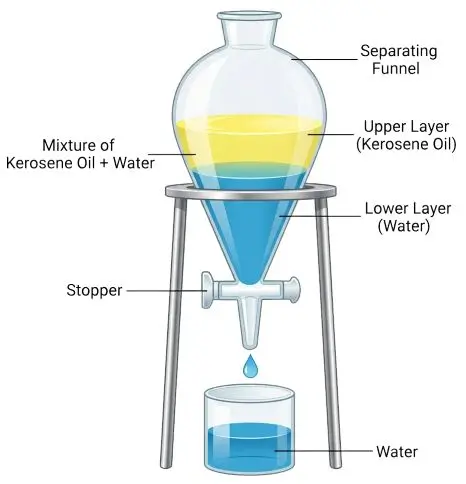
Method:
A separating funnel is used to separate immiscible liquids like kerosene oil and water.
Procedure:
- The mixture of kerosene oil and water is poured into the separating funnel.
- The mixture is allowed to stand for some time.
- Water (heavier) settles at the bottom, while kerosene oil (lighter) forms the upper layer.
- The stopcock is opened to allow the water to flow out into a beaker.
- The stopcock is closed when the oil layer reaches the outlet, leaving kerosene oil in the funnel.
Thus, kerosene oil and water are separated.
Question 7
State the principles involved in the following methods used to separate the components of mixtures.
(a) Solvent extraction
(b) Gravity separation
(c) Fractional crystallisation
(d) Fractional distillation
Also give one example of a mixture separated by employing the above methods.
Answer:
(a) Solvent extraction
- Principle: Separation is based on the difference in solubility of substances in a solvent. One component dissolves in the solvent while the other does not.
- Example: Separation of salt and sand using water.
(b) Gravity separation
- Principle: Separation is based on the difference in densities of the components. The heavier particles settle down under gravity.
- Example: Separation of sand from water.
(c) Fractional crystallisation
- Principle: Separation is based on the difference in solubility of substances in a solvent at different temperatures.
- Example: Separation of sodium chloride and potassium nitrate.
(d) Fractional distillation
- Principle: Separation is based on the difference in boiling points of miscible liquids.
- Example: Separation of alcohol and water.
Download ICSE Class 8 Chemistry Chapter 3 Elements, Compounds and Mixtures Selina Solutions PDF
Students looking for complete ICSE Class 8 Chemistry Chapter 3 Elements, Compounds and Mixtures Selina Solutions PDF can use these notes for revision, homework, and exam preparation.
Practice all exercise questions regularly to score better marks in ICSE examinations.
Why Study Selina Solutions for Chapter 3?
- Easy explanations for students
- Step-by-step answers
- Exam-oriented preparation
- Helps in revision
- Improves conceptual understanding
Students preparing for school exams can use these ICSE Class 8 Chemistry Chapter 3 Elements, Compounds and Mixtures Selina Solutions for quick revision and better understanding.
Conclusion
Elements, Compounds and Mixtures is an important chapter in ICSE Class 8 Chemistry. Understanding the differences between these topics helps students build a strong foundation for higher classes. Practice Selina solutions regularly and revise important definitions and examples for better exam performance.
ICSE Class 8 Chemistry Selina Solutions
The Selina Concise Chemistry Class 8 book includes the following chapters:
Official Website:
Students can visit the official CISCE website for more details and updates.