Introduction
Looking for ICSE Class 8 Chemistry Chapter 5 Language of Chemistry Selina Solutions? This chapter is one of the most important chapters in ICSE Chemistry because it introduces students to the language used in chemical formulas, symbols, valency, radicals, and chemical equations. It helps students understand how chemicals are represented and how reactions are written correctly. The chapter includes topics such as symbols of elements, molecular formulae, radicals, valency, and balancing equations.
In this article, students can get step-by-step Selina solutions, important definitions, solved examples, and exam-oriented explanations for easy learning.
Study Support by Rohit Academy
Rohit Academy offers expert-curated ICSE Class 8 Chemistry Study Materials including ICSE Language of Chemistry Selina Solutions, diagrams, and key formulas for better understanding.
You can also visit :
| ☛ ICSE Class 8 Chemistry Chapter 5: Language of Chemistry Notes |
| ☛ ICSE Class 8 Physics |
| ☛ ICSE Class 8 Chemistry |
| ☛ ICSE Class 8 Mathematics |
| ☛ ICSE Class 8 Biology |
(A) Objective Type Questions
Question 1
Choose the correct answer from the multiple choices given below.
Question 1(i)
The formula of a compound represents:
(a) an atom (b) a molecule
(c) an ion (d) all of these
Answer:
(b) a molecule
Explanation:
A chemical formula represents one molecule of a compound.
For example, H2O represents one molecule of water made of 2 H atoms + 1 O atom.
Question 1(ii)
The symbol of sulphite ion is:
(a) SO32– (b) HSO4–
(c) SO42– (d) S2–
Answer:
(a) SO32–
Explanation:
- Sulphite ion → SO32–
- Sulphate ion → SO42–
- Bisulphate ion → HSO4–
- Sulphide ion → S2–
So the correct one is SO32–.
Question 1(iii)
Which of the following sets of elements show variable valencies?
(a) Iron and calcium
(b) Copper and sodium
(c) Lead and mercury
(d) Silver and potassium
Answer:
(c) Lead and mercury
Explanation:
- Lead (Pb): shows valency +2 and +4.
- Mercury (Hg): shows valency +1 and +2.
Hence, both show variable valencies.
Question 1(iv)
Which of the following has zero valency?
(a) Hydrogen (b) Chlorine
(c) Carbon (d) Neon
Answer:
(d) Neon
Explanation:
Noble gases like Neon have complete outer shells, so they don’t combine with other elements — their valency is zero.
Question 1(v)
The valencies shown by copper are:
(a) 1 and 2 (b) 1 and 4
(c) 2 and 4 (d) 2 and 3
Answer:
(a) 1 and 2
Explanation:
Copper forms two ions —
- Cu+ → cuprous (valency 1)
- Cu2+ → cupric (valency 2)
Question 1(vi)
Which of the following represents correct symbol of potassium?
(a) K (b) P
(c) K+ (d) Ka
Answer:
(c) K
Explanation:
The symbol of potassium is K (capital letter only).
K⁺ is the ion, not the element’s symbol.
Assertion Reason Type
Question 2
The following questions are Assertion-Reason based questions. Choose the answer based on the codes given below.
Question 2(i)
Assertion (A): When an atom gains one or more electrons, it becomes negatively charged.
Reason (R): The number of electrons in an atom exceeds the number of protons upon gaining electrons.
(a) Both A and R are true and R is the correct explanation of A.
(b) Both A and R are true but R is not the correct explanation of A.
(c) A is true but R is false.
(d) A is false but R is true.
Answer:
(a) Both A and R are true, and R is the correct explanation of A.
Explanation:
Gaining electrons increases the negative charge; having more electrons than protons makes the atom a negative ion (anion).
Question 2(ii)
Assertion (A): Each element has its own unique symbol, which is a short hand representation of its atom.
Reason (R): The symbol of some elements is the same as the first letter of their names.
(a) Both A and R are true and R is the correct explanation of A.
(b) Both A and R are true but R is not the correct explanation of A.
(c) A is true but R is false.
(d) A is false but R is true.
Answer:
(b) Both A and R are true, but R is not the correct explanation of A.
Explanation:
Both statements are true, but the reason only explains some cases, not why each element has a unique symbol.
Question 2(iii)
Assertion (A): Magnesium burns in oxygen to produce a compound magnesium oxide with the molecular formula MgO.
Reason (R): Magnesium oxide is a white amorphous solid.
(a) Both A and R are true and R is the correct explanation of A.
(b) Both A and R are true but R is not the correct explanation of A.
(c) A is true but R is false.
(d) A is false but R is true.
Answer:
(b) Both A and R are true, but R is not the correct explanation of A.
Explanation:
Both facts are correct, but the reason (white amorphous solid) doesn’t explain how MgO is formed.
Question 2(iv)
Assertion (A): The valency of inert gases like helium, neon, and argon is zero.
Reason (R): The outermost shell of inert gases is complete.
(a) Both A and R are true and R is the correct explanation of A.
(b) Both A and R are true but R is not the correct explanation of A.
(c) A is true but R is false.
(d) A is false but R is true.
Answer:
(a) Both A and R are true, and R is the correct explanation of A.
Explanation:
Inert gases have complete outer shells, so they don’t form bonds — valency is zero.
Question 2(v)
Assertion (A): A chemical equation is the symbolic representation of a chemical reaction using symbols and formulae of the substances involved in the reaction.
Reason (R): Every chemical equation needs to be balanced to follow the law of conservation of mass.
(a) Both A and R are true and R is the correct explanation of A.
(b) Both A and R are true but R is not the correct explanation of A.
(c) A is true but R is false.
(d) A is false but R is true.
Answer:
(b) Both A and R are true, but R is not the correct explanation of A.
Explanation:
Both are true, but balancing is a separate requirement; it doesn’t explain what a chemical equation is.
Fill in the blanks
Question 3
Fill in the blanks:
(a) A symbol represents _________ of an element.
(b) An atom is neither created nor destroyed during a __________.
(c) __________ are positively charged ions.
(d) Total number of atoms of all the elements present in Al2O3 is __________.
(e) __________ is the symbolic representation of a chemical reaction using symbols and formulae of the substances taking part in the reaction.
Answer:
(a) A symbol represents one atom of an element.
(b) An atom is neither created nor destroyed during a chemical reaction.
(c) Cations are positively charged ions.
(d) Total number of atoms of all the elements present in Al2O3 is 5.
(e) A chemical equation is the symbolic representation of a chemical reaction.
True or False
Question 4
Write ‘true’ or ‘false’ for the following and correct the false statements.
(a) When an atom gains one or more electrons, it becomes positively charged.
(b) The valency of nitrogen in ammonia gas is 3.
(c) The sulphide ion is a polyatomic ion.
(d) The nitrate ion is represented as NO₂⁻.
(e) The element cobalt is represented as CO.
Answer:
(a) False
Correction : When an atom gains electrons it becomes negatively charged.
(b) True
(c) False
Correction : The sulphide ion is a monoatomic ion.
(d) False
Correction : Nitrate is NO₃⁻. NO₂⁻ is nitrite.
(e) False
Correction : The element cobalt is represented as CO. CO is the formula for carbon monoxide.
Match the following
Question 5
Match the following:
| Column A | Column B |
| (a) Combining capacity of an element | (i) Silicon dioxide |
| (b) The radical/ion formed due to the loss of electrons | (ii) Molecular formula |
| (c) Symbolic representation of a compound | (iii) Calcium carbonate |
| (d) Marble | (iv) Valency |
| (e) Sand | (v) Cation |
Answer:
| Column A | Column B |
| (a) Combining capacity of an element | (iv) Valency |
| (b) The radical/ion formed due to the loss of electrons | (v) Cation |
| (c) Symbolic representation of a compound | (ii) Molecular formula |
| (d) Marble | (iii) Calcium carbonate |
| (e) Sand | (i) Silicon dioxide |
Question 6
Name the following:
(a) A polyatomic positive ion.
(b) The substances written on the left side of an arrow in an equation.
(c) The substances which are formed during a chemical reaction.
(d) An unbalanced chemical equation.
(e) An atom or group of atoms that behave as a single charged unit.
(f) A substance used to increase the rate of reaction.
Answer:
(a) A polyatomic positive ion — Ammonium ion (NH4+)
(b) The substances which are formed during a chemical reaction — Products
(c) The substances written on the left side of an arrow in an equation — Reactants
(d) An unbalanced chemical equation — Skeletal equation
(e) An atom or group of atoms that behave as a single charged unit — Radical (or ion)
Question 7
Write the names of the following ions:
(a) HCO3–
(b) MnO42–
(c) N3–
(d) Cr2O72–
Answer:
(a) HCO3– → Hydrogen carbonate ion (or Bicarbonate ion)
(b) MnO42– → Manganate ion
(c) N3– → Nitride ion
(d) Cr2O72– → Dichromate ion
Question 8
Write the names of the compounds represented by the following formulae:
(a) K₂CO₃
(b) P₂O₅
(c) H₂S
(d) Ca(OH)₂
(e) CuSO₄
(f) SiO₂
Answer:
(a) K₂CO₃ → Potassium carbonate
(b) P₂O₅ → Phosphorus pentoxide
(c) H₂S → Hydrogen sulphide
(d) Ca(OH)₂ → Calcium hydroxide
(e) CuSO₄ → Copper(II) sulphate
(f) SiO₂ → Silicon dioxide
(B) Short Answer Type Questions
Question 1
Give the symbols and valencies of the following radicals:
(a) Hydroxide
(b) Chloride
(c) Carbonate
(d) Ammonium
(e) Nitrate
Answer:
| Radical | Symbol | Valency |
| (a) Hydroxide | OH– | 1 |
| (b) Chloride | Cl– | 1 |
| (c) Carbonate | CO32– | 2 |
| (d) Ammonium | NH4+ | 1 |
| (e) Nitrate | NO3– | 1 |
Question 2
Write the molecular formulae for the following compounds and name the elements present.
(a) Sodium bicarbonate
(b) Sodium chloride
(c) Sulphuric acid
(d) Nitric acid
Answer:
| Compound | Molecular Formula | Elements Present |
| Sodium bicarbonate | NaHCO3 | Sodium, Hydrogen, Carbon, Oxygen |
| Sodium chloride | NaCl | Sodium, Chlorine |
| Sulphuric acid | H2SO4 | Hydrogen, Sulphur, Oxygen |
| Nitric acid | HNO3 | Hydrogen, Nitrogen, Oxygen |
Question 3
The valency of aluminium is 3. Write the valency of other radicals present in the following compounds. Also name the compounds.
(a) AlCl3 (b) Al2O3
(c) AlN (d) Al2(SO4)3
Answer:
| Compound | Other Radical | Valency of Radical | Name of Compound |
| AlCl3 | Cl– | 1 | Aluminium chloride |
| Al2O3 | O2– | 2 | Aluminium oxide |
| AlN | N3– | 3 | Aluminium nitride |
| Al2(SO4)3 | SO42– | 2 | Aluminium sulphate |
Question 4
Write the molecular formulae for the oxides and sulphides of the following elements:
(a) Sodium
(b) Calcium
(c) Hydrogen
Answer:
| Element | Oxide | Sulphide |
| (a) Sodium | Na2O | Na2S |
| (b) Calcium | CaO | CaS |
| (c) Hydrogen | H2O | H2S |
Question 5
Define:
(a) Symbol
(b) Molecular formula
(c) Radical
(d) Valency
Answer:
(a) Symbol : A symbol is a shorthand notation representing an element (e.g., H for Hydrogen, O for Oxygen).
(b) Molecular formula : It is a formula that shows the number and kinds of atoms present in one molecule of a substance (e.g., H₂O, CO₂).
(c) Radical : A radical is an atom or group of atoms that behaves as a single unit and carries a charge (e.g., SO₄²⁻, NH₄⁺).
(d) Valency : Valency is the combining capacity of an atom or radical to form chemical bonds with other atoms.
Question 6
Differentiate between:
(a) Reactants and products
(b) Cation and anion
A balanced and an unbalanced chemical equation
Answer:
(a) Differences between Reactants and Products:
| Reactants | Product |
| Substances that take part in a chemical reaction | Substances formed as a result of the reaction |
| Reactants are written on the left hand side of the equation. | Products are written on the right hand side of the equation. |
| Example: In the reaction: H₂ + Cl₂ → 2HCl Reactants = H₂ and Cl₂ | Example: In the reaction: H₂ + Cl₂ → 2HCl Products = HCl |
(b) Differences between cation and anion:
| Cation | Anion |
| Positively charged ion | Negatively charged ion |
| Formed when an atom loses electrons. | Formed when an atom gains electrons. |
| Example : Na⁺, Ca²⁺, Al³⁺ | Example : Cl⁻, O²⁻, SO₄²⁻ |
(c) Differences between a balanced and an unbalanced chemical equation:
| Balanced Equation | Unbalanced Equation |
| Number of atoms of each element is equal on both sides | Number of atoms of each element is not equal on both sides |
| Obeys the Law of Conservation of Mass. | Does not obey the Law of Conservation of Mass. |
Question 7
State the law of conservation of mass.
Answer:
Mass can neither be created nor destroyed in a chemical reaction. The total mass of the reactants is always equal to the total mass of the products.
Question 8
State two points of information necessary to write the molecular formula of a compound.
Answer:
Two Points of Information Necessary to Write the Molecular Formula of a Compound :
- Symbols of the elements that form the compound.
Example: Hydrogen (H), Oxygen (O), Carbon (C), etc. - Valency of each element to determine the ratio in which the atoms combine.
Example:- For H₂O: Hydrogen (valency 1) and Oxygen (valency 2) combine in the ratio 2 : 1.
- Hence, the molecular formula is H₂O.
(C) Long Answer Type Questions
Question 1
Balance the following equations:
(a) N₂ + H₂ → NH₃
(b) H₂ + O₂ → H₂O
(c) Na₂O + H₂O → NaOH
(d) CO + O₂ → CO₂
(e) Zn + HCl → ZnCl₂ + H₂
Answer:
(a) N₂ + 3H₂ → 2NH₃
(b) 2H₂ + O₂ → 2H₂O
(c) Na₂O + H₂O → 2NaOH
(d) 2CO + O₂ → 2CO₂
(e) Zn + 2HCl → ZnCl₂ + H₂
Question 2
Write balanced chemical equations using symbols and formulae for the following word equations:
(a) Iron + Chlorine → Iron (III) chloride
(b) Magnesium + dil. sulphuric acid → Magnesium sulphate + hydrogen
(c) Magnesium + oxygen → Magnesium oxide
(d) Calcium oxide + water → Calcium hydroxide
(e) Sodium + chlorine → Sodium chloride
Answer:
(a) 2Fe + 3Cl₂ → 2FeCl₃
(b) Mg + H₂SO₄ (dil.) → MgSO₄ + H₂
(c) 2Mg + O₂ → 2MgO
(d) CaO + H₂O → Ca(OH)₂
(e) 2Na + Cl₂ → 2NaCl
Question 3
What information do you get from the following chemical equation?
(a) Zn(s) + 2HCl(dil) → ZnCl₂(aq) + H₂(g)
(b)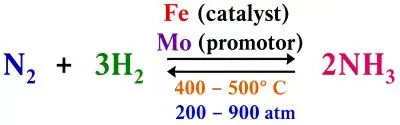
Answer:
(a) Zn + 2HCl → ZnCl₂ + H₂
- 1 atom of zinc reacts with 2 molecules of hydrogen chloride to form 1 molecule of zinc chloride and 1 molecule of hydrogen gas.
- It shows the reactants, products, and their mole ratios.
- It also indicates that hydrogen gas is liberated during the reaction.
(b) N₂ + 3H₂ → 2NH₃
- 1 molecule of nitrogen reacts with 3 molecules of hydrogen to form 2 molecules of ammonia.
- The reaction is catalyzed by Fe and promoted by Mo at 400–450 °C and 200–900 atm (Haber process).
Question 4
What is variable valency? Give two examples of elements showing variable valency.
Answer:
Variable valency means the ability of an element to exhibit more than one valency — that is, it can combine with other elements in different proportions to form different compounds.
Examples:
- Iron (Fe): shows valencies +2 and +3
- Ferrous (FeCl₂) → Fe²⁺
- Ferric (FeCl₃) → Fe³⁺
- Copper (Cu): shows valencies +1 and +2
- Cuprous (Cu₂O) → Cu⁺
- Cupric (CuO) → Cu²⁺
Question 5
(a) What is a chemical equation?
(b) Why is it necessary to balance a chemical equation?
(c) What are the limitations of a chemical equation?
Answer:
(a) A chemical equation is a symbolic representation of a chemical reaction using the symbols and formulae of the substances involved.
It shows the reactants on the left-hand side and the products on the right-hand side, separated by an arrow (→).
Example: 2H2 + O2 → 2H2O
(b) It is necessary to balance a chemical equation to obey the Law of Conservation of Mass, which states that mass can neither be created nor destroyed in a chemical reaction.
Hence, the number of atoms of each element must be equal on both sides of the equation.
Example:
Unbalanced: H₂ + O₂ → H₂O
Balanced: 2H₂ + O₂ → 2H₂O
(c) A chemical equation has the following limitations:
It does not show the physical states of the reactants and products (solid, liquid, gas, or aqueous).
- It does not indicate the reaction conditions like temperature, pressure, or catalyst.
- It does not show the rate or mechanism of the reaction.
- It does not give any information about the energy changes (heat absorbed or evolved).
Question 6
State the important information obtained from the following in four points:
(a) A molecular formula of a compound.
(b) A balanced chemical equation for a reaction.
Answer:
(a) A molecular formula gives the following information:
- Name and symbols of the elements present in the compound.
- Number of atoms of each element in one molecule.
- Simplest ratio in which different elements combine.
- Relative number of moles or combining capacity (valency) of the elements.
Example:
For H₂SO₄ —
- Elements present: Hydrogen, Sulphur, and Oxygen
- Number of atoms: 2, 1, and 4 respectively
(b) A balanced chemical equation provides the following information:
- Names and symbols of reactants and products involved in the reaction.
- Number of molecules or moles of each substance participating.
- Physical states of reactants and products (solid, liquid, gas, aqueous).
- Conditions of reaction, such as temperature, pressure, catalyst, and energy change (heat absorbed or evolved).
Question 7
State five ways by which a chemical equation can be made more informative.
Answer:
A chemical equation can be made more informative by:
- Indicating the physical states of reactants and products (s, l, g, aq).
- Mentioning heat changes (ΔH, heat absorbed or evolved).
- Showing reaction conditions (temperature, pressure, catalyst).
- Mentioning concentration of reactants (dilute, concentrated).
- Indicating reversible or irreversible nature of the reaction (⇌ or →).
Download ICSE Class 8 Chemistry Chapter 5 Language of Chemistry Selina Solutions PDF
Students looking for complete ICSE Class 8 Chemistry Chapter 5 Language of Chemistry Selina Solutions PDF can use these notes for revision, homework, and exam preparation.
Practice all exercise questions regularly to score better marks in ICSE examinations.
Conclusion
ICSE Class 8 Chemistry Chapter 5 Language of Chemistry Selina Solutions helps students understand the basic language used in Chemistry. Learning symbols, radicals, valency, molecular formulae, and balancing equations builds a strong foundation for higher classes. Practice the solved questions regularly for better exam preparation.
ICSE Class 8 Chemistry Selina Solutions
The Selina Concise Chemistry Class 8 book includes the following chapters:
Official Website:
Students can visit the official CISCE website for more details and updates.