Introduction
Hydrogen is one of the most important chapters in ICSE Class 8 Chemistry. This chapter helps students understand the properties, preparation, uses, and importance of hydrogen in daily life and industries. If you are searching for ICSE Class 8 Chemistry Hydrogen Notes PDF Download, these notes will help you revise the chapter quickly and prepare well for exams.
Study Support by Rohit Academy
Rohit Academy offers expert-curated ICSE Class 8 Chemistry Study Materials including ICSE Hydrogen Chapter Notes, diagrams, and key formulas for better understanding.
You can also visit:
| ☛ ICSE Class 8 Chemistry Chapter 7: Hydrogen Selina Solutions |
| ☛ ICSE Class 8 Physics |
| ☛ ICSE Class 8 Chemistry |
| ☛ ICSE Class 8 Mathematics |
| ☛ ICSE Class 8 Biology |
Hydrogen | ICSE Class 8 Chemistry Notes
Introduction & Properties
- Symbol: H
- Formula: H2 (Diatomic molecule)
- Atomic Number: 1
- Atomic Mass: 1.00794 amu
- Valency : 1 (Monovalent)
- Nature: Colourless, odourless, and tasteless gas. It is non-poisonous and the lightest of all known gases.
- Solubility: Sparingly soluble in water.
- Combustibility: Highly combustible but does not support combustion. It burns in air with a pale blue flame to produce water:
2H2 + O2 → 2H2O + Heat
OCCURRENCE
❖ In Free State
- Hydrogen is the most abundant element in the universe.
- It is found in the sun and stars.
- On earth, it occurs in traces in volcanic gases and the upper atmosphere.
❖ In Combined State
Due to its high reactivity, hydrogen mainly occurs in combined form as:
- Water
- Acids
- Alkalis
- Organic compounds
- Petroleum and natural gas
PREPARATION OF HYDROGEN
1. By Electrolysis of Water
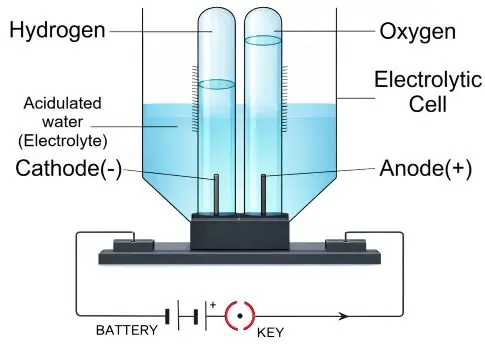
When electric current is passed through acidulated water, it decomposes into hydrogen and oxygen.

- Hydrogen is collected at the cathode (negative electrode).
- Oxygen is collected at the anode (positive electrode).
- Ratio of hydrogen to oxygen collected = 2 : 1 (by volume)
***Note:
- Water containing a little sulphuric acid is called acidulated water.
- Acid is added to make water a good conductor of electricity.
Electrolysis
Electrolysis is the process of passing electric current through:
- An aqueous solution, or
- A molten compound
to bring about a chemical change.
Steps in Electrolysis:
- Ions move towards oppositely charged electrodes.
- Chemical reactions occur at the electrodes.
ELECTROLYSIS – IMPORTANT TERMS
Electrolytes
Electrolytes are substances that conduct electricity in:
- Aqueous solution, or
- Molten state
They conduct electricity because they contain free mobile ions.
Types of Electrolytes
(a) Strong Electrolytes
- Dissociate almost completely into ions.
- Contain large number of ions.
- Examples: Sodium chloride, Sodium hydroxide, Hydrochloric acid, Sulphuric acid, Nitric acid, etc.
(b) Weak Electrolytes
- Dissociate partially into ions.
- Contain small number of ions.
- Examples: Ammonium hydroxide, Acetic acid, etc.
Non-Electrolytes
- Substances that do not conduct electricity in molten or aqueous state because they do not produce ions.
- Examples: Sugar, Pure water, Alcohol
Electrodes
- The two solid conductors through which electric current enters or leaves an electrolyte are called electrodes.
- They are usually made of:
- Metals
- Graphite
Two types of electrodes:
| Anode | Cathode |
| Connected to positive terminal | Connected to negative terminal |
| Current enters electrolyte | Current leaves electrolyte |
| Anions migrate here | Cations migrate here |
Ions
Ions are electrically charged atoms or group of atoms.
Two types:
1. Anion
- Negatively charged ion
- Move towards anode
- Examples: Cl–, OH–, SO42–, CO32–
2. Cation
- Positively charged ion
- Move towards cathode
- Examples: Na⁺, Ca²⁺, Ba²⁺, Al³⁺, Pb²⁺
Electrolytic Cell
- The container in which electrolysis takes place is called an electrolytic cell.
- It is connected to:
- Battery
- Key
- Wires
2. Laboratory Preparation of Hydrogen
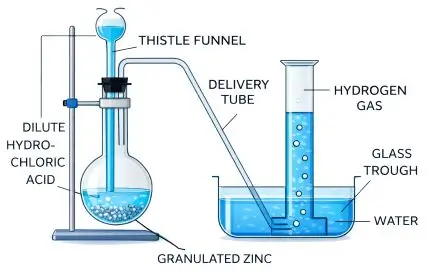
Chemicals required to prepare hydrogen gas in the laboratory:
- Granulated zinc
- Dilute hydrochloric acid (HCl) or dilute sulphuric acid (H2SO4)
Chemical Equation:
- Zn + 2HCl → ZnCl2 + H2
- Zn + H2SO4 → ZnSO4 + H2
Why granulated zinc is preferred:
Granulated zinc contains a small impurity of copper, which acts as a catalyst and increases the speed of reaction.
Collection method:
Hydrogen is collected by the downward displacement of water because it is sparingly soluble in water and lighter than air.
Precautions:
- Do not collect the first few bubbles (they contain air).
- Keep away from flame (hydrogen is inflammable).
Important Notes
- Hydrogen is sparingly soluble in water.
- It is collected over water.
- Hydrogen is lighter than air but not collected by downward displacement of air (mixture may explode).
Why is dilute nitric acid not used?
Because nitric acid is a strong oxidising agent. It oxidises hydrogen to water instead of releasing hydrogen gas.
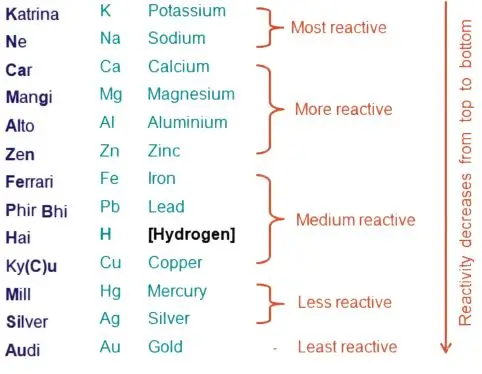
The Reactivity Series of Metals (or Activity Series of Metals)
***Note
- The most reactive metals like potassium and sodium are placed at the top, while less reactive metals like copper and gold are at the bottom.
- Metals below hydrogen in the reactivity series cannot displace hydrogen from water or dilute acids, while magnesium, zinc, and iron can produce hydrogen under suitable conditions.
3. By Action of Water on Metals
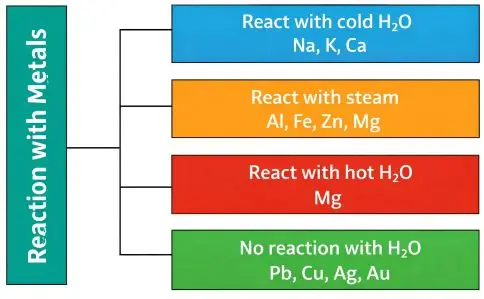
(a) With Cold Water (very active metals):
Very active metals like Na, K, Ca react with cold water.
| Metal | + | Cold Water | → | Metallic hydroxide | + | H2 |
| 2Na | + | 2H2O (cold) | → | 2NaOH | + | H2 |
| 2K | + | 2H2O (cold) | → | 2KOH | + | H2 |
| Ca | + | 2H2O (cold) | → | Ca(OH)2 | + | H2 |
(b) With Hot water:
Magnesium reacts slowly with boiling water:
Mg + 2H2O (hot) → Mg(OH)2 + H2
(c) With Steam (heated metals):
When steam is passed over hot metals like Mg, Zn, Al, Fe:
| Metal | + | Steam | → | Metal oxide | + | H2 |
| Mg | + | H2O (steam) | → | MgO | + | H2 |
| Zn | + | H2O (steam) | → | ZnO | + | H2 |
| 3Fe | + | 4H2O (steam) | → | Fe3O4 | + | 4H2 |
| 2Al | + | 3H2O (steam) | → | Al2O3 | + | 4H2 |
***Note
- Metals such as lead, copper, silver and gold do not react with water at all.
- Magnesium reacts with both hot water and steam.
- Potassium and sodium are kept under kerosene oil because they react violently with air and moisture and may catch fire.
MANUFACTURE OF HYDROGEN (Bosch Process)
Hydrogen is prepared on large scale by Bosch Process.
Step 1: Formation of water gas
Steam passed over hot coke at 1000 °C:

(Endothermic reaction)
Step 2: Conversion of carbon monoxide into carbon dioxide
Water gas mixed with steam and passed over catalyst (Fe2O3 + Cr2O3):

- Catalyst: Fe2O3
- Promoter: Cr2O3
(Exothermic reaction)
Step 3: Removal of CO2
Carbon dioxide is removed by passing the mixture through water under pressure or alkali solution where CO2 dissolves.
2KOH + CO2 ⟶ K2CO3 + H2O
Step 4: Removal of CO
Gas passed through ammoniacal cuprous chloride solution.
- Carbon monoxide dissolves.
- Pure hydrogen is obtained.
PROPERTIES OF HYDROGEN
Physical Properties:
- Colourless, odourless, tasteless gas
- Non-poisonous
- Sparingly soluble in water
- Lightest gas
- Cannot be easily liquefied
Chemical Properties:
1. Action on Litmus
- Hydrogen is neutral to litmus.
- It does not change the colour of red or blue litmus paper.
2. Combustibility
- Hydrogen burns with a pale blue flame.
- It produces water.
2H2 + O2 → 2H2O + Heat - Hydrogen is combustible but does not support combustion.
3. Reactions of Hydrogen with Non-Metals
(i) With Oxygen:
Hydrogen burns in oxygen to form water.
2H2 + O2 → 2H2O + Heat
- Reaction is exothermic.
- Hydrogen–oxygen mixture is called detonating mixture (explosive).
(ii) With Chlorine
In diffused sunlight:
H2 + Cl2 \(\xrightarrow{diffused\ sunlight}\) 2HCl
- Forms hydrogen chloride gas.
- Reaction is explosive in direct sunlight.
(iii) With Nitrogen
At 450°C, 200 atm pressure, iron catalyst:
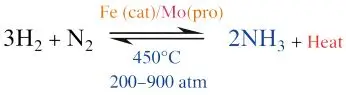
- Forms ammonia gas.
- Molybdenum acts as promoter.
(iv) With Sulphur
- Forms hydrogen sulphide gas.
- Has a rotten egg smell.
H2 + S → H2S
4. Reaction with Metals
When heated, hydrogen reacts with some metals to form metal hydrides.
Example:
2Na + H2 → 2NaH
Ca + H2 → CaH2
5. As a Reducing Agent
- Hydrogen is a good reducing agent.
- It removes oxygen from metal oxides.
- Used to extract less reactive metals like copper, lead, iron, etc.
- Not used on large scale due to explosive nature with oxygen.
- Example:
CuO + H2 → Cu + H2O
PbO + H2 → Pb + H2O
TEST FOR HYDROGEN
- Impure hydrogen burns with a “pop” sound. This confirms the presence of hydrogen gas.
- Pure hydrogen burns silently with a pale blue flame.
OXIDATION AND REDUCTION
Oxidation:
- Addition of oxygen
- Removal of hydrogen
- Example:
- C + O2 → CO2
Carbon get oxidised. - H2S + Cl2 → 2HCl + S
Hydrogen sulphide is oxidised.
- C + O2 → CO2
Reduction:
- Addition of hydrogen
- Removal of oxygen
- Example:
- N2 + 3H2 → 2NH3
Nitrogen is reduced. - 2HgO → 2Hg + O2
Mercuric oxide is reduced.
- N2 + 3H2 → 2NH3
Oxidising Agent
- Substance that:
- Supplies oxygen
- Removes hydrogen
- Example: Oxygen, chlorine, nitric acid, carbon dioxide
- The oxidising agent itself gets reduced.
Reducing Agent
- Substance that:
- Supplies hydrogen
- Removes oxygen
- Example: Hydrogen, carbon, carbon monoxide
- The reducing agent itself gets oxidised.
Redox Reaction
- Reaction in which oxidation and reduction occur simultaneously.
Important Point
- Substance which gets reduced → is the oxidising agent
- Substance which gets oxidised → is the reducing agent
Example 1
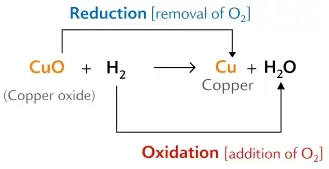
- Substance oxidised : H2
- Substance reduced : CuO
- Oxidising agent : CuO
- Reducing agent : H2
Example 2
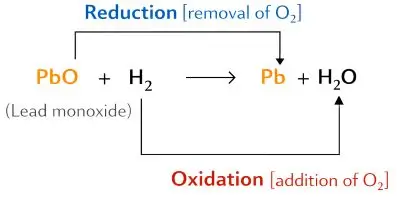
- Substance oxidised : H2
- Substance reduced : PbO
- Oxidising agent : PbO
- Reducing agent : H2
Example 3
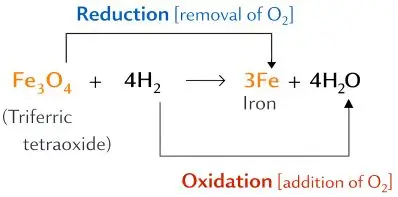
- Substance oxidised : H2
- Substance reduced : Fe3O4
- Oxidising agent : Fe3O4
- Reducing agent : H2
Example 4
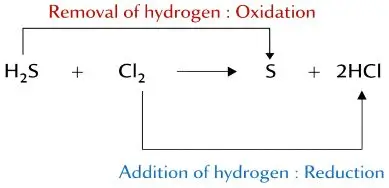
- Substance oxidised : H2s
- Substance reduced : Cl2
- Oxidising agent : Cl2
- Reducing agent : H2S
USES OF HYDROGEN
- Used in cutting and welding metals (oxyhydrogen flame).
- Used as a fuel (rocket fuel and future clean fuel).
- Used in hydrogenation of vegetable oils to make vanaspati ghee in the presence of a catalyst such as nickel, palladium, or platinum.
- Used in manufacture of ammonia, methanol, hydrochloric acid and fertilisers.
- Earlier used in weather balloons.
ICSE Class 8 Chemistry Hydrogen Notes PDF Download
Download the ICSE Class 8 Chemistry Hydrogen Notes PDF and revise the chapter anytime.
Conclusion
Hydrogen is an important chapter in ICSE Class 8 Chemistry. Understanding its properties, preparation, reactions, and uses helps students build a strong foundation in chemistry. These notes are designed in simple language for easy learning and better exam performance.
ICSE Class 8 Chemistry Notes
Official Website:
Students can visit the official CISCE website for more details and updates.