Introduction
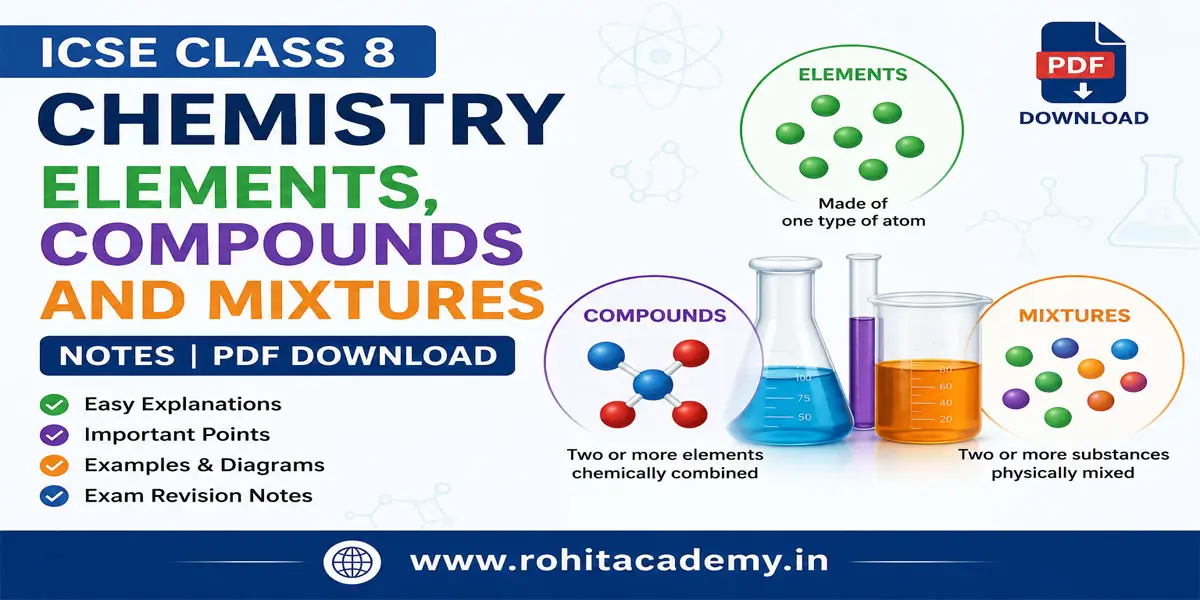
Chemistry becomes more interesting when we understand what substances are made of and how they combine. In this chapter, Elements, Compounds and Mixtures, students learn the basic building blocks of matter and the differences between pure and impure substances. These notes are prepared according to the ICSE Class 8 Chemistry syllabus and help students in revision and exam preparation.
Students can also download the ICSE Class 8 Chemistry Elements, Compounds and Mixtures Notes PDF for quick study.
Study Support by Rohit Academy
Rohit Academy offers expert-curated ICSE Class 8 Chemistry Study Materials including ICSE Elements, Compounds and Mixtures Chapter Notes, diagrams, and key formulas for better understanding.
You can also visit:
| ☛ ICSE Class 8 Chemistry Chapter 3: Elements, Compounds and Mixtures Selina Solutions |
| ☛ ICSE Class 8 Physics |
| ☛ ICSE Class 8 Chemistry |
| ☛ ICSE Class 8 Mathematics |
| ☛ ICSE Class 8 Biology |
Elements, Compounds and Mixtures | ICSE Class 8 Chemistry Notes
Matter
- Matter is anything that has mass and occupies space.
- Example : book, pen, table, water etc.
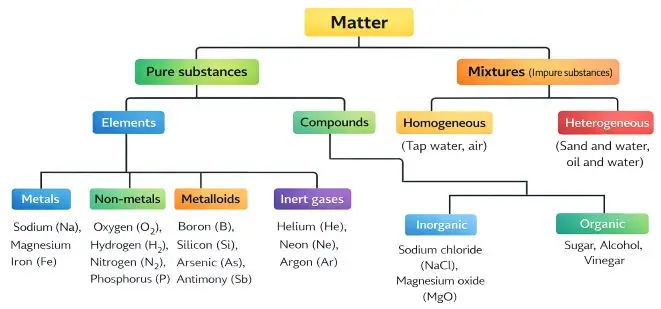
Types of Matter:
- Pure Substances
- Elements
- Compounds
- Impure Substances
- Mixtures
Pure Substances
- A pure substance has a definite chemical composition and fixed physical and chemical properties. They are always homogeneous (uniform throughout).
- Examples: Gold, silver, water, sugar, sodium chloride
- Pure substances are of two types:
1. Elements
2. Compounds
Elements
- An element is a pure substance that cannot be broken down into simpler substances by any physical or chemical process.
- Examples: Hydrogen, Nitrogen, Oxygen, Sodium
Important Points About Elements
- Elements consist of only one type of atom.
- The smallest unit of an element is an atom.
- Each element has its own properties.
- Every element is represented by a symbol.
Example:- Hydrogen → H
- Oxygen → O
- Iron → Fe
Classification of Elements
Based on their properties, elements are classified into
- Metals
- Non-metals
- Metalloids
- Noble (Inert) gases
1. Metals
Characteristics:
- Have metallic lustre (shine)
- Usually hard solids
- Malleable – can be beaten into thin sheets
- Ductile – can be drawn into wires
- Good conductors of heat and electricity
- Sonorous – produce sound when struck
Examples:
- Sodium (Na)
- Magnesium (Mg)
- Aluminium (Al)
- Potassium (K)
- Calcium (Ca)
- Iron (Fe)
- Copper (Cu)
- Silver (Ag)
- Gold (Au)
- Mercury (Hg)
- Lead (Pb)
- Beryllium (Be)
Exceptions:
- Sodium and Potassium – soft metals
- Mercury – liquid metal
- Zinc – brittle
- Tungsten – poor conductor of electricity
2. Non-Metals
Characteristics:
- Can exist in solid, liquid or gas form
- Generally dull
- Not malleable or ductile
- Poor conductors of heat and electricity
- Not sonorous
Examples
- Hydrogen (H)
- Carbon (C)
- Nitrogen (N)
- Oxygen (O)
- Fluorine (F)
- Phosphorus (P)
- Sulphur (S)
- Chlorine (Cl)
- Bromine (Br)
- Iodine (I)
Exceptions:
- Iodine and graphite are lustrous.
- Graphite conducts electricity.
- Diamond is the hardest natural substance
***Note:
- A liquid non-metal: Bromine
3. Metalloids
Metalloids having properties of both metals and non-metals.
Characteristics:
- Hard solids
- Intermediate properties between metals and non-metals
Examples:
- Boron (B)
- Silicon (Si)
- Germanium (Ge)
- Arsenic (As)
4. Noble (Inert) Gases
Noble gases are monoatomic gases that do not react chemically with other elements or compounds.
Characteristics:
- Monoatomic gases
- Chemically inactive
- Present in air in very small amounts
Examples
- Helium (He)
- Neon (Ne)
- Argon (Ar)
Molecules of Elements and Atomicity
Atomicity : The number of atoms present in a molecule of an element is called atomicity.
Types of Molecules Based on Atomicity
| Type | Atomicity | Example |
| Monoatomic | 1 | Na, K, Fe, Cu, Al, Mg, He, Ne, Ar |
| Diatomic | 2 | H2, O2, N2, Cl2, Br2 |
| Triatomic | 3 | O3 |
| Polyatomic | 4, 8 | P4, S8 |
Compounds
A compound is a pure substance formed when two or more elements combine chemically in a fixed proportion by mass.
Examples:
- Water (H2O)
- Carbon dioxide (CO2)
- Sodium chloride (NaCl)
Important Points About Compounds
- Components combine chemically.
- Always have fixed composition.
- Properties differ from their constituent elements.
- Components can be separated only by chemical methods.
- Smallest unit of a compound is a molecule.
Characteristics of Compounds
- Pure and homogeneous substances
- Fixed melting and boiling points
- Definite chemical formula
- Energy is either absorbed or released during formation
- Components cannot be separated by physical methods
Important Points About Compounds
- Compounds are made of different types of atoms.
- definite molecular formulae.
- The smallest unit of a compound is a molecule.
- fixed melting and boiling points.
- homogeneous.
- Properties of a compound are different from its constituent elements.
Examples Explaining Compounds
1. Water (H2O)
Water is formed when hydrogen and oxygen combine chemically in the ratio 1 : 8 by mass.
2H2 + O2 → 2H2O
- H2 : A combustible gas.
- O2 : A gas that supports combustion.
- H₂O : A liquid at room temperature that extinguishes fire.
2. Sodium Chloride (NaCl)
Sodium + Chlorine → Sodium Chloride
- Sodium: soft, highly reactive metal
- Chlorine: poisonous greenish-yellow gas
- Sodium chloride: common salt used in food
3. Iron (II) Sulphide (FeS)
Iron sulphide is formed when iron and sulphur combine chemically in the ratio 7 : 4 by mass.
Iron + sulphur → Iron sulphide
- Iron: grey metal, attracted by magnet
- Sulphur: yellow non-metal
- Iron sulphide: black solid, not attracted by a magnet
Names and Formulae of Some Common Compounds:
| Compound | Formula |
| Water | H2O |
| Carbon dioxide | CO2 |
| Sodium chloride (Common salt) | NaCl |
| Glucose | C6H12O6 |
| Sodium bicarbonate (Baking soda) | NaHCO3 |
| Sodium carbonate | Na2CO3 |
| Calcium carbonate (chalk, marble) | CaCO3 |
| Silicon dioxide (Sand) | SiO2 |
| Acetic acid (Vinegar) | CH3COOH |
| Copper sulphate | CuSO4 |
| Magnesium oxide | MgO |
| Potassium hydroxide | KOH |
| Calcium hydroxide | Ca(OH)2 |
| Hydrochloric acid | HCl |
| Sulphuric acid | H2SO4 |
| Nitric acid | HNO3 |
| Silver nitrate | AgNO3 |
| Barium chloride | BaCl2 |
| Calcium oxide | CaO |
| Ammonia | NH3 |
Difference Between Elements and Compounds
| Elements | Compounds |
| Simplest pure substances | Made of two or more elements |
| Smallest unit is an atom | Smallest unit is a molecule |
| Cannot be broken down | Can be decomposed chemically |
| Contain only one type of atom | Contain different atoms |
Mixtures
A mixture is a combination of two or more substances mixed in any proportion without chemical reaction.
Examples:
- Air
- Milk
- Sea water
- Petroleum
Characteristics of Mixtures
- Mixtures consist of two or more pure substances.
- Components do not combine chemically.
- Each component retains its own properties.
- Components are loosely mixed together.
- Mixtures do not have fixed melting or boiling points.
- Components can be separated by physical methods.
- No energy change generally occurs during formation.
- Mixtures do not have chemical formulas.
Types of Mixtures
1. Homogeneous Mixtures
- Definition: A mixture where the components are uniformly distributed and cannot be seen separately.
- Examples: Air (mixture of gases), Tap water, Alloys (like Brass or Bronze), and Salt solution.
2. Heterogeneous Mixtures
- Definition: A mixture where the components are not uniformly distributed and can be easily seen separately.
- Examples: Sand and water, oil and water, or a mixture of salt and sugar.
Difference Between Compounds and Mixtures:
| Compounds | Mixtures |
| Pure substances | Impure substances |
| Fixed composition | Variable composition |
| Formed by chemical reaction | Formed by physical mixing |
| Components separated chemically | Components separated physically |
| Have definite formula | No chemical formula |
Types of Mixtures Based on Physical State
Mixtures can exist in solid, liquid or gaseous states depending on the state of their components.
| Types of Mixtures | Homogeneous Examples | Heterogeneous Examples |
| Solid + Solid | Alloys (brass, bronze, stainless steel) | Sugar and salt, sand and stone |
| Solid + Liquid | Sugar + water, salt + water | Sand + water, mud + water |
| Liquid + Liquid | Water + alcohol, acetone + water | Oil + water |
| Liquid + Gas | Carbon dioxide in water, ammonia in water | Soap lather |
| Gas + Gas | Air | All gases mix uniformly |
Need for Separation of Mixtures
Separation is done to:
1. To obtain useful substances
Example:
Crude petroleum is refined to obtain useful fuels such as LPG, petrol, diesel, kerosene, and petroleum wax.
2. To remove unwanted or harmful substances
Example:
Small stones are removed from rice, wheat or pulses before cooking.
3. To obtain pure substance
Example:
Salt is obtained from sea water.
Methods of Separation of Mixtures
Separation of Solid–Solid Mixtures
1. Mechanical Removal (Handpicking)
- Principle: Based on the difference in size, shape, or colour.
- Condition: Used only when the quantity is small and the substance to be separated is easily identifiable.
- Example: Picking out tiny stones and chaff from rice or pulses.
2. Magnetic Separation
- Principle: Used when one component is magnetic.
- Examples: Iron filings from sulphur, Iron and sand mixture.
3. Gravity Separation Method
- Used when one insoluble component is heavier than the other.
- The heavier particles settle at the bottom, while lighter particles remain above.
- Example
Mixture of sand and sawdust in water:- Sawdust floats
- Sand settles at the bottom
4. Sublimation
- Used when one component sublimes on heating.
- Substances that Sublime:
- Ammonium chloride
- Iodine
- Camphor
- Naphthalene
- Example
- Mixture of ammonium chloride and common salt
5. Solvent Extraction Method
- Principle: Based on the difference in solubility of the components in a specific solvent.
- Method: One component dissolves in the solvent while the other remains insoluble. The solution is then filtered and evaporated to recover the soluble solid.
- Example: A mixture of sodium chloride (soluble) and calcium carbonate (insoluble) can be separated using water as the solvent.
6. Fractional Crystallisation
- Principle: Based on the difference in the solubilities of two or more solids in the same solvent.
- Method: The mixture is dissolved in a minimum amount of solvent and then cooled. The less soluble substance crystallises out first.
- Example: Separating potassium nitrate and sodium chloride from their mixture.
Separation of Solid–Liquid Mixtures
1. Sedimentation and Decantation
- Sedimentation: The process where heavy, insoluble solid particles in a liquid settle down at the bottom when left undisturbed.
- Sediment: The solid that settles at the bottom.
- Supernatant Liquid: The clear liquid that remains above the sediment.
- Decantation: The process of pouring out the clear supernatant liquid into another container without disturbing the sediment.
- Loading: A process used to speed up sedimentation by adding a substance like alum. Alum helps fine particles (like clay in river water) settle down more quickly.
- Example: Sand and water.
2. Filtration
- Separates insoluble solids from liquids using a filter.
- Example: Chalk and water.
3. Evaporation
- Used to obtain solid solute from solutions.
- Example: Salt from sea water.
4. Crystallisation
- Formation of pure crystals from a hot saturated solution by cooling it slowly.
- Example: Obtaining pure sugar crystals from a sugar solution.
5. Distillation
- Separates a liquid from a solution by boiling and condensation.
- Example: Distilled water from salt solution, mixture of iodine and alcohol
6. Centrifugation
- Used to separate suspended particles by spinning.
- Example: Cream from milk
Separation of Liquid–Liquid Mixtures
1. Using a Separating Funnel (For Immiscible Liquids):
- Principle: Based on the difference in the densities of the liquids.
- Method: The mixture is placed in a separating funnel and allowed to stand. The heavier liquid forms the lower layer, and the lighter liquid forms the upper layer. The stopper is opened to let the heavier liquid trickle out into a separate vessel.
- Example: Separating kerosene oil and water or carbon tetrachloride and water.
2. Fractional Distillation (For Miscible Liquids):
- Used to separate miscible liquids with different boiling points.
- Example: Alcohol and water, Petroleum products
3. Chromatography
- Definition: A modern technique used to separate components of a mixture when the components are very similar in their properties.
- Principle: It is based on the difference in the rates of adsorption of different components on the surface of a suitable adsorbent (the stationary phase).
Key Terms:
- Stationary Phase: The material that remains fixed (e.g., filter paper, silica gel).
- Mobile Phase: The solvent that moves (e.g., water, ethyl alcohol, acetic acid).
Advantages of Chromatography
- Only very small quantity of substance is required.
- Components with similar physical and chemical properties can be separated.
- Helps identify different components of a mixture.
- Used for quantitative estimation of components.
Applications of Chromatography
- Chromatography is used:
- To separate colours in dyes.
- To separate drugs from blood.
- To separate pigments from natural colours.
- To purify industrial products.
Separation of Gas-Gas Mixtures
1. Diffusion
- Principle: Based on the difference in the densities of the gases. Lighter gases diffuse more rapidly than heavier ones.
- Example: A mixture of Hydrogen and Oxygen. Hydrogen, being lighter, diffuses first.
2. Solvent Extraction
- Principle: Some gases dissolve in a specific solvent while others do not.
- Example: A mixture of Carbon dioxide (CO2) and Carbon monoxide (CO). CO2 is highly soluble in water, whereas CO is only sparingly soluble.
3. Liquefaction
- Principle: Based on the fact that some gases liquefy more easily at high pressure and low temperature.
- Example: Ammonia can be separated from Nitrogen by liquefying it under pressure.
Separation of Multi-Component Mixtures
Example 1: Iron Filings, Sulphur and Common Salt
Steps
- Use a magnet to remove iron filings.
- Add water to dissolve common salt.
- Filter the mixture to separate sulphur.
- Evaporate the salt solution to obtain salt.
Example 2: Sand, Common Salt and Ammonium Chloride
Steps
- Use Sublimation to remove ammonium chloride.
- Add water to the remaining mixture.
- Salt dissolves in water, sand does not.
- Use decantation to separate salt solution from sand.
- Evaporation gives back common salt.
ICSE Class 8 Chemistry Elements, Compounds and Mixtures Notes PDF Download
Students can save and download the ICSE Class 8 Chemistry Elements, Compounds and Mixtures Notes PDF for quick revision anytime.
Conclusion
The chapter Elements, Compounds and Mixtures forms the foundation of chemistry for ICSE students. Understanding the differences among these substances helps students learn advanced chemistry topics easily. These notes are useful for revision, homework, and exam preparation.
ICSE Class 8 Chemistry Notes
Official Website:
Students can visit the official CISCE website for more details and updates.