Carbon and Its Compounds | ICSE Class 8 Chemistry Notes
Carbon is one of the most important elements found in nature. It forms a large number of compounds that are essential for life. Carbon is present in living organisms, fuels, food materials, and many everyday substances. In this chapter, students learn about carbon, its occurrence, properties, and important compounds.
Study Support by Rohit Academy
Rohit Academy offers expert-curated ICSE Class 8 Chemistry Study Materials including ICSE Carbon and Its Compounds Chapter Notes, diagrams, and key formulas for better understanding.
You can also visit:
| ☛ ICSE Class 8 Chemistry Chapter 9: Carbon and Its Compounds Selina Solutions |
| ☛ ICSE Class 8 Physics |
| ☛ ICSE Class 8 Chemistry |
| ☛ ICSE Class 8 Mathematics |
| ☛ ICSE Class 8 Biology |
Introduction to Carbon
- Carbon is the basis of life.
- All living organisms (plants and animals) contain carbon.
- It is one of the most widely distributed elements on Earth.
- Atomic number: 6
- Valency: 4 (has four electrons in the outermost shell).
- The name carbon comes from the Latin word carbo (meaning coal).
Occurrence of Carbon
Carbon occurs in free state and combined state.
- Free State
- Coal
- Diamond
- Graphite
- Combined State
- In the atmosphere as carbon dioxide (CO₂)
- In natural water as dissolved CO₂
- In natural gas and petroleum
- As carbonates (CaCO₃, Na₂CO₃ etc.)
- In carbohydrates, proteins, fats and vitamins
Carbon Cycle
- Plants absorb CO₂ during photosynthesis.
- Animals release CO₂ during respiration.
- Burning of fuels also releases CO₂.
- This continuous movement of carbon between air, plants and animals is called the carbon cycle.
Catenation
- Carbon has a unique property of self-linking.
- It can form long chains (straight, branched or cyclic).
- This property is called catenation.
Organic and Inorganic Compounds
❖ Organic Compounds:
- Contain carbon and are mainly obtained from living organisms.
- Examples:
- Methane (CH₄)
- Ethane (C₂H₆)
- Ethanol (C₂H₅OH)
- Acetic acid (CH₃COOH)
- Glucose (C₆H₁₂O₆)
❖ Inorganic Compounds
Derived from non-living sources.
- Carbon dioxide (CO₂)
- Carbon monoxide (CO)
- Calcium carbonate (CaCO₃)
- Sodium carbonate (Na₂CO₃)
- Sodium bicarbonate (NaHCO₃)
Section (A) : Allotropy in Carbon
Allotropy
The phenomenon by which an element exists in two or more forms in the same physical state with identical chemical properties but different physical properties.
Types of Allotropes of Carbon
- Crystalline allotropes
- Amorphous (non-crystalline) allotropes
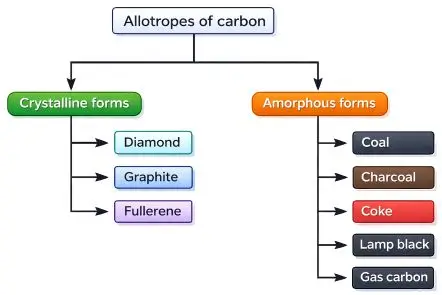
(A) Crystalline Allotropes
1. Graphite
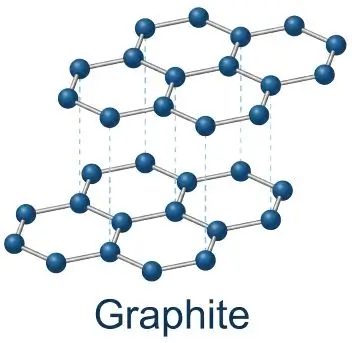
Structure:
- Each carbon atom is bonded to three other carbon atoms.
- Forms hexagonal layers.
- One free electron makes it a good conductor.
Properties of Graphite:
- Greyish black, soft and greasy
- Density: 2.39 g/cm3
- High melting point (~3700°C)
- Good conductor of heat and electricity
Uses of Graphite:
- Lubricant
- Electrodes in electric furnaces
- Graphite has a high melting point, so it is used for making crucibles to melt metals at high temperatures.
- Pencil leads
- Carbon brushes
- Nuclear reactors (moderator)
2. Diamond
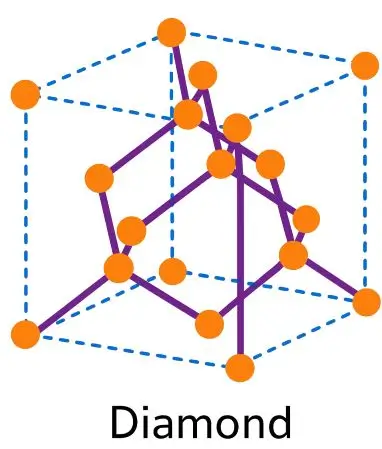
Structure of Diamond:
- Diamond is the purest form of carbon.
- Each carbon atom is bonded to four other carbon atoms.
- Forms a rigid tetrahedral structure.
- Very strong covalent bonding.
Properties of Diamond:
- Colourless and transparent (pure form)
- Hardest natural substance
- Density: 3.5 g/cm³
- Bad conductor of electricity
- Brilliant shine
Uses of Diamond:
- Making jewellery
- Cutting and drilling rocks and glass
- Industrial tools
- Bearings and precision instruments
***Note
Colourless and transparent diamonds are costlier than coloured diamonds.
3. Fullerenes
- Third crystalline form of carbon.
- Carbon atoms arranged in cage-like structures.
- Most common: Buckminsterfullerene (C60).
Properties of Fullerenes:
- Soluble in organic solvents
- Chemically more reactive
- Low density
Uses of Fullerenes:
- Superconductors
- Semiconductors
- Lubricants
B. Amorphous Allotropes
- Coal
- Coke
- Charcoal
- Lamp black
- Gas carbon
- Wood charcoal
- Sugar charcoal
- Bone charcoal
Differences Between Diamond and Graphite
| Graphite | Diamond |
| 1. Each carbon atom is bonded to three other carbon atoms. | 1. Each carbon atom is bonded to four other carbon atoms. |
| 2. It is soft and slippery. | 2. It is very hard. |
| 3. Low density | 3. High density |
| 4. It is a good conductor of electricity. | 4. It is a bad conductor of electricity. |
Important Points
- CaCO3 is the chemical formula of chalk, marble and limestone.
- Carbon burns in oxygen to form carbon dioxide.
- Carbon forms a very large number of compounds (Organic Chemistry).
Section (B) : Amorphous Forms of Carbon
Meaning of Amorphous
- The word amorphous means without definite shape or form.
- Amorphous substances do not have a regular arrangement of atoms.
- They do not have a definite geometrical shape.
Amorphous Forms of Carbon
The main amorphous forms of carbon are:
- Coal
- Coke
- Charcoal
- Lamp black (soot)
- Gas carbon
These forms usually contain small amounts of impurities like hydrogen, nitrogen, oxygen and sulphur.
Coal
Coal is a hard, black fossil fuel formed from ancient plant remains buried under the earth.
Formation of Coal (Carbonization)
- The slow conversion of dead plants into coal under high pressure and temperature is called carbonization.
Types of Coal
| Type | Carbon % | Features |
| Peat | 50–60% | First stage, light brown, inferior form of coal |
| Lignite | > 60% | Brown, harder than peat |
| Bituminous | 70–90% | Most common, black, household coal |
| Anthracite | 92–98% | Superior type of coal, Purest form, hard, highest heat value, |
Uses of Coal
- Domestic and industrial fuel
- Preparation of coke, coal gas and coal tar
- Manufacture of synthetic petrol
- Production of fertilizers, drugs and perfumes
- Source of organic compounds (benzene, naphthalene, etc.)
Destructive Distillation of Coal
Destructive distillation is the process of heating a substance (like coal) strongly in the absence of air to obtain useful products such as coke, coal tar, and coal gas.
Products Obtained:
- Coke
- Coal tar
- Coal gas
- Ammoniacal solution
Coke
Properties of coke:
- Black, porous solid
- Contains about 98% carbon
- Burns without smoke
- Good reducing agent
- Poor conductor of heat and electricity
Types of coke:
- Hard coke – Used in industrial furnaces
- Soft coke – Used in household furnaces
Uses of coke:
- Smokeless fuel
- Reducing agent in extraction of metals
- Manufacture of water gas (CO + H₂) and producer gas
- Preparation of artificial graphite and metallic carbides
Coal Tar
- Thick, black liquid with strong smell
- On fractional distillation gives useful chemicals
- Used to make dyes, drugs, explosives, perfumes, etc.
Coal Gas
- Purified coal gas is used as fuel
- Mainly contains methane after purification
Ammoniacal Solution
- Used in making fertilizers
Charcoal
When organic substances are heated in the absence of air, a black porous solid called charcoal is formed.
Types of Charcoal:
- Wood charcoal
- Sugar charcoal
- Bone charcoal
(A) Wood Charcoal
Preparation:
Obtained by heating wood in limited supply of air.
Properties:
- Soft, black, porous solid
- Brittle and tasteless
- Floats on water (due to trapped air)
- Bad conductor of heat and electricity
- Good adsorbent
Adsorption:
The property by which a substance absorbs gases, liquids or solids on its surface.
Activated Charcoal
- Formed by heating charcoal at about 900°C with steam.
- Has higher adsorption capacity.
Uses of Wood Charcoal:
- Fuel
- Reducing agent
- Preparation of water gas
- Used in gas masks
- Used in medicines (tablets for indigestion)
- Decolourising sugar syrup
- Water purifier filters
***Note:
Wood charcoal is used in water filters and gas masks because it has a strong adsorption property.
It has a porous structure with a large surface area, which helps it adsorb impurities, harmful gases, and bad odours from water and air.
(B) Sugar Charcoal
- Purest form of amorphous carbon
- Prepared by heating sugar in absence of air
Uses:
- Reducing agent
- Decolourising coloured solutions
- Making artificial diamonds
(C) Bone Charcoal
- Obtained by destructive distillation of bones
- Contains calcium phosphate
Uses:
- Decolourising cane sugar
- Making black paints
- Water purification
- Making phosphorus compounds
Lamp Black (Soot)
Preparation:
Produced by burning carbon-rich substances in limited air.
Properties:
- Fine black powder
- Contains 98–99% carbon
Uses:
- Shoe polish
- Printing ink
- Carbon paper
- Paints
- Making kajal
- Tyres and gun powder
Gas Carbon
Preparation:
Obtained during destructive distillation of coal.
Properties:
- Grey solid
- Good conductor of heat and electricity
Uses:
- Making electrodes of dry cells
- Lining electrolytic cells
- Carbon rods for arc lamps
Summary Table – Uses of Allotropes of Carbon
| Allotrope | Major Uses |
| Diamond | Jewellery, cutting tools |
| Graphite | Lubricant, electrodes, pencil leads |
| Fullerene | Insulators, superconductors |
| Coal | Fuel, source of chemicals |
| Coke | Reducing agent, fuel |
| Wood charcoal | Fuel, adsorbent |
| Sugar charcoal | Reducing agent |
| Bone charcoal | Decolourising sugar |
| Lamp black | Inks, paints |
| Gas carbon | Electrodes |
Section (C) : Carbon Dioxide (CO2)
Introduction
- Molecular formula: CO₂
- Relative molecular mass: 44 amu
- One molecule of carbon dioxide contains:
- 1 atom of carbon
- 2 atoms of oxygen
Occurrence of Carbon Dioxide
(A) In Free State
- Present in air (about 0.03%–0.04% by volume)
- Dissolved in natural water
- Present in volcanic gases
(B) In Combined State
- As carbonates and bicarbonates in earth’s crust
- Limestone (CaCO3)
- Dolomite (CaCO3·MgCO3)
- In shells of marine animals
Preparation of Carbon Dioxide
1. By Burning Carbon or Its Compounds
(a) Burning Carbon
C + O2 → CO2 + Heat
(b) Burning Methane
CH4 + 2O2 → CO2 + 2H2O
2. By Heating Metal Carbonates and Bicarbonates:
(a) Heating Copper Carbonate
CuCO3 → CuO + CO2
(b) Heating Sodium Bicarbonate
2NaHCO3 → Na2CO3 + H2O + CO2
3. By Action of Dilute Acids on Metal Carbonates and Bicarbonates:
(a) Calcium Carbonate + Dilute HCl
CaCO₃ + 2HCl → CaCl₂ + H₂O + CO₂
(b) Sodium Carbonate + Dilute H₂SO₄
Na₂CO₃ + H₂SO₄ → Na₂SO₄ + H₂O + CO₂
(c) Sodium Carbonate + Dilute HCl
Na₂CO₃ + 2HCl → 2NaCl + H₂O + CO₂
(d) Sodium Bicarbonate + Dilute HCl
NaHCO₃ + HCl → NaCl + H₂O + CO₂
(e) Baking Soda + Vinegar (Acetic Acid)
NaHCO₃ + CH₃COOH → CH₃COONa + H₂O + CO₂
***Note:
- Chemical name of baking soda: Sodium bicarbonate (NaHCO3)
- Used to make food soft and spongy.
Laboratory Preparation of CO₂
Chemicals Required
- Marble chips (CaCO₃)
- Dilute Hydrochloric Acid (HCl)
Chemical Equation:
CaCO₃ + 2HCl → CaCl₂ + H₂O + CO₂
Procedure:
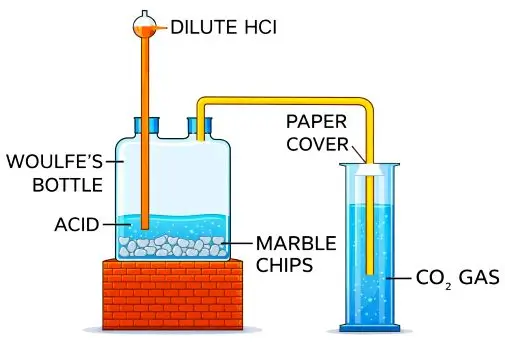
- Marble chips are placed in a Woulfe’s bottle.
- Dilute HCl is added through a thistle funnel.
- CO₂ gas is produced and collected through a delivery tube.
Collection:
Collected by upward displacement of air
(Because CO₂ is heavier than air)
Why not collected over water?
Because CO₂ is highly soluble in water.
Why sulphuric acid not used?
Sulphuric acid forms insoluble calcium sulphate (CaSO₄), which coats the marble chips and stops the reaction.
CaCO3 + H2SO4 ⟶ CaSO4 + H2O + CO2 (g)
Properties of Carbon Dioxide
(A) Physical Properties:
- Colourless, odourless gas
- Slightly acidic taste
- 1.5 times heavier than air
- Soluble in water
- Can be liquefied under pressure
Dry Ice
- Solid CO₂ formed at −78°C
- Sublimes directly into gas
- Used as refrigerant
(B) Chemical Properties:
1. Combustibility
- CO₂ is neither combustible nor a supporter of combustion.
- It extinguishes burning substances.
2. Action on Litmus
- Turns moist blue litmus red.
- Shows that CO₂ is acidic in nature.
3. Reaction with Water
CO₂ + H₂O → H₂CO₃
(Carbonic acid is formed.)
4. Reaction with Alkalis
(a) With Sodium Hydroxide
2NaOH + CO₂ → Na₂CO₃ + H₂O
(b) With Potassium Hydroxide
2KOH + CO₂ → K₂CO₃ + H₂O
5. Reaction with Lime Water
When carbon dioxide is passed through lime water:
- In small amounts: Lime water turns milky due to formation of calcium carbonate.
Ca(OH)2 + CO2 ⟶ CaCO3 + H2O - In excess: The milkiness disappears because soluble calcium bicarbonate is formed.
CaCO3 + CO2 + H2O ⟶ Ca(HCO3)2
This is the test for CO₂.
6. Reaction with Metals
2Mg + CO₂ → 2MgO + C
7. Reaction with Metallic Oxides (Basic Oxides):
CO₂ reacts with basic oxides to form carbonates.
(a) Sodium oxide:
Na₂O + CO₂ → Na₂CO₃
(b) Magnesium oxide:
MgO + CO₂ → MgCO₃
8. Reaction with Non-metals
CO₂ reacts with red hot coke to form carbon monoxide (a poisonous gas).
CO₂ + C → 2CO
Tests for Carbon Dioxide
- Turns moist blue litmus paper pink/red.
- Extinguishes a burning candle (non-supporter of combustion).
- Turns limewater milky.
Ca(OH)₂ + CO₂ → CaCO₃ + H₂O
Milkiness disappears on passing excess CO₂:
CaCO₃ + H₂O + CO₂ → Ca(HCO₃)₂
This is the best chemical test for CO₂.
Uses of Carbon Dioxide
- Aerated drinks (soda water)
- Refrigeration (dry ice)
- Hospitals (Carbogen : 5% CO₂ + 95% O₂)
- Manufacture of fertilizers (urea)
- Preparation of chemicals (washing soda, baking soda)
- Baking industry (makes cakes soft and spongy)
- Photosynthesis
- Fire extinguishers
Fire Extinguishers
- A fire extinguisher is a device used to put out small fires by spraying a substance that stops burning.
- The substance used in modern fire extinguishers is carbon dioxide (CO₂).
CO₂ is used because:
- It does not burn
- It does not support combustion
- It is heavier than air and cuts off oxygen supply
TYPES OF FIRE EXTINGUISHERS
1. Soda–Acid Fire Extinguisher
Contains:
- Sodium bicarbonate (NaHCO₃) solution
- Concentrated sulphuric acid (H₂SO₄) in a glass tube
Working:
- On pressing the plunger, acid mixes with sodium bicarbonate.
- CO₂ gas is produced and comes out with force.
Chemical Reaction:
2NaHCO₃ + H₂SO₄ → Na₂SO₄ + 2H₂O + 2CO₂
Limitation:
- Cannot be used for oil fires
(Solution is heavier than oil and sinks below it.)
2. Foam-Type Fire Extinguisher
Contains:
- Sodium bicarbonate solution
- Aluminium sulphate solution
- A small amount of soap (to produce foam)
Working:
- On mixing, CO₂ and aluminium hydroxide are formed.
- Foam spreads over burning oil.
- Cuts off oxygen supply.
Chemical Reaction:
6NaHCO₃ + Al₂(SO₄)₃ → 3Na₂SO₄ + 2Al(OH)₃ + 6CO₂
Advantage:
- Can be used for oil fires
(Foam floats on oil and prevents oxygen contact.)
3. Liquid Carbon Dioxide Fire Extinguisher:
Features:
- Modern type extinguisher.
- Contains liquid CO₂ stored under high pressure.
Working:
- On opening the valve, pressure drops.
- Liquid CO₂ changes into dry ice (white snow).
- CO₂ spreads over fire and cuts oxygen supply.
Used For:
- Oil fires
- Electrical fires
Why Soda-Acid and Foam-Type Cannot Be Used for Electrical Fires?
Soda-acid and foam-type fire extinguishers are not used for electrical fires because they contain water or aqueous solutions, which can conduct electricity and cause electric shock.
Carbon Dioxide Cycle
The process by which the amount of CO₂ in the atmosphere is maintained is called the carbon dioxide cycle.
Addition of CO₂:
- Burning of fossil fuels like coal, petrol, and diesel.
- Respiration by living organisms.
- Decay of plants and animals (decomposition).
- Industries
- Volcanic eruptions
Removal of CO₂:
- Photosynthesis
- Dissolution in water
Greenhouse Effect
The greenhouse effect is the process by which gases like carbon dioxide (CO₂), methane, and water vapour trap heat in the Earth’s atmosphere and prevent it from escaping into space, thereby warming the Earth.
Benefits of the Greenhouse Effect:
- It keeps the Earth warm enough to support life.
- It maintains a suitable temperature for plants, animals, and humans.
- It prevents extreme temperature differences between day and night.
GLOBAL WARMING
The gradual increase in the average temperature of the Earth due to increased greenhouse gases is called global warming.
Causes of Increased CO₂:
- Deforestation
- Burning fossil fuels
- Industrial pollution
- Vehicle emissions
- Decrease in photosynthesis due to loss of vegetation
Effects of Global Warming:
- Rise in Earth’s temperature
- Melting of glaciers
- Floods in coastal areas
- Disturbance in rainfall pattern
- Extinction of species
Steps to Balance CO₂:
- Plant more trees
- Reduce fossil fuel use
- Use renewable energy
- Install filters in factories
Section (D) : Carbon Monoxide (CO)
Introduction
- Molecular formula: CO
- Relative molecular mass: 28
- Carbon monoxide contains one atom of carbon and one atom of oxygen in each molecule.
Occurrence of Carbon Monoxide
Carbon monoxide occurs in:
- Coal gas
- Volcanic gases
- Tobacco fumes
- Chimney gases
- Exhaust gases of automobiles (in small amounts)
Formation of Carbon Monoxide
Carbon monoxide is formed when carbon burns in a limited supply of oxygen (incomplete combustion).
Balanced equation:
2C + O₂ ⟶ 2CO
Incomplete Burning of Fuels
Domestic and industrial ovens burning coal, coke or charcoal produce carbon monoxide.
Steps involved:
- Carbon burns in oxygen to form carbon dioxide.
C + O2 ⟶ CO2 + heat - Carbon dioxide passes through hot coke and gets reduced to carbon monoxide.
CO2 + C ⟶ 2CO - The carbon monoxide produced burns with a pale blue flame to form carbon dioxide again.
2CO + O₂ ⟶ 2CO2
Exhaust Gases of Automobiles
- Automobiles use petrol or diesel as fuel.
- These fuels contain carbon and hydrogen.
- They burn in the engine with a limited supply of air.
- This produces a small amount of carbon monoxide.
Fuel
A fuel is a substance that burns in air to produce usable energy (heat and light) along with other products such as oxides.
Examples: Coal, Wood, Petroleum, Diesel, Cooking gas etc.
Properties of Carbon Monoxide
- Carbon monoxide is a colourless, tasteless and neutral gas, but it has a faint odour.
- It is a highly poisonous gas.
- It is very sparingly soluble in water.
- It is a thermally stable gas (does not decompose easily at high temperature).
- It is a combustible gas but a non-supporter of combustion.
- In air, it burns with a blue flame to form carbon dioxide.
Reaction:
2CO + O₂ \(\xrightarrow{Heat}\) 2CO2
Reducing Action of Carbon Monoxide
- Carbon monoxide is a strong reducing agent.
- It reduces the oxides of moderately reactive or less reactive metals to their respective metals and itself gets oxidized to carbon dioxide.
- Examples:
- Reduction of copper oxide
CuO + CO \(\xrightarrow{Heat}\) Cu + CO₂ - Reduction of lead monoxide
PbO + CO \(\xrightarrow{Heat}\) Pb + CO₂ - Reduction of ferric oxide
Fe₂O₃ + 3CO \(\xrightarrow{Heat}\) 2Fe + 3CO₂
- Reduction of copper oxide
Uses:
Due to its reducing action, carbon monoxide is used in metallurgy for extracting metals from their ores, especially iron.
Carbon Monoxide is Poisonous
Carbon monoxide is a highly poisonous gas.
- Even 0.5% carbon monoxide in air can cause death.
- CO combines with haemoglobin in red blood cells to form carboxyhaemoglobin.
- This prevents haemoglobin from carrying oxygen.
- As a result, body cells do not receive oxygen.
Effect
This leads to respiratory failure, suffocation (asphyxiation), and death.
Harmful Effects of Carbon Monoxide
1. Sleeping in a Closed Room with Burning Coal:
Sleeping in a closed room where coal or wood is burning is very dangerous.
- Limited air supply leads to formation of carbon monoxide.
- Since CO is colourless and almost odourless, people cannot detect it easily.
- This may lead to carbon monoxide poisoning during sleep.
For this reason, carbon monoxide is called the “Silent Killer.”
2. Starting a Car Engine in a Closed Garage:
- Exhaust gases from automobiles contain carbon monoxide.
- Starting a car engine in a closed garage increases CO concentration in the air.
- This increases the risk of carbon monoxide poisoning.
Remedies for Carbon Monoxide Poisoning
- The victim should be immediately taken to fresh air (open place).
- The victim should be given artificial respiration with carbogen.
Carbogen
Carbogen is a mixture of:
- 95% oxygen
- 5% carbon dioxide
It helps restore normal breathing.
Gas Masks
At places where carbon monoxide concentration is high, people should use gas masks that absorb CO and convert it into carbon dioxide.
These masks contain hopcalite (a mixture of metallic oxides).
ICSE Class 8 Chemistry Carbon and Its Compounds Notes PDF Download
Download the complete ICSE Class 8 Chemistry Carbon and Its Compounds Notes PDF and revise the chapter easily for exams.
Conclusion
Carbon and its compounds play a vital role in our daily lives. Understanding the properties of carbon, its allotropes, and important compounds such as carbon dioxide and carbon monoxide helps students build a strong foundation in chemistry. These notes are useful for quick revision and exam preparation for ICSE Class 8 students.
ICSE Class 8 Chemistry Notes
Official Website:
Students can visit the official CISCE website for more details and updates.