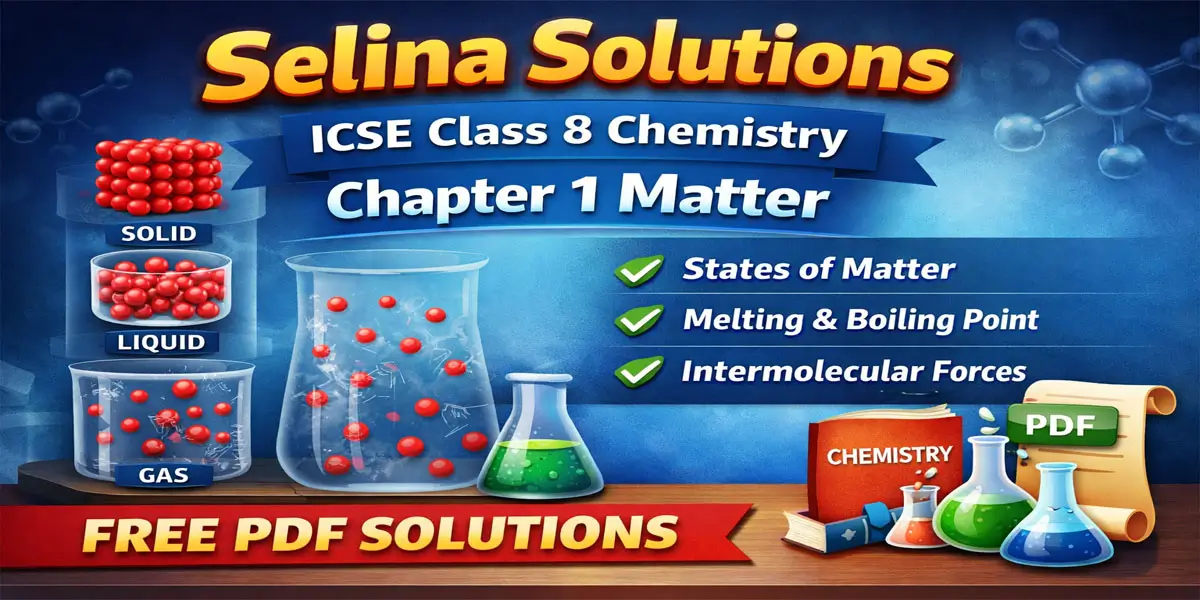
Introduction
If you are searching for ICSE Class 8 Chemistry Matter Selina Solutions, you are at the right place. Chapter 1 Matter is one of the most important chapters in ICSE Class 8 Chemistry. It introduces students to the basic concepts of matter, its properties, states of matter, and change of state.
Our ICSE Class 8 Chemistry Matter Selina Solutions help students understand textbook questions easily with accurate and simple answers. These solutions are useful for homework, revision, and exam preparation.
Study Support by Rohit Academy
Rohit Academy offers expert-curated ICSE Class 8 Chemistry Study Materials including ICSE Measurements and Experimentation Chapter Notes, diagrams, and key formulas for better understanding.
You can also visit :
| ☛ ICSE Class 8 Chemistry Chapter 1: Matter Notes |
| ☛ ICSE Class 8 Physics |
| ☛ ICSE Class 8 Chemistry |
| ☛ ICSE Class 8 Mathematics |
| ☛ ICSE Class 8 Biology |
(A) Multiple Choice Type
Question 1
Choose the correct answer from the multiple choices given below.
Question 1(i)
The process in which a substance in solid state directly changes into gaseous state is called as:
(a) Condensation (b) Sublimation
(c) Deposition (d) Vaporisation
Answer:
(b) Sublimation
Explanation:
Sublimation is the process in which a solid changes directly into gas without passing through the liquid state. Example: camphor, naphthalene, iodine.
Question 1(ii)
The three states of matter i.e. solid, liquid and gas exist due to:
(a) Random motion of molecules in a substance
(b) Intermolecular space
(c) Intermolecular force of attraction
(d) All of the above
Answer:
(d) All of the above
Explanation:
The state of matter depends on the motion of molecules, the space between molecules, and the intermolecular forces of attraction. All these factors together determine whether a substance is solid, liquid, or gas.
Question 1(iii)
The intermolecular force of attraction is the strongest in:
(a) solids (b) liquids
(c) gases (d) none of the above
Answer:
(a) solids
Explanation:
In solids, molecules are very closely packed and strongly attracted to each other. Therefore, intermolecular forces are strongest in solids.
Question 1(iv)
Which of the following substances has the largest intermolecular spaces?
(a) A piece of iron metal
(b) A glass of water
(c) A spoon of common salt
(d) A balloon filled with hydrogen gas
Answer:
(d) A balloon filled with hydrogen gas
Explanation:
Gases have the largest intermolecular spaces compared to solids and liquids. Hydrogen gas molecules are far apart inside the balloon.
Question 1(v)
The type of energy possessed by a moving body is called as:
(a) Electrical energy (b) Light energy
(c) Heat energy (d) Kinetic energy
Answer:
(d) Kinetic energy
Explanation:
Kinetic energy is the energy possessed by an object due to its motion.
Question 1(vi)
What happens to the kinetic energy when a solid substance is heated?
(a) Increases
(b) Decreases
(c) No change
(d) May increase or decrease
Answer:
(a) Increases
Explanation:
When a solid is heated, its molecules gain energy and vibrate more rapidly. Therefore, the kinetic energy of the molecules increases.
Assertion Reason Type
Question 2
The following questions are Assertion -Reason based questions. Choose the answer based on the codes given below.
Question 2(i)
Assertion (A): Matter exists in three states; i.e. solids, liquids and gases.
Reason (R): The intermolecular forces of attraction and intermolecular spaces are different in different kinds of matter.
(a) Both A and R are true and R is the correct explanation of A.
(b) Both A and R are true but R is not the correct explanation of A.
(c) A is true but R is false.
(d) A is false but R is true.
Answer:
(a) Both A and R are true and R is the correct explanation of A.
Explanation:
Matter exists as solid, liquid, or gas because the intermolecular forces of attraction and intermolecular spaces vary in different substances. Strong forces and small spaces form solids, moderate forces form liquids, and very weak forces with large spaces form gases.
Question 2(ii)
Assertion (A): Liquid molecules can move freely and are able to occupy the whole space available to them.
Reason (R): The molecules of liquids have larger intermolecular spaces and weaker intermolecular forces of attraction than those in solids.
(a) Both A and R are true and R is the correct explanation of A.
(b) Both A and R are true but R is not the correct explanation of A.
(c) A is true but R is false.
(d) A is false but R is true.
Answer:
(d) A is false but R is true.
Explanation:
Liquids can move freely but cannot occupy the whole space available to them; only gases can do that.
However, it is true that liquids have larger intermolecular spaces and weaker forces of attraction than solids.
Question 2(iii)
Assertion (A): Naphthalene balls become smaller with the passage of time, as they sublime.
Reason (R): Naphthalene balls sublime, as such solids have stronger intermolecular forces of attraction in comparison to other solids.
(a) Both A and R are true and R is the correct explanation of A.
(b) Both A and R are true but R is not the correct explanation of A.
(c) A is true but R is false.
(d) A is false but R is true.
Answer:
(c) A is true but R is false.
Explanation:
Naphthalene balls slowly sublime (solid → gas), so they become smaller with time.
But sublimation occurs because such substances have relatively weak intermolecular forces, not stronger ones.
Question 2(iv)
Assertion (A): Conversion of a substance in solid state to its liquid state is called melting.
Reason (R): On heating, the kinetic energy of solid molecules increases.
(a) Both A and R are true and R is the correct explanation of A.
(b) Both A and R are true but R is not the correct explanation of A.
(c) A is true but R is false.
(d) A is false but R is true.
Answer:
(a) Both A and R are true and R is the correct explanation of A.
Explanation:
When a solid is heated, its molecules gain kinetic energy and vibrate faster, weakening the intermolecular forces. This causes the solid to change into a liquid, which is called melting.
Question 2(v)
Assertion (A): Solids can be hardly compressed by applying pressure.
Reason (R): The molecules in solids are closely packed.
(a) Both A and R are true and R is the correct explanation of A.
(b) Both A and R are true but R is not the correct explanation of A.
(c) A is true but R is false.
(d) A is false but R is true.
Answer:
(a) Both A and R are true and R is the correct explanation of A.
Explanation:
In solids, molecules are very closely packed with very little intermolecular space, so they cannot be compressed easily. Hence solids are almost incompressible.
Fill in the blanks
Question 3
Fill in the blanks:
(a) The change of a solid into a liquid is called …………… .
(b) The process in which a solid directly changes into gas is called …………… .
(c) The change of water vapour into water is called …………… .
(d) The temperature at which a liquid starts changing into its vapour state is ………….. .
(e) A gas can be changed into a liquid and then into solid by …………… its pressure and cooling.
(f) LPG cylinders contain cooking gas in …………… state at high pressure.
(g) In a chemical reaction, the total mass of the reactants is …………… to the total mass of the products.
Answer:
(a) The change of a solid into a liquid is called melting.
(b) The process in which a solid directly changes into gas is called sublimation.
(c) The change of water vapour into water is called condensation.
(d) The temperature at which a liquid starts changing into its vapour state is boiling point.
(e) A gas can be changed into a liquid and then into solid by increasing its pressure and cooling.
(f) LPG cylinders contain cooking gas in liquid state at high pressure.
(g) In a chemical reaction, the total mass of the reactants is equal to the total mass of the products.
True or False
Question 4
Write whether the following statements are true or false.
(a) Matter can be created or destroyed during a chemical reaction.
(b) When a substance changes its state, its mass is also changed.
(c) In solids, the molecules can only vibrate about their mean positions. They are not free to move.
(d) In liquids, the kinetic energy of molecules is less than that of solids.
(e) In gases, the intermolecular forces of attraction are negligible.
Answer:
(a) False
Correct statement: Matter can neither be created nor destroyed during a chemical reaction (Law of Conservation of Mass).
(b) False
Correct statement: When a substance changes its state, its mass remains the same.
(c) True
(d) False
Correct statement: In liquids, the kinetic energy of molecules is greater than that of solids.
(e) True
Match the following
Question 5
Match the following:
| Column A | Column B |
| (a) Smallest inter-molecular spaces | (i) Diffusion |
| (b) Random motion of particles in a liquid | (ii) Gases |
| (c) Intermixing of gaseous molecules | (iii) Intermolecular force of attraction |
| (d) Highest kinetic energy | (iv) Brownian motion |
| (e) Increases with a decrease in temperature | (v) Solids |
Answer:
| Column A | Column B |
| (a) Smallest inter-molecular spaces | (v) Solids |
| (b) Random motion of particles in a liquid | (iv) Brownian motion |
| (c) Intermixing of gaseous molecules | (i) Diffusion |
| (d) Highest kinetic energy | (ii) Gases |
| (e) Increases with a decrease in temperature | (iii) Intermolecular force of attraction |
(B) Short Answer Type Questions
Question 1
Name the following:
(a) The substances which can flow.
(b) The intermixing of two or more substances due to their motion.
(c) The force of attraction between the particles of a substance.
(d) The substances which have a definite shape and volume.
(e) The state of matter which is highly compressible.
(f) The temperature at which a solid starts changing into a liquid.
(g) The change of vapour of a substance directly into a solid on cooling.
Answer:
(a) Fluids
(b) Diffusion
(c) Intermolecular force of attraction
(d) Solids
(e) Gas
(f) Melting Point
(g) Deposition
Question 2
Give two examples for each of the following:
(a) The substances which can sublime.
(b) The substances which do not change their state on heating.
(c) The substances which can flow.
Answer:
(a) Camphor, Naphthalene
(b) Sand, Wood.
(c) Water, Air.
Question 3
Define the following terms:
(a) Matter
(b) Intermolecular force of attraction
(c) Diffusion
(d) Brownian motion
(e) Kinetic energy
Answer:
(a) Matter: Matter is anything that has mass and occupies space.
(b) Intermolecular force of attraction: The force of attraction between the molecules (particles) of a substance is called intermolecular force of attraction.
(c) Diffusion: Diffusion is the intermixing of two or more substances on their own due to the random motion of their molecules.
(d) Brownian motion: Brownian motion is the random zig-zag movement of tiny particles in a liquid or gas.
(e) Kinetic energy: Kinetic energy is the energy possessed by a body due to its motion.
Question 4
Give reasons:
(a) A gas can fill the whole vessel in which it is enclosed.
(b) Solids cannot be compressed.
(c) Liquids can flow.
(d) When magnesium is burnt in air, there is an increase in mass after the reaction.
(e) When sodium chloride is added to a definite volume of water and stirred well, a solution is formed, but there is no increase in the level of water.
(f) piece of chalk can be broken easily into smaller pieces but a coal piece cannot be broken easily.
Answer:
(a) Gas particles are very far apart and have negligible intermolecular forces of attraction. They move freely in all directions, so they spread out and fill the entire vessel.
(b) In solids, the particles are very closely packed with very little space between them and strong intermolecular forces. Therefore, they cannot be compressed.
(c) In liquids, the particles are less tightly packed than in solids and can move or slide past one another. Hence, liquids can flow.
(d) Magnesium reacts with oxygen from the air to form magnesium oxide. Since oxygen combines with magnesium, the mass increases.
Reaction: 2Mg + O₂ → 2MgO
(e) Water has intermolecular spaces. The sodium chloride particles occupy these spaces when dissolved, so the water level does not increase.
(f) Chalk has weaker intermolecular forces between its particles, so it breaks easily. Coal has stronger intermolecular forces, making it harder to break.
Question 5
State your observation when:
(a) A gas jar which appears empty is inverted over a gas jar containing Bromine vapours.
(b) Solid ammonium chloride is heated.
(c) Vinegar is added to baking soda.
Answer:
(a) The reddish-brown bromine vapours slowly spread into the upper gas jar. After some time, both gas jars appear uniformly reddish-brown due to diffusion of bromine vapours.
(b) White fumes are produced and the solid ammonium chloride disappears. On the cooler parts of the test tube, white solid ammonium chloride is deposited again.
(c) Brisk effervescence (bubbling) is observed due to the release of carbon dioxide gas.
Question 6
Give word equations for the following reactions:
(a) Barium chloride solution is added to sodium sulphate solution.
(b) Vinegar is added to baking soda.
(c) Magnesium burns in oxygen.
Answer:
(a) Barium chloride + Sodium sulphate → Barium sulphate + Sodium chloride
(b) Acetic acid + Sodium bicarbonate → Carbon dioxide + Water + Sodium acetate
(c) Magnesium + Oxygen (Air) → Magnesium oxide
Question 7
Some of the properties of solids, liquids and gases are listed ahead.
Separate these properties for the three states of matter.
Definite volume, least closely packed, can flow downwards, highly compressible, highly rigid, diffuse slowly.
Answer:
Solids
- Definite volume
- Highly rigid
- Diffuse slowly
Liquids
- Definite volume
- Can flow downwards
Gases
- Least closely packed
- Highly compressible
Question 8
Arrange the following:
(a) Solids, liquids and gases in increasing order of the constant motion of their particles.
(b) Copper metal, water vapour and milk in decreasing order of their intermolecular forces of attraction.
Answer:
(a) Solids < Liquids < Gases.
(b) Copper metal > Milk > Water vapour
(C) Long Answer Type Questions
Question 1
What are the three states of matter? Define each of them and give two examples of each.
Answer:
The three states of matter are solids, liquids and gases.
- Solids : A solid has a definite shape and a definite volume.
Examples: Iron, Wood - Liquids : A liquid has a definite volume but no definite shape.
Examples: Water, Oil - Gases : A gas has neither a definite shape nor a definite volume.
Examples: Oxygen, Carbon dioxide.
Question 2
(a) What is meant by interconversion of matter?
(b) State two factors responsible for the change of state of matter.
(c) What happens to intermolecular forces of attraction when a solid substance is heated?
Answer:
(a) The interconversion of states of matter is the process in which a substance changes from one state of matter to another and then back to its original state without any change in its chemical composition.
(b) The two factors responsible for the change of state of matter are:
◉ Change in temperature
◉ Change in pressure.
(c) When a solid is heated, its particles gain energy and start moving faster. As a result, the intermolecular forces of attraction become weaker, allowing the particles to move more freely.
Question 3
State the main postulates of kinetic theory of matter.
Answer:
Main Postulates of the Kinetic Theory of Matter:
- Matter is made up of very tiny particles called atoms or molecules.
- The particles of matter are in constant motion. They keep moving continuously in all directions.
- There are spaces between the particles of matter, known as intermolecular spaces.
- The particles of matter attract each other. This attraction is called intermolecular force of attraction.
- The particles possess kinetic energy, and this energy increases when the temperature increases.
Question 2
(a) What is meant by interconversion of matter?
(b) State two factors responsible for the change of state of matter.
(c) What happens to intermolecular forces of attraction when a solid substance is heated?
Answer:
(a) The interconversion of states of matter is the process in which a substance changes from one state of matter to another and then back to its original state without any change in its chemical composition.
(b) The two factors responsible for the change of state of matter are:
◉ Change in temperature
◉ Change in pressure.
(c) When a solid is heated, its particles gain energy and start moving faster. As a result, the intermolecular forces of attraction become weaker, allowing the particles to move more freely.
Question 3
State the main postulates of kinetic theory of matter.
Answer:
Main Postulates of the Kinetic Theory of Matter:
- Matter is made up of very tiny particles called atoms or molecules.
- The particles of matter are in constant motion. They keep moving continuously in all directions.
- There are spaces between the particles of matter, known as intermolecular spaces.
- The particles of matter attract each other. This attraction is called intermolecular force of attraction.
- The particles possess kinetic energy, and this energy increases when the temperature increases.
Question 4
What happens to water if:
(a) it is kept in a deep freezer?
(b) it is heated?
Explain the change of state of water for the above two conditions with the help of kinetic theory.
Answer:
(a) When water is kept in a deep freezer, it loses heat and freezes to form ice (solid state).
Explanation:
According to the kinetic theory, when water is cooled, the kinetic energy of its particles decreases. The particles move more slowly and come closer together. The intermolecular forces of attraction become stronger, causing the liquid water to change into solid ice.
(b) When water is heated, it changes into water vapour (steam) after reaching its boiling point.
Explanation:
When water is heated, the kinetic energy of its particles increases. The particles move faster and farther apart. The intermolecular forces of attraction become weaker, allowing the liquid to change into gas (water vapour).
Question 5
(a) State the law of conservation of mass.
(b) What change occurs in the mass of a solid when it is heated to convert into a liquid?
(c) What do you observe when barium chloride solution is mixed with sodium sulphate solution?
What difference is observed in the mass of reactants and products in the above reaction?
Answer:
(a) The law of conservation of mass states that mass can neither be created nor destroyed during a chemical reaction. The total mass of the reactants is always equal to the total mass of the products.
(b) There is no change in the mass of the substance when a solid is heated to convert into a liquid. Only the state of matter changes, not the mass.
(c) When barium chloride solution is mixed with sodium sulphate solution, a white precipitate of barium sulphate is formed.
Reaction:
BaCl₂ + Na₂SO₄ → BaSO₄ ↓ + 2NaCl
Difference in mass of reactants and products:
There is no difference in mass. The total mass of the reactants is equal to the total mass of the products, which shows the law of conservation of mass.
ICSE Class 8 Chemistry Matter Selina Solutions PDF Download
Download ICSE Class 8 Chemistry Matter Selina Solutions PDF with chapter-wise solved answers, explanations, and free study resources for easy exam preparation.
Why Study ICSE Class 8 Chemistry Matter?
Matter is the foundation of Chemistry. Everything around us is made of matter. This chapter explains:
- Definition of matter
- Properties of matter
- States of matter
- Interconversion of states
- Melting point and boiling point
- Evaporation and condensation
- Sublimation process
By learning this chapter properly, students can build a strong base for future chemistry topics.
ICSE Class 8 Chemistry Matter Selina Solutions – Benefits
Using ICSE Class 8 Chemistry Matter Selina Solutions gives many advantages:
1. Step-by-Step Answers
2. Better Understanding
3. Exam Ready Preparation
4. Time Saving
Why Students Search for ICSE Class 8 Chemistry Matter Selina Solutions
Students search these solutions because Selina textbook questions are very important in school exams. Teachers often ask direct questions from the book exercises.
With ICSE Class 8 Chemistry Matter Selina Solutions, students can prepare confidently and improve marks.
Tips to Score Good Marks in Chemistry
- Learn definitions carefully
- Practice textbook questions daily
- Revise diagrams and examples
- Understand keywords like melting point and boiling point
- Use Selina solutions regularly
Free PDF Download
Many students also search for ICSE Class 8 Chemistry Matter Selina Solutions PDF Download so they can study offline anytime.
Conclusion
ICSE Class 8 Chemistry Matter Selina Solutions are the best resource for students who want clear explanations and correct textbook answers. By practicing these solutions daily, students can strengthen concepts and score higher marks in exams.
For more ICSE notes, MCQs, solutions, and study materials, visit Rohit Academy.
ICSE Class 8 Chemistry Selina Solutions
The Selina Concise Chemistry Class 8 book includes the following chapters:
Official Website:
Students can visit the official CISCE website for more details and updates.