Introduction
Atomic Structure is one of the most important chapters in ICSE Class 8 Chemistry. This chapter helps students understand the basic structure of matter, atoms, subatomic particles, and electronic arrangement. These notes are prepared in simple language for quick revision and exam preparation.
Students can use these ICSE Class 8 Chemistry Atomic Structure Notes PDF for school exams, homework, and last-minute revision.
Study Support by Rohit Academy
Rohit Academy offers expert-curated ICSE Class 8 Chemistry Study Materials including ICSE Atomic Structure Chapter Notes, diagrams, and key formulas for better understanding.
You can also visit:
| ☛ ICSE Class 8 Chemistry Chapter 4: Atomic Structure Selina Solutions |
| ☛ ICSE Class 8 Physics |
| ☛ ICSE Class 8 Chemistry |
| ☛ ICSE Class 8 Mathematics |
| ☛ ICSE Class 8 Biology |
Atomic Structure | ICSE Class 8 Chemistry Notes
Atom
- An atom is the smallest particle of an element that exhibits all the properties of that element.
- Atoms are extremely tiny particles and cannot be seen with the naked eye.
- They can be observed using powerful electron microscopes.
- Atoms take part in chemical reactions.
Dalton’s Atomic Theory
John Dalton proposed that:
- All matter is made up of very small particles called atoms.
- Atoms are indivisible and cannot be created or destroyed in a chemical reaction.
- All atoms of the same element are identical in mass and properties.
- Atoms of different elements have different masses and properties.
- Atoms combine in simple whole number ratios to form compounds.
- Atoms rearrange during chemical reactions.
Limitations / Drawbacks of Dalton’s Atomic Theory
- Dalton stated that atoms are indivisible particles. However, later discoveries showed that atoms are made up of smaller particles called electrons, protons, and neutrons.
- Dalton proposed that all atoms of an element have exactly the same mass. But it is now known that atoms of the same element can have slightly different masses, known as isotopes.
Sub-Atomic (Fundamental) Particles
Atoms are made up of three main particles:
- Electron (e⁻): Negatively charged particle
- Proton (p⁺): Positively charged particle
- Neutron (n⁰): Neutral particle (no charge).
Nucleons
Protons and neutrons together are called nucleons.
Electrical Neutrality of an Atom
- An atom has the same number of protons and electrons.
- The positive charge of protons is balanced by the negative charge of electrons.
- As a result, the overall charge of an atom is zero, making it electrically neutral.
Discovery of Electrons : Cathode Rays (By J. J. Thomson)
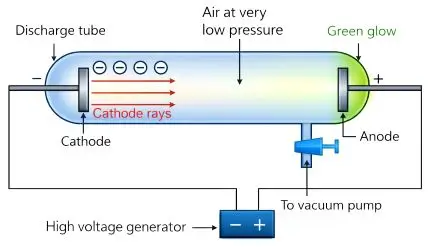
Electrons were discovered by J.J. Thomson while he was studying the properties of cathode rays in a discharge tube.
- The Experiment: High-voltage electricity was passed through a glass tube (discharge tube) containing gas at very low pressure.
- Observation: Streams of rays were emitted from the negative electrode (cathode) toward the positive electrode (anode). These were named cathode rays.
- Conclusion: These rays consisted of negatively charged particles, which Thomson named electrons.
Properties of Electrons
- Negatively charged particle.
- Present in all atoms.
- Mass of electron = 9.108 × 10⁻³¹ kg
It is 1/1837 of the mass of a hydrogen atom. - Charge of electron = − 1.602 × 10⁻³¹ C
Discovery of Protons – Anode Rays/Canal Rays (By E. Goldstein)
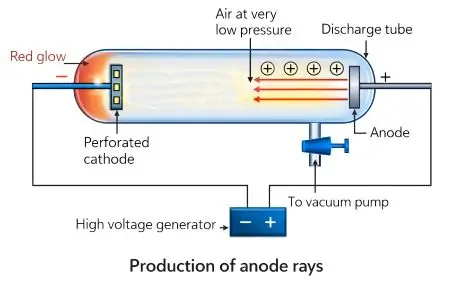
Experiment:
- Used perforated cathode discharge tube.
- Observed canal rays (anode rays).
Conclusion:
Canal rays consist of positively charged particles called protons.
Properties of Protons
- Positively charged particle.
- Charge = +1.602 × 10⁻¹⁹ C.
- Mass ≈ 1.67 × 10⁻²⁷ kg.
- Present in the nucleus of atoms.
Discovery of Neutrons (By J. Chadwick)
Conclusion:
Discovered neutral particles called neutrons.
Properties of Neutrons
- A neutron is electrically neutral (no charge).
- Mass slightly greater than proton.
- Present in the nucleus.
- The number of neutrons may be equal to or greater than the number of protons.
- Atoms of the same element can have different numbers of neutrons, forming isotopes.
Comparison between Proton, Neutron and Electron
| Particles | Location | Mass | Charge | Discovered by |
| Electron (e⁻) | Orbit | Negligible | −1.6 × 10⁻¹⁹ C | J. J. Thomson |
| Proton (p⁺) | Nucleus | 1.67 × 10⁻²⁷ kg | +1.6 × 10⁻¹⁹ C | E. Rutherford |
| Neutron (n⁰) | Nucleus | 1.67 × 10⁻²⁷ kg | No charge | J. Chadwick |
Thomson’s Atomic Model (Plum Pudding Model)
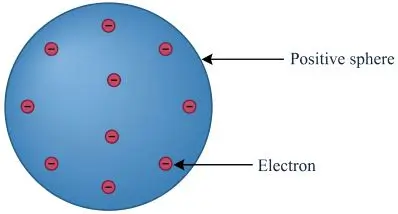
Proposed by J. J. Thomson.
Features:
- Atom is a positively charged sphere.
- Electrons embedded inside it like plums in pudding.
- Atom is electrically neutral.
Limitation:
Could not explain experimental observations.
Rutherford’s Atomic Model
Based on Alpha Particle Scattering Experiment (1911).
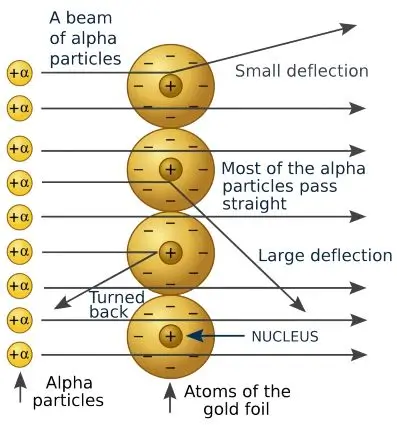
Observations of Rutherford’s Experiment
Rutherford observed the following results:
- Most alpha particles passed straight through the gold foil without any deflection.
- Some alpha particles were deflected slightly from their path.
- Very few alpha particles bounced back.
Conclusions of Rutherford
- Empty Space: Since most particles passed through, most of the space inside an atom is empty.
- Central Mass: There is a heavy, positively charged mass at the center that caused the deflection.
- The Nucleus: This central mass is very small compared to the total size of the atom. Rutherford named this dense center the nucleus.
Bohr’s Atomic Model (1913)
Proposed by Niels Bohr.
Main Points:
- Electrons revolve in fixed circular paths called orbits or shells.
- Each orbit has fixed energy.
- Shells are named K, L, M, N.
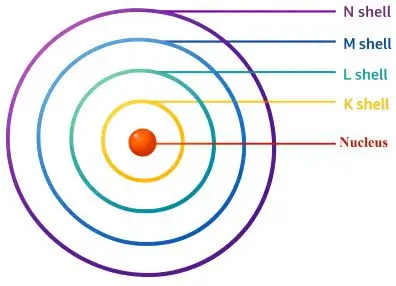
Energy increases with distance from nucleus.
- Shell nearest to nucleus → lowest energy
- Shell farthest from nucleus → highest energy
Structure of an Atom
An atom has two main parts:
1. Nucleus
- Contains protons and neutrons
- Positively charged
2. Electron shells
- Surround the nucleus
- Contain electrons
Atomic Number (Z)
The number of protons present in the nucleus of an atom is called the atomic number. It is represented by Z.
- Atomic number = Number of protons
- Atomic number = Number of electrons
- Example: Oxygen
Z = 8
Mass Number (A)
The total number of protons and neutrons present in the nucleus is called the mass number. It is represented by A.
- Mass Number (A) = Protons + Neutrons
- Mass number = Atomic number + No. of neutrons
- No. of neutrons = Mass number − Atomic number
- Example:
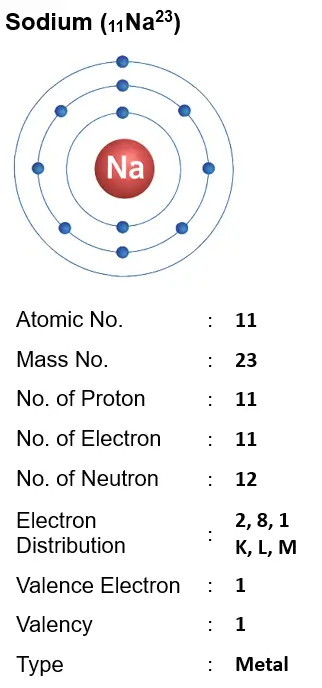
Sodium \(\left({_11^{23}}Na\right)\)
A = 23
Z = 11
Neutrons = 23 − 11 = 12
Electronic Configuration
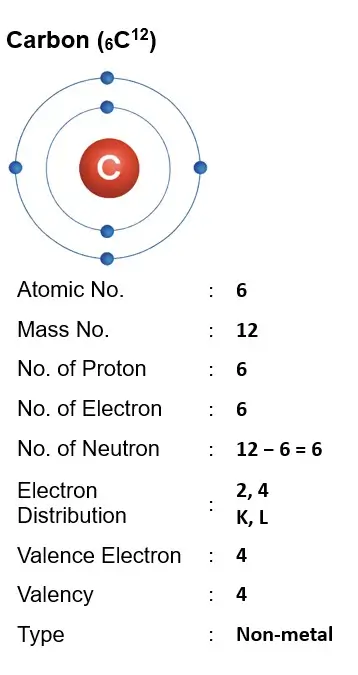
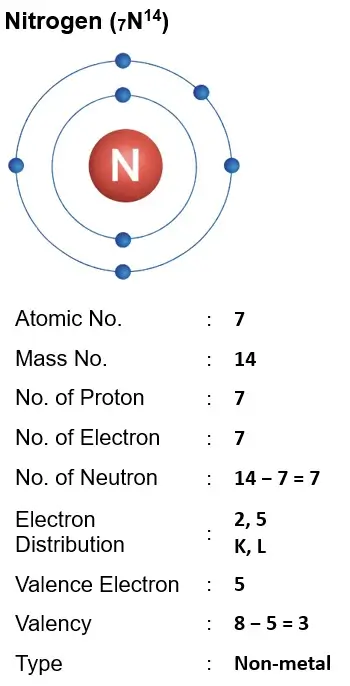
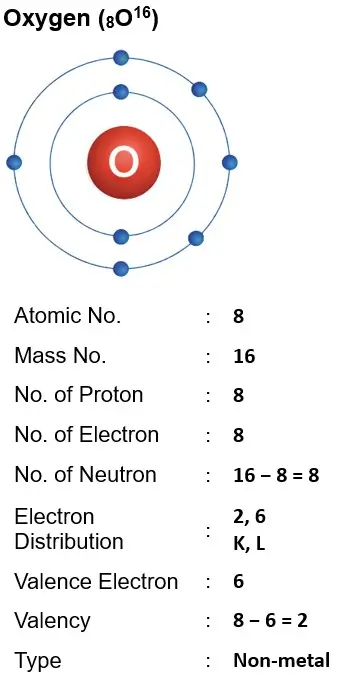
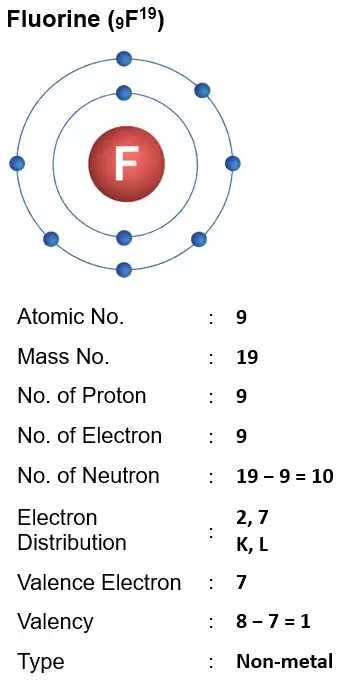
The arrangement of electrons in different shells (orbits) of an atom is called electronic configuration.
Bohr-Bury Rules
Maximum electrons in a shell = 2n2
| Shell | n | Maximum Electrons |
| K | 1 | 2 |
| L | 2 | 8 |
| M | 3 | 18 |
| N | 4 | 32 |
Symbolic Representation of Elements
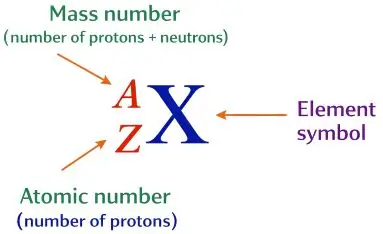
- Outer shell cannot contain more than 8 electrons.
Valence Shell & Valency
- Valence Shell : The outermost shell of an atom.
- Valence Electrons : Electrons present in the outermost shell.
- Valency : The combining capacity of an atom.
Example:
Na → valency = 1
O → valency = 2
N → valency = 3
Octet Rule
Atoms tend to gain, lose, or share electrons to achieve 8 electrons in their outermost shell.
This stable condition is called the Octet Rule.
Example
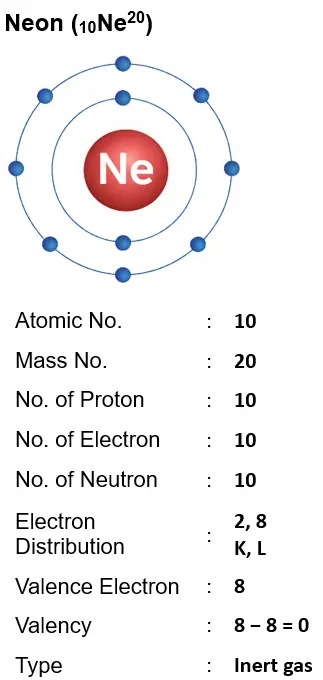
- Neon (2,8) is stable because its outer shell has 8 electrons.
Hydrogen and Helium follow the duplet rule (2 electrons).
Ions
Charged particles formed when atoms gain or lose electrons.
- Cation : Positive ion (loss of electron)
Example:
Na → Na⁺ - Anion : Negative ion (gain of electron)
Example:
Cl → Cl⁻
Isotopes
Isotopes are atoms of same elements having same atomic number and different mass numbers.
Examples of Isotopes:
1. Hydrogen: Has three isotopes:
- Protium \(\left({_\mathbf{1}^\mathbf{1}}\mathbf{H}\right)\) : 1 proton, 0 neutrons.
- Deuterium \(\left({_\mathbf{1}^\mathbf{2}}\mathbf{H}\right)\) : 1 proton, 1 neutron.
- Tritium \(\left({_\mathbf{1}^\mathbf{3}}\mathbf{H}\right)\) : 1 proton, 2 neutrons.
2. Carbon: Carbon-12 \(\left({_\mathbf{6}^\mathbf{12}}\mathbf{C}\right)\), Carbon-13 \(\left({_\mathbf{6}^\mathbf{13}}\mathbf{C}\right)\), and Carbon-14 \(\left({_\mathbf{6}^\mathbf{14}}\mathbf{C}\right)\).
3. Chlorine: Chlorine-35 \(\left({_\mathbf{17}^\mathbf{35}}\mathbf{Cl}\right)\) and Chlorine-37 \(\left({_\mathbf{17}^\mathbf{37}}\mathbf{Cl}\right)\).
Properties of Isotopes
- Same chemical properties
- Different physical properties
Radicals
A radical is an atom or group of atoms that carries a positive or negative charge.
Examples:
| Radical | Formula | Valency |
| Ammonium | NH4+ | 1 |
| Nitrate | NO3− | 1 |
| Sulphate | SO42− | 2 |
| Carbonate | CO32− | 2 |
| Phosphate | PO43− | 3 |
Variable Valency
Some elements show more than one valency.
- Lower valency → suffix “ous”
- Higher valency → suffix “ic”
Examples:
| Ion | Name | Valency |
| Fe2+ | Ferrous [Iron (II)] | 2 |
| Fe3+ | Ferric [Iron (III)] | 3 |
| Cu+ | Cuprous [Copper (I)] | 1 |
| Cu2+ | Cupric [Copper (II)] | 2 |
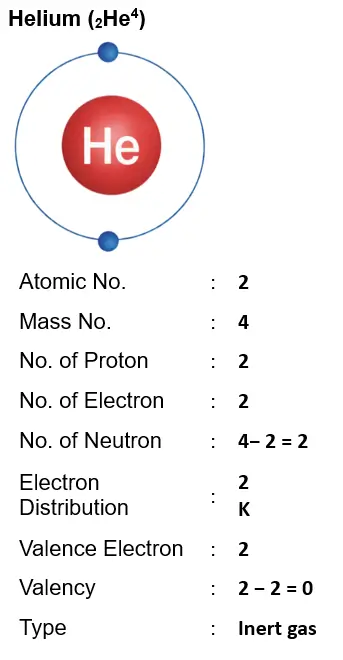
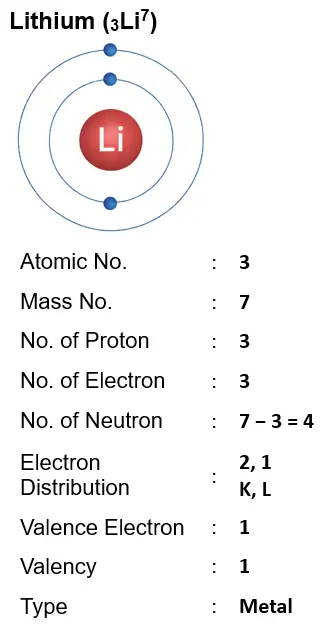
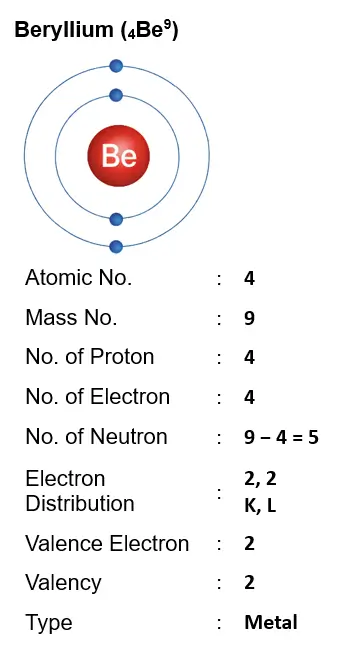
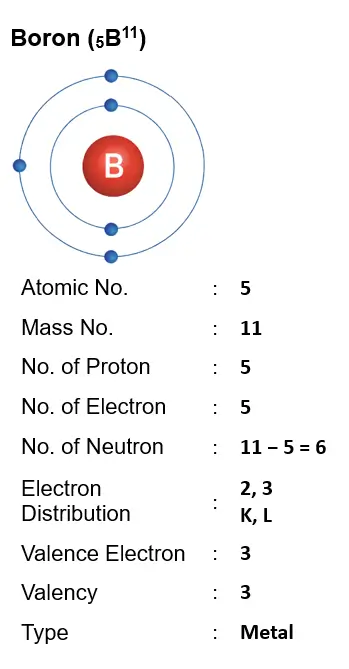
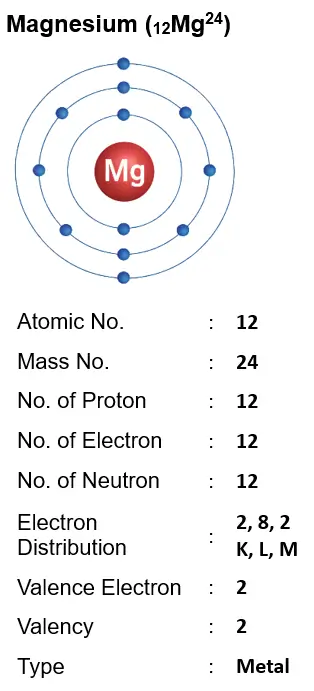
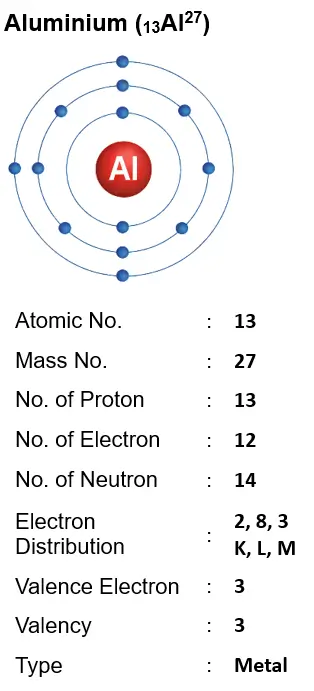
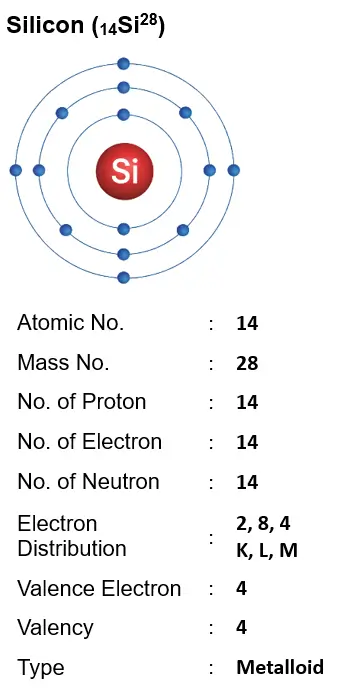
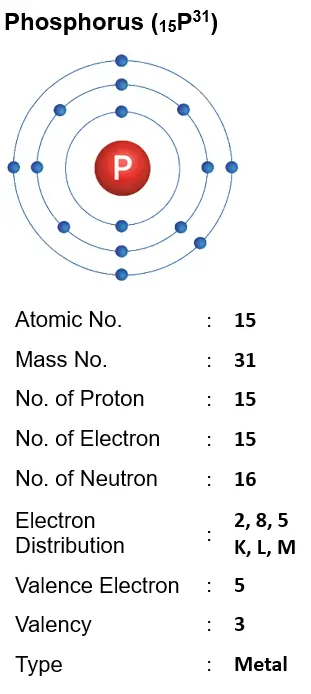
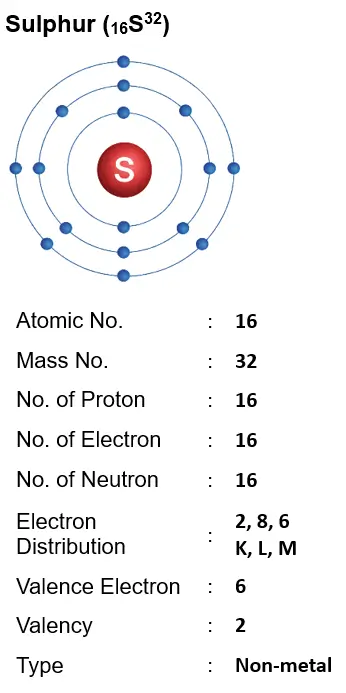
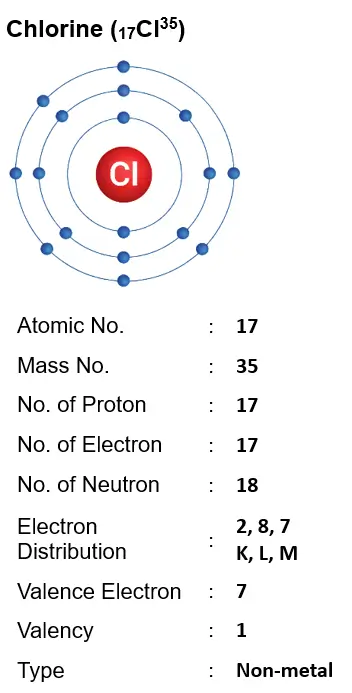
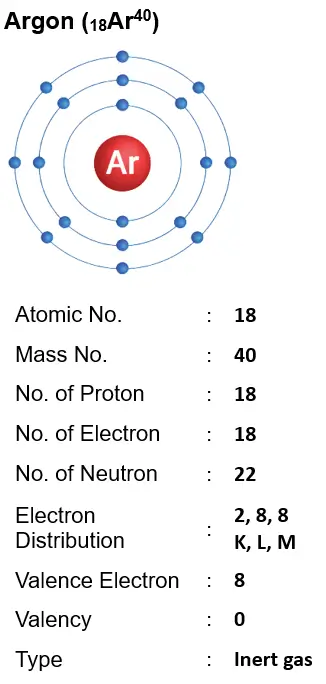
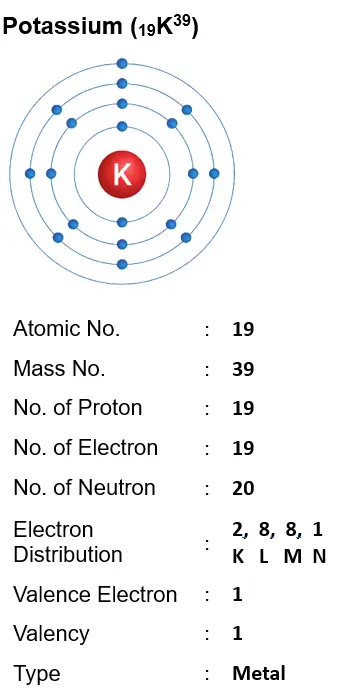
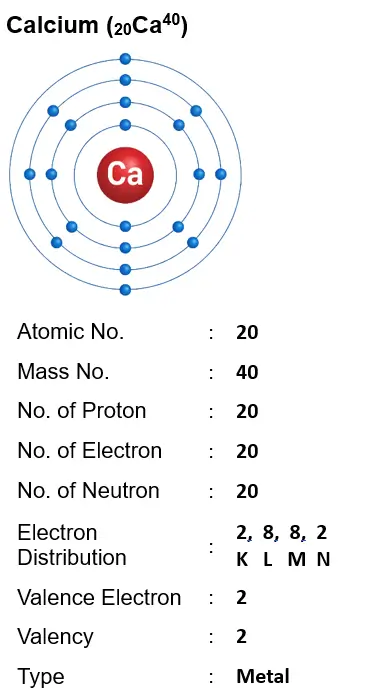
Electronic Configurations of First Twenty Elements
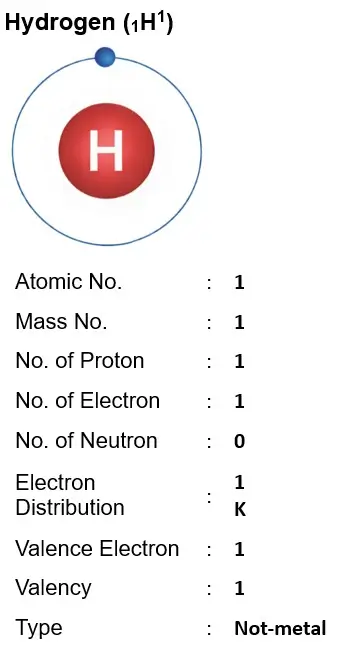 |  |
 |  |
 |  |
 |  |
 |  |
 |  |
 |  |
 |  |
 |  |
 |  |
Download ICSE Class 8 Chemistry Atomic Structure Notes PDF
Students looking for ICSE Class 8 Chemistry Atomic Structure Notes PDF Download can use these notes for quick revision and concept clarity. These notes cover atom structure, subatomic particles, electronic configuration, atomic number, mass number, and valency in an easy format.
Exam Tips for ICSE Class 8 Atomic Structure
- Learn symbols of subatomic particles.
- Practice electronic configuration.
- Remember atomic number and mass number formulas.
- Revise valency chart regularly.
- Solve previous year questions for better preparation.
ICSE Class 8 Chemistry Notes
Official Website:
Students can visit the official CISCE website for more details and updates.