Introduction
Water is one of the most important substances on Earth and is essential for all forms of life. In the ICSE Class 8 Chemistry syllabus, the chapter Water explains the physical and chemical properties of water, its importance, purification methods, and the concepts of hard and soft water. These notes provide a concise summary of the chapter and help students prepare effectively for examinations.
Study Support by Rohit Academy
Rohit Academy offers expert-curated ICSE Class 8 Chemistry Study Materials including ICSE Water Chapter Notes, diagrams, and key formulas for better understanding.
You can also visit:
| ☛ ICSE Class 8 Chemistry Chapter 8: Water Selina Solutions |
| ☛ ICSE Class 8 Physics |
| ☛ ICSE Class 8 Chemistry |
| ☛ ICSE Class 8 Mathematics |
| ☛ ICSE Class 8 Biology |
Water | ICSE Class 8 Chemistry Notes
Introduction to Water
- Chemical Formula : H₂O
- Chemical Name : Dihydrogen Oxide
- Ratio of hydrogen to oxygen by mass = 1 : 8
- Ratio of hydrogen to oxygen by volume = 2 : 1
Importance of Water
Water is one of the most essential substances for life. No living organism can survive without water.
Water exists in three states of matter:
- Solid – Ice and snow
- Liquid – Water in rivers, lakes, oceans
- Gas – Water vapour in the atmosphere
Where is Water Found?
- In oceans, seas, rivers, lakes and ponds
- As underground water
- In polar regions and mountains as ice and glaciers
- In the atmosphere as water vapour, clouds, fog and mist
Why Water is Important:
- Required for drinking and survival.
- Acts as a medium for biochemical reactions in the body.
- Regulates body temperature.
- Used for cooking, cleaning, bathing and washing.
- Essential for agriculture and photosynthesis.
- Provides nutrients to aquatic plants and animals.
- Controls the earth’s climate.
- Used in industries and manufacturing.
- Generates hydroelectric power.
Water – An Essential Constituent of Living Things
Water forms a major part of the body mass of living organisms.
| Living Organism | Percentage of Water |
| Human beings | 70% |
| Elephants | 80% |
| Plants | 60% |
| Leafy vegetables | 90% |
| Potatoes | 70% |
Even dry-looking substances like wood, peas and beans contain some water.
Water as a Renewable Resource
Water is a renewable resource because it continuously circulates in nature through the water cycle.
Water exists in three states:
- Solid (Ice)
- Liquid (Water)
- Gas (Water vapour)
Water Cycle (Balance of Water in Nature)
The continuous circulation of water from the earth’s surface to the atmosphere and back to the earth is called the water cycle.
Processes involved:
- Evaporation : Water changes into vapour due to heat of the sun.
- Condensation : water vapour cools and changes back into tiny water droplets to form clouds.
- Precipitation : When water droplets in clouds become heavy and fall to the earth as rain, snow, or hail.
- Collection : Water collects in rivers, lakes and oceans.
Importance of Water Cycle:
- Maintains climate balance.
- Makes water available in different forms.
- Balances water in the atmosphere and on earth.
Sources of Water
Main Sources:
- Oceans and seas
- Rivers and lakes
- Springs and wells
- Rainwater
1. Oceans and Seas
- Cover about 71% of earth’s surface.
- Contain large amounts of dissolved salts.
- Not suitable for drinking (salty water).
2. Rivers and Lakes
- Formed from rain and melting snow.
- Contain dissolved and suspended impurities.
- Need purification before drinking.
3. Springs and Wells
- Sources of underground water.
- Usually contain dissolved minerals.
4. Rainwater
- Purest natural form of water.
- First shower contains impurities.
- Later showers are cleaner.
Water Available for Human Consumption
Although water covers most of the earth:
- Only about 1% of total water is suitable for direct human use.
- Water fit for drinking is called potable water.
Physical Properties of Water
- Colourless, transparent, tasteless and odourless liquid.
- Freezing point = 0°C
- Boiling point = 100°C (at normal pressure)
- Exists in all three states.
- Has high specific heat capacity (heats and cools slowly).
Effect of Pressure on Water
On Boiling Point:
- Boiling point increases with increase in pressure.
- Boiling point decreases with decrease in pressure.
- In a pressure cooker, steam gets trapped and increases the pressure inside.
- Higher pressure raises the boiling point of water (about 120°C), so food cooks faster.
- At high altitudes, atmospheric pressure is low, which lowers the boiling point of water. As a result, water boils below 100°C and does not provide sufficient heat to cook food quickly. Therefore, food takes a longer time to cook.
On Freezing Point:
- Increasing pressure can lower the freezing point of water.
- The pressure under a skater’s shoes melts ice, helping the skater glide.
Effect of Impurities in Water
On Freezing Point:
- Impurities lower the freezing point of water.
- Example: Salt mixed with ice lowers its melting point
On Boiling Point:
- Impurities raise the boiling point of water.
- Example: Adding salt increases boiling temperature.
Anomalous Expansion of Water
Normally, substances contract on cooling.
But water behaves differently.
- When water is cooled, it contracts and its density increases up to 4°C.
- At 4°C, water has maximum density (minimum volume).
- Below 4°C, water starts expanding on further cooling.
- At 0°C, water becomes ice.
- Ice is lighter than water and floats on it.
This unusual behaviour is called Anomalous Expansion of Water.
Importance of Anomalous Expansion of Water:
1. Survival of Aquatic Life:
During winter, the surface water cools first and freezes. Ice, being lighter, floats and forms a layer on the surface. This layer acts as an insulator and prevents the water below from freezing. The lower layers remain at 4°C, allowing aquatic organisms to survive.
2. Bursting of Water Pipes in Winter:
When water freezes, it expands. This expansion increases pressure inside pipes, causing them to burst in very cold regions.
3. Floating of Icebergs:
Ice is less dense than water due to anomalous expansion. Therefore, large icebergs float on the surface of sea water.
High Specific Heat Capacity of Water
- Water requires a large amount of heat to become hot.
- It also takes longer to cool.
- Water neither heats up nor cools down quickly.
Importance:
Water has a high specific heat capacity, so it can absorb a large amount of heat from a machine or engine (such as a car radiator) without a big rise in temperature.
Water – A Universal Solvent
Water is called a universal solvent because it dissolves a large number of solid, liquid, and gaseous substances.
Solution
A solution is a homogeneous mixture of two or more substances whose composition can be varied.
Components of a Solution
- Solvent : The substance present in larger quantity that dissolves another substance.
- Solute : The substance present in smaller quantity that gets dissolved.
Solution = Solute + Solvent - Example:
Sugar solution → Sugar (solute) + Water (solvent)
Types of Solutions
Aqueous Solution
- A solution in which water is the solvent.
- Example: Salt water, Sugar water
Non-Aqueous Solution
- A solution in which the solvent is not water.
- Example: Alcohol solution, Carbon tetrachloride solution
Miscible and Immiscible Liquids
Miscible Liquids
- Liquids that dissolve in water. Examples: Milk, Alcohol, Vinegar, Fruit juice.
Immiscible Liquids
- Liquids that do not dissolve in water. Examples: Petrol, Diesel, Mustard oil.
Effect of Temperature on Solubility
- For Solids:
- Solubility increases with increase in temperature.
- Example: Sugar dissolves faster in hot tea.
- For Gases:
- Solubility decreases with increase in temperature.
- Boiled water tastes flat because dissolved gases escape.
- In summer, fish in shallow ponds may die because warm water contains less dissolved oxygen.
Effect of Pressure on Solubility
- For Solids:
- Pressure has almost no effect.
- For Gases:
- Solubility increases with increase in pressure.
- Cold drinks contain dissolved carbon dioxide under high pressure. When the bottle is opened, pressure decreases and the gas escapes quickly, producing a fizz sound.
Importance of Gases and Minerals in Natural Water
Natural water contains dissolved gases and salts which are important:
- Oxygen
- Essential for survival of aquatic life.
- Carbon Dioxide
- Used by aquatic plants for photosynthesis.
- Nitrogen
- Helps in formation of nitrogen compounds by bacteria
- Nourishes water plants.
- Mineral Salts
- Essential for human health.
- Add taste to drinking water.
- Example: Sodium chloride (common salt)
Types of Solutions Based on Solubility
Saturated Solution
A solution that cannot dissolve more solute at a given temperature.
Unsaturated Solution
A solution that can dissolve more solute at a given temperature.
Supersaturated Solution
A solution that contains more solute than it can normally hold at room temperature, usually formed by heating a saturated solution and then cooling it carefully.
Conclusion
Water can dissolve a substance only up to a certain limit at a given temperature.
Solutions, Suspensions and Colloids
Mixtures can be classified based on particle size and nature of mixture.
Examples:
- Salt in water
- Sand in water
- Milk
Solution
Example: Salt in water
Characteristics:
- Homogeneous mixture
- Transparent
- Particle size less than 10⁻¹⁰ m
- Particles are not visible
- Particles do not settle down
- Cannot be separated by filtration
- Example: Sugar and water, salt and water.
Suspension
Example: Sand in water
Characteristics:
- Heterogeneous mixture
- Opaque
- Particle size greater than 10⁻⁷ m
- Particles are visible
- Particles settle at the bottom
- Can be separated by filtration
- Example: chalk and water, sand and water.
Colloid
Example: Milk
Characteristics:
- Appears homogeneous but actually heterogeneous
- Translucent
- Particle size between 10⁻¹⁰ m and 10⁻⁷ m
- Particles do not settle down
- Cannot be separated by ordinary filtration
- Cannot be seen under a powerful microscope
- Examples of colloids: Milk, Blood, Smoke, Jelly, Butter, Ink, Soap solution
Why Are They Different?
The difference between a solution, suspension and colloid is mainly due to particle size:
- Smallest particles → Solution
- Medium sized particles → Colloid
- Largest particles → Suspension
Water of Crystallisation
The fixed amount of water chemically combined with a salt in its crystal form is called Water of Crystallisation.
Example:
- Copper sulphate pentahydrate → CuSO4·5H2O
- On heating:
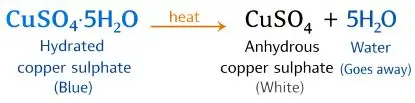
Blue crystals turn white because water is removed.
Hydrated and Anhydrous Substances
- Hydrated Substances
- Salts that contain water of crystallisation.
- Example: CuSO4·5H2O (Blue vitriol)
- Anhydrous Substances
- Substances that do not contain water of crystallisation.
- Example: Common salt (NaCl), Potassium nitrate (KNO3), Sugar
Differences Between Solution, Suspension and Colloid
| Property | Solution | Suspension | Colloid |
| Nature | Homogeneous | Heterogeneous | Heterogeneous (appears homogeneous) |
| Particle Size | < 10⁻¹⁰ m | > 10⁻⁷ m | 10⁻¹⁰ to 10⁻⁷ m |
| Transparency | Transparent | Opaque | Translucent |
| Visibility | Not visible | Visible | Seen under microscope |
| Settling | Do not settle | Settle down | Do not settle |
| Filtration | Cannot be filtered | Can be filtered | Pass through filter paper but not ultrafilters |
Important Definitions
- Crystal : A homogeneous solid with definite geometrical shape and symmetrically arranged particles.
- Crystallisation : Process of separating crystals from a hot saturated solution.
- Anhydrous Substance : A substance that does not contain water of crystallisation.
Efflorescence, Deliquescence and Hygroscopy
- Efflorescence
- Loss of water of crystallisation on exposure to air.
- Example: Washing soda
- Deliquescence
- Deliquescent substances are substances that absorb moisture from the atmosphere and dissolve in it, forming a solution.
- Examples: Sodium hydroxide (NaOH), Magnesium chloride (MgCl2), Calcium chloride (CaCl2), Iron (III) chloride (FeCl3).
- Hygroscopic Substances
- Hygroscopic substances absorb moisture from air without dissolving in it.
- Examples: Conc. sulphuric acid (H2SO4), Phosphorus pentoxide (P2O5), Quicklime (CaO), Anhydrous calcium chloride (CaCl2), Silica gel
Chemical Properties of Water
1. Neutral Nature
- Pure water is neutral to litmus.
- It does not change the colour of red or blue litmus paper.
2. Decomposition by Electrolysis

3. Reaction with Metals
Water reacts with active metals to produce hydrogen gas.
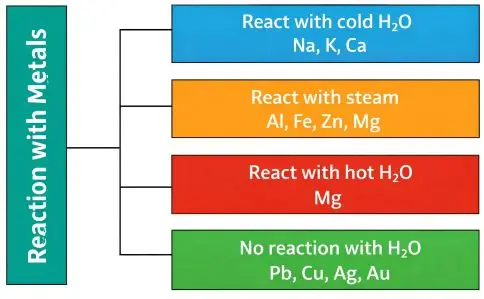
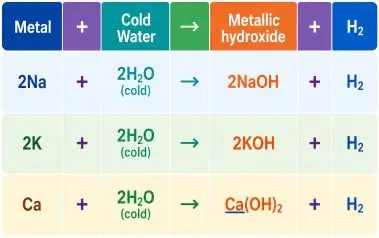
(a) With Cold Water (very active metals):
Very active metals like Na, K, Ca react with cold water.
(b) With Hot water:
Magnesium reacts slowly with boiling water:
Mg + 2H2O (hot) → Mg(OH)2 + H2
(c) With Steam (heated metals):
When steam is passed over hot metals like Mg, Zn, Al, Fe:
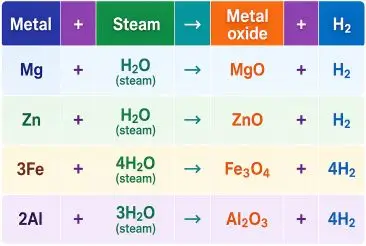
***Note
- Metals such as lead, copper, silver and gold do not react with water at all.
- Magnesium reacts with both hot water and steam.
- Potassium and sodium are kept under kerosene oil because they react violently with air and moisture and may catch fire.
Metal Activity Series (Decreasing Reactivity):
K > Na > Ca > Mg > Al > Zn > Fe > Pb > (H) > Cu > Hg > Ag > Au > Pt
4. Reaction with Non-Metals
(i) Carbon + Steam (1000°C)
When red hot coke is passed over steam, water gas (a mixture of carbon monoxide and hydrogen) is formed.

(ii) Chlorine + Water (in sunlight)
Cl2 + 2H2O \(\xrightarrow{sunlight}\) 2HCl + O2
Chlorine water forms hydrochloric acid and releases oxygen in sunlight.
5. Reaction with Oxides
Metallic oxides react with water to form metal hydroxides (alkalis).
Examples:
- Na2O + H2O → 2NaOH
- K2O + H2O → 2KOH
- CaO + H2O → Ca(OH)2
- Mg + H2O → Mg(OH)2
👉 Soluble bases are called alkalis.
6. With Non-Metallic Oxides:
Non-metallic oxides dissolve in water to form acids.
Examples:
- CO2 + H2O → H2CO3 (Carbonic acid)
- SO2 + H2O → H2SO3 (Sulphurous acid)
Tests for Water
- Pure water boils at 100°C.
- Pure water freezes at 0°C.
- White CuSO4 turns blue when water is added.
- Blue cobalt chloride turns pink in presence of water.
Some Common Hydrated Salts
| Common Name | Chemical Name | Formula |
| Blue vitriol | Copper sulphate pentahydrate | CuSO4·5H2O |
| Green vitriol | Iron (II) sulphate heptahydrate | FeSO4·7H2O |
| White vitriol | Zinc sulphate heptahydrate | ZnSO4·7H2O |
| Epsom salt | Magnesium sulphate heptahydrate | MgSO4·7H2O |
| Washing soda | Sodium carbonate decahydrate | Na2CO3·10H2O |
| Glauber’s salt | Sodium sulphate decahydrate | Na2SO4·10H2O |
HARD WATER AND SOFT WATER
- Soft Water
- Water that forms lather easily with soap.
- Example: Rain water, distilled water
- Does not contain dissolved salts of calcium and magnesium.
- Hard Water
- Water that does not form lather easily with soap.
- Forms a white sticky scum with soap.
- Contains dissolved salts of calcium (Ca²⁺) and magnesium (Mg²⁺).
Types of Hard Water
1. Temporary Hard Water
- Temporary hardness is caused by calcium bicarbonate [Ca(HCO3)2] and magnesium bicarbonate [Mg(HCO3)2].
- Hardness can be removed by boiling.
- On boiling:
Ca(HCO₃)₂ → CaCO₃ ↓ + H₂O + CO₂ Mg(HCO₃)₂ → MgCO₃↓ + H₂O + CO₂
2. Permanent Hard Water
- Permanent hardness is caused by calcium sulphate (CaSO4), magnesium sulphate (MgSO4), calcium chloride (CaCl2) and magnesium chloride (MgCl2).
- Hardness cannot be removed by boiling.
REMOVAL OF HARDNESS OF WATER
1. Boiling
- Removes temporary hardness only.
Ca(HCO3)2 \(\xrightarrow{boiled}\) CaCO3 ↓ + H2O + CO2
Mg(HCO3)2 \(\xrightarrow{boiled}\)Mg(OH)2 ↓ + 2CO2
- Insoluble carbonates are formed and can be filtered.
2. Adding Sodium Carbonate (Washing Soda)
- Removes permanent hardness.
- Forms insoluble carbonates which settle down.
- Example:
Na₂CO₃ + CaSO₄ → CaCO₃ ↓ + Na₂SO₄
Na₂CO₃ + MgCl₂ → MgCO₃ ↓ + 2NaCl
ADVANTAGES OF HARD WATER
- Adds taste to water.
- Contains calcium and magnesium good for bones and teeth.
DISADVANTAGES OF HARD WATER
- Wastes soap (no lather formation).
- Not good for washing clothes.
- Not suitable for boilers (forms scale).
- Not suitable for cooking and textile industries.
WATER POLLUTION
Water pollution is the contamination of water by harmful substances making it unfit for human use.
Causes of Water Pollution
- Industrial Waste: Discharge of chemical wastes, acids, and heavy metals from factories.
- Thermal Pollution: Hot water from nuclear and thermal power plants reduces oxygen levels and harms aquatic life.
- Sewage & Garbage: Domestic waste and human activities (washing/bathing) in water bodies lead to the growth of germs.
- Agricultural Runoff: Excessive use of fertilizers and pesticides that wash into rivers.
Water-borne Diseases
Diseases spread through polluted water:
- Typhoid
- Cholera
- Hepatitis
- Diarrhoea
- Dysentery
PREVENTION OF WATER POLLUTION
- Treat domestic sewage and industrial waste before discharging them into water bodies.
- Avoid washing clothes or bathing animals near rivers and lakes.
- Plant trees along riverbanks to prevent soil erosion.
- Use biodegradable fertilizers and pesticides.
WATER MANAGEMENT
Water is a precious natural resource and must be conserved.
Methods of Conservation:
- Construct dams and reservoirs.
- Do not leave taps running.
- Recycle industrial water.
- Plant trees.
- Practise rainwater harvesting.
- Repair leaking taps and pipes.
- Use drip irrigation.
- Use biodegradable fertilizers and pesticides.
EFFECT OF WATER SCARCITY ON PLANTS
- Plants need water for survival.
- Without water, plants dry up.
- Lack of plants affects oxygen supply.
- Leads to drought conditions.
- Disturbs ecological balance.
ICSE Class 8 Chemistry Water Notes PDF Download
Download ICSE Class 8 Chemistry Water Notes PDF and revise all important concepts before your examination.
Conclusion
The chapter Water is an important part of ICSE Class 8 Chemistry. Understanding the properties of water, methods of purification, potable water, and the differences between hard and soft water helps students build a strong foundation in Chemistry. These notes are useful for quick revision and exam preparation.
ICSE Class 8 Chemistry Notes
Official Website:
Students can visit the official CISCE website for more details and updates.