Introduction
Chemistry is an important subject in ICSE Class 8 because it helps students understand changes taking place around us. One of the most important chapters is Chemical Reactions. In this chapter, students learn how substances change into new substances through different reactions.
These ICSE Class 8 Chemistry Chemical Reactions Notes are prepared in simple language for easy understanding and quick revision.
Study Support by Rohit Academy
Rohit Academy offers expert-curated ICSE Class 8 Chemistry Study Materials including ICSE Chemical Reactions Chapter Notes, diagrams, and key formulas for better understanding.
You can also visit:
| ☛ ICSE Class 8 Chemistry Chapter 6: Chemical Reactions Selina Solutions |
| ☛ ICSE Class 8 Physics |
| ☛ ICSE Class 8 Chemistry |
| ☛ ICSE Class 8 Mathematics |
| ☛ ICSE Class 8 Biology |
Section A : Chemical Reaction
What is a Chemical Reaction?
A chemical reaction is a process in which one or more substances change into new substances with different properties.
- Reactants: Substances that take part in the reaction.
- Products: Substances formed after the reaction.
Example 1
Hydrogen reacts with oxygen to form water.

- Reactants → Hydrogen, Oxygen
- Products → H₂O
***Note
The products formed in a chemical reaction have properties completely different from those of the reactants.
For example, hydrogen is combustible and oxygen supports combustion, whereas water is used to extinguish fire.
Example 2
Sodium hydroxide reacts with hydrochloric acid to form sodium chloride and water.
NaOH + HCl → NaCl + H₂O
- Reactants → NaOH, HCl
- Products → NaCl, H₂O
What Happens During a Chemical Reaction?
During a chemical reaction:
- Old chemical bonds break.
- Rearrangement of atoms takes place in a chemical reaction.
- New bonds are formed.
- Energy may be absorbed or released.
A chemical bond is the attractive force that holds atoms or ions together.
Characteristics of Chemical Reactions
1. Evolution of Gas
Some reactions produce gases.
Example 1
When dilute sulphuric acid is added to granulated zinc, hydrogen gas is evolved with effervescence.

Example 2
When sodium sulphite reacts with dilute hydrochloric acid, sulphur dioxide gas is evolved, which has a pungent smell.

Effervescence
Formation of gas bubbles during a chemical reaction is called effervescence.
2. Change in Colour
Some reactions show a colour change.
Example 1
When an iron nail is placed in blue copper sulphate solution, the blue colour gradually fades and changes to light green. A reddish-brown coating of copper is deposited on the iron nail.

Example 2
When hydrogen sulphide gas is passed through copper sulphate solution, a black precipitate of copper sulphide is formed along with sulphuric acid.

Example 3
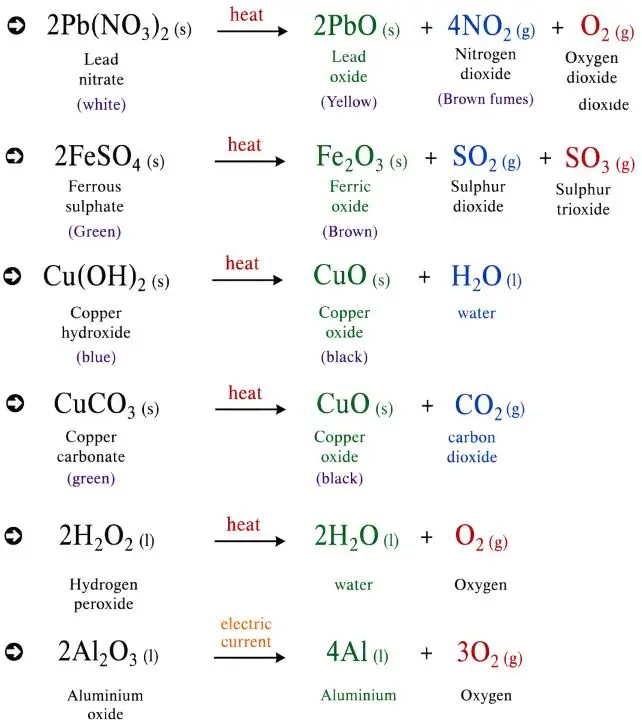
When lead nitrate is heated, it decomposes to form yellow lead monoxide, brown nitrogen dioxide gas, and oxygen gas. Brown fumes are observed during the reaction.

3. Formation of Precipitate
An insoluble solid formed during a reaction is called a precipitate.
Example 1
When silver nitrate solution is added to sodium chloride solution, a white precipitate of silver chloride is formed along with sodium nitrate solution.

Example 2
When ferrous sulphate solution is added to sodium hydroxide solution, a dirty green precipitate of ferrous hydroxide is formed.

4. Change of State
In some chemical reactions, substances change their physical state. These states are shown in brackets as solid (s), liquid (l), or gas (g) in the equation.
Example 1
Hydrogen gas reacts with oxygen gas to form water, which is a liquid.

Example 2
Ammonia gas reacts with hydrogen chloride gas to produce solid ammonium chloride.

5. Change in Energy
Energy changes occur during reactions.
- Energy Released
Burning fuel releases heat and light
CH4 + 2O2 → CO2 + 2H2O + Heat - Energy Absorbed
Decomposition of calcium carbonate absorbs heat.
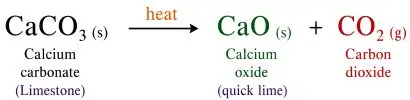
CaCO3 → CaO + CO2
Conditions Needed for a Reaction
1. Close Contact
Reactants must come in contact.
Example
Sodium reacts vigorously with cold water forming sodium hydroxide and hydrogen gas.

2. In Solution Form
Reactions occur faster when substances are mixed in solution.
Example
When few drops of dilute sulphuric acid are added to an aqueous solution of barium chloride, a white precipitate of barium sulphate is formed.

3. Heat
Some reactions require heating.
Example
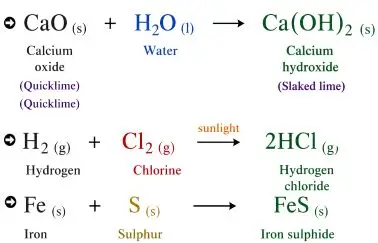
Iron and sulphur react only on heating to form iron sulphide.

4. Light
Reactions requiring light are called photochemical reactions.
Example:
Photosynthesis is the process by which green plants prepare food in the form of glucose from carbon dioxide and water in the presence of sunlight, releasing oxygen as a by-product.

Condition: Presence of sunlight and chlorophyll.
5. Electricity
Reactions occurring due to electric current are called electrochemical reactions.
Example
Water decomposes into hydrogen and oxygen.

Note: Pure water is a poor conductor of electricity. Small amounts of acid, alkali or salt are added to improve conductivity.
6. Pressure
Some reactions require high pressure.
Example
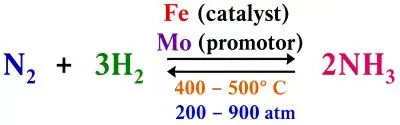
Nitrogen reacts with hydrogen at high pressure and temperature to form ammonia.
Catalysts
- A catalyst is a substance that changes the speed of a chemical reaction without itself being used up or chemically changed at the end of the reaction.
- Positive Catalyst:
When a catalyst increases the rate of a chemical reaction, it is known as a positive catalyst. - Example:
(i) When potassium chlorate (KClO3) is heated in the presence of manganese dioxide (MnO2), it decomposes into potassium chloride (KCl) and oxygen gas at a lower temperature (about 300°C).

Observation:
Manganese dioxide acts as a positive catalyst and speeds up the reaction.
(ii) Finely divided iron is used as a positive catalyst in the manufacture of ammonia from hydrogen and oxygen.
- Negative Catalyst:
When a catalyst decreases the rate of a chemical reaction, it is known as a negative catalyst.
For example, Phosphoric acid acts as a negative catalyst to decrease the rate of decomposition of hydrogen peroxide. - Promoter: A promoter is a substance that increases the efficiency of a catalyst in a chemical reaction.
Example: Molybdenum increases iron’s efficiency in ammonia production. - Enzymes
Enzymes are natural catalysts found in living organisms. They help with digestion and many other functions.
Examples: Amylase, Pepsin, Lipase, Trypsin, Zymase etc.
Section B : Types of Chemical Reactions
Chemical reactions can be divided into the following types:
- Combination Reaction
- Decomposition Reaction
- Displacement Reaction
- Double Displacement Reaction
- Precipitation reaction
- Neutralisation reaction
1. Combination Reaction
- A reaction where two or more substances join to form a single new substance is called a combination reaction.
- It is also known as a synthesis reaction.
- General form: A + B → AB
Examples:
1. Two elements → One compound
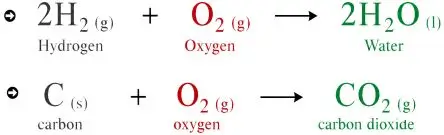
When magnesium ribbon is burnt in air, it burns with a bright white flame and forms white magnesium oxide (MgO).

2. Element + Compound → One compound
Carbon monoxide reacts with oxygen to form carbon dioxide.

3. Two compounds → One compound
Ammonia combines with hydrogen chloride to form ammonium chloride.
More Examples of Combination Reactions
Key Points
- One product is always formed.
- Heat may be released.
- Most combination reactions are exothermic.
2. Decomposition Reaction
- A decomposition reaction is when a single compound breaks into two or more simpler substances.
- It is the opposite of a combination reaction.
- General form: AB → A + B
(A) Thermal Decomposition
Decomposition caused by heat is called thermal decomposition.
Examples
- Thermal decomposition of limestone: When calcium carbonate (limestone) is heated, it breaks into calcium oxide (quick lime) and carbon dioxide gas.
- Thermal decomposition of potassium chlorate: When potassium chlorate is heated in the presence of manganese dioxide catalyst, it decomposes to give potassium chloride and oxygen gas.

(B) Electrolytic Decomposition
Decomposition caused by electricity is called electrolytic decomposition.
Examples
- Decomposition of water: When an electric current passes through water, it breaks into hydrogen and oxygen gas.
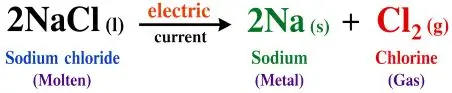
- Decomposition of sodium chloride: When an electric current passes through a solution of sodium chloride, it breaks into sodium and chlorine gas.
More Examples of Decomposition Reactions
***Key point
All decomposition reactions are endothermic reactions.
The Reactivity Series of Metals (or Activity Series of Metals)
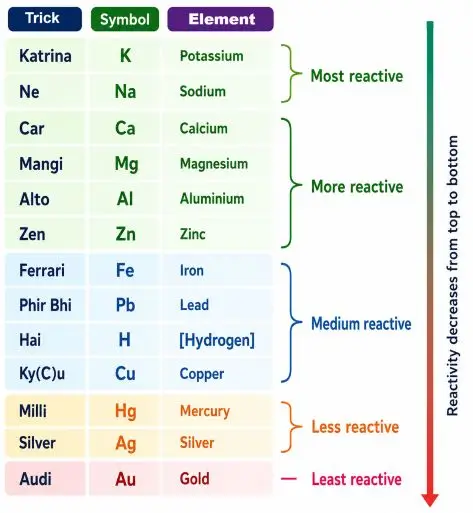
- The reactivity of metals varies from one metal to another.
- Metals can be grouped into three categories:
(a) Highly reactive
(b) Moderately reactive
(c) Least reactive - Metals are arranged in decreasing order of reactivity in a list called the Reactivity (or Activity) Series.
- A metal higher in the series loses electrons more easily than one below it.
- More reactive metals displace less reactive metals from their salt solutions.
- Metals above hydrogen in the series are more reactive than hydrogen and can displace hydrogen from water, acids, or alkalis.
- Metals below hydrogen cannot displace hydrogen.
- Metals that are more reactive than hydrogen include: potassium, sodium, calcium, magnesium, aluminium, zinc, iron, tin, and lead.
- Metals that are less reactive than hydrogen include: copper, mercury, silver, and gold.
- A simplified reactivity order is: K > Na > Ca > Mg > Al > Zn > Fe > Pb > H > Cu > Hg > Ag > Au
- Metals higher in the reactivity series can take part in reactions with oxygen or dilute acids more easily.
- Metals lower in the reactivity series do not react with oxygen or dilute acids easily.
- Potassium is the most reactive metal, while gold is the least reactive.
Why some metals are more reactive than others
- When metals react, they lose electrons to form positive ions.
- If a metal loses electrons easily, it reacts faster and is considered more reactive.
- If a metal loses electrons slowly, it reacts less and is considered less reactive.
- For example, potassium loses electrons quickly, so it is most reactive. Gold loses electrons less easily, so it is least reactive.
Reactivity of Metals with oxygen, water and acid
| Metal | Reaction with Oxygen | Reaction with Water | Reaction with Acids |
| K (Potassium) | React with oxygen at room temperature to form oxides | Reacts very vigorously with cold water | Explosive with dilute acids, gives hydrogen |
| Na (Sodium) | React with oxygen at room temperature to form oxides | Reacts very vigorously with cold water | Explosive with dilute acids, gives hydrogen |
| Ca (Calcium) | React with oxygen at room temperature to form oxides | Reacts moderately with cold water | Reacts less vigorously than Na & K |
| Mg (Magnesium) | Forms oxide on heating | Reacts with hot water or steam | Reacts to produce hydrogen |
| Al (Aluminium) | Forms oxide when heated; also reacts at room temperature | No reaction with hot water or steam | Reacts to produce hydrogen |
| Zn (Zinc) | Forms oxide on heating | Reacts with steam only | Reacts to produce hydrogen |
| Fe (Iron) | Forms oxide on heating | Reacts with steam only | Reacts to produce hydrogen |
| Pb (Lead) | Forms oxide on strong heating | No reaction | Reacts with concentrated HCl to give hydrogen |
| Cu (Copper) | Forms oxide on strong heating | No reaction | No reaction with dilute acids |
| Hg (Mercury) | Forms oxide on strong heating | No reaction | No reaction with dilute acids |
| Ag (Silver) | No reaction even on strong heating | No reaction | No reaction with dilute acids |
| Au (Gold) | No reaction even on strong heating | No reaction | No reaction with dilute acids |
| Pt (Platinum) | No reaction even on strong heating | No reaction | No reaction with dilute acids |
3. Displacement Reaction
- A displacement reaction happens when a more reactive element replaces a less reactive element from its compound.
- General form: AB + C → CB + A
(C is more reactive than A) - A stronger (more reactive) element pushes out a weaker one.
- Examples:
(i) When an iron metal is placed in copper sulphate solution, iron displaces copper because it is more reactive. The blue colour of the solution fades, and reddish-brown copper is deposited on the iron surface. The solution turns light green due to the formation of iron sulphate.
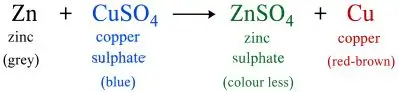
(ii) When zinc metal is placed in copper sulphate solution, zinc displaces copper because it is more reactive. The blue colour of the solution fades, and reddish-brown copper is deposited on the zinc surface. Thus, the blue colour of the solution gradually fades and becomes colourless.
(iii) Zinc reacts with dilute hydrochloric acid and releases hydrogen gas because it is more reactive than hydrogen.
Zn + 2HCl → ZnCl2 + H2
(iv) Highly reactive metals such as sodium and potassium react with cold water to release hydrogen. These reactions are very vigorous because of their high reactivity.
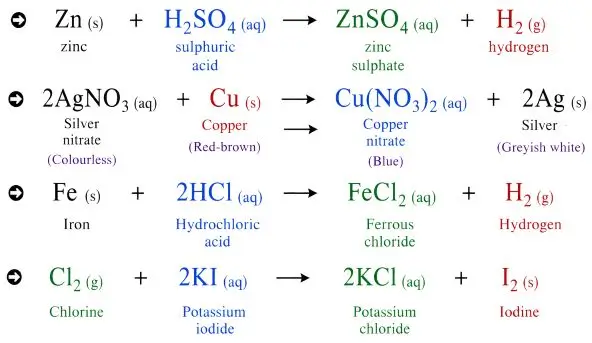
More examples of displacement reactions:
Key Points
- A more reactive element replaces a less reactive one.
- Metals like K, Na, Ca, Mg, Zn are more reactive than iron and copper.
- This helps us compare reactivity of different elements and build the reactivity series.
4. Double Displacement Reaction
- A double displacement reaction happens when two compounds in solution exchange their ions to form new compounds.
- General form: AB + CD → AD + CB
- Also called double decomposition reaction.
- Double displacement reactions are of two types:
- (a) Precipitation reactions
- (b) Neutralization reactions
(a) Precipitation Reaction
- A precipitation reaction happens when two aqueous solutions react to form an insoluble solid (called a precipitate).
- The precipitate is shown by a downward arrow (↓) in the equation.
- Example:
When barium chloride solution is mixed with copper sulphate solution, a white solid called barium sulphate forms as a precipitate.

More Examples of Precipitation
- AgNO3(aq) + HCl(aq) → AgCl(s)↓ + HNO3(aq)
- CuSO4(aq) + 2NaOH(aq) → Cu(OH)2(s)↓ + Na2SO4(aq)
- Pb(NO3)2(aq) + 2NH4OH(aq) → Pb(OH)2(s)↓ + 2NH4NO3(aq)
- CaCl2 + 2NaOH → Ca(OH)2↓ + 2NaCl
(b) Neutralization Reaction
- A neutralization reaction occurs when an acid reacts with a base to form salt and water.
- General form: Acid + Base → Salt + Water
- Example 1
When sodium hydroxide reacts with dilute hydrochloric acid, it produces sodium chloride and water.

Example 2
Zinc oxide reacts with nitric acid to form zinc nitrate and water.

More Examples of Neutralization


Key point
- Metal oxides and hydroxides are bases.
- Those that dissolve in water are called alkalis.
Indicators
Indicators help us identify whether a solution is acidic or basic by showing a colour change.
| Indicator | Colour in Acid | Colour in Base |
| Red Litmus | No change | Blue |
| Blue Litmus | Red | No change |
| Methyl orange (orange) | Red or pink | Yellow |
| Phenolphthalein (colourless) | No change | Pink |
Importance of Neutralization in Daily Life
- Indigestion
When we eat a lot of spicy or oily food, the stomach produces more hydrochloric acid, which can cause a burning sensation. To get relief, we take an antacid such as milk of magnesia (magnesium hydroxide). It reacts with the extra acid, neutralises it, and reduces the discomfort. - Oral hygiene
Toothpastes contain mild bases that neutralize acids formed in the mouth. - Insect stings
When an ant or bee stings, it releases formic acid into the skin, which causes pain and itching. Applying baking soda or calamine lotion helps because they are basic and neutralise the acid, easing the irritation. - Soil treatment
- Plants grow best in neutral soil.
- Acidic soil is treated with bases like quicklime or slaked lime.
- Basic soil is treated with organic matter.
Types of Chemical Reactions Based on Energy Change
Chemical reactions involve breaking old bonds and forming new ones. This takes or releases energy, usually as heat.
So, reactions are of two types:
1. Exothermic Reaction
- Reactions that release energy as heat are called exothermic reactions.
- They raise the temperature of the surroundings.
- Examples
(i) Carbon burns in air to form carbon dioxide and releases a large amount of heat.

(ii) When quicklime reacts with water, it forms slaked lime and gives off a large amount of heat.

***Note
Most neutralization reactions are exothermic.
(ii) Endothermic Reaction
- Reactions that absorb energy as heat are called endothermic reactions.
- They lower the temperature of the surroundings.
Examples
(i) When calcium carbonate is heated, it breaks down to form calcium oxide and carbon dioxide.
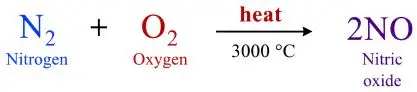
(ii) Nitrogen and oxygen combine at high temperature to form nitric oxide.
(iii) When ammonium chloride is dissolved in water, the container becomes cold.

Oxides
- An oxide is a compound made of oxygen and a metal or non-metal.
- Metals combine with oxygen to form metal oxides, while non-metals form non-metal oxides.
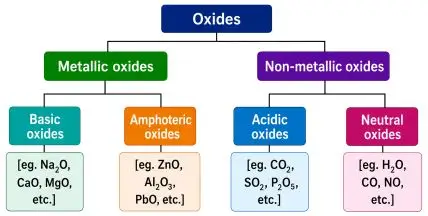
Classification of Oxides
Oxides are mainly of two types:
- Metallic oxides
- Non-metallic oxides
1. Metallic oxides
A metallic oxide is formed by the chemical combination of a metal with oxygen.
Preparation of metallic oxides
(a) By reaction between metal and oxygen
- 4Na + O2 \(\xrightarrow{heat}\) 2Na2O
- 2Ca + O2 \(\xrightarrow{heat}\) 2CaO
- 2Cu + O2 \(\xrightarrow{heat}\) 2CuO
- 2Zn + O2 \(\xrightarrow{heat}\) 2ZnO
(b) By heating metal carbonates or nitrates
- PbCO3 \(\xrightarrow{heat}\) PbO + CO2
- ZnCO3 \(\xrightarrow{heat}\) ZnO + CO2
- 2Pb(NO3)2 \(\xrightarrow{heat}\) 2PbO + 4NO2 + O2
Types of Metallic Oxides
(A) Basic Oxides
- Most metallic oxides are basic in nature.
- They react with water to form alkalis (soluble bases).
- Examples:
- Na₂O + H₂O → 2NaOH
- K₂O + H₂O → 2KOH
- Both sodium hydroxide and potassium hydroxide are strong alkalis and turn litmus paper blue.
- Basic oxides + acids → Salt + Water
- CuO + H2SO4 → CuSO4 + H2O
- CaO + 2HCl → CaCl2 + H2O
Note: All alkalis are bases, but not all bases are alkalis — because not all bases are soluble in water.
(B) Amphoteric Oxides
- These metallic oxides show both acidic and basic behavior.
- can react with both acids and bases to form salt and water.
- Examples: Zinc oxide (ZnO), Lead monoxide (PbO), Aluminium oxide (Al₂O₃)
- Chemical reactions
- ZnO + 2HCl → ZnCl2 + H2O
- ZnO + 2NaOH → Na2ZnO2 + H2O
- PbO + 2HCl → PbCl2 + H2O
- PbO + 2NaOH → Na2PbO2 + H2O
- Al₂O₃ + 6HCl → 2AlCl3 + 3H2O
- Al₂O₃ + 2NaOH → 2NaAlO2 + H2O
2. Non-metallic Oxides
- These oxides are formed when non-metals combine with oxygen.
- Examples: Carbon dioxide (CO₂), Sulphur dioxide (SO₂), Nitrogen dioxide (NO₂)
- Preparation of Non-metallic Oxides
- Heating non-metals with oxygen.
- C + O2 \(\xrightarrow{heat}\) CO2
- S + O2 \(\xrightarrow{heat}\) SO2
- 2H2 + O2 \(\xrightarrow{heat}\) 2H2O
Types of Non-metallic Oxides
1. Acidic Oxides
- They dissolve in water to form acids.
- They react with bases to form salt and water.
- Most acidic oxides turn moist blue litmus paper red.
- Examples
- CO₂ + H₂O → H₂CO₃
- SO₂ + H₂O → H₂SO₃
- SO₃ + H₂O → H₂SO₄
- 2NO₂ + H₂O → HNO₂ + HNO₃
- Reaction with bases:
- CO₂ + 2NaOH → Na₂CO₃ + H₂O
- SO₂ + 2KOH → K₂SO₃ + H₂O
2. Neutral Oxides
- These are neither acidic nor basic in nature.
- They do not change the colour of litmus.
- Do not react with acids or bases.
- Examples: Carbon monoxide (CO), Nitric oxide (NO), Water (H₂O)
ICSE Class 8 Chemistry Chemical Reactions Notes PDF Download
Students looking for ICSE Class 8 Chemical Reactions Notes PDF Download can use these notes for quick revision and concept clarity. These notes cover atom structure, subatomic particles, electronic configuration, atomic number, mass number, and valency in an easy format.
Conclusion
These ICSE Class 8 Chemistry Chemical Reactions Notes PDF help students understand definitions, reaction types, equations, and important concepts easily. Regular revision of notes improves exam preparation and scoring.
ICSE Class 8 Chemistry Notes
Official Website:
Students can visit the official CISCE website for more details and updates.