Introduction
Are you searching for ICSE Class 8 Chemistry Language of Chemistry Notes PDF Download? This chapter is one of the most important topics in ICSE Class 8 Chemistry because it introduces students to chemical symbols, valency, radicals, formula writing, and chemical equations. These notes will help students understand the basics of chemistry in a simple and easy language.
Study Support by Rohit Academy
Rohit Academy offers expert-curated ICSE Class 8 Chemistry Study Materials including ICSE Language of Chemistry Chapter Notes, diagrams, and key formulas for better understanding.
You can also visit:
| ☛ ICSE Class 8 Chemistry Chapter 5: Language of Chemistry Selina Solutions |
| ☛ ICSE Class 8 Physics |
| ☛ ICSE Class 8 Chemistry |
| ☛ ICSE Class 8 Mathematics |
| ☛ ICSE Class 8 Biology |
Language of Chemistry | ICSE Class 8 Chemistry Notes
Symbol
A symbol is a shorthand notation representing an element (e.g., H for Hydrogen, O for Oxygen).
Need for Symbols
Symbols are used because:
- They make the representation of elements and compounds simpler.
- They help in writing chemical equations easily and clearly.
Rules for Writing Symbols
1. Single Letter Symbols
The symbol is the first letter of the element’s name, written in capital.
Examples:
- Hydrogen → H
- Oxygen → O
- Carbon → C
2. Two-Letter Symbols
If two or more elements start with the same letter, use two letters.
The first letter is capital, the second is small.
Examples:
- Cobalt → Co
- Calcium → Ca
- Chlorine → Cl
- Chromium → Cr
3. Each Symbol Represents One Atom
Examples:
- H represents one atom of hydrogen.
- C represents one atom of carbon.
4. Symbols Derived from Latin or Greek Names
Some symbols come from the Latin or Greek names of elements.
Examples:
- Iron → Ferrum → Fe
- Sodium → Natrium → Na
- Potassium → Kalium → K
- Copper → Cuprum → Cu
Valency
Valency is the combining capacity of an atom of an element or a radical with other atoms to form molecules or compounds.
Examples
- Hydrogen Chloride (HCl):
One atom of chlorine combines with one atom of hydrogen.
Valency of chlorine = 1 - Water (H2O):
One atom of oxygen combines two atoms of hydrogen.
Valency of oxygen = 2 - Ammonia (NH3):
One atom of nitrogen combines with three atoms of hydrogen.
Valency of nitrogen = 3 - Methane (CH4):
One atom of carbon combines with four atoms of hydrogen.
Valency of carbon = 4
Trend in Valency
- The valency of elements increases from 1 to 4 and then decreases back to 1.
- Elements like Helium, Neon, and Argon have a valency of 0, as their outermost electron shell is complete — they are inert gases.
Modern Concept of Valency
Valency can also be defined as:
The number of electrons lost, gained, or shared by an atom during a chemical reaction or when forming compounds.
Example 1: Sodium Chloride (NaCl)
- Sodium atom loses one electron → forms Na⁺ (cation).
- Chlorine atom gains one electron → forms Cl⁻ (anion).
- Hence, both have a valency of 1.
Example 2: Hydrogen Chloride (HCl)
- Hydrogen shares one electron with chlorine.
- Both have a valency of 1.
Name, Symbol, and Valency of the some Important Elements
| Atomic No. | Name of the element | Symbol | Valency |
| 1 | Hydrogen | H | 1 |
| 2 | Helium | He | 0 |
| 3 | Lithium | Li | 1 |
| 4 | Beryllium | Be | 2 |
| 5 | Boron | B | 3 |
| 6 | Carbon | C | 4 |
| 7 | Nitrogen | N | 3 |
| 8 | Oxygen | O | 2 |
| 9 | Fluorine | F | 1 |
| 10 | Neon | Ne | 0 |
| 11 | Sodium | Na | 1 |
| 12 | Magnesium | Mg | 2 |
| 13 | Aluminium | Al | 3 |
| 14 | Silicon | Si | 4 |
| 15 | Phosphorus | P | 3 |
| 16 | Sulphur | S | 2 |
| 17 | Chlorine | Cl | 1 |
| 18 | Argon | Ar | 0 |
| 19 | Potassium | K | 1 |
| 20 | Calcium | Ca | 2 |
| 26 | Iron | Fe | 2, 3 |
| 29 | Copper | Cu | 1, 2 |
| 30 | Zinc | Zn | 2 |
| 35 | Bromine | Br | 1 |
| 47 | Silver | Ag | 1 |
| 53 | Iodine | I | 1 |
| 56 | Barium | Ba | 2 |
| 80 | Mercury | Hg | 1, 2 |
| 82 | Lead | Pb | 2 |
Variable Valency
Some elements can show more than one valency.
This happens because they can lose different numbers of electrons in different compounds.
Examples of Metals with Variable Valency
| Element /Symbol | Lower Valency | Higher Valency |
| Copper (Cu) | Cu+ → Cuprous / Copper (I) | Cu2+ → Cupric / Copper (II) |
| Iron (Fe) | Fe2+ → Ferrous / Iron (II) | Fe3+ → Ferric / Iron (III) |
Naming Rule
- Lower valency: ends with -ous (e.g., Ferrous → Fe2+)
- Higher valency: ends with -ic (e.g., Ferric → Fe3+)
Radicals / Ions
- A radical is an atom or a group of atoms that behaves as a single unit with a positive or negative charge.
- Radicals are also called ions.
Types of Radicals
(i) Basic Radicals
- Have a positive charge.
- Also called cations.
- All metallic ions and ammonium (NH₄⁺) are basic radicals.
(ii) Acid Radicals
- Have a negative charge.
- Also called anions.
- Mostly non-metallic ions or groups with negative charge.
Valency and Symbols of Some Common Positive Radicals
| Valency / Charge | Name | Symbol |
| Monovalent (1+) | Sodium | Na+ |
| Potassium | K+ | |
| Copper (I) / Cuprous | Cu+ | |
| Silver | Ag+ | |
| Hydrogen | H+ | |
| Ammonium | NH4+ | |
| Bivalent (2+) | Magnesium | Mg2+ |
| Calcium | Ca2+ | |
| Barium | Ba2+ | |
| Zinc | Zn2+ | |
| Copper (II) / Cupric | Cu2+ | |
| Iron (II) / Ferrous | Fe2+ | |
| Trivalent (3+) | Aluminium | Al3+ |
| Iron (III) / Ferric | Fe3+ |
Valency and Symbol of Common Negative Radicals
| Valency / Charge | Name | Symbol |
| Monovalent (1−) | Chloride | Cl– |
| Bromide | Br– | |
| Iodide | I– | |
| Hydroxide | OH– | |
| Nitrite | NO2– | |
| Nitrate | NO3– | |
| Bicarbonate (Hydrogen carbonate) | HCO3– | |
| Bisulphite (Hydrogen sulphite) | HSO3– | |
| Bisulphate (Hydrogen sulphate) | HSO4– | |
| Acetate | CH3COO– | |
| Aluminate | AlO2– | |
| Bivalent (2−) | Oxide | O2– |
| Sulphide | S2– | |
| Carbonate | CO32– | |
| Sulphite | SO32– | |
| Sulphate | SO42– | |
| Zincate | ZNO22– | |
| Trivalent (3−) | Nitride | N3– |
| Phosphate | PO43– |
Naming an Ion or a Radical
1. For Positive Ions (Cations)
Derived from the parent element name.
Example: Na⁺ → Sodium ion,
Cu+ → Cuprous ion
2. For Negative Ions (Anions):
Derived by replacing the last few letters of the element’s name with the suffix “-ide”.
Example: Cl⁻ → Chloride ion,
O²⁻ → Oxide ion
3. For Polyatomic Ions:
Names often end with –ate, –ite, or –ide depending on oxygen content.
Examples:
- SO₄²⁻ → Sulphate ion
- SO₃²⁻ → Sulphite ion
- OH⁻ → Hydroxide ion
***Remember
New wpDataTable
| Name | Symbol | Valency |
| Cuprous / Copper (I) | Cu+ | 1 |
| Cupric / Copper (II) | Cu2+ | 2 |
| Ferrous / Iron (II) | Fe2+ | 2 |
| Ferric / Iron (III) | Fe3+ | 3 |
| Sulphate | SO42– | 2 |
| Sulphite | SO32– | 2 |
| Sulphide | S2– | 2 |
| Nitrate | NO3– | 1 |
| Nitrite | NO2– | 1 |
| Nitride | N3– | 3 |
Molecular Formula of Compounds
- A molecular formula represents the symbols and number of atoms of each element in a molecule.
- It shows:
- The types of atoms present.
- The number of each atom in the compound.
- Examples
- Sulphur dioxide (SO₂):
One atom of sulphur + two atoms of oxygen → SO₂ - Water (H₂O):
Two atoms of hydrogen + one atom of oxygen → H₂O
- Sulphur dioxide (SO₂):
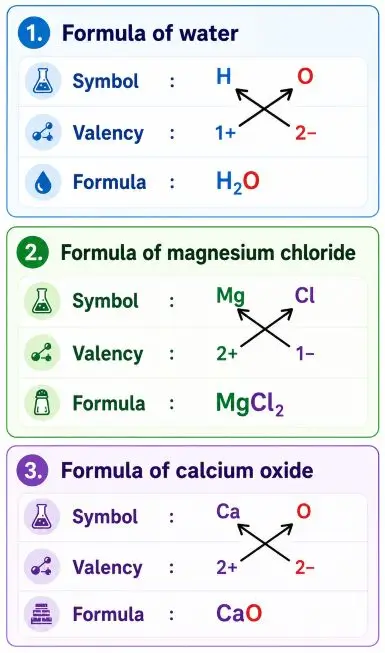
To Write a Molecular or Chemical Formula
To write a chemical formula, the following are needed:
- Symbols of elements or radicals
- Valencies (combining capacities) of the elements/radicals
The criss-cross method is used to write the formula.
Molecular formulae of some common compound
Naming rules for simple compounds
- Rule 1 : metal + non-metal
The name of metal is written first, then the name of non-metal is written with ‘-ide’ ending.
Example:
CaO – Calcium Oxide - Rule 2 : non-metal + non-metal
The number of atoms of each element is generally indicated in the name by ‘di’, ‘tri’, ‘tetra’, ‘Penta’ etc.
Example:- N2O5 – dinitrogen pentoxide
- PCl3 – Phosphorus trichloride
(prefix mono is not used)
- Rule 3: If the first element of a molecular compound is Hydrogen, the number of its atom is not written.
Example:
H2S – Hydrogen Sulphide
| Name of Chemical Compounds | Chemical Formulas | Name of Chemical Compounds | Chemical Formulas |
| Hydrogen oxide | H2O | Ammonium hydroxide | NH4OH |
| Magnesium oxide | MgO | Aluminium hydroxide | Al(OH)3 |
| Carbon dioxide | CO2 | Lead (II) nitrate | Pb(NO3)2 |
| Sodium chloride (Common salt) | NaCl | Sodium acetate | CH3COONa |
| Barium hydroxide | Ba(OH)2 | Ferrous chloride | FeCl2 |
| Iron (II) nitrate | Fe(NO3)2 | Zinc oxide | ZnO |
| Sodium sulphate | Na2SO4 | Potassium iodide | KI |
| Aluminium oxide | Al2O3 | Potassium hydroxide | KOH |
| Potassium bromide | KBr | Calcium carbonate (marble) | CaCO3 |
| Zinc chloride | ZnCl2 | Sulphur dioxide | SO2 |
| Magnesium nitrate | Mg(NO3)2 | Silver nitrate | AgNO3 |
| Silver chloride | AgCl | Sodium bisulphate | NaHSO4 |
| Calcium hydroxide | Ca(OH)2 | Calcium nitrate | Ca(NO3)2 |
| Ferric oxide | Fe2O3 | Calcium nitride | Ca3N2 |
| Potassium sulphate | K2SO4 | Calcium chloride | CaCl2 |
| Sodium carbonate | Na2CO3 | Calcium bisulphate | Ca(HSO4)2 |
| Cupric nitrate | Cu(NO3)2 | Ammonium sulphate | (NH4)2SO4 |
| Barium sulphate | BaSO4 | Sodium oxide | Na2O |
| Calcium oxide | CaO | Potassium nitrite | KNO2 |
| Hydrogen chloride | HCl | Aluminium chloride | AlCl3 |
| Sodium hydroxide | NaOH | Sodium nitrate | NaNO3 |
| Sodium bisulphate | NaHSO3 | Zinc sulphate | ZnSO4 |
| Potassium carbonate | K2CO3 | Calcium sulphate | CaSO4 |
| Sodium bromide | NaBr | Hydrogen sulphide | H2S |
| Potassium bisulphate | KHSO4 | Magnesium carbonate | MgCO3 |
| Copper sulphide | CuS | Magnesium chloride | MgCl2 |
| Carbon monoxide | CO | Calcium sulphite | CaSO3 |
| Ammonium chloride | NH4Cl | Potassium nitrate | KNO3 |
| Sodium bicarbonate (Baking soda) | NaHCO3 | Magnesium nitride | Ca3N2 |
| Potassium chloride | KCl | Sodium bisulphate | NaHSO4 |
| Magnesium bicarbonate | Mg(HCO3)2 | Lead oxide | PbO |
| Cupric hydroxide | Cu(OH)2 | Cuprous sulphate | CuSO4 |
| Calcium bisulphite | Ca(HSO3)2 | Potassium sulphite | K2CO3 |
| Aluminium sulphate | Al2(SO4)3 | Ferrous sulphide | CaSO3 |
| Iron (II) nitrate | Fe(NO3)2 | Copper chloride | CuCl2 |
| Barium chloride | BaCl2 | Potassium bisulphite | KHSO3 |
| Barium hydroxide | Ba(OH)2 | Calcium bicarbonate | Ca(HCO3)2 |
| Sodium nitrite | NaNO3 | Sodium zincate | Na2ZnO2 |
| Ferrous sulphide | FeS | Potassium zincate | K2ZnO2 |
| Potassium nitride | K3N | Sodium aluminate | NaAlO2 |
| Ferrous sulphide | FeS | Magnesium hydroxide | Mg(OH)2 |
| Potassium sulphite | K2SO3 | Potassium bicarbonate | KHCO3 |
| Ferrous Sulphate | FeSO4 | Zinc hydroxide | Zn(OH)2 |
| Copper carbonate | CuCO3 | Sodium sulphite | Na2SO3 |
| Ammonia | NH3 | Silicon dioxide (sand) | SiO2 |
| Sulphuric Acid (Hydrogen sulphate) | H2SO4 | Ferrous hydroxide | Fe(OH)2 |
| Acetic acid (Vinegar) | CH3COOH | Potassium chlorate | KClO3 |
| Carbonic acid | H2CO3 | Methane | CH4 |
| Sodium acetate | CH3COONa | Nitric Acid (Hydrogen nitrate) | HNO3 |
Important points
- Always write metal (positive radical) first, followed by the non-metal (negative radical).
- Reduce the valencies to their lowest ratio when possible.
- Use brackets for polyatomic radicals if more than one unit is required.
Example: Ca(NO₃)₂ → Calcium nitrate. - The subscript in a chemical formula represents the number of atoms of that element.
Significance of Molecular / Chemical Formula
- Represents one molecule of a compound.
- Shows the elements or ions present in the compound.
- Indicates the number and ratio of each kind of atom or ion in one molecule.
- Helps calculate the molecular mass of a compound, if the atomic masses of its elements are known.
Example: Sulphur Dioxide (SO₂)
- Molecular formula: SO₂
- Elements present: Sulphur (S) and Oxygen (O)
- Composition: 1 atom of Sulphur + 2 atoms of Oxygen
- Molecular mass of SO₂ = 32 + (2 × 16) = 64 amu
Atomic Mass
The mass of an atom is called its atomic mass.
Because atoms are extremely small, their masses are measured using a standard reference atom.
Atomic Mass Unit (amu):
- Defined as 1/12th of the mass of one atom of carbon-12 isotope.
- The atomic mass of an element is a number that shows how heavy its atom is compared to 1 amu.
- Symbol: amu (atomic mass unit)
Examples of Atomic Masses (First 20 Elements)
| Element | Atomic mass | Element | Atomic mass |
| Hydrogen | 1 | Sodium | 23 |
| Helium | 4 | Magnesium | 24 |
| Lithium | 7 | Aluminium | 27 |
| Beryllium | 9 | Silicon | 28 |
| Boron | 10 | Phosphorus | 31 |
| Carbon | 12 | Sulphur | 32 |
| Nitrogen | 14 | Chlorine | 35.5 |
| Oxygen | 16 | Argon | 40 |
| Fluorine | 19 | Potassium | 39 |
| Neon | 20 | Calcium | 40 |
Chemical Equations
A chemical equation is the symbolic representation of a chemical reaction using symbols and formulae of the substances involved.
Key Terms:
- Reactants: Substances that react (present on the left-hand side).
- Products: Substances formed as a result of the reaction (present on the right-hand side).
Example:
- Burning of coal in air
- Word equation:
Carbon + Oxygen → Carbon dioxide - Symbolic equation:
C + O2 → CO2
Here,
Reactants: Carbon, Oxygen
Product: Carbon dioxide
Steps Involved in Writing a Chemical Equation
- Write the symbols or formulae of the reactants on the left-hand side, with a plus (+) sign between them if more than one.
- Write the symbols or formulae of the products on the right-hand side, with a plus (+) sign between them if more than one.
- Put an arrow (→) between the reactants and products.
The arrow points from reactants to products. - Represent the reactants and products by their correct formulae.
- The equation should be balanced, i.e., the number of atoms of each element on both sides must be equal.
Examples of Chemical Reactions
1. Reaction of Lead Monoxide with Carbon: PbO + C → Pb + CO
2. Reaction between Iron and Sulphur: Fe + S → FeS
3. Reaction between Carbon Dioxide and Water: CO2 + H2O → H2CO3
4. Reaction between Calcium Oxide and Water: CaO + H2O → Ca(OH)2
Word Equation
A word equation shows the names of the reactants and products involved in a chemical reaction.
Example:
Magnesium + Oxygen → Magnesium Oxide
Skeletal Chemical Equation
If the number of atoms of each element in the reactants is not equal to the number of atoms of each element in the products, the equation is called a Skeletal Chemical Equation.
It is also known as an Unbalanced Chemical Equation.
Example:
Mg + O2 → MgO
Balanced Chemical Equation
A balanced chemical equation is one in which the number of atoms of each element on the reactant side is equal to the number of atoms of the same element on the product side.
Example:
2Mg + O2 → 2MgO
Need for Balancing a Chemical Equation
- A chemical equation must be balanced to satisfy the Law of Conservation of Mass, i.e., the number of atoms of each element on both sides of the equation must be equal.
- For example,
Hydrogen + Chlorine → Hydrogen chloride
Unbalanced: H₂ + Cl₂ → HCl
Balanced: H₂ + Cl₂ → 2HCl
Law of Conservation of Mass
- “Matter can neither be created nor destroyed; it can only be transformed from one form to another.”
- During a chemical reaction, the total mass of the reactants equals the total mass of the products.
Important Tips for Balancing Equations
- Always balance one element at a time.
- Begin with the compound that has the greatest number of atoms of any element.
- Never alter the subscripts within chemical formulas.
- Only adjust coefficients (numbers before symbols or formulas).
- Double-check that the number of atoms of each element is the same on both sides.
Trick for balance chemical equation (M-N-O-H)
- First balance metal.
- Then balance non-metal.
- Balance oxygen
- Balance hydrogen
Balance the following chemical equation :
- H2 + O2 → H2O
- Na + H2O → NaOH + H2
- Mg + O2 → MgO
- H2 + N2 → NH3
- Zn + HCl → ZnCl2 + H2
- CH4 + O2 → CO2 + H2O
- Fe + HCl → FeCl2 + H2
- NaCl + AgNO3 → AgCl + NaNO3
- Na2O + H2O → NaOH
- BaCl2 + H2SO4 → BaSO4 + HCl
- Mg(OH)2 + HCl → MgCl2 + H2O
- NaOH + H2SO4 → Na2SO4 + H2O
- H2O2 → H2O + O2
- NaOH + HCl → NaCl + H2O
- H2S + Cl2 → HCl +
- SCa(OH)2 + CO2 → CaCO3 + H2O
- ZnCO3 ZnO + CO2
- Zn + H2SO4 → ZnSO4 + H2
- Fe + CuSO4 → ZnSO4 + Cu
- CuSO4 + H2S → CuS + H2SO4
- Na2CO3 + HCl → NaCl + H2O + CO2
- CuSO4 + NaOH → Cu(OH)2 + Na2SO4
- BaCl2 + Al2(SO4)3 → BaSO4 + AlCl3
- HNO3 + Ca(OH)2 → Ca(NO3)2 + H2O
- Al(OH)3 → Al2O3 + H2O
- Zn + NaOH \(\xrightarrow{Heat}\) Na2ZnO2 + H2
- Ca + HNO3 → Ca(NO3)2 + H2
- Na + O2 → Na2O
- Na2SO3 + HCl → NaCl + H2O + SO2
- BaCl2 + H2SO4 → BaSO4 + HCl
- Fe + H2O → Fe3O4 + H2
- Fe + O2 → Fe2O3
- S + H2SO4 → SO2 + H2O
- NH3 + CuO → Cu + N2 + H2O
- Pb(NO3)2 → PbO + NO2 + O2
- Al2(SO4)3 + NaOH → Al(OH)3 + Na2SO4
- Pb3O4 + HCl → PbCl2 + H2O + Cl2
- Zn + HNO3 → Zn(NO3)2 + H2O + N2O
- HNO3 + H2S → NO2 + H2O + S
- CO2 + H2O (\xrightarrow[{Chlorophyll}]{Sunlight}\) C6H12O6 + O2
- FeSO4 → Fe2O3 + SO2 + SO3
- Al + H2SO4 → Al2(SO4)3 + H2
- Pb(NO3)2 + KI → PbI2 + KNO3
Write the balanced equation for the following chemical reactions:
- Carbon + Oxygen ⟶ Carbon dioxide
- Nitrogen + Oxygen ⟶ Nitrogen monoxide
- Calcium + Nitrogen ⟶ Calcium nitride
- Calcium oxide + Carbon dioxide ⟶ Calcium carbonate
- Calcium oxide + Water ⟶ Calcium hydroxide
- Sodium + Chlorine ⟶ Sodium chloride
- Magnesium burns in oxygen to form magnesium oxide.
- Hydrogen + Chlorine → Hydrogen chloride
- Magnesium + Sulphuric acid ⟶ Magnesium sulphate + Hydrogen
- Sodium + Water → Sodium hydroxide + Hydrogen
- Zinc + Silver nitrate → Zinc nitrate + Silver
- Aluminium + Copper chloride → Aluminium chloride + Copper
- Iron + Sulphuric acid ⟶ Ferrous sulphate + Hydrogen
- Sodium hydroxide + Sulphuric acid ⟶ Sodium sulphate + Water
- Potassium bicarbonate + Sulphuric acid ⟶ Potassium sulphate + Carbon dioxide + Water
- Magnesium(s) + Hydrochloric acid(aq) → Magnesium chloride(aq) + Hydrogen(g)
- Barium chloride + Aluminium sulphate → Barium sulphate + Aluminium chloride
- Barium chloride + Potassium sulphate → Barium sulphate + Potassium chloride
- Copper sulphate + Sodium hydroxide → Copper hydroxide + Sodium sulphate
- Calcium hydroxide + Carbon dioxide → Calcium carbonate + Water
- Potassium bromide(aq) + Barium iodide(aq) → Potassium iodide(aq) + Barium bromide(s)
- Zinc carbonate(s) → Zinc oxide(s) + Carbon dioxide(g)
- Sodium metal reacts with water to give sodium hydroxide and hydrogen.
- Hydrogen gas combines with nitrogen to form ammonia.
- Solutions of Barium chloride and Sodium sulphate in water react to give insoluble Barium sulphate and the solution of Sodium chloride.
- Iron (III) oxide reacts with Aluminium and gives molten iron and aluminium oxide.
- Chlorine + Sulphur dioxide + Water ⟶ Sulphuric acid + Hydrogen chloride
Limitations of a Chemical Equation
A balanced equation gives limited information. It does not show:
- The physical states of reactants and products.
- The time taken for the reaction.
- The rate of the reaction.
- The heat changes involved (absorption or evolution).
- The conditions like temperature, pressure, or catalysts.
- The nature of the reaction (reversible or irreversible).
- The concentration of reactants and products.
Making a Chemical Equation More Informative
A chemical equation can be made more descriptive by:
1. Indicating the physical states:
- (s) for solid
- (l) for liquid
- (g) for gas
- (aq) for aqueous solution
Example: CaCO₃(s) → CaO(s) + CO₂(g)
2. Indicating heat change:
- + heat on the product side → Heat is released (exothermic reaction)
- – heat or “heat absorbed” → Heat is absorbed (endothermic reaction)
3. The conditions under which a reaction takes place (such as temperature, pressure, catalyst, or light) are written above or below the arrow (→) in the equation.
4. Use dil. for dilute and conc. for concentrated solutions.
5. Indicating reversible or irreversible nature using arrows:
- (→) for irreversible
- (⇌) for reversible
Example:
Formation of Ammonia (Haber’s Process):
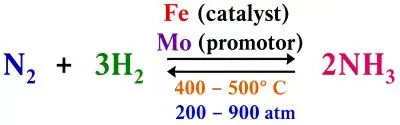
- Reaction is reversible and exothermic.
6. Important Symbols in Equations
- ↑ → Gas evolved
- ↓ → Precipitate formed
- Δ → Heat applied
- (aq) → Aqueous solution
- + heat → Exothermic reaction
- – heat → Endothermic reaction
Answer Key
Balance the following chemical equation:
- 2H2 + O2 → 2H2O
- 2Na + 2H2O → 2NaOH + H2
- 2Mg + O2 → 2MgO
- 3H2 + N2 → 2NH3
- Zn + 2HCl → ZnCl2 + H2
- CH4 + 2O2 → CO2 + 2H2O
- Fe + 2HCl → FeCl2 + H2
- NaCl + AgNO3 → AgCl + NaNO3
- Na2O + H2O → NaOH
- BaCl2 + H2SO4 → BaSO4 + 2HCl
- Mg(OH)2 + 2HCl → MgCl2 + 2H2O
- 2NaOH + H2SO4 → Na2SO4 + 2H2O
- 2H2O2 → 2H2O + O2
- NaOH + HCl → NaCl + H2O
- H2S + Cl2 → 2HCl + S
- Ca(OH)2 + CO2 → CaCO3 + H2O
- ZnCO3 ZnO + CO2
- Zn + H2SO4 → ZnSO4 + H2
- Fe + CuSO4 → ZnSO4 + Cu
- CuSO4 + H2S → CuS + H2SO4
- Na2CO3 + 2HCl → 2NaCl + H2O + CO2
- CuSO4 + 2NaOH → Cu(OH)2 + Na2SO4
- 3BaCl2 + Al2(SO4)3 → 3BaSO4 + 2AlCl3
- 2HNO3 + Ca(OH)2 → Ca(NO3)2 + 2H2O
- 2Al(OH)3 → Al2O3 + 3H2O
- Zn + 2NaOH \(\xrightarrow{Heat}\) Na2ZnO2 + H2
- Ca + 2HNO3 → Ca(NO3)2 + H2
- 4Na + O2 → 2Na2O
- Na2SO3 + 2HCl → 2NaCl + H2O + SO2
- BaCl2 + H2SO4 → BaSO4 + 2HCl
- 3Fe + 4H2O → Fe3O4 + 4H2
- 4Fe + 3O2 → 2Fe2O3
- S + 2H2SO4 → 3SO2 + 2H2O
- 2NH3 + 3CuO → 3Cu + N2 + 3H2O
- 2Pb(NO3)2 → 2PbO + 4NO2 + O2
- Al2(SO4)3 + 6NaOH → 2Al(OH)3 + 3Na2SO4
- Pb3O4 + 8HCl → 3PbCl2 + 4H2O + Cl2
- 4Zn + 10HNO3 → 4Zn(NO3)2 + 5H2O + N2O2
- HNO3 + H2S → 2NO2 + 2H2O + S
- 6CO2 + 6H2O \(\xrightarrow[{Chlorophyll}]{Sunlight}\) C6H12O6 + 6O2
- 2FeSO4 → Fe2O3 + SO2 + SO3
- 2Al + 3H2SO4 → Al2(SO4)3 + 3H2
- Pb(NO3)2 + 2KI → PbI2 + 2KNO3
Write the balanced equation for the following chemical reactions:
- C + O2 ⟶ CO2
- N2 + O2 ⟶ 2NO
- 3Ca + N2 ⟶ Ca3N2
- CaO + CO2 ⟶ CaCO3
- CaO + H2O ⟶ Ca(OH)2
- 2Na + Cl2 ⟶ 2NaCl
- 2Mg + O2 ⟶ 2MgO
- H2 + Cl2 ⟶ 2HCl
- Mg + H2SO4 ⟶ MgSO4 + H2
- 2Na + 2H2O ⟶ 2NaOH + H2
- Zn + 2AgNO3 ⟶ Zn(NO3)2 + 2Ag
- 2Al + 3CuCl2 ⟶ 2AlCl3 + 3Cu
- Fe + H2SO4 ⟶ FeSO4 + H2
- 2NaOH + H2SO4 ⟶ Na2SO4 + 2H2O
- 2KHCO3 + H2SO4 ⟶ K2SO4 + 2CO2 + 2H2O
- Mg + 2HCl ⟶ MgCl2 + H2
- 3BaCl2 + Al2(SO4)3 ⟶ 3BaSO4 + 2AlCl3
- BaCl2 + K2SO4 ⟶ BaSO4 + 2KCl
- CuSO4 + 2NaOH ⟶ Cu(OH)2 + Na2SO4
- Ca(OH)2 + CO2 ⟶ CaCO3 + H2O
- 2KBr + BaI2 ⟶ 2KI + BaBr2
- ZnCO3 ⟶ ZnO + CO2
- 2Na + 2H2O ⟶ 2NaOH + H2
- N2 + 3H2 ⟶ 2NH3
- BaCl2 + Na2SO4 ⟶ BaSO4 + 2NaCl
- Fe2O3 + 2Al ⟶ Al2O3 + 2Fe
- Cl2 + SO2 + 2H2O ⟶ H2SO4 + 2HCl
ICSE Class 8 Chemistry Language of Chemistry Notes PDF Download
Students looking for ICSE Class 8 Language of Chemistry Notes PDF Download can use these notes for quick revision and concept clarity. These notes cover atom structure, subatomic particles, electronic configuration, atomic number, mass number, and valency in an easy format.
Conclusion
ICSE Class 8 Chemistry Language of Chemistry Notes are essential for building a strong foundation in chemistry. By learning symbols, valency, radicals, and formulas, students can understand chemical reactions more effectively and score better in examinations.
ICSE Class 8 Chemistry Notes
Official Website:
Students can visit the official CISCE website for more details and updates.