Introduction
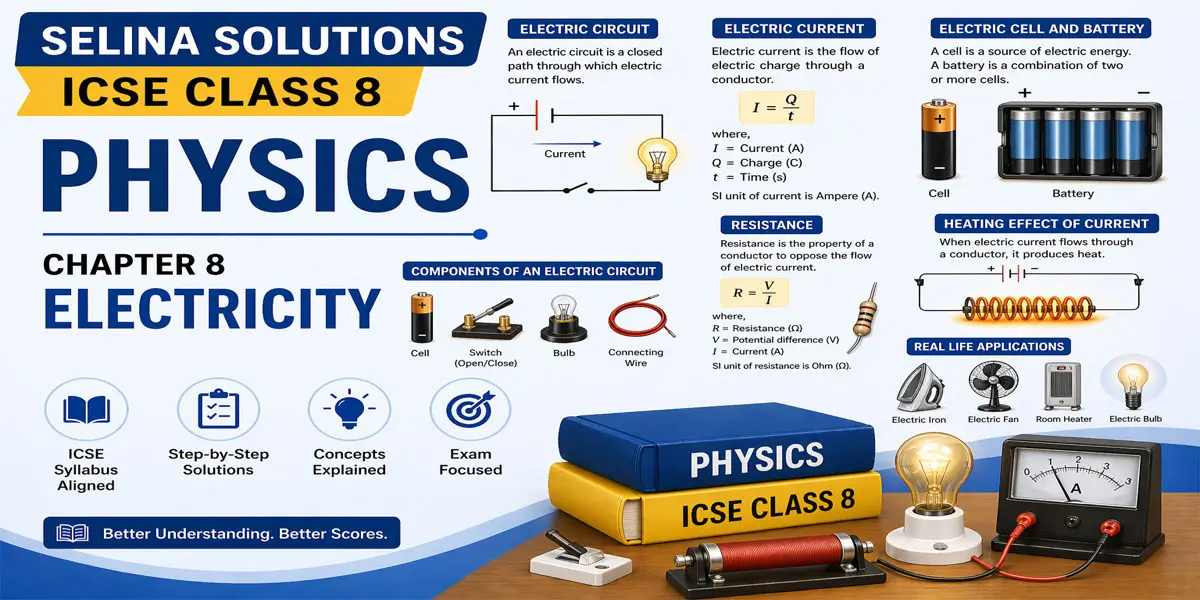
Electricity is one of the most important topics in Physics and plays a major role in our daily life. Students of ICSE Class 8 often look for accurate and easy-to-understand solutions for Chapter 8 Electricity from the Selina textbook. If you are searching for ICSE Class 8 Physics Chapter 8 Electricity Selina Solutions, you are in the right place.
In this article, we provide step-by-step answers, explanations, and concepts to help students prepare for school exams, class tests, and homework.
About Chapter 8 Electricity
Chapter 8 Electricity introduces students to the basic concepts of electric current, electric circuits, conductors, insulators, cells, batteries, switches, bulbs, and safety rules while using electricity.
Study Support by Rohit Academy
Rohit Academy offers expert-curated ICSE Class 8 Physics Study Materials including ICSE Electricity Chapter Notes, diagrams, and key formulas for better understanding.
You can also visit:
| ☛ ICSE Class 8 Physics Chapter 8: Electricity Notes |
| ☛ ICSE Class 8 Physics |
| ☛ ICSE Class 8 Chemistry |
| ☛ ICSE Class 8 Mathematics |
| ☛ ICSE Class 8 Biology |
Section (A) Household Electricity : (A) Objective Type Questions
Question 1
Choose the correct answer from the multiple choices given below.
Question 1(a)
All wires used in electric circuits should be covered with:
(i) Colouring material
(ii) Conducting material
(iii) an insulating material
(iv) none of the above
Answer:
(iii) an insulating material
Explanation:
The metal core of a wire conducts electricity, so it is covered with an insulating material (like PVC or rubber) to prevent electric shocks and short circuits.
Question 1(b)
Electrical work done per unit time is:
(i) electrical energy (ii) electric current
(iii) electric voltage (iv) electrical power
Answer:
(iv) electrical power
Explanation:
Power is defined as the rate of doing work or energy used per unit time. In electricity, this is called electrical power.
Electrical Power \(=\ \frac{Work\operatorname{done}}{time\ taken}\)
Question 1(c)
One kilowatt is equal to:
(i) 100 watt
(ii) 1000 watt
(iii) 10 watt
(iv) none of these
Answer:
(ii) 1000 watt
Explanation:
The prefix kilo means 1000, so
1 kW = 1000 W.
Question 1(d)
Fuse wire is an alloy of:
(i) tin-lead
(ii) copper-lead
(iii) tin-copper
(iv) lead-silver
Answer:
(i) tin-lead
Explanation:
A fuse wire is made of a tin and lead alloy because this alloy has a low melting point, allowing it to melt quickly when excess current flows.
Question 1(e)
A fuse wire should have:
(i) a low melting point
(ii) high melting point
(iii) very high melting point
(iv) none of the above
Answer:
(i) a low melting point
Explanation:
A fuse protects the circuit by melting easily when current exceeds the safe limit, thus breaking the circuit.
Question 1(f)
When switch of an electrical appliance is put off, it disconnects:
(i) the live wire
(ii) the neutral wire
(iii) the earth wire
(iv) the live and the neutral wires
Answer:
(i) the live wire
Explanation:
The switch is connected in the live wire so that switching off cuts the supply of current to the appliance, ensuring safety.
Question 1(g)
The purpose of an electric meter in a house is:
(i) to give the cost of electricity directly
(ii) to give the consumption of electrical energy
(iii) to safeguard the circuit from electrical short circuit
(iv) to put on or off the mains.
Answer:
(ii) to give the consumption of electrical energy
Explanation:
An electric meter measures the electrical energy consumed (usually in kWh or units), which is used to calculate the bill.
Question 1(h)
If out of the two lighted bulbs in a room, one bulb suddenly fuses, then:
(i) the other bulb will glow more
(ii) the other bulb will glow less
(iii) the other bulb will also fuse
(iv) the other bulb will remain lighted and unaffected.
Answer:
(iv) the other bulb will remain lighted and unaffected.
Explanation:
In household wiring, bulbs are connected in parallel, so if one bulb fuses, the others continue to receive full voltage and remain unaffected.
Section (A) Household Electricity : Fill in the blanks
Question 2
Fill in the blanks:
(a) The unit in which we pay the cost of electricity is …………… .
(b) The electrical energy consumed in a house is measured by …………… .
(c) In a household electrical circuit, the appliances are connected in …………… with the mains.
(d) A switch is connected to the …………… wire.
(e) The insulated wire in red color in a cable is the …………… wire.
(f) One kilowatt hour is equal to …………… joule.
(g) A fuse wire should have low …………… .
Answer:
(a) The unit in which we pay the cost of electricity is kWh.
(b) The electrical energy consumed in a house is measured by kWh meter.
(c) In a household electrical circuit, the appliances are connected in parallel with the mains.
(d) A switch is connected to the live wire.
(e) The insulated wire in red colour in a cable is the live wire.
(f) One kilowatt hour is equal to 3.6 x 10⁶ joule.
(g) A fuse wire should have low melting point.
Section (A) Household Electricity : True or False
Question 3
Write true or false for each statement:
(a) A fuse wire has a high melting point.
(b) Flow of protons constitutes electric current.
(c) A fuse wire is made of silver.
(d) S.I. unit and commercial unit of electrical energy are same.
(e) Overloading of electric current in circuits can lead to an electrical short circuit.
(f) Our body can allow electricity to pass through it.
(g) The metallic cases of all appliances are insulators of electricity.
(h) The earth wire protects us from an electric shock.
(i) A switch should not be touched with wet hands.
(j) All electrical appliances in a household circuit work at the same voltage.
(k) In a cable, the green wire is the live wire.
(l) A fuse is connected to the live wire.
(m) A switch is connected to the neutral wire.
Answer:
(a) False
Correct Statement : A fuse wire has a low melting point.
(b) False
Correct Statement : Flow of electrons constitutes electric current.
(c) False
Correct Statement : A fuse wire is made of an alloy of lead and tin.
(d) False
Correct Statement : The S.I. unit of electrical energy is joule (J), while the commercial unit is kilowatt hour (kWh).
(e) True
(f) True
(g) False
Correct Statement : The metallic cases of all appliances are conductors of electricity.
(h) True
(i) True
(j) True
(k) False
Correct Statement : In a cable, the green wire is the Earth wire.
OR, In a cable, the red wire is the live wire.
(l) True
(l) False
Correct Statement : A switch is connected to the live wire.
Section (A) Household Electricity : Match the Column
Question 4
Match the following:
| Column A | Column B |
| (a) Electric power | (i) volt |
| (b) kWh | (ii) joule |
| (c) Electric current | (iii) volt x ampere |
| (d) Electrical energy | (iv) watt |
| (e) watt | (v) ampere |
| (f) Potential difference | (vi) electrical energy |
Answer:
| Column A | Column B |
| (a) Electric power | (iv) watt |
| (b) kWh | (vi) electrical energy |
| (c) Electric current | (v) ampere |
| (d) Electrical energy | (ii) joule |
| (e) watt | (iii) volt x ampere |
| (f) Potential difference | (i) volt |
Section (A) Household Electricity : (B) Short Answer Type Questions
Question 1
From where does electricity come to our homes?
Answer:
The electricity comes to our homes from city substations.
Question 2
What is an electric meter? Where is it fixed in our house?
Answer:
An electric meter is a device used to measure the amount of electrical energy consumed in a house, usually in kilowatt hours (kWh).
It is fixed at the point where the main supply enters the house, usually on a wall outside the house or near the main switch board.
Question 3
State the purpose of kWh meter.
Answer:
A kWh meter is used to measure the amount of electrical energy consumed in a house or building in kilowatt hours (kWh), which is the unit used for calculating the electricity bill.
Question 4
For which unit do we pay our electricity bill?
Answer:
We pay for electricity in kilowatt hour (kWh), also called a unit.
Question 5
How can you check just by seeing the meter whether electricity is in use or not?
Answer:
When electricity is in use, electric current flows through the meter, causing the armature to rotate. A counter attached to the armature records the number of rotations, which indicates the amount of electrical energy consumed.
Question 6
One day the meter reading was 7643 units while on the following day, it was 7657 units. What is the consumption of electricity in a day?
Answer:
- Initial reading = 7643 units
- Final reading = 7657 units
- Consumption of electricity in a day
= Final reading − Initial reading
= 7657 – 7643
= 14 units (or 14 kWh)
So, the electricity consumed in one day is14 units.
Question 7
A source of potential difference V volt sends current I ampere in a circuit for time t second. Write expressions for:
(a) electrical energy supplied by the source, and
(b) electrical power spent by the source.
Answer:
(a) Electrical energy, E = Vit
(b) Electrical power, P = VI
Question 8
Name the unit in which you pay the cost of your electricity bill. How is it related to joule?
Answer:
The cost of electricity is paid in kilowatt hour (kWh), commonly called a unit.
Relationship between kWh and Joule:
1 kWh = 3.6 × 10⁶ J
Question 9
If an appliance of power P watt is used for time t hour, how much electrical energy is consumed in kWh?
Answer:
Energy consumed \(=\frac{P\ \times\operatorname{t}}{1000}\) kWh
Question 10
State one property of the material of a fuse wire.
Answer:
It should have a low melting point.
Question 11
Name the material of a fuse wire.
Answer:
An alloy of tin and lead.
Question 12
How does a fuse protect the electric wiring (or an appliance) from being damaged?
Answer:
A fuse is a thin wire of low melting point connected in series with the circuit. When the current exceeds the safe limit (due to overload or short circuit), the fuse wire heats up and melts, breaking the circuit. This stops the flow of current and protects the wiring or appliance from damage and fire.
Question 13
Write the full form of M.C.B.
Answer:
The full form of M.C.B. is miniature circuit breaker.
Question 14
How is M.C.B. superior to the fuse wire?
Answer:
An M.C.B. (Miniature Circuit Breaker) is superior to a fuse wire because:
- Automatic operation: It automatically trips and cuts off the current when there is an overload or short circuit.
- Reusable: After tripping, it can be reset by switching it on again, whereas a fuse wire must be replaced.
- Faster and safer: It works more quickly and reliably than a fuse, giving better protection to wiring and appliances.
Question 15
With which wire: live or neutral is the fuse wire connected?
Answer:
The fuse wire is connected to thelive wire.
Question 16
State the voltage at which electricity is supplied to our houses.
Answer:
Electricity is supplied to our houses at 220 volt.
Question 17
State the colour coding of the three wires in a cable used for wiring in a household electrical circuit.
Answer:
- Live wire: Red or Brown
- Neutral wire: Black or Light Blue
- Earth wire: Green or Yellow
Question 18
Why is the metal covering of an electrical appliance earthed?
Answer:
The metal covering of an electrical appliance is earthed to prevent electric shock.
If the live wire accidentally touches the metal body, the current flows to the earth through the earth wire (which has low resistance) instead of passing through a person touching the appliance. This keeps the metal body at earth potential and protects the user from shock.
Section (A) Household Electricity : (C) Long Answer Type Questions
Question 1
What is an electric fuse? State its purpose in the household electrical circuit?
Answer:
Electric fuse:
An electric fuse is a safety device consisting of a thin wire made of a metal or alloy with a low melting point, connected in series in an electrical circuit.
Purpose in a household electrical circuit:
The fuse protects electrical wiring and appliances from damage. When the current exceeds the safe limit (due to overload or short circuit), the fuse wire melts and breaks the circuit, stopping the flow of current and preventing fire or damage.
Question 2
What do you mean by short circuiting of a circuit?
Answer:
Short circuiting of a circuit:
Short circuiting occurs when the live wire and neutral wire come into direct contact or when the resistance of the circuit becomes very low, causing a large current to flow suddenly.
Effect:
This excessive current produces a lot of heat, which can damage appliances, melt wires, or cause fire. Devices like fuses or MCBs are used to protect circuits from short circuiting.
Question 3
In the household electric circuit, if one bulb is fused in a room, the other bulbs keep glowing. Explain the reason.
Answer:
In household wiring, bulbs and other appliances are connected in parallel.
In a parallel circuit, each bulb has its own separate path for the flow of current. If one bulb gets fused, the circuit of that bulb breaks, but the other bulbs still have complete circuits, so current continues to flow through them and they keep glowing.
Question 4
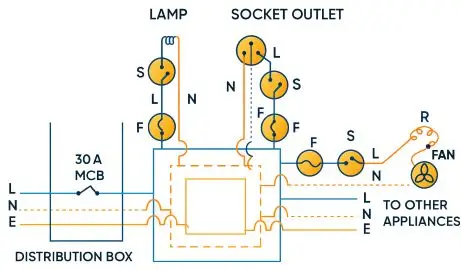
Draw a labelled diagram with the necessary switches to connect a bulb, a fan and a plug socket in a room with the mains. In what arrangement will you connect them to the mains?
Answer:
All electrical appliances in a house are connected in parallel to the mains supply.
The diagram is shown below.
Section (A) Household Electricity : (D) Think and Answer
Question 1
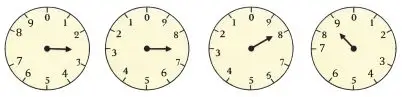
Figure shows the reading on the dials of a meter. State what is its reading.
Answer:
The reading on the meter is 2789.
Question 2
Can we use copper wire as a fuse wire? Give reason.
Answer:
No, copper wire cannot be used as a fuse wire because the melting point of copper is very high, so it does not melt easily when excess current flows.
Question 3
Which fuse wire is thick: 5 A or 15 A?
Answer:
The 15 A fuse wire is thicker than the 5 A fuse wire because the thickness of a fuse wire depends on its current rating. The higher the current rating, the thicker the fuse wire.
Question 4
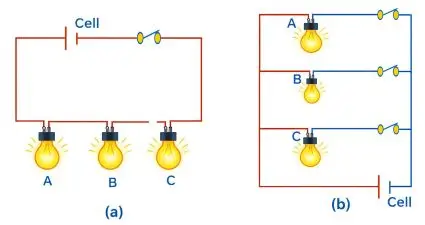
Figure shows two ways of connecting the three bulbs A, B and C to a battery. Name the two arrangements. Which of them do you prefer to use in a household circuit? Give a reason to support your answer.
Answer:
Figure (a) is series arrangement and Figure (b) is parallel arrangement.
The parallel arrangement is preferred because:
- Each appliance gets the same voltage (220 V).
- Every appliance has its own separate switch.
- If one appliance stops working, it does not affect the operation of the others.
Question 5
How are the electrical appliances connected in a house circuit: in series or in parallel? Give reason.
Answer:
Electrical appliances in a house are connected in parallel.
Reason:
- Each appliance gets the same voltage (220 V).
- Every appliance has its own separate switch.
- If one appliance stops working, it does not affect the operation of the others.
Section (A) Household Electricity : (E) Numericals
Question 1
An electrical appliance is rated as 60 W – 150 V.
(a) What do you understand by this statement?
(b) How much current will flow through the appliance when in use?
Solution:
(a) The rating 60 W – 150 V means that when the appliance is connected to a 150 V supply, it consumes 60 W of electrical power.
(b) Given,
P = 60 W
V = 150 V
We know that:
P = V I
∴ I = P / V = 60 / 150 = 0.4 A
∴ Current flowing through the appliance = 0.4 A
Question 2
An electric iron of power 1.5 kW is used for 30 minutes to press clothes. Calculate the electrical energy consumed in:
(a) kilowatt hour (b) joule
Solution:
Given,
Power, P = 1.5 kW
Time, t = 30 minutes = 0.5 hour
(a) Electrical energy in kilowatt hour
E = P × t
E = 1.5 × 0.5 = 0.75 kWh
∴ Electrical energy consumed = 0.75 kWh
(b) Electrical energy in joule
1 kWh = 3.6 × 10⁶ J
E = 0.75 × 3.6 × 106
E = 2.7 × 10⁶ J
∴ Electrical energy consumed = 2.7 × 10⁶ J
Question 3
Assuming the electric consumption per day to be 12 kWh and the rate of electricity to be ₹ 6.25 per unit, find how much money is to be paid in a month of 30 days?
Solution:
Given,
Electric energy consumed per day = 12 kWh
Rate of electricity = ₹ 6.25 per unit
Number of days = 30
Total energy consumed in 30 days = 12 × 30 = 360 kWh (units)
Cost of electricity = 360 × 6.25 = ₹ 2250
∴ Money to be paid in a month = ₹2250
Question 4
In a premise 5 bulbs each of 100 W, 2 fans each of 60 W, 2 A.Cs each of 1.5 kW are used for 5 h per day. Find:
(a) total power consumed per day,
(b) total power consumed in 30 days,
(c) total electrical energy consumed in 30 days,
(d) the cost of electricity at the rate of ₹ 6.25 per unit.
Solution:
Power of 5 bulbs = 5 × 100 W = 500 W
Power of 2 fans = 2 × 60 W = 120 W
Power of 2 A.C.s = 2 × 1.5 kW = 3.0 kW
= 3000 W
Total power = 500 + 120 + 3000 = 3620 W
(a) Total power consumed per day = 3620 W
(b) Power consumed for 30 days
= 3620 x 30/1000 = 108.6 kW
(c) Power consumed in 30 days = 108.6 kW
time = 5 h
Electrical energy consumed in 30 days
= Power x time
= 108.6 x 5
=543 kWh
(d) Cost of 1 unit = ₹ 6.25
Cost of 543 units = 6.25 x 543 = ₹ 3393.75
∴ Cost of electricity = ₹ 3393.75.
Section (B) Static Electricity : (A) Objective Type Questions
Question 1
Choose the correct answer from the multiple choices given below.
Question 1(a)
When a glass rod is rubbed with dry silk cloth, the charge acquired by the silk cloth is:
(i) Positive
(ii) Negative
(iii) Both positive and negative
(iv) None of the above
Answer:
(ii) Negative
Explanation:
Electrons move from the glass rod to the silk. The silk gains electrons, so it becomes negatively charged.
Question 1(b)
When an ebonite rod is rubbed with fur, the rod acquires:
(i) positive charge
(ii) negative charge
(iii) no charge
(iv) none of the above
Answer:
(ii) Negative charge
Explanation:
Ebonite gains electrons from fur during rubbing, so it becomes negatively charged.
Question 1(c)
When a negatively charged body is brought closer to another negatively charged body, then they will show:
(i) attraction
(ii) no effect
(iii) repulsion
(iv) none of the above
Answer:
(iii) Repulsion
Explanation:
Like charges repel each other according to the law of electrostatics.
Question 1(d)
Charging a conductor by bringing another charged conductor close to it without touching is called:
(i) induction
(ii) conduction
(iii) convection
(iv) radiation
Answer:
(i) Induction
Explanation:
In induction, charges are rearranged in a conductor due to the influence of a nearby charged body without direct contact.
Question 1(e)
The factor responsible for charging a conductor is:
(i) transfer of protons
(ii) transfer of neutrons
(iii) transfer of electrons
(iv) transfer of both protons and electrons
Answer:
(iii) Transfer of electrons
Explanation:
Only electrons are free to move in solids. Protons and neutrons remain bound in the nucleus.
Question 1(f)
Two objects when rubbed together get charged. The charges on them are:
(i) equal and opposite
(ii) equal and similar
(iii) unequal and similar
(iv) unequal and opposite
Answer:
(i) Equal and opposite
Explanation:
Charge is conserved. Electrons lost by one object are gained by the other.
Question 1(g)
When a glass rod is rubbed with silk, the glass rod and the silk get charged because:
(i) electrons are transferred from the silk to the glass rod
(ii) electrons are transferred from the glass rod to the silk
(iii) protons are transferred from the silk to the glass rod
(iv) protons are transferred from the glass rod to the silk
Answer:
(ii) Electrons are transferred from the glass rod to the silk
Explanation:
Glass loses electrons and becomes positively charged, while silk gains electrons and becomes negatively charged.
Question 1(h)
The conductor of electricity is:
(i) Wood
(ii) Glass
(iii) Ebonite
(iv) human body
Answer:
(iv) Human body
Explanation:
The human body contains water and dissolved salts, which allow electric current to pass, making it a conductor. Wood, glass, and ebonite are insulators (in dry conditions).
Question 1(i)
A gold leaf electroscope is to be charged positively by conduction. For this:
(i) a positively charged rod is held close to the disc of electroscope
(ii) a positively charged rod is placed in contact with the disc of electroscope
(iii) a negatively charged rod is held close to the disc of electroscope
(iv) a negatively charged rod is touched with the disc of electroscope
Answer:
(ii) A positively charged rod is placed in contact with the disc of electroscope
Explanation:
Charging by conduction requires direct contact so that charge flows to the electroscope.
Question 1(j)
A glass rod rubbed with silk is touched with the disc of a negatively charged gold leaf electroscope. The divergence of leaves will:
(i) Decrease
(ii) Increase
(iii) remain unchanged
(iv) first decreases and then increases
Answer:
(i) Decrease
Explanation:
The glass rod is positively charged. On touching, it neutralizes some of the negative charge, reducing repulsion between leaves, so divergence decreases.
Question 1(k)
The rod in a gold leaf electroscope is made up of:
(i) wood
(ii) brass
(iii) glass
(iv) ebonite
Answer:
(ii) Brass
Explanation:
Brass is a good conductor, allowing charge to pass to the gold leaves.
Question 1(l)
Lightning conductor is made up of:
(i) copper (ii) glass
(iii) ebonite (iv) wood
Answer:
(i) Copper
Explanation:
Copper is an excellent conductor and safely carries large electric currents from lightning to the ground.
Section (B) Static Electricity : Assertion Reason Type
Question 2
The following questions are Assertion–Reason based questions. Choose the answers based on the code given below.
Question 2(a)
Assertion (A) : A fuse is used in an electrical appliance to safeguard from electric shocks.
Reason (R) : A fuse melts and breaks the circuit when excessive current flows through it.
(i) Both A and R are true and R is the correct explanation of A
(ii) Both A and R are true and R is not the correct explanation of A
(iii) Assertion is true but reason is false
(iv) Assertion is false but reason is true
Answer:
(iv) Assertion is false but reason is true
Explanation:
A fuse mainly protects appliances and wiring from overcurrent or short circuit, not from electric shocks (earthing prevents shocks). The reason is correct because a fuse wire melts when current exceeds the safe limit.
Question 2(b)
Assertion (A) : MCB is more effective than a fuse in household wiring.
Reason (R) : MCB can be reset (raised up) after tripping whereas fuse must be neglected once blown.
(i) Both A and R are true and R is the correct explanation of A
(ii) Both A and R are true and R is not the correct explanation of A
(iii) Assertion is true but reason is false
(iv) Assertion is false but reason is true
Answer:
(i) Both A and R are true and R is the correct explanation of A
Explanation:
An MCB trips automatically during overload and can be reset easily, while a fuse must be replaced. This makes MCB safer and more convenient.
Question 2(c)
Assertion (A) : Lightning is a natural example of static electricity.
Reason (R) : Lightning occurs due to the accumulation of same charges in clouds and earth’s surface.
(i) Both A and R are true and R is the correct explanation of A
(ii) Both A and R are true and R is not the correct explanation of A
(iii) Assertion is true but reason is false
(iv) Assertion is false but reason is true
Answer:
(iii) Assertion is true but reason is false
Explanation:
Lightning is caused by accumulation of opposite charges between clouds and the earth (or between clouds), not the same charges.
Question 2(d)
Assertion (A) : Conductors can be charged by friction.
Reason (R) : Conductors allow charges to flow through them and do not retain static charges.
(i) Both A and R are true and R is the correct explanation of A
(ii) Both A and R are true and R is not the correct explanation of A
(iii) Assertion is true but reason is false
(iv) Assertion is false but reason is true
Answer:
(iv) Assertion is false but reason is true
Explanation:
Conductors generally cannot be charged by friction in ordinary conditions because charges flow away through the body or earth. The reason correctly states that conductors allow charges to move freely and do not retain static charges.
Section (B) Static Electricity : Fill in the blanks
Question 3
Fill in the blanks:
(a) Like charges …………… while unlike charges …………… .
(b) Mercury is a …………… of electricity while pure water is …………… of electricity.
(c) An ebonite rod when rubbed with fur acquires the …………… charge.
(d) When an uncharged conductor is brought in contact with the disc of a gold leaf electroscope, its leaves …………… .
(e) Charge is shared in charging a conductor by the method of …………… .
Answer:
(a) Like charges repel while unlike charges attract.
(b) Mercury is a conductor of electricity while pure water is insulator of electricity.
(c) An ebonite rod when rubbed with fur acquires the negative charge.
(d) When an uncharged conductor is brought in contact with the disc of a gold leaf electroscope, its leaves will remain unchanged.
(e) Charge is shared in charging a conductor by the method of conduction.
Section (B) Static Electricity : True or False
Question 4
Write true or false for each statement:
(a) The number of electrons and protons in an atom are same.
(b) If the charge is not in motion, we call it static electricity.
(c) Human body is a conductor of electricity.
(d) When an ebonite rod is rubbed with fur, the electrons move from ebonite to fur.
(e) When a glass rod is rubbed with dry silk cloth, the electrons move from glass to silk.
(f) The cap of gold leaf electroscope is made of copper.
(g) If a glass rod rubbed with silk is brought near the cap of a negatively charged electroscope, the divergence of leaves will decrease.
(h) In induction, a positively charged body can make an uncharged body positively charged.
(i) A lightning conductor saves the building from lightning.
(j) When a comb is rubbed with dry hair both comb and paper get similarly charged.
(k) A glass rod rubbed with silk repels an ebonite rod rubbed with fur.
(l) When an ebonite rod is rubbed with fur, the protons move from the ebonite rod to the fur.
(m) A conductor has a large number of free electrons.
(n) An ebonite rod can be charged by touching it with a charged copper rod.
(o) To find whether a body is charged or not, an uncharged electroscope is used.
(p) To find whether the charge on a body is positive or negative, an uncharged electroscope is used.
(q) If a negatively charged rod is brought near a negatively charged pith ball electroscope, the pith ball will be stuck with the rod.
Answer:
(a) True
(b) True
(c) True
(d) False
Correct Statement : When an ebonite rod is rubbed with fur, electrons move from the fur to the ebonite rod.
(e) True
(f) False
Correct Statement : The cap of gold leaf electroscope is made of brass.
(g) True
(h) False
Correct Statement : In induction, a positively charged body can make an uncharged body negatively charged.
(i) True
(j) False
Correct Statement : When a comb is rubbed with dry hair both comb and paper get oppositely charged.
(k) False
Correct Statement : A glass rod rubbed with silk attracts an ebonite rod rubbed with fur.
(l) False
Correct Statement : When an ebonite rod is rubbed with fur, the free electrons move from fur to ebonite rod.
(m) True
(n) False
Correct Statement : An ebonite rod can be charged by rubbing it with fur.
(o) True
(p) False
Correct Statement : To find whether the charge on a body is positive or negative, a charged electroscope is used.
(q) False
Correct Statement : If a negatively charged rod is brought near a negatively charged pith ball electroscope, the pith ball will move away from the rod.
Section (B) Static Electricity : Match the Column
Question 5
Match the following:
| Column A | Column B |
| (a) Two like charges | (i) negative charge |
| (b) Two unlike charges | (ii) repel |
| (c) Silver is a | (iii) insulator |
| (d) Silk is an | (iv) attract |
| (e) Ebonite rod rubbed with fur acquires | (v) conductor |
Answer:
| Column A | Column B |
| (a) Two like charges | (ii) repel |
| (b) Two unlike charges | (iv) attract |
| (c) Silver is a | (v) conductor |
| (d) Silk is an | (iii) insulator |
| (e) Ebonite rod rubbed with fur acquires | (i) negative charge |
Section (B) Static Electricity : (B) Short Answer Type Questions
Question 1
What do you understand by electricity at rest?
Answer:
Electricity at rest is called static electricity. It refers to electric charges that remain stationary on the surface of an object.
Question 2
Why does a plastic comb rubbed with dry hair attract bits of paper?
Answer:
When a plastic comb is rubbed with dry hair, it becomes electrically charged due to friction. The charged comb attracts small bits of paper by electrostatic force.
Question 3
Who discovered the way of producing electricity by friction?
Answer:
The Greek philosopher Thales of Miletus discovered that electricity can be produced by friction (by rubbing amber).
Question 4
Name two substances which can be charged by friction.
Answer:
Glass rod and ebonite rod
Question 5
What are the two kinds of charges?
Answer:
The two kinds of charges are positive charge and negative charge.
Question 6
What do you mean by conservation of charges?
Answer:
Conservation of charge means that electric charge cannot be created or destroyed; it can only be transferred from one body to another.
Question 7
Name three constituents of an atom and state the kind of charge on each of them.
Answer:
- Proton – Positive charge
- Electron – Negative charge
- Neutron – No charge (neutral)
Question 8
What is the net charge on an atom?
Answer:
The net charge on an atom is zero because the number of protons equals the number of electrons.
Question 9
What are free electrons?
Answer:
Free electrons are electrons that are loosely bound to atoms and can move freely within a material, especially in conductors.
Question 10
What causes the charging of two objects when they are rubbed together?
Answer:
Charging occurs due to the transfer of electrons from one object to another during rubbing (friction).
Question 11
Give one example each of a conductor and an insulator of electricity.
Answer:
- Conductor: Copper
- Insulator: Rubber
Question 12
State two ways of charging a conductor.
Answer:
The two ways of charging a conductor are:
- By Conduction
- By Induction.
Question 13
Name the way of charging a conductor in which the charge is shared.
Answer:
Charging by conduction, because charge is transferred and shared between the bodies.
Question 14
Can you charge an insulator by the method of conduction?
Answer:
No, Insulators cannot be effectively charged by conduction because charges cannot move freely through them.
Question 15
What is an electroscope? Name the two types of electroscopes.
Answer:
An electroscope is a device used to detect the presence of electric charge.
The two types of electroscopes are:
- Pith ball electroscope.
- Gold leaf electroscope.
Question 16
A positively charged glass rod is touched with the disc of an uncharged gold leaf electroscope. What will be your observation?
Answer:
The gold leaves diverge (spread apart) because the electroscope becomes positively charged by conduction.
Question 17
A negatively charged ebonite rod is touched with the disc of a negatively charged gold leaf electroscope. What will be your observation?
Answer:
The divergence of the gold leaves increases, because more negative charge is transferred to the electroscope.
Question 18
What causes lightning?
Answer:
Lightning is caused by the sudden discharge of electric charges between clouds or between a cloud and the Earth due to a large buildup of static electricity.
Question 19
What are the effects of lightning?
Answer:
- Damage to buildings and trees
- Fires
- Death or injury to living beings
- Damage to electrical equipment
Question 20
What is a lightning conductor? How does it work?
Answer:
A lightning conductor is a metal rod fixed on the top of a building and connected to the ground by a thick metal wire.
It provides a safe path for electric charges from lightning to pass into the Earth, protecting the building.
Question 21
How is a tall building protected from damage due to lightning?
Answer:
A tall building is protected by installing a lightning conductor which safely carries the electric charge
from lightning to the ground.
Section (B) Static Electricity : (C) Long Answer Type Questions
Question 1
Describe an experiment to demonstrate that there are two kinds of charges.
Answer:
Experiment:
Take two glass rods and rub them with silk. Suspend one rod freely with a silk thread and bring the other rubbed glass rod near it. The two rods repel each other.
Now take an ebonite rod rubbed with fur and bring it near the suspended glass rod. They attract each other.
Conclusion:
Since like charges repel and unlike charges attract, it shows that there are two kinds of charges—positive and negative.
Question 2
How will you show that like charges repel and unlike charges attract each other?
Answer:
Experiment:
Suspend a charged glass rod freely using a silk thread. Bring another glass rod rubbed with silk near it. The suspended rod moves away, showing repulsion (like charges repel).
Now bring an ebonite rod rubbed with fur near the suspended glass rod. The suspended rod moves towards it, showing attraction (unlike charges attract).
Conclusion:
This experiment shows that like charges repel each other and unlike charges attract each other.
Question 3
Briefly describe the structure of an atom.
Answer:
An atom consists of two main parts:
- Nucleus:
- Located at the center of the atom.
- Contains protons (positively charged) and neutrons (no charge).
- Almost all the mass of the atom is concentrated in the nucleus.
- Electrons:
- Negatively charged particles.
- Revolve around the nucleus in fixed paths called shells or energy levels.
Question 4
A glass rod is rubbed with silk. Explain the charging of the glass rod and the silk on the basis of electron movement.
Answer:
When a glass rod is rubbed with silk, some free electrons move from the glass rod to the silk. As the glass rod loses electrons, it becomes positively charged. The silk gains the same number of electrons and therefore becomes negatively charged by an equal amount.
Question 5
An ebonite rod is rubbed with fur. Explain the charging of the ebonite rod and the fur on the basis of electron movement.
Answer:
When an ebonite rod is rubbed with fur, electrons are transferred from the fur to the ebonite rod. The ebonite rod gains electrons and becomes negatively charged. The fur loses electrons and becomes positively charged by an equal amount.
Question 6
Distinguish between conductors and insulators of electricity.
Answer:
| Conductors | Insulators |
| Materials that allow electric current to pass through them easily. | Materials that do not allow electric current to pass through them easily. |
| Have a large number of free electrons. | No free electrons. |
| They cannot be charged by rubbing. | They can be charged by rubbing. |
| Used for making wires and electrical connections. | Used for covering wires and providing safety. |
| Examples: Copper, aluminium, iron. | Examples: Rubber, plastic, glass, wood. |
Question 7
Describe the method of charging a conductor by conduction.
Answer:
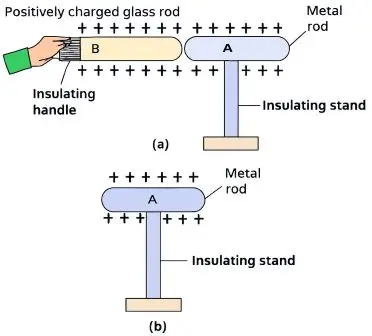
Charging by conduction is the process of charging a conductor by direct contact with a charged body. When a charged conductor touches an uncharged conductor, electrons are transferred from one to the other. As a result, the uncharged conductor becomes charged with the same kind of charge as the charged conductor.
Question 8
Explain the charging by conduction in terms of movement of electrons.
Answer:
In charging by conduction, a charged conductor is brought in direct contact with a neutral conductor. Due to the contact, electrons move from the body having excess electrons to the body having fewer electrons. After the transfer of electrons, the neutral conductor becomes charged with the same type of charge as the charged conductor.
Question 9
Describe the method of charging a conductor by induction.
Answer:
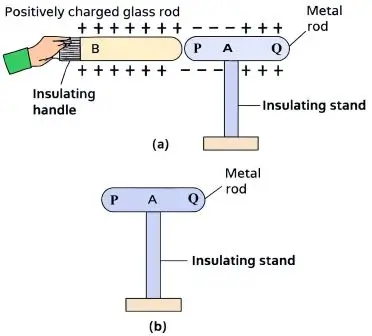
Charging by induction is the process of charging a conductor without touching it with a charged body. When a charged object is brought near a neutral conductor, the charges in the conductor rearrange. The conductor is then earthed, allowing electrons to flow to or from the earth. After removing the earth connection and then the charged body, the conductor remains charged with a charge opposite to that of the inducing body.
Question 10
Explain the charging by induction in terms of movement of electrons.
Answer:
When a charged body is brought near a neutral conductor, electrons in the conductor move due to the influence of the charged body. If the conductor is earthed, electrons either flow to the earth or come from the earth, depending on the type of charge on the inducing body. After removing the earth connection and then the charged body, the conductor is left charged with a charge opposite to that of the inducing body.
Question 11
Describe a pith ball electroscope. How can you use it to test whether a body is charged or uncharged?Answer:
Pith Ball Electroscope:
A pith ball electroscope consists of a small light pith ball suspended by a silk or dry thread from a stand. The pith ball is very light, so it can easily move when electric forces act on it.
To test whether a body is charged or uncharged:
- Bring the body near the pith ball without touching it.
- If the pith ball is attracted, the body is charged.
- If there is no attraction, the body is uncharged.
Conclusion:
Attraction of the pith ball indicates the presence of electric charge on the body.
Question 12
How will you use a pith ball electroscope to find out whether the charge on a charged body is positive or negative?
Answer:
A pith ball electroscope is first given a known charge (positive or negative). The charged body is then brought near the pith ball.
- If the pith ball is repelled, the body has the same type of charge.
- If the pith ball is attracted, the body has the opposite type of charge.
Thus, by observing attraction or repulsion, the nature of charge on the body can be determined.
Question 13
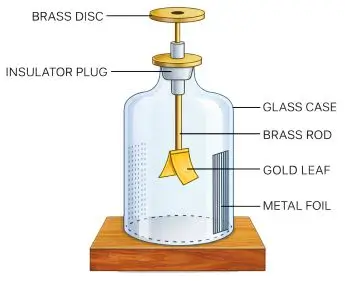
Draw a labelled diagram of a gold leaf electroscope and describe its construction.
Answer:
Construction of a Gold Leaf Electroscope:
- A brass rod is fitted vertically and has a brass disc at its upper end.
- Two thin gold or aluminium leaves are attached to the lower end of the brass rod.
- The rod passes through an ebonite cork (insulating plug) fitted in the mouth of a glass bottle.
- The glass bottle protects the leaves from air currents and moisture.
- Tin foil strips are fixed on the inner sides of the bottle near the bottom.
- These tin foils are connected to the earth, which helps in proper functioning of the electroscope.
Question 14
How will you use a gold leaf electroscope to find out whether a body is charged or uncharged?
Answer:
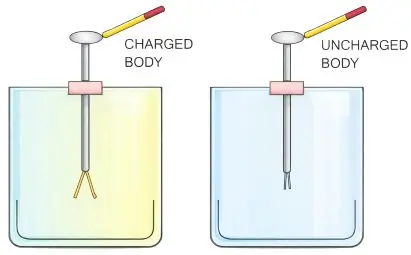
To test whether a body is charged, bring it near the metal disc of a gold leaf electroscope.
- If the gold leaves diverge, the body is charged.
- If the gold leaves do not diverge, the body is uncharged.
Question 15
How will you use a gold leaf electroscope to find out whether the charge on a charged body is positive or negative?
Answer:
First, charge the gold leaf electroscope with a known charge. Then bring the charged body near the metal disc.
- If the divergence of the leaves increases, the body has the same type of charge.
- If the divergence decreases, the body has the opposite type of charge.
Thus, the nature of charge on the body can be determined.
Question 16
Describe Franklin’s experiment. What did he conclude from his experiment?
Answer:
Franklin’s Experiment:
Benjamin Franklin flew a kite during a thunderstorm. A metal key was tied to the wet string of the kite, and a Leyden jar was connected near the lower end. When the charged cloud passed overhead, sparks were produced at the key, showing that electric charge had travelled down the wet string.
Conclusion:
Franklin concluded that lightning is a form of electricity and that clouds carry electric charge. This experiment led to the invention of the lightning conductor to protect buildings.
Question 17
State three safety measures that you will observe in a thunderstorm.
Answer:
- Stay indoors and avoid open fields, tall trees, and electric poles.
- Do not use electrical appliances or wired telephones during a thunderstorm.
- If caught outside, crouch down on the ground with feet together and avoid lying flat.
Section (B) Static Electricity : (D) Think and Answer
Question 1
A glass rod is rubbed with silk. State the kind of charge acquired by each.
Answer:
When a glass rod is rubbed with silk, the glass rod acquires a positive charge and the silk acquires a negative charge.
Question 2
An ebonite rod is rubbed with fur. State the kind of charge acquired by each.
Answer:
When an ebonite rod is rubbed with fur, the ebonite rod acquires a negative charge and the fur acquires a positive charge.
Question 3
A glass rod rubbed with silk is suspended near an ebonite rod rubbed with fur. What will be your observation? Give a reason to your answer.
Answer:
Observation:
The glass rod moves towards the ebonite rod (attraction).
Reason:
A glass rod rubbed with silk becomes positively charged, while an ebonite rod rubbed with fur becomes negatively charged. Since unlike charges attract each other, attraction is observed.
Question 4
An ebonite rod rubbed with fur is suspended near another ebonite rod rubbed with fur. State your observation and give a reason to support your answer.
Answer:
Observation:
The suspended ebonite rod moves away (repels) from the other ebonite rod.
Reason:
Both ebonite rods rubbed with fur acquire a negative charge. Sincelike charges repel each other, repulsion is observed.
Question 5
An ebonite rod is rubbed with fur. Compare the charges acquired by them.
Answer:
When an ebonite rod is rubbed with fur, electrons move from the fur to the ebonite rod. As a result, the fur loses electrons and becomes positively charged, while the ebonite rod gains the same number of electrons and becomes negatively charged. Thus, both acquire equal and opposite charges.
Question 6
In each of the following cases, state which body loses electrons:
(a) A glass rod when rubbed with silk.
(b) An ebonite rod when rubbed with fur.
Answer:
(a) Glass rod loses electrons.
(b) Fur loses electrons.
Question 7
A metal rod A is to be charged positively by using another charged rod B. What should be the kind of charge on the rod B if charging is to be done by conduction?
Answer:
For charging by conduction, the rod B should be positively charged.
Question 8
Figure below shows a metal rod AB placed on an insulating stand. In Fig.(a), a negatively charged ebonite rod C is touched with the metal rod AB, while in Fig.(b), the negatively charged ebonite rod C is held near the rod AB. State the kind of charges at the ends A and B of the rod, in each case.
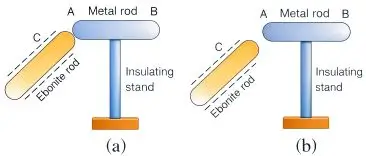
Answer:
(a) When the negatively charged ebonite rod touches the metal rod, electrons are transferred to the metal rod and the charge spreads over it.
- End A – Negative charge
- End B – Negative charge
(b) When the negatively charged ebonite rod is held near the metal rod, induction takes place.
- End A – Positive charge
- End B – Negative charge
Question 9
When a charged rod is touched with the disc of a positively charged gold leaf electroscope, it is observed that the divergence of leaves decreases. What is the kind of charge on the rod?
Answer:
The rod is negatively charged.
Download ICSE Class 8 Physics Chapter 8 Electricity Selina Solutions
Students looking for accurate and easy solutions can use these notes for daily study. Practice regularly and revise diagrams for better marks.
Why Choose Selina Solutions?
Selina textbooks are widely used in ICSE schools. Their questions are designed to improve conceptual understanding. Our ICSE Class 8 Physics Chapter 8 Electricity Selina Solutions help students by:
- Providing correct answers in simple language
- Explaining concepts clearly
- Saving time during homework
- Helping in exam revision
- Improving confidence before tests
Benefits of Studying Electricity Solutions
By practicing these solutions regularly, students can:
- Learn the correct method of answering
- Score better marks in exams
- Understand diagrams and circuits easily
- Revise important definitions quickly
Conclusion
Preparing with ICSE Class 8 Physics Chapter 8 Electricity Selina Solutions is the best way to understand the chapter and score high marks. These solutions are written in student-friendly language and cover all textbook questions in detail. Practice regularly and revise all concepts to perform well in your exams.
ICSE Class 8 Physics Selina Solutions
The Selina Concise Physics Class 8 book includes the following chapters:
Official Website:
Students can visit the official CISCE website for more details and updates.