
Introduction
Students looking for ICSE Class 8 Physics Chapter 7 Sound Selina Solutions can find complete and easy-to-understand answers here. This chapter explains the concept of sound, vibrations, propagation of sound, pitch, loudness, quality, echo, and the human ear.
Our solutions are prepared according to the latest ICSE syllabus and help students understand each question step-by-step. These answers are useful for homework, revision, and exam preparation.
Study Support by Rohit Academy
Rohit Academy offers expert-curated ICSE Class 8 Physics Study Materials including ICSE Sound Chapter Notes, diagrams, and key formulas for better understanding.
You can also visit:
| ☛ ICSE Class 8 Physics Chapter 7: Sound Notes |
| ☛ ICSE Class 8 Physics |
| ☛ ICSE Class 8 Chemistry |
| ☛ ICSE Class 8 Mathematics |
| ☛ ICSE Class 8 Biology |
(A) Multiple Choice Type
Question 1
Choose the correct answer from the multiple choices given below.
Question 1(a)
Sound cannot travel in:
(i) solid
(ii) liquid
(iii) gas
(iv) vacuum
Answer:
(iv) vacuum
Explanation:
Sound needs a material medium (solid, liquid, or gas) to propagate. In a vacuum, there are no particles to transmit sound waves.
Question 1(b)
When sound travels in form of a wave:
(i) the particles of medium move from the source to the listener
(ii) the particles of medium remain stationary
(iii) the particles of medium start vibrating up and down
(iv) the particles of medium transfer energy without leaving their mean positions
Answer:
(iv) the particles of medium transfer energy without leaving their mean positions
Explanation:
Particles only vibrate about their mean positions and pass energy forward; they do not travel from source to listener.
Question 1(c)
The safe limit of loudness of audible sound is:
(i) 0 to 80 dB
(ii) above 80 dB
(iii) 0 to 120 dB
(iv) above 120 dB
Answer:
(i) 0 to 80 dB
Explanation:
Prolonged exposure above 80 dB can damage hearing.
Question 1(d)
The unit of loudness is:
(i) cm
(ii) second
(iii) hertz
(iv) decibel
Answer:
(iv) decibel
Explanation:
Loudness (sound intensity level) is measured in decibels (dB).
Question 1(e)
In a piano, pitch is decreased by :
(i) using thicker string
(ii) increasing tension
(iii) reducing length of string
(iv) striking it hard
Answer:
(i) using thicker string
Explanation:
Thicker strings vibrate with lower frequency, producing a lower pitch.
Question 1(f)
By reducing the amplitude of a sound wave, its:
(i) pitch decreases
(ii) loudness decreases
(iii) loudness increases
(iv) pitch increases
Answer:
(ii) loudness decreases
Explanation:
Loudness depends on amplitude; smaller amplitude means softer sound.
Question 1(g)
Pitch of a note depends on:
(i) amplitude
(ii) loudness
(iii) frequency
(iv) waveform
Answer:
(iii) frequency
Explanation:
Higher frequency produces a higher pitch.
Assertion Reason Type
Question 2
The following questions are Assertion–Reason based questions. Choose the answers based on the code given below.
Question 2(a)
Assertion (A): To make a shrill sound in a flute, holes are opened.
Reason (R): The holes are opened to increase the length of the vibrating air column. Both A and R are true and R is the correct explanation of A
(i) Both A and R are true and R is the correct explanation of A
(ii) Both A and R are true and R is not the correct explanation of A
(iii) Assertion is true but reason is false
(iv) Assertion is false but reason is true
Answer:
(iii) Assertion is true but reason is false
Explanation:
Opening holes shortens the effective length of the vibrating air column, increasing frequency and producing a shrill (high-pitched) sound. The reason incorrectly states that length increases.
Question 2(b)
Assertion (A): Loudness and quality of sound are independent of each other.
Reason (R): Loudness depends on amplitude while quality of sound depends on the waveform of sound.
(i) Both A and R are true and R is the correct explanation of A
(ii) Both A and R are true and R is not the correct explanation of A
(iii) Assertion is true but reason is false
(iv) Assertion is false but reason is true
Answer:
(i) Both A and R are true and R is the correct explanation of A
Explanation:
Loudness depends on amplitude, while quality (timbre) depends on waveform. Since they depend on different factors, they are independent of each other.
Fill in the blanks
Question 3
Fill in the blanks :
(a) The time period of a wave is 2 s. Its frequency is ________.
(b) The pitch of a stringed instrument is increased by ________ tension in string.
(c) The pitch of a flute is decreased by ________ length of air column.
(d) Smaller the membrane, ________ is the pitch.
(e) If a drum is beaten hard, its loudness ________.
(f) A tuning fork produces sound of ________ frequency.
Answer:
(a) The time period of a wave is 2 s. Its frequency is 0.5 hertz.
(b) The pitch of a stringed instrument is increased by increasing tension in string.
(c) The pitch of a flute is decreased by increasing length of air column.
(d) Smaller the membrane, higher is the pitch.
(e) If a drum is beaten hard, its loudness increases.
(f) A tuning fork produces sound of single frequency.
True or False
Question 4
Write true or false for each statement :
(a) When sound propagates in air, it does not carry energy with it.
(b) In a longitudinal wave, compression and rarefaction are formed.
(c) The distance from one compression to nearest rarefaction is called wavelength.
(d) The frequency is measured in second.
(e) The quality of a sound depends on the amplitude of wave.
(f) The pitch of sound depends on frequency.
(g) Decibel is the unit of pitch of a sound.
Answer:
(a) False
(b) True
(c) False
(d) False
(e) False
(f) True
(g) False
Match the Columns
Question 5
Match the following:
| Column A | Column B |
| (a) Amplitude | (i) frequency |
| (b) Frequency | (i) amplitude |
| (c) Loudness | (ii) maximum displacement on either side |
| (d) Pitch | (iii) presence of other frequencies |
| (e) Waveform | (iv) 1 / Time period |
Answer:
| Column A | Column B |
| (a) Amplitude | (iii) maximum displacement on either side |
| (b) Frequency | (v) 1 / Time period |
| (c) Loudness | (ii) amplitude |
| (d) Pitch | (i) frequency |
| (e) Waveform | (iv) presence of other frequencies |
(B) Short Answer Type Questions
Question 1
How does sound travel in air?
Answer:
Sound travels in air in the form of longitudinal waves through successive compressions and rarefactions of air particles.
Question 2
What is a longitudinal wave?
Answer:
A longitudinal wave is a wave in which the particles of the medium vibrate parallel to the direction of propagation of the wave.
Question 3
Define the following terms :
(a) Amplitude
(b) Frequency
(c) Time period
Answer:
(a) Amplitude (a) : The maximum displacement of a vibrating particle from its mean position is called amplitude.
(b) Frequency (f) : The number of vibrations produced per second is called frequency.
(c) Time period (T) : The time taken to complete one vibration is called time-period.
Question 4
Obtain relationship between the time period and frequency.
Answer:
\(f=\frac{1}{t}\)
Where,
- f = frequency
- t = time period
Question 5
Name the three characteristics of a musical sound.
Answer:
The three characteristics of a musical sound are:
- Loudness
- Pitch (or shrillness)
- Quality (or timbre)
Question 6
Which of the following determines the loudness of a sound wave?
(a) Wavelength (b) Frequency (c) Amplitude
Answer:
Amplitude determines the loudness of a sound wave.
Question 7
How is loudness related to the amplitude of a wave?
Answer:
Loudness is directly proportional to the square of the amplitude of the wave.
Loudness ∝ (amplitude)2
Question 8
If the amplitude of a wave is doubled, what will be the effect on its loudness?
Answer:
The loudness becomes four times.
Question 9
Name the unit in which the loudness of sound is expressed.
Answer:
The loudness of sound is expressed in decibel (dB).
Question 10
Why is the loudness of sound heard by a plucked wire increased when mounted on a sound board?
[Hint: The surface area of vibrating air increases.]
Answer:
The sound board increases the surface area of vibrating air, producing larger amplitude vibrations and hence greater loudness.
Question 11
State three factors on which loudness of sound heard by a listener depends.
Answer:
The three factors on which loudness of sound heard by a listener depends are:
- Amplitude of wave
- Distance of the listener from the source
- Surface area of the vibrating body
Question 12
What determines the pitch of a sound?
Answer:
The frequency of vibration determines the pitch of a sound.
Question 13
Name the characteristic of sound related to its frequency.
Answer:
The characteristic of sound related to its frequency is pitch.
Question 14
Which characteristic of sound makes it possible to recognize a person by his voice without seeing him?
Answer:
Quality (or Timbre)
Question 15
State the factors that determine :
(a) the pitch of a note
(b) the loudness of the sound heard
(c) the quality of the note
Answer:
(a) Pitch of a note → Frequency
(b) Loudness of the sound heard → Amplitude of vibration
(c) Quality of the note → Waveform of sound
Question 16
Name the characteristic of sound affected due to a change in its :
(a) amplitude (b) wave form (c) frequency
Answer:
(a) Amplitude → Loudness
(b) Wave form → Quality
(c) Frequency → Pitch
Question 17
How is the pitch of sound in a guitar changed when :
(a) a thin wire is used?
(b) a wire under less tension is used?
Answer:
(a) When a thin wire is used, the pitch of sound increases.
(b) When a wire under less tension is used, the pitch of sound decreases.
(C) Long Answer Type Questions
Question 1
Explain the mechanism of formation of a longitudinal wave when source vibrates in air.
Answer:
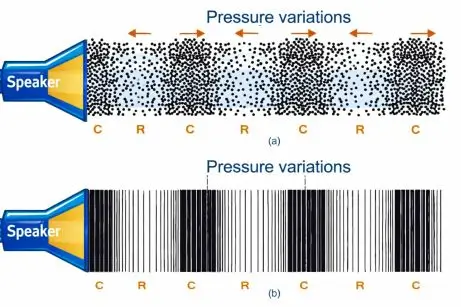
When a source vibrates in air, it sets the surrounding air particles into vibration, producing a longitudinal wave. The process occurs as follows: When the vibrating source moves forward, it pushes the nearby air particles closer together, creating a region of high pressure and high density called a compression.
- When the source moves backward, it leaves behind a region of low pressure and low density called a rarefaction.
- These compressions and rarefactions are formed alternately and travel outward through the air.
- The air particles do not move forward with the wave; instead, they vibrate to and fro about their mean positions in the direction of wave propagation.
- The transfer of energy from one particle to the next causes the sound wave to travel through air.
Thus, a sound wave in air is a longitudinal wave consisting of compressions and rarefactions.
Question 2
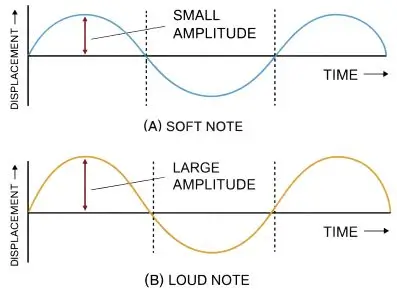
How does the wave pattern of a loud note differ from a soft note? Draw a diagram.
Answer:
Loudness is the characteristic by which a loud sound can be distinguished from a faint sound, even when both have the same pitch and quality.
The figure below shows the difference between the wave patterns of a loud note and a soft note.
Question 3
Name and define the characteristic which enables one to distinguish two sounds of same loudness, but of different frequencies, given by the same instrument.
Answer:
The characteristic which enables one to distinguish two sounds of the same loudness, but of different frequencies, is Pitch.
Definition:
Pitch is the characteristic of sound that enables us to distinguish between two sounds of the same loudness produced by the same instrument, but having different frequencies.
A sound with higher frequency has higher pitch, and a sound with lower frequency has lower pitch.
Question 4
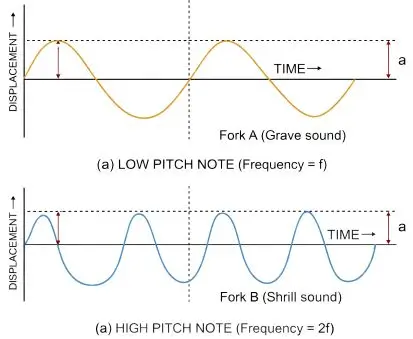
Draw a diagram to show the wave pattern of a high pitch note and a low pitch note, but of the same loudness.
Answer:
The diagram below shows the wave patterns of a high-pitch note and a low-pitch note, both having the same loudness.
(D) Think and Answer
Question 1
Standing at a distance, how is it possible to detect the filling of a bucket under a water tap by hearing the sound?
Answer:
When the bucket is empty, the water from the tap strikes the hard bottom of the bucket and produces a loud sound. As the bucket gradually fills, the water falls on the water surface, which absorbs the sound energy. Hence, the sound becomes feeble. By noticing this gradual decrease in loudness, one can detect from a distance that the bucket is being filled.
Question 2
The frequencies of notes given by flute, guitar and trumpet are respectively 400 Hz, 200 Hz and 500 Hz. Which one of these has the highest pitch?
Answer:
Pitch depends on the frequency of a sound; higher the frequency, higher is the pitch.
Among the given frequencies—flute (400 Hz), guitar (200 Hz), and trumpet (500 Hz)—the trumpet has the highest frequency.
Therefore, the trumpet has the highest pitch.
Question 3
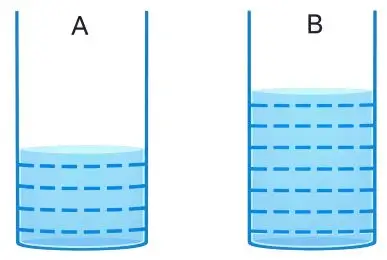
Figure shows two jars A and B containing water up to different heights. Which will produce sound of higher pitch when air is blown in them?
Answer:
Jar A will produce a sound of higher pitch.
Reason:
When air is blown into the jars, the pitch of sound depends on the length of the air column. Jar A has less water, so the air column is longer, which vibrates with a higher frequency. Hence, Jar A produces a sound of higher pitch.
Question 4
Two identical guitars are played by two persons to give notes of the same pitch. Will they differ in quality? Give reason for your answer.
Answer:
No, the notes will not differ in quality.
Reason:
Quality (timbre) of a sound depends on the nature of the source and the waveform produced. Since both guitars are identical and give notes of the same pitch, they produce the same waveform. Hence, the quality of the sound will be the same.
Question 5
Two musical notes of the same pitch and same loudness are played on two different instruments. Their wave patterns are as shown in figure.
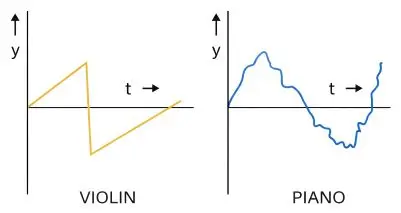
How do they differ in:
(a) Loudness
(b) Pitch and
(c) Quality?
Answer:
(a) Loudness will be the same for both instruments because both produce waves of the same amplitude.
(b) Pitch will be the same for both instruments since they have the same frequency.
(c) Quality will be different because the waveforms are different, as shown in the given wave patterns.
Question 6
Figure shows four waves A, B, C and D.
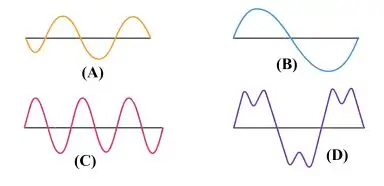
Name the wave which shows
(a) a note from a musical instrument,
(b) a soft note,
(c) a shrill note
Answer:
(a) A note from a musical instrument: Wave (D)
Reason: A musical note has a complex but periodic waveform due to the presence of overtones.
(b) A soft note: Wave A
Reason: Loudness depends on amplitude. Wave I has the smallest amplitude, hence it represents a soft note.
(c) A shrill note: Wave (C)
Reason: Shrillness (high pitch) depends on frequency. Wave III has the highest frequency, so it is the most shrill.
Question 7
What happens when a lighted candle is placed in front of a loudspeaker making a loud and steady noise. Give reason.
Answer:
When a lighted candle is placed in front of a loudspeaker producing a loud and steady sound, the flame of the candle flickers.
Reason:
Sound waves consist of compressions and rarefactions of air. These cause rapid variations in air pressure near the flame, disturbing it continuously. As a result, the candle flame flickers in rhythm with the sound vibrations.
(E) Numericals
Question 1
Two waves of the same pitch have amplitudes in the ratio 1:3. What will be the ratio of their:
(i) Loudness
(ii) pitch?
Answer:
(i) Loudness:
Loudness is proportional to the square of the amplitude.
Given that the amplitudes are in the ratio 1 : 3,
Loudness ratio =(1)2 : (3)2 = 1 : 9
(ii) Pitch:
Pitch depends on the frequency of the sound and is independent of amplitude.
Since both waves have the same pitch, their frequencies are equal.
Therefore, Pitch of first wave : Pitch of second wave = 1 : 1
Question 2
Two waves have frequencies 256 Hz and 512 Hz, but same amplitude. Compare their:
(i) loudness, and
(ii) pitch.
Answer:
(i) Loudness:
Since the amplitudes of the two waves are the same, their loudness is also the same.
Hence, the ratio of their loudness is 1 : 1.
(ii) Pitch:
Pitch depends on frequency.
The ratio of the frequencies is 256 Hz : 512 Hz = 1 : 2.
Therefore, the ratio of their pitch is 1 : 2.
Question 3
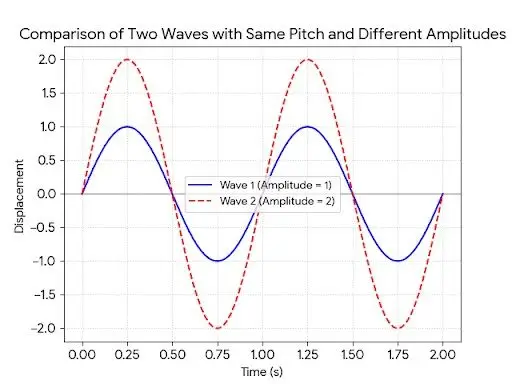
Two waves have the same pitch but their amplitudes are in the ratio of 1 : 2. Draw a figure to show the two waves.
Answer:
The figure below shows two waves having the same pitch but different amplitudes in the ratio 1 : 2.
Question 4
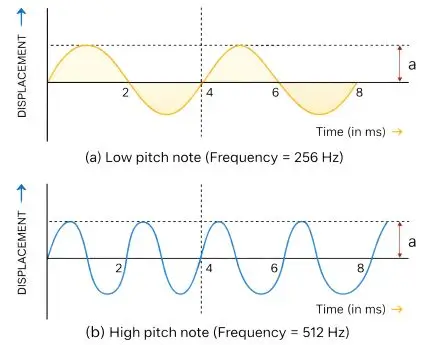
Two waves of the same amplitude have frequencies 256 Hz and 512 Hz respectively. Represent the two waves in the graphical form.
Answer:
The two waves with frequencies 256 Hz and 512 Hz are represented in graphical form below :
ICSE Class 8 Physics Sound Selina Solutions PDF Download
Students can also download the chapter solutions PDF for offline study and revision anytime.
Why Use Selina Solutions?
Selina textbook solutions are very helpful because they provide:
- Accurate answers as per ICSE board pattern
- Easy explanations for quick learning
- Stepwise numerical solutions
- Better understanding of important concepts
- Helpful revision before exams
Benefits for Students
By using these ICSE Class 8 Physics Chapter 7 Sound Selina Solutions, students can improve concept clarity and score higher marks in school examinations.
Conclusion
If you want the best study material for ICSE Class 8 Physics Chapter 7 Sound Selina Solutions, this page will help you with complete answers, explanations, and exam-ready content. Practice regularly to master the chapter easily.
ICSE Class 8 Physics Selina Solutions
The Selina Concise Physics Class 8 book includes the following chapters:
Official Website:
Students can visit the official CISCE website for more details and updates.