ICSE Class 10 Physics Selina Solutions – Chapter 7: Sound Exercise 7(A)
Preparing for the ICSE Class 10 Physics examination? You are in the right place. This page provides ICSE Class 10 Physics Chapter 7: Sound Exercise 7(A) – Selina Solutions with accurate, step-by-step answers written in simple language. These solutions are designed according to the latest ICSE syllabus and exam pattern, helping students understand every concept with ease.
Exercise 7(A) covers the fundamental concepts of sound, including the production of sound, longitudinal waves, frequency, time period, amplitude, wavelength, pitch, loudness, quality (timbre), resonance, and the speed of sound. A clear understanding of these topics is essential for solving both theory and numerical questions in the ICSE Board examination.
All answers on this page are explained in a student-friendly manner to strengthen conceptual understanding instead of encouraging rote learning. Whether you are completing your homework, revising before exams, or preparing for school tests, these Selina solutions will help you score better.
Study Support by Rohit Academy
Rohit Academy offers expert-curated ICSE Class 10 Physics Study Materials including ICSE Sound Selina Solutions, diagrams, and key formulas for better understanding.
Study materials related to chapter 7: Sound
To help you prepare the entire chapter thoroughly, explore the following study resources related to Chapter 7 Sound:
(A) Multiple Choice Type
(Choose the correct answer from the options given below).
Question 1
With respect to sound waves, which of the following statements are correct ?
(1) The maximum displacement of a particle on either side of its mean position is called the amplitude of the wave.
(2) Time taken by the particle of a medium to complete one vibration is called the time period.
(3) The number of vibrations made by the particle of a medium in one second is called the frequency.
(4) The frequency of a wave is different than the frequency of the source producing it.
(a) 1 (b) 1, 2
(c) 1, 2, 3 (d) 1, 2, 3 and 4
Answer:
(c) 1, 2, 3
Explanation:
Statements (1), (2), and (3) correctly define amplitude, time period, and frequency. Statement (4) is incorrect because the frequency of a sound wave is the same as the frequency of its source.
Question 2
Various types of mechanical waves are :
(a) electromagnetic, longitudinal, transverse
(b) electromagnetic, transverse
(c) longitudinal, transverse
(d) electromagnetic, transverse
Answer:
(c) Longitudinal, transverse
Explanation:
Mechanical waves require a material medium and are of two types:
- Longitudinal waves (e.g., sound in air)
- Transverse waves (e.g., waves on a stretched string)
Electromagnetic waves are not mechanical waves.
Question 3
Due to vibrations of medium particles, the energy transformation is from :
(a) heat energy to kinetic energy and vice versa
(b) kinetic energy to potential energy and vice versa
(c) heat energy to potential energy and vice versa
(d) potential energy to nuclear energy and vice versa
Answer:
(b) Kinetic energy to potential energy and vice versa
Explanation:
As particles vibrate:
- At the mean position, kinetic energy is maximum.
- At the extreme positions, potential energy is maximum.
Thus, energy continuously changes between kinetic and potential forms.
Question 4
With the increase in temperature of a gas, the speed of sound:
(a) decreases (b) increases
(c) remains the same (d) cannot say
Answer:
(b) Increases
Explanation:
As the temperature of a gas increases, its molecules move faster, allowing sound to travel more quickly.
Question 5
The condition for reflection of sound wave is :
(a) surface must be smooth
(b) surface must be polished
(c) reflecting surface must be bigger than the wavelength of the sound wave
(d) reflecting surface must be smaller than the wavelength of the sound wave
Answer:
(c) Reflecting surface must be bigger than the wavelength of the sound wave
Explanation:
For proper reflection, the reflecting surface should be large compared to the wavelength of the sound wave.
Question 6
Time taken to hear the echo if distance between the listener and the obstacle d is given by :
(a) t = d×V (b) t = 2d×V
(c) t = V/2d (d) t = 2d/V
Answer:
(d) t = 2d/V
Explanation:
The sound travels to the obstacle and back.
- Total distance = 2d
- Speed = V
Therefore, t = 2d/V
Question 7
To detect the obstacles in their path, bats produce:
(a) infrasonic waves (b) ultrasonic waves
(c) electromagnetic waves (d) radio waves
Answer:
(b) Ultrasonic waves
Explanation:
Bats use ultrasonic waves (frequency above 20,000 Hz) and detect the reflected sound (echo) to locate obstacles and prey.
Question 8
With respect to ultrasonic waves, which of the following statements is incorrect ?
(a) they travel undeviated through a long distance
(b) they have a speed greater than the speed of sound in a medium
(c) they are not easily absorbed in a medium
(d) they can be confined to a narrow beam
Answer:
(b) They have a speed greater than the speed of sound in a medium
Explanation:
Ultrasonic waves are sound waves, so they travel at the same speed as ordinary sound in the same medium. They differ only in frequency, not speed.
Question 9
Infrasonic sound waves have a frequency :
(a) between 20 Hz to 10,000 Hz
(b) below 20 Hz
(c) above 20,000 Hz
(d) between 20 Hz to 20,000 Hz
Answer:
(b) Below 20 Hz
Explanation:
- Infrasonic: Below 20 Hz
- Audible: 20 Hz – 20,000 Hz
- Ultrasonic: Above 20,000 Hz
Question 10
The diagram shown below depicts a displacement time graph of particle a wave travelling with speed 20 m/s.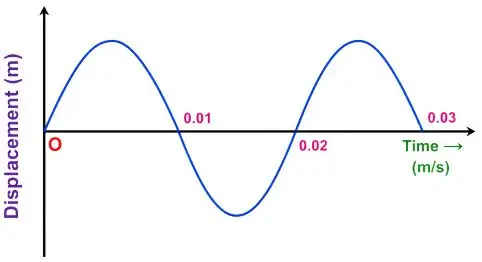
The frequency of the wave is :
(a) 50 Hz (b) 33.3 Hz
(c) 100 Hz (d) 1000 Hz
Answer:
(a) 50 Hz
Explanation:
From the graph, the particle completes one full vibration in 0.02 s.
Therefore,
Time Period (T) = 0.02 S
Using the formula,
Frequency (f)
50 Hz
The given speed of 20 m/s is not required to calculate the frequency from a displacement–time graph.
Question 11
A girl claps in a classroom but is unable to hear an echo. Which option best explains the reason for the same ?
(a) There is no reflection of sound from the walls.
(b) Sound waves are completely absorbed by the walls.
(c) Echo returns in less than 0.1 s.
(d) Echoes require sounds of ultrasonic frequency.
Answer:
(c) Echo returns in less than 0.1 s.
Explanation:
The human ear can distinguish an echo only if the reflected sound is heard at least 0.1 s after the original sound. In a classroom, the walls are too close, so the reflected sound returns in less than 0.1 s and merges with the original sound.
Question 12
In ancient India, dome shaped courts were built in forts to allow even the faintest of sounds to be heard from far away. Which statement best explains this effect?
(a) Dome increases the frequency of the sound so it becomes louder.
(b) Dome absorbs high frequency sound and re-emits it at a high amplitude.
(c) Dome focuses the reflected sound and multiple reflected waves reinforce at listener’s position.
(d) Dome traps air thereby increasing air pressure resulting in amplification of sound.
Answer:
Dome focuses the reflected sound and multiple reflected waves reinforce at listener’s position.
Explanation:
A dome-shaped roof reflects and focuses sound waves toward specific points. Multiple reflected sound waves combine (reinforce), making even a faint sound clearly audible over a long distance.
Question 13
Assertion (A): Sound waves can travel in vacuum, but light waves cannot.
Reason (R): Light is an electromagnetic wave, but sound is a mechanical wave.
(a) both A and R are true and R is the correct explanation of A
(b) both A and R are true and R is not the correct explanation of A
(c) assertion is false but reason is true.
(d) assertion is true but reason is false.
Answer:
(c) Assertion is false but Reason is true.
Explanation:
- Assertion: False. Sound cannot travel in a vacuum, whereas light can.
- Reason: True. Light is an electromagnetic wave and does not require a medium, while sound is a mechanical wave and requires a material medium.
Question 14
Assertion (A): The speed of sound in a gas increases with an increase in humidity.
Reason (R): Density of a gas decreases with increase in humidity.
(a) both A and R are true and R is the correct explanation of A
(b) both A and R are true and R is not the correct explanation of A
(c) assertion is false but reason is true.
(d) assertion is true but reason is false.
Answer:
(a) Both A and R are true and R is the correct explanation of A.
Explanation:
Humid air contains more water vapour, which is lighter than the nitrogen and oxygen it replaces. This reduces the density of air, allowing sound to travel faster. Therefore, both the assertion and the reason are true, and the reason correctly explains the assertion.
Question 15
Assertion (A): The flash of lightening is seen before the sound of thunder is heard.
Reason (R): The speed of sound is greater than the speed of light.
(a) both A and R are true and R is the correct explanation of A
(b) both A and R are true and R is not the correct explanation of A
(c) assertion is false but reason is true.
(d) assertion is true but reason is false.
Answer:
(d) Assertion is true but Reason is false.
Explanation:
- Assertion: True. Light travels much faster than sound, so we see the lightning before hearing the thunder.
- Reason: False. The speed of light is much greater than the speed of sound.
(B) Very Short Questions
Question 1
State two factors on which the speed of a wave travelling in a medium depends.
Answer:
The speed of a wave depends on:
- The nature (elasticity) of the medium.
- The density of the medium.
(C) Short Questions
Question 1
What are mechanical waves?
Answer:
Mechanical waves are waves that require a material medium for their propagation. They cannot travel through a vacuum.
Question 2
Define the following terms in relation to a wave:-
(a) amplitude,
(b) frequency,
(c) wavelength, and
(d) wave velocity.
Answer:
(a) Amplitude:
The maximum displacement of a particle from its mean position.
(b) Frequency:
The number of vibrations made by a particle in one second.
(c) Wavelength:
The distance between two successive compressions or rarefactions (or two consecutive crests or troughs).
(d) Wave velocity:
The distance travelled by a wave in one second.
Question 3
A wave passes from one medium to another medium. Mention one property of the wave out of speed, frequency or wavelength (i) which changes, (ii) which does not change.
Answer:
(i) Which changes: Speed (or wavelength)
(ii) Which does not change: Frequency
Question 4
State two differences between the light and sound waves.
Answer:
| Light Waves | Sound Waves |
| Light waves are transverse. | Sound waves are longitudinal. |
| Light can travel through vacuum. | Sound cannot travel through vacuum. |
Question 5
What do you mean by reflection of sound? State one condition for the reflection of a sound wave. Name a device in which reflection of a sound wave is used.
Answer:
- Reflection of sound is the bouncing back of sound waves after striking a surface.
- Condition: The reflecting surface should be larger than the wavelength of the sound.
- Device: Megaphone (or Sound Board).
Question 6
What is meant by an echo? State two conditions necessary for an echo to be heard distinctly.
Answer:
Echo: An echo is the repetition of sound heard after reflection from a distant surface.
Conditions for Hearing an Echo:
- Distance between listener and reflector should be at least 17 m in air.
- Reflecting surface should be large.
Question 7
A man is standing at a distance of 12 m from a cliff. Will he be able to hear a clear echo of his sound ? Give a reason for your answer.
Answer:
No. A clear echo cannot be heard because the cliff is only 12 m away. The reflected sound returns in less than 0.1 s, so it merges with the original sound.
Question 8
State two applications of echo.
Answer:
- Measuring the depth of the sea (SONAR).
- Locating underwater objects such as submarines and rocks.
Question 9
Explain how the speed of sound can be determined by the method of echo.
Answer:
Measure the distance d between the observer and the reflecting surface and the time t taken to hear the echo.
Since the sound travels a distance 2d,
Speed of sound
Question 10
State the use of echo by a bat, dolphin and fisherman.
Answer:
- Bat: To avoid obstacles and locate prey.
- Dolphin: To locate food and navigate underwater.
- Fisherman: To locate shoals of fish using SONAR.
Question 11
How do bats avoid obstacles in their way, when in flight?
Answer:
Bats emit ultrasonic waves. They receive the reflected waves (echoes) from nearby objects and determine their position, enabling them to avoid obstacles.
Question 12
What is meant by sound ranging? Give one use of sound ranging.
Answer:
Sound ranging is the technique of locating or measuring the distance of an object using reflected sound waves.
Use: Measuring the depth of the sea.
Question 13
Name the waves used for sound ranging. State one reason for their use. Why are the waves mentioned by you not audible to us?
Answer:
Ultrasonic waves are used for sound ranging because they can travel long distances in a narrow, undeviated beam and produce clear echoes. The frequency range of audible sound is 20 Hz to 20,000 Hz, whereas ultrasonic waves have a frequency greater than 20,000 Hz. Therefore, ultrasonic waves are inaudible to the human ear.
Question 14
What is ‘SONAR’? State the principle on which it is based.
Answer:
- SONAR (Sound Navigation And Ranging) is a device used to detect and locate underwater objects and measure sea depth.
- Principle: It works on the reflection (echo) of ultrasonic waves.
Question 15
State the use of echo in medical field.
Answer:
Echoes of ultrasonic waves are used in ultrasonography (ultrasound scanning) to obtain images of internal organs and to monitor the development of a foetus during pregnancy.
(D) Numericals
Question 1
The wavelength of waves produced on the surface of water is 20 cm. If the wave velocity is 24 m s–1, calculate : (i) the number of waves produced in one second, and (ii) the time in which one wave is produced.
Solution:
Given:
- Wavelength, λ = 20 cm = 0.20 m
- Wave velocity, v = 24 m s–1
(i) Using the formula:
Wave velocity = Frequency × Wavelength
v = fλ
Substituting the given values:
24 = f × 0.20
f = 24 / 0.20
f = 120 s–1
∴ Number of waves produced in one second = 120
(ii) Time period:
T = 0.0083 s
∴ Time taken to produce one wave = 0.0083 s
Question 2
Calculate the minimum distance in air required between the source of sound and the obstacle to hear an echo.
Take speed of sound in air = 350 m s–1.
Solution:
Given:
- Speed of sound in air, v = 350 m s–1
- Minimum time interval for hearing an echo, t = 0.1 s
Using the formula:
Substituting the given values:
Therefore, the minimum distance is 17.5 m.
Question 3
What should be the minimum distance between the source and reflector in water so that the echo is heard distinctly?
(The speed of sound in water = 1400 m s–1).
Solution:
Given:
- Speed of sound in water, v = 1400 m s–1
- Time interval, t = 0.1 s
Using the formula:
Substituting the given values:
Therefore, the minimum distance between the source and reflector is 70 m.
Question 4
A man standing 25 m away from a wall produces a sound and receives the reflected sound. (a) Calculate the time after which he receives the reflected sound if the speed of sound in air is 350 m s–1. (b) Will he be able to hear a distinct echo? Explain the answer.
Solution:
(a) Given:
- Distance from wall, d = 25 m
- Speed of sound, v = 350 m s–1
Using the formula:
Substituting the given values:
Therefore, the reflected sound is heard after 0.143 s.
(b) Since the time interval is 0.143 s, which is greater than 0.1 s, a distinct echo will be heard.
Therefore, the answer is Yes.
Question 5
A RADAR sends a signal with a speed of 3 x 10⁸ m s–1 to an aeroplane at a distance 300 km from it. After how much time is the signal received back after reflecting from the aeroplane?
Solution:
Given:
- Distance of aeroplane, d = 300 km = 300 × 1000 m = 3 × 10⁵ m
- Speed of radar signal, v = 3 × 10⁸ m s–1
Using the formula:
Substituting the given values:
Therefore, the signal is received back after = 2 × 10⁻³ s.
Question 6
A man standing 48 m away from a wall fires a gun. Calculate the time after which an echo is heard. (The speed of sound in air is 320 m s–1).
Solution:
Given:
- Distance from wall, d = 48 m
- Speed of sound, v = 320 m s–1
Using the formula:
Substituting the given values:
Therefore, the echo is heard after 0.3 s.
Question 7
A ship on the surface of water sends a signal and receives it back from a submarine inside water after 4 s. Calculate the distance of the submarine from the ship. (The speed of sound in water is 1450 m s–1).
Solution:
Given:
- Time interval, t = 4 s
- Speed of sound in water, v = 1450 m s–1
Using the formula:
Substituting the given values:
Therefore, the submarine is 2900 m away from the ship.
Question 8
A pendulum has a frequency of 5 vibrations per second. An observer starts the pendulum and fires a gun simultaneously. He hears echo from the cliff after 8 vibrations of the pendulum. If the velocity of sound in air is 340 m s–1, find the distance between the cliff and the observer.
Solution:
Given:
- Frequency, f = 5 Hz
- Number of vibrations = 8
- Speed of sound, v = 340 m s–1
Time period:
Time taken for 8 vibrations:
⇒ t = 8 × 0.2
⇒ t = 1.6 s
Using the formula:
Therefore, the distance between the observer and the cliff is 272 m.
Question 9
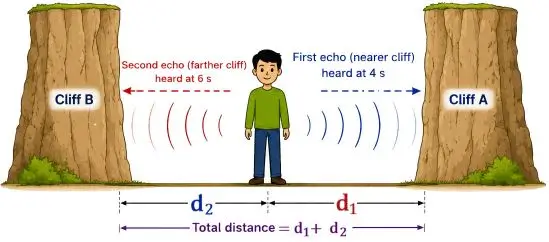
A person standing between two vertical cliffs produces a sound. Two successive echoes are heard at 4s and 6s. Calculate the distance between the cliffs.
(Speed of sound in air = 320 m s–1)
[HINT : First echo will be heard from the nearer cliff and the second echo from the farther cliff.]
Solution:
Given:
- Time for first echo, t1 = 4 s
- Time for second echo, t2 = 6 s
- Speed of sound, v = 320 m s–1
Using the formula:
Distance of nearer cliff:
Distance of farther cliff:
Distance between the cliffs:
Distance = d1 + d2 = 640 + 960 = 1600 m
Therefore, the distance between the two cliffs is 1600 m.
Question 10
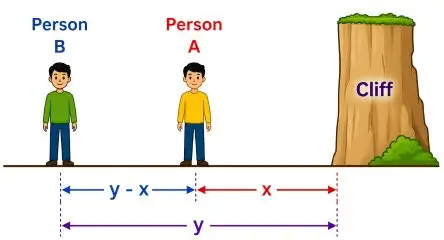
A person standing at a distance x in front of a cliff fires a gun. Another person B standing behind the person A at a distance y from the cliff hears two sounds of the fired shot after 2 s and 3 s respectively. Calculate x and y (take speed of sound 320 m s–1).
Solution:
Given:
- Speed of sound, v = 320 m s–1
- Time for first sound, t1 = 2 s
- Time for second sound, t2 = 3 s
Using the formula:
For the first sound:
Distance travelled = (y − x)
Substituting the given values:
⇒ y − x = 320 × 2
⇒ y − x = 640 m
Hence, y − x = 640 m ……. (1)
For the second sound:
Distance travelled = (y + x)
Substituting the given values:
⇒ y + x = 320 × 3
⇒ y + x = 960 m
Hence,
y + x = 960 m ……(2)
Adding equations (1) and (2):
⇒ y − x + y + x= 640 + 960
⇒ 2y = 1600
⇒ y
⇒ y = 800 m
Substituting the value of y in equation (1):
⇒ 800 − x = 640
⇒ x = 800 − 640
⇒ x = 160 m
Therefore, x = 160 m and y = 800 m.
Question 11
On sending an ultrasonic wave from a ship towards the bottom of a sea, the time interval between sending the wave and receiving it back is found to be 1.5 s. If the velocity of wave in sea water is 1400 m s–1, find the depth of sea.
Solution:
Given:
- Time interval, t = 1.5 s
- Speed of sound in sea water, v = 1400 m s–1
Using the formula:
Substituting the given values:
Therefore, the depth of the sea is 1050 m.
Question 12
Figure below shows the distance-displacement graph of two waves A and B. Compare (i) the amplitude, (ii) the wavelength of the two waves.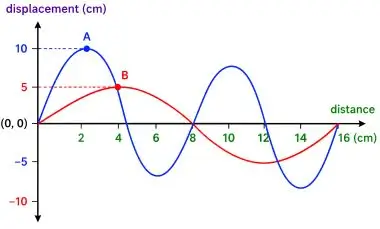
Solution:
(i) From the graph:
- Amplitude of wave A = 10 cm
- Amplitude of wave B = 5 cm
Ratio of amplitudes:
Amplitude of A : Amplitude of B
= 10 : 5
= 2 : 1
Therefore, the ratio of the two amplitudes is 2 : 1.
(ii) From the graph:
- Wavelength of wave A, λ1 = 8 cm
- Wavelength of wave B, λ2 = 16 cm
Ratio of wavelengths:
Wavelength of A : Wavelength of B
= 8 : 16
= 1 : 2
Therefore, the ratio of the two wavelengths is 1 : 2.
Download Selina Solutions for ICSE Class 10 Physics Exercise 7(A) – Sound
You can download free PDF solutions for Selina Class 10 Physics Exercise 7(A) to revise offline. These solutions are exam-ready and designed by subject experts.
Why Study These Selina Solutions?
- Prepared according to the latest ICSE syllabus.
- Step-by-step answers in simple and easy language.
- Accurate explanations based on Selina Concise Physics.
- Useful for school exams, unit tests, and ICSE Board examinations.
- Ideal for quick revision and last-minute preparation.
You can also visit:
ICSE Class 10 Physics Notes
| ☛ ICSE Class 10 Physics Chapter 1 – Force Notes |
| ☛ ICSE Class 10 Physics Chapter 2 – Work, Energy and Power Notes |
| ☛ ICSE Class 10 Physics Chapter 3 – Machines Notes |
| ☛ ICSE Class 10 Physics Chapter 4 – Refraction of Light at Plane Surfaces Notes |
| ☛ ICSE Class 10 Physics Chapter 5 – Refraction through Lens Notes |
| ☛ ICSE Class 10 Physics Chapter 6 – Spectrum Notes |
| ☛ ICSE Class 10 Physics Chapter 7 – Sound Notes |
| ☛ ICSE Class 10 Physics Chapter 8 – Current Electricity Notes |
| ☛ ICSE Class 10 Physics Chapter 9 – Electrical Power and Household Circuits Notes |
| ☛ ICSE Class 10 Physics Chapter 10 – Electro-magnetism Notes |
| ☛ ICSE Class 10 Physics Chapter 11 – Calorimetry Notes |
| ☛ ICSE Class 10 Physics Chapter 12 – Radioactivity Notes |
Official Website:
Students can visit the official CISCE website for more details and updates.