ICSE Class 10 Physics Selina Solutions – Chapter 6: Spectrum Exercise 6(C)
Welcome to Rohit Academy. Here you will find ICSE Class 10 Physics Chapter 6: Spectrum Exercise 6(C) Selina Solutions prepared according to the latest ICSE syllabus. The solutions are written in simple language with detailed explanations to help students understand concepts, revise effectively, and perform well in school and board examinations.
About Exercise 6(C)
Exercise 6(C) is the final exercise of the Spectrum chapter and includes numerical problems, conceptual questions, reasoning-based questions, and applications of light and the electromagnetic spectrum. It tests students’ understanding of wavelength, frequency, speed of light, and the practical uses of different electromagnetic waves.
Regular practice of this exercise strengthens problem-solving skills and improves confidence for the ICSE Board Examination.
Study Support by Rohit Academy
Rohit Academy offers expert-curated ICSE Class 10 Physics Study Materials including ICSE Spectrum Selina Solutions, diagrams, and key formulas for better understanding.
Study materials related to chapter 6: Spectrum
(A) Multiple Choice Type
(Choose the correct answer from the options given below).
Question 1
The intensity of scattered light is related to its wavelength as :
(a) \(I\ \propto\ \lambda^4\)
(b) \(I\ \propto\ \lambda^2\)
(c) \(I\ \propto\ 1/\lambda^4\)
(d) \(I\ \propto\ 1/\lambda^2\)
Answer:
(c) \(I\ \propto\ 1/\lambda^4\)
Explanation:
Intensity of scattered light is found to be inversely proportional to the fourth power of the wavelength of light.
(i.e., \(I\ \propto\ 1/\lambda^4\)).
Question 2
In the white light of Sun, maximum scattering by the air molecules present in the earth’s atmosphere is for :
(a) red colour
(b) yellow colour
(c) green colour
(d) blue colour
Answer:
(d) blue colour
Explanation:
Among the options, blue has the shortest wavelength, so it scatters the most in air.
Question 3
Violet light is scattered nearly …………… times more than the red light.
(a) 4
(b) 8
(c) 16
(d) 9
Answer:
(c) 16
Explanation:
According to Rayleigh scattering, the amount of scattering is inversely proportional to the fourth power of the wavelength of the light.
We know,
\(\lambda_{violet}=4000\ Å\) and \(\lambda_{red}=8000\ Å\)
According to Rayleigh scattering,
\(\frac{Intensity\ of\ scattering\ of\ violet}{Intensity\ of\ scattering\ of\ red}=\left(\frac{\lambda_{red}}{\lambda_{violet}}\right)^4\)
So,
\(\frac{Intensity\ of\ scattering\ of\ violet}{Intensity\ of\ scattering\ of\ red}=\left(\frac{8000}{4000}\right)^4=2^4=16\)
Hence, Intensity of scattering of violet = 16 time Intensity of scattering of red.
Question 4
To an astronaut in a space-ship, the earth appears :
(a) White
(b) Red
(c) Blue
(d) Black
Answer:
(c) blue
Explanation:
When an astronaut travels beyond Earth’s atmosphere in a rocket, the sky appears black, but the Earth looks blue due to the scattering of sunlight’s blue wavelengths by the atmosphere reaching the astronaut.
Question 5
The danger signal is red because its wavelength is the …………… and therefore it gets ………… the least.
(a) least, deviated
(b) longest, scattered
(c) longest, dispersed
(d) least, scattered
Answer:
(b) longest, scattered
Explanation:
Red light has the longest wavelength of all visible colours. According to Rayleigh’s law, scattering is inversely proportional to the fourth power of wavelength . So, longer wavelengths scatter the least. That is why red light can travel farther through fog, rain, or dust, making it the safest choice for danger and warning signals.
Question 6
During the day the sky appears blue, while during sunset it appears reddish. Which reason correctly explain this phenomenon?
(a) Blue light has higher wavelength, so it gets scattered more during the day.
(b) Blue light has shorter wavelength, so it gets scattered more during the day.
(c) Scattering depends only on the intensity and not on the wavelength of the light.
(d) Red light has shorter wavelength, so it gets scattered more at sunset.
Answer:
(b) Blue light has shorter wavelength, so it gets scattered more during the day.
Explanation:
Blue light has a shorter wavelength, so it is scattered more by the atmosphere. At sunset, most blue light is scattered away, making the sky appear reddish.
Question 7
Vehicles use yellow fog lights instead of white while driving in foggy conditions. The correct reason for this is:-
(a) White light is absorbed completely by water droplets.
(b) Yellow light has a shorter wavelength so it scatters more.
(c) Yellow light has a longer wavelength, so it scatters less in fog and penetrates farther.
(d) Yellow light has all seven colours in it.
Answer:
(c) Yellow light has a longer wavelength, so it scatters less in fog and penetrates farther.
Explanation:
Yellow light has a longer wavelength, so it is scattered less by fog and can travel farther, giving better visibility.
(B) Very Short Questions
Question 1
When sunlight enters the earth’s atmosphere, state which colour of light is scattered (i) the most, and (ii) the least.
Answer:
(i) Violet is scattered the most.
(ii) Red is scattered the least.
Question 2
A beam of blue, green and yellow light passes through the the earth’s atmosphere. Name the colour which is scattered (a) the least, (b) the most.
Answer:
(a) Yellow light is scattered the least as it has the highest wavelength.
(b) Blue light is scattered the most as it has the lowest wavelength.
(C) Short Questions
Question 1
What is meant by scattering of light?
Answer:
Scattering is the process of absorption and then re-emission of light energy by the dust particles and air molecules present in the atmosphere.
Question 2
How does the intensity of scattered light depend on the wavelength of incident light? State the condition when this dependence hold.
Answer:
The intensity of scattered light is inversely proportional to the fourth power of the wavelength of the incident light, i.e. \(I\ \propto\ 1/\lambda^4\).
This means shorter wavelengths (like blue) are scattered much more strongly than longer wavelengths (like red).
Condition: This relation holds when the scattering particles are much smaller than the wavelength of light (Rayleigh scattering), such as air molecules in the atmosphere.
Question 3
Which colour of white light is scattered the least? Give reason.
Answer:
Red light is scattered the least because it has the longest wavelength among the visible colours. Since scattering is inversely proportional to the fourth power of wavelength (\(I\ \propto\ 1/\lambda^4\)), longer wavelengths scatter much less than shorter ones.
Question 4
The danger signal is red. Why?
Answer:
Red is scattered the least, so it travels farther and remains visible through fog, dust and rain.
Question 5
How would the sky appear when seen from the space (or moon)? Give reason for your answer.
Answer:
Black, because there is no atmosphere there to scatter sunlight.
Question 6
What characteristic property of light is responsible for the blue colour of the sky?
Answer:
The characteristic property of light responsible for the blue colour of sky is scattering.
Question 7
The colour of the sky, in direction other than of the Sun is blue. Explain.
Answer:
Blue (or violet) light, having a shorter wavelength, is scattered much more than red light, which has a longer wavelength. As a result, the light that comes directly from the Sun is rich in red, while the scattered light coming from all other directions is mostly blue. That is why the sky, away from the Sun, appears blue.
Question 8
Why does the Sun appear red at sunrise and sunset?
Answer:
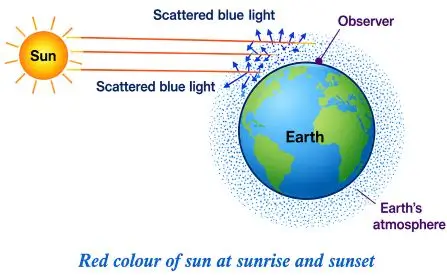
As sunlight travels a longer path through the atmosphere, most of the blue and green light gets scattered away. What finally reaches our eyes is mainly red and orange light.
As a result, the Sun and the region near by it, is seen red.
Question 9
The sky at noon appears white. Give reason.
Answer:
At noon, the Sun is directly above our head, so we get the light rays directly from the Sun after travelling the shortest distance, without much scattering of any particular colour. Hence, the sky is seen white.
Question 10
The clouds are seen white. Explain.
Answer:
Cloud droplets are much larger than the wavelength of light, so they scatter all colours nearly equally, which looks white.
Question 11
Give reason why the smoke from a fire looks white.
Answer:
The smoke from a fire looks white because its particles are larger than the wavelength of light. Such particles scatter all colours equally, and the combined effect of this scattering makes the smoke appear white.
Download Selina Solutions for ICSE Class 10 Physics Exercise 6(C) – Spectrum
Download ICSE Class 10 Physics Selina Solutions Chapter 6 Spectrum Exercise 6(C) PDF and practice offline.
Why Choose Rohit Academy Selina Solutions?
Our solutions are designed to help students:
- Understand difficult concepts easily.
- Solve numerical problems step by step.
- Learn accurate board-standard answers.
- Revise important formulas and definitions.
- Score higher marks in the ICSE Physics examination.
Features of These Solutions
- Fully updated according to the latest ICSE syllabus
- Step-by-step solutions for every question
- Simple and easy-to-understand explanations
- Board exam-oriented answers
- Helpful diagrams wherever required
- Ideal for quick revision
- Suitable for self-study and homework
Tips to Score High Marks in Exercise 6(C)
- Memorize the order of the electromagnetic spectrum.
- Learn the uses of different electromagnetic waves.
- Practice all numerical questions regularly.
- Revise important formulas related to wavelength and frequency.
- Solve previous years’ ICSE board questions for better preparation.
Conclusion
The ICSE Class 10 Physics Chapter 6: Spectrum Exercise 6(C) Selina Solutions by Rohit Academy provide accurate, easy-to-understand, and exam-focused answers for every question. By practising these solutions regularly, students can strengthen their conceptual knowledge, improve numerical problem-solving skills, and achieve excellent marks in the ICSE Board Examination.
You can also visit:
ICSE Class 10 Physics Notes:
| ☛ ICSE Class 10 Physics Chapter 1 – Force Notes |
| ☛ ICSE Class 10 Physics Chapter 2 – Work, Energy and Power Notes |
| ☛ ICSE Class 10 Physics Chapter 3 – Machines Notes |
| ☛ ICSE Class 10 Physics Chapter 4 – Refraction of Light at Plane Surfaces Notes |
| ☛ ICSE Class 10 Physics Chapter 5 – Refraction through Lens Notes |
| ☛ ICSE Class 10 Physics Chapter 6 – Spectrum Notes |
| ☛ ICSE Class 10 Physics Chapter 7 – Sound Notes |
| ☛ ICSE Class 10 Physics Chapter 8 – Current Electricity Notes |
| ☛ ICSE Class 10 Physics Chapter 9 – Electrical Power and Household Circuits Notes |
| ☛ ICSE Class 10 Physics Chapter 10 – Electro-magnetism Notes |
| ☛ ICSE Class 10 Physics Chapter 11 – Calorimetry Notes |
| ☛ ICSE Class 10 Physics Chapter 12 – Radioactivity Notes |
Official Website:
Students can visit the official CISCE website for more details and updates.