Introduction
Understanding Force is a vital part of ICSE Class 10 Physics. In this chapter, students learn about the nature, types, and effects of force in everyday life. This blog provides ICSE Class 10 Force Notes that include key concepts, formulas, solved numericals, and frequently asked questions. Let’s dive into the Force Chapter Class 10 ICSE in a simplified and exam-ready format.
Study Support by Rohit Academy
Rohit Academy offers expert-curated ICSE Class 10 Physics Study Materials including ICSE Force Chapter Notes, diagrams, and key formulas for better understanding.
Study materials related to chapter 1: Force
Section A : Moment of force and Equilibrium
Force
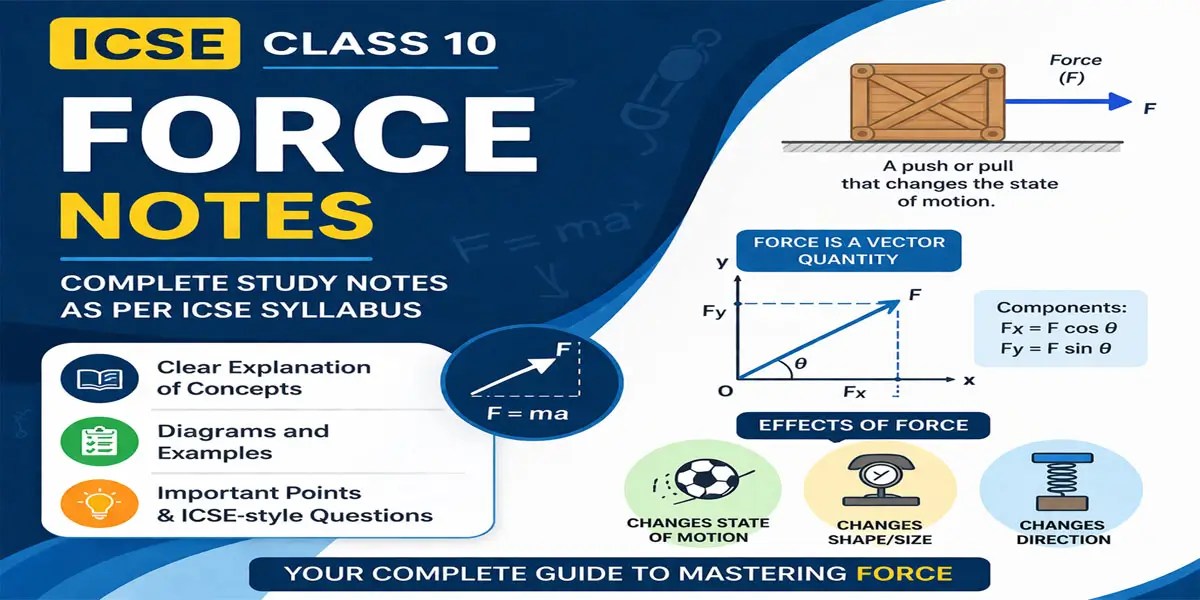
- Force is a push or pull that can change the state of motion of a body. It can also change the shape or size of a body.
- Force is a vector quantity.
- S.I. Unit : Newton (N).
- C.G.S. Unit : dyne
- Gravitational unit : gf or kgf;
Where, 1 kgf = 9.8 N.
Types of Motion
(a) Translational Motion:
When a body moves in a straight line under the action of force, it is called translational motion.
Example: Pushing a ball on the floor
(b) Rotational Motion:
When a body rotates about a fixed axis or pivot, it is called rotational motion.
Examples:
- Opening a door
- Rotating a wheel
- Turning a steering wheel
Moment of Force (Torque)
The moment of force is equal to the product of the magnitude of the force and the perpendicular distance of the force from the pivoted point.
Formula: Moment of Force = Force × Perpendicular Distance from Pivot
Symbol: M = F × d
Factors Affecting Turning Effect
- Magnitude of Force
Greater the force, greater the turning effect. - Perpendicular Distance from Pivot
Greater the distance from pivot, greater the turning effect.
Units of moment of force
- S.I. unit : Newton meter (Nm)
- C.G.S. unit : dyne cm
Relationship between the SI unit and CGS unit of moment of force
1 N = 105 dyne
1 m = 102 cm
1 N m = 105 dyne × 102 cm
1 N m = 107 dyne cm
Clockwise and Anticlockwise Moments
Clockwise Moment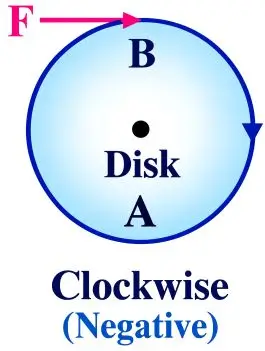
- If a force rotates a body in the clockwise direction, the moment produced is called a clockwise moment.
- Taken as negative (−).
- It produces inward motion.
Anticlockwise Moment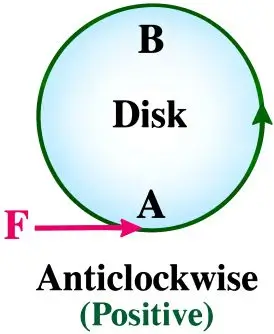
- If a force rotates a body in the anticlockwise direction, the moment produced is called an anticlockwise moment.
- Taken as positive (+).
- It produces outward motion.
Direction of rotation of a body can be changed by two ways:
- By changing the point of application of force.
- By changing the direction of force.
Common example of moment of force
- To open or shut a door, we apply the force at the free end of it because larger perpendicular distance, less force is needed to open or shut the door.
- A spanner (or wrench) has a long handle to produce larger turning moment so that nut can easily be turned with a less force.
- The stone of a hand flour grinder is provided with a handle near its rim so that a small force can rotate it easily about the central pivot.
- It is easier to turn a steering wheel of large diameter than a small one because the force acts at a greater distance from the centre, producing a larger turning effect.
- A potter turns his wheel by applying force through a stick near the rim of the wheel. Applying force near the rim increases the distance from the axis, giving a greater turning effect and making the wheel rotate easily.
- A jack screw used to lift a heavy vehicle is designed with a long arm so that it requires less force to rotate and raise or lower the vehicle.
***Note
- Larger the perpendicular distance, less the force required to produce the same turning effect.
- We can increase the moment of force by increasing the perpendicular distance of the force from the axis of rotation.
- We can reduce the moment of force by decreasing the perpendicular distance of the force from the axis of rotation.
Couple
- A couple is formed by two equal and opposite parallel forces acting along different lines.
- A couple produces rotation but not translation.
- Examples:
- Opening a car wheel nut with a wrench
- Turning steering wheel
- Tightening bottle cap
- Turning key in lock
Moment of Couple
- The moment of a couple is the product of either force and the perpendicular distance between the two forces.
- When two equal and opposite forces act on a body along different lines, the body undergoes rotational motion.
- Formula:
Moment of Couple = Force × Perpendicular Distance between the Forces
Units
- S.I. Unit: Newton metre (N m)
- C.G.S. Unit: Dyne centimetre (dyne cm)
Important Points
- Moment of a couple is a vector quantity.
- The direction of the moment is determined by the direction of rotation.
***Note
If a body is acted upon by two unequal forces in opposite directions and not along the same line, the body will show both:
- Rotational motion
- Translational motion
Equilibrium of Bodies
A body is said to be in equilibrium when:
- No change occurs in state of rest
- No change occurs in linear motion
- No change occurs in rotational motion
Conditions for Equilibrium
- Resultant force must be zero.
- Algebraic sum of moments must be zero.
Meaning:
Anticlockwise moments = Clockwise moments
Types of Equilibrium
(a) Static Equilibrium
- When a body remains at rest under several forces.
- Examples:
- Book lying on table
- Balanced beam balance
- Box pulled equally from opposite sides
(b) Dynamic Equilibrium
- When a body moves with constant velocity under balanced forces.
- Examples:
- Raindrop falling with constant speed
- Aeroplane moving at constant height
- Satellite moving around planet
- Stone whirled in circle at constant speed
Principle of Moments
When a body is in equilibrium, the sum of the clockwise moments about a pivot is equal to the sum of the anticlockwise moments about the same pivot.
Sum of clockwise moments = Sum of anticlockwise moments
Formula:
W1l1 = W2l2
Where:
- W1, W2 = Weights
- l 1, l2 = Distances from pivot
This principle is used in:
- Beam balance
- Seesaw
- Lever systems
Section B : Centre of gravity (CG)
What is Centre of Gravity (C.G.)?
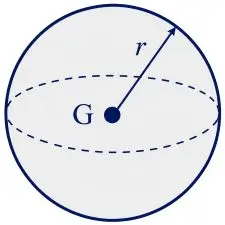
The Centre of Gravity (C.G.) of a body is the point where the entire weight of a body acts.
Definition:
The centre of gravity of a body is the point about which the algebraic sum of moments of all the particles of the body is zero.
Concept of Centre of Gravity
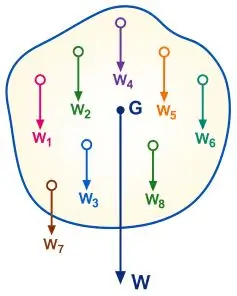
A body consists of many particles having weights:
W = w1 + w2 + w3 + …
Instead of considering all these weights separately, they can be replaced by one resultant force W acting at point G, called the Centre of Gravity.
Thus, the body behaves as if all its weight acts at point G.
Important Points about Centre of Gravity
1. Position depends on shape
The position of C.G. depends on:
- Shape of the body
- Distribution of mass
If the shape changes, the centre of gravity also changes.
Example:
- Straight wire → C.G. at midpoint
- Wire bent into a circle → C.G. at centre
2. C.G. may lie outside the body
The centre of gravity is not always inside the material of the body.
Examples:
- Circular ring → C.G. at centre of ring
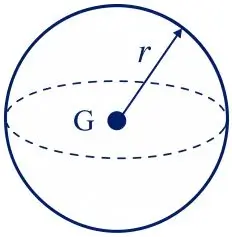
- Hollow sphere → C.G. at centre
Although no material exists there, C.G. lies at that point.
Centre of Gravity of Regular Objects
| Object | Position of C.G. | Figure |
| Rod | Midpoint of rod |
 |
| Circular ring | Centre of ring |
 |
| Circular disc | Geometrical centre |
 |
| Solid sphere | Centre of sphere |
 |
| Hollow sphere | Centre of sphere |
 |
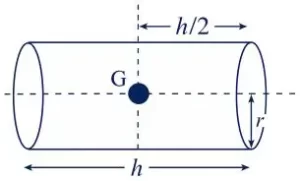
| Cylinder | Midpoint on axis |
 |
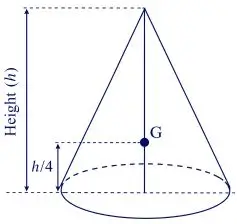
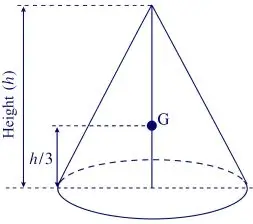
| Solid cone | h/4 from base |
 |
| Hollow cone | h/3 from base |
 |
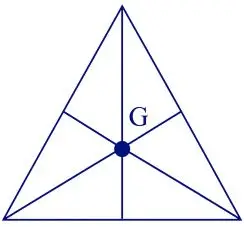
| Triangular lamina | Intersection of medians |
 |
| Rectangle | Intersection of diagonals |
 |
| Square | Intersection of diagonals |
 |
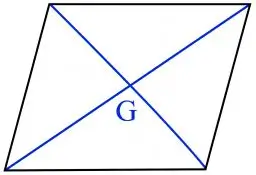
| Parallelogram | Intersection of diagonals |
 |
Section C : Uniform Circular Motion
Uniform Circular Motion
When an object moves in a circular path with constant speed, its motion is called uniform circular motion.
Important Points
- Speed remains constant.
- Direction of motion changes continuously.
- Velocity changes because direction changes.
- Therefore, the motion is accelerated motion.
Velocity in Uniform Circular Motion
The direction of velocity is always along the tangent to the circular path at that point.
Example:
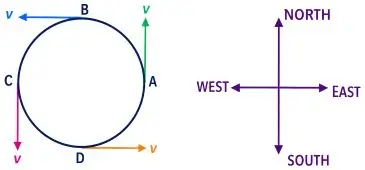
- At point A → velocity towards north
- At point B → velocity towards west
- At point C → velocity towards south
- At point D → velocity towards east
Thus, velocity changes continuously.
Difference Between Uniform Linear Motion and Uniform Circular Motion
| Uniform Linear Motion | Uniform Circular Motion |
| Speed and velocity remain constant | Speed remains constant but velocity changes |
| Acceleration is zero | Acceleration is present |
| Motion is unaccelerated | Motion is accelerated |
| Path is straight | Path is circular |
Centripetal Force
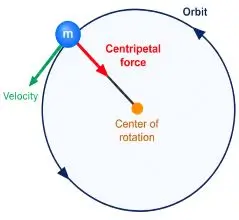
- A force acting on a body moving in a circular path towards the centre of the circle is called centripetal force.
- Centripetal force is the force required to keep an object moving in a circular path.
- The word centripetal means centre seeking.
Characteristics of Centripetal Force
- Acts towards the centre of the circle.
- Changes the direction of motion.
- Necessary for circular motion.
- Without it, the body moves in a straight line.
Formula:
Where:
- F = Centripetal force
- m = Mass of body
- v = Velocity
- r = Radius of circular path
Examples of Centripetal Force
1. Electron Revolving Around Nucleus
Electrostatic force between nucleus and electron provides centripetal force.
2. Planet Revolving Around Sun
Gravitational force of the Sun provides centripetal force.
3. Moon Revolving Around Earth
Earth’s gravitational force acts as centripetal force.
4. Stone Tied to a String
Tension in the string provides centripetal force.
Centrifugal Force
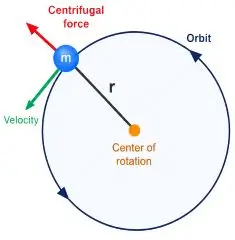
A force acting on a body away from the centre of a circular path is called centrifugal force.
Characteristics
- Acts opposite to centripetal force.
- Magnitude is equal to centripetal force.
- Direction is outward from the centre.
- It is not a real force.
- It is a fictitious (virtual) force.
Example:
- The children playing on a merry-go-round ride experience an outward force that tends to throw them on the outer side.
- Mud flying off the tyre.
Important Note
Centrifugal force is not the reaction force of centripetal force because action and reaction act on different bodies.
Difference Between Centripetal Force and Centrifugal Force
| Centripetal Force | Centrifugal Force |
| Centripetal force acts towards the centre of the circular path. | Centrifugal force acts away from the centre of the circular path. |
| It is a real force acting on the body. | It is a fictitious (virtual) force. |
| It keeps the body moving in a circular path. | It appears to push the body outward from the centre. |
Important Formulas for Class 10 ICSE Force
Students must memorize these formulas to solve numericals effectively.
- S.I. unit of force = \(Newton\ (N)\).
- \(1\ kgf\ =\ 9.8\ N\)
- S.I. unit of moment of couple is \(Newton\ meter\ (Nm)\).
- Torque \(=\ F\ \times\ ⊥ d\)
\(F_1\ \times\ d_1\ =\ F_2\ \times\ d_2\)
- \(1\ N\ =\ 10^5\ dyne\)
- \(1\ Nm\ =\ 10^7\ dyne\ cm\)
- \(Load\ \times\ Length\ of\ Load\ arm\ =\ Effort\ \times\ Length\ of\ Effort\ arm\)
- \(W_1\ \times\ l_1\ =\ W_2\ \times\ l_2\)
Download ICSE Class 10 Force Notes PDF
You can download simplified ICSE Physics Force Notes PDF including diagrams and key concepts for quick revision. These notes are useful for last-minute exam prep.
Tips to Master the Force Chapter
- Focus on conceptual clarity and diagrams.
- Practice numerical problems daily.
- Review all formulas and definitions regularly.
- Solve previous year ICSE Force Chapter Class 10 questions.
You can also visit:
ICSE Class 10 Physics Notes
| ☛ ICSE Class 10 Physics Chapter 1 – Force Notes |
| ☛ ICSE Class 10 Physics Chapter 2 – Work, Energy and Power Notes |
| ☛ ICSE Class 10 Physics Chapter 3 – Machines Notes |
| ☛ ICSE Class 10 Physics Chapter 4 – Refraction of Light at Plane Surfaces Notes |
| ☛ ICSE Class 10 Physics Chapter 5 – Refraction through Lens Notes |
| ☛ ICSE Class 10 Physics Chapter 6 – Spectrum Notes |
| ☛ ICSE Class 10 Physics Chapter 7 – Sound Notes |
| ☛ ICSE Class 10 Physics Chapter 8 – Current Electricity Notes |
| ☛ ICSE Class 10 Physics Chapter 9 – Electrical Power and Household Circuits Notes |
| ☛ ICSE Class 10 Physics Chapter 10 – Electro-magnetism Notes |
| ☛ ICSE Class 10 Physics Chapter 11 – Calorimetry Notes |
| ☛ ICSE Class 10 Physics Chapter 12 – Radioactivity Notes |
Official Website:
Students can visit the official CISCE website for more details and updates.