
Introduction
Preparing for the ICSE Class 10 Physics examination? These Chapter 7: Sound Notes are designed according to the latest ICSE syllabus and cover every important concept in a simple and student-friendly language. Whether you are revising before the examination or studying the chapter for the first time, these notes will help you understand the topic quickly and score better marks.
These notes include all important definitions, formulas, diagrams, numerical concepts, resonance, echo, SONAR, musical instruments, previous year questions, and board examination tips. You can also download the PDF for offline study and quick revision.
Why These Notes Are Useful
- Based on the latest ICSE syllabus
- Easy and simple explanations
- Exam-oriented content
- Important formulas and definitions
- Board-level numerical concepts
- Quick revision before exams
- Useful for Selina Concise Physics solutions
Study Support by Rohit Academy
Rohit Academy offers expert-curated ICSE Class 10 Physics Study Materials including ICSE Sound notes Solutions, diagrams, and key formulas for better understanding.
Study materials related to chapter 7: Sound
To help you prepare the entire chapter thoroughly, explore the following study resources related to Chapter 7: Sound:
Section (A) : Reflection of Sound Waves and Echoes
What is Sound?
Sound is a type of mechanical wave produced when an object vibrates. These vibrations are transferred through the particles of a medium such as air, water, or solids.
***Note:
When the medium particles vibrate, there is a change of kinetic energy into the potential energy and vice versa.
Important Points
- Sound requires a material medium for propagation.
- It cannot travel through a vacuum.
- Sound travels as longitudinal waves in gases and liquids.
- In solids, sound can travel as both longitudinal and transverse waves.
Audible and Inaudible Sound
The normal human ear can hear sounds having frequencies between 20 Hz and 20,000 Hz (20 kHz).
| Frequency | Type of Sound |
| Less than 20 Hz | Infrasonic |
| 20 Hz – 20,000 Hz | Audible |
| Above 20,000 Hz | Ultrasonic |
Examples:
- Elephants communicate using infrasonic waves.
- Bats and dolphins use ultrasonic waves.
Basic Terms of Sound Waves
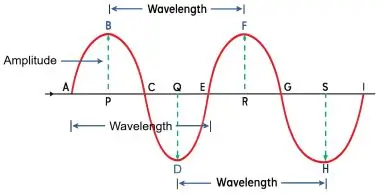
1. Amplitude (A)
- The maximum displacement of the particle from its mean position is called amplitude.
- SI unit: metre (m)
- Determines the loudness of sound
- Effect: Greater amplitude ⇒ Louder sound
2. Time Period (T)
- The time taken to complete one vibration is called time period.
- SI unit: second (s)
3. Frequency (f)
- The number of vibrations produced in one second is called frequency.
- SI unit: hertz (Hz) or s–1
4. Wavelength (λ)
- The distance travelled by a wave during one complete vibration is called wavelength.
- SI Unit: metre (m)
5. Wave Velocity (V)
- Distance travelled by sound in one second is called Wave Velocity.
- SI Unit: m s–1
Relation between time-period and frequency
Where,
- f = frequency
- t = time period
Relationship Between Velocity, Frequency and Wavelength of a Wave
⇒
⇒ V = f × λ
Where:
- v = Velocity of the wave (m s–1)
- f = Frequency of the wave (Hz)
- λ (lambda) = Wavelength of the wave (m)
Mechanical Waves
Mechanical waves require a material medium for propagation.
They are of two types:
1. Longitudinal Waves
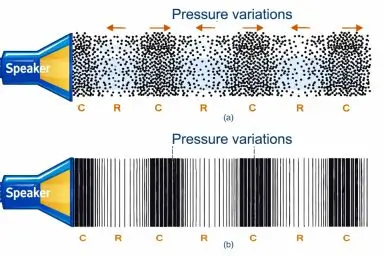
- Particles vibrate parallel to the direction of propagation.
- Consist of compressions and rarefactions.
- Example: Sound in air.
2. Transverse Waves
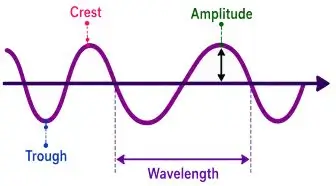
- Particles vibrate perpendicular to the direction of propagation.
- Consist of crests and troughs.
- Example: Waves on a stretched string.
Speed of Sound
Sound travels fastest in solids and slowest in gases.
- Iron: 5000 m/s
- Water: 1500 m/s
- Air: 330 m/s
Factors Affecting the Speed of Sound
1. Temperature
As the temperature increases, the particles of the medium move faster, so sound travels more quickly.
Temperature ↑ ⇒ Speed of sound ↑
2. Humidity
Moist air is less dense than dry air. Therefore, sound travels faster in humid air.
Humidity ↑ ⇒ Speed of sound ↑
3. Density of the Medium
The speed of sound depends on the density of the medium. Generally, sound travels faster in denser media like solids because their particles are closely packed.
3. Elasticity of the Medium
The greater the elasticity of a medium, the faster sound travels through it because the particles return to their original positions more quickly.Elasticity ↑ ⇒ Speed of sound ↑
Does Pressure Affect Speed?
No. The speed of sound in air is almost independent of pressure.
Difference Between Light and Sound Waves
| Light Waves | Sound Waves |
| Electromagnetic waves | Mechanical waves |
| Travel through vacuum | Require a medium |
| Transverse waves | Longitudinal in air |
| Speed = 3 × 10⁸ m/s | Speed ≈ 340 m/s |
| Very small wavelength | Comparatively large wavelength |
Reflection of Sound Waves
Definition: Reflection of sound is the bouncing back of sound waves after striking a surface.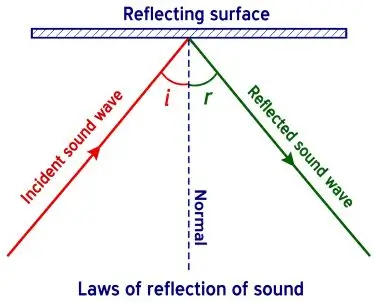
Laws of Reflection:
- Angle of incidence = Angle of reflection.
- Incident wave, reflected wave and normal lie in the same plane.
- Condition: The reflecting surface should be larger than the wavelength of the sound.
- Applications: Megaphone, speaking tube, soundboards, and ear trumpet.
Echo
An echo is the repetition of sound caused due to reflection from a distant obstacle.
The reflected sound should be heard separately after the original sound.
Persistence of Hearing:
Human ears retain the sensation of a sound for 0.1 second (1/10th of a second).
Conditions for Hearing an Echo
- Distance between listener and reflector should be at least 17 m in air.
- Reflecting surface should be large.
- Reflected sound must be sufficiently loud.
Reverberation
When sound undergoes repeated reflections, it persists for some time even after the source stops.
This effect is called reverberation.
Examples
- Large halls
- Temples
- Auditoriums
Determination of Speed of Sound by Echo Method
The speed of sound can be determined using the echo produced by a distant reflector.
Formula:
Where
- V = speed of sound
- d = distance from reflector
- t = total time taken by echo
Ultrasonic Waves & Practical Applications
Why Ultrasonic Waves are Used (Properties):
- Travel undeviated over long distances.
- Can be confined into a narrow beam.
- Not easily absorbed by the medium.
Uses of Echo
1. Animals (Sound Ranging):
- Bats: Emit and detect high-frequency ultrasound (up to 100 kHz) to locate obstacles and fly safely in the dark.
- Dolphins & Fishermen: Emit ultrasonic waves to detect obstacles/prey and shoals of fish.
2. SONAR (Sound Navigation and Ranging):
It is a device that uses ultrasonic waves. It is used on ships to measure the depth of the ocean (echo depth sounding) and to detect or locate underwater objects such as submarines, icebergs, and shipwrecks.
3. Medical Field:
- Ultrasonography: Used to obtain images of internal human organs (liver, gallbladder, uterus, foetus etc.).
- Echocardiography: Used to study the structure and functioning of the human heart.
Section (B) : Natural, Damped and Forced Vibrations; Resonance
Natural Vibrations (Free Vibrations)
The periodic vibrations of a body in the absence of any external force on it are called natural (or free) vibrations.
Characteristics of Natural Vibrations
- No external periodic force acts on the body.
- The body vibrates with its own natural frequency.
- Frequency depends on the size, shape and material of the body.
- In vacuum, the amplitude remains constant.
- In air, the amplitude gradually decreases because of air resistance.
Natural Frequency
The frequency with which a body vibrates naturally after being disturbed is called its natural frequency.
Different bodies have different natural frequencies.
Examples of Natural Vibrations
1. Simple Pendulum
The frequency of a simple pendulum is:
Where
- f = frequency
- g = acceleration due to gravity
- l = length of the pendulum
***Note:
- Longer pendulum ⇒ Lower frequency
- Shorter pendulum ⇒ Higher frequency
2. Spring-Mass System
A stretched spring vibrates with its natural frequency.
Where
- K = force constant of spring
- m = mass attached
***Note
- Larger K ⇒ Higher frequency
- Larger mass ⇒ Lower frequency
3. Tuning Fork
A tuning fork produces vibrations of only one frequency, giving a pure note.
4. Piano
Each string vibrates with its own natural frequency.
5. Air Column in Flute
The frequency depends upon the effective length of the air column.
- Smaller air column → Higher frequency
- Longer air column → Lower frequency
6. Stringed Musical Instruments
Examples:
- Guitar
- Sitar
- Violin
Frequency depends upon:
- Length of string (l)
- Radius (thickness) (r)
- Tension (T)
Formula:
where d is the density of the material.
Frequency Increases When:
- Length decreases
- Radius decreases
- Tension increases
7. Modes of Vibration in a Stretched String
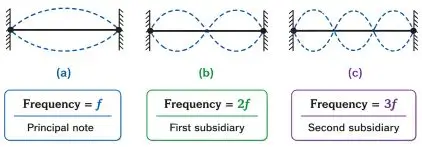
A stretched string can vibrate in different modes.
| Mode | Frequency |
| Principal mode | f |
| First subsidiary | 2f |
| Second subsidiary | 3f |
- Frequency Ratio =1 : 2 : 3
- Wavelength Ratio = 3 : 2: 1
- Principal note = 2l
- First subsidiary = l
- Second subsidiary = 2l/3
Nature of Natural Vibrations
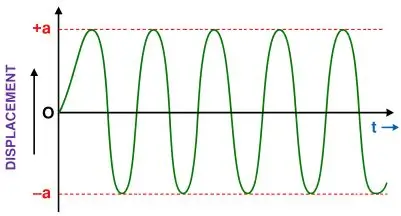
Natural vibrations are simple harmonic vibrations.
In an ideal vacuum:
- Amplitude remains constant.
- Frequency remains constant.
- No loss of energy occurs.
In practical conditions, air resistance gradually reduces the amplitude.
Damped Vibrations
When a vibrating body loses energy due to friction or air resistance, its amplitude gradually decreases with time. Such vibrations are called damped vibrations.
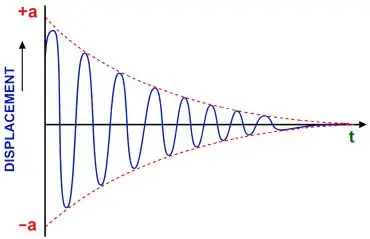
Characteristics of Damped Vibrations
- Amplitude continuously decreases.
- Energy is gradually lost.
- Motion finally stops.
- Frequency is slightly lower than natural frequency.
Causes of Damping
- Air resistance
- Friction
- Viscosity of medium
Examples of Damped Vibrations
- A slim branch of a tree pulled and released.
- A tuning fork vibrating in the air.
- A simple pendulum oscillating in air or liquid.
- A loaded spring vibrating in air.
Difference Between Natural and Damped Vibrations
| Natural Vibrations | Damped Vibrations |
| Amplitude remains constant | Amplitude decreases continuously |
| No energy loss | Energy is continuously lost |
| No resistive force | Resistive force acts |
| Continue for long time (ideal case) | Finally stop |
Forced Vibrations
The vibrations of a body produced under the influence of an external periodic force are called forced vibrations.
Characteristics:
- External periodic force acts continuously.
- Frequency becomes equal to the frequency of the applied force.
- Amplitude depends upon the applied force.
- Energy supplied compensates for energy lost.
Forces Acting on the Body:
- Restoring force
- Frictional/resistive force
- External periodic force (Driving force)
Key Characteristics:
- The body does not vibrate with its natural frequency; it is forced to vibrate at the frequency of the applied external force.
- The amplitude depends on the difference between the applied frequency and the body’s natural frequency:
- If frequencies are far apart ⇒ Small amplitude.
- If frequencies are close/equal ⇒ Large amplitude.
Examples of Forced Vibrations
- Table vibrating due to a tuning fork
- Guitar strings while playing
- Loudspeaker diaphragm
- Sound box of musical instruments
Difference Between Natural and Forced Vibrations
| Natural Vibrations | Forced Vibrations |
| No external force | External periodic force acts |
| Frequency is natural frequency | Frequency equals driving frequency |
| Depends on body | Depends on external force |
Resonance (Special Case of Forced Vibrations)
Definition:
Resonance is a special case of forced vibrations in which the frequency of the applied periodic force becomes exactly equal to the natural frequency of the vibrating body, causing it to vibrate with a very large amplitude.
Conditions for Resonance
- External periodic force should act.
- Frequency of applied force must equal the natural frequency.
- Energy transfer should be continuous.
Characteristics of Resonance
- Maximum amplitude
- Loud sound produced
- Maximum transfer of energy
- Vibrations remain in phase
Demonstration of Resonance
1. Two Tuning Forks
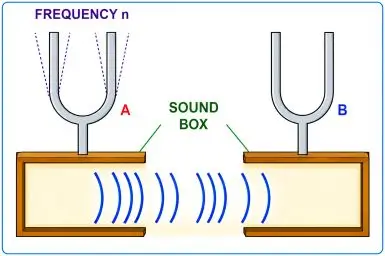
Observation:
When one tuning fork vibrates, the other also starts vibrating if both have the same natural frequency.
Reason:
Resonance occurs because both tuning forks have identical natural frequencies.
2. Pendulums
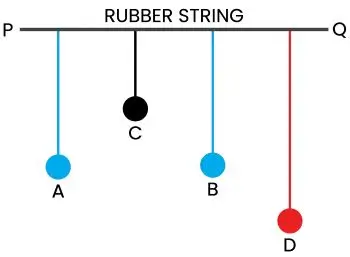
Observation:
- Pendulum B (same length as A) vibrates with maximum amplitude.
- Pendulums C and D vibrate with very small amplitude.
Reason:
Only pendulum B has the same natural frequency as pendulum A.
3. Resonance in Air Column
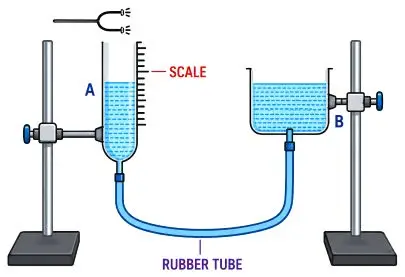
Observation:
A loud sound is heard when the air column length becomes suitable.
Reason:
Natural frequency of air column becomes equal to the tuning fork frequency.
Difference Between Forced and Resonant Vibrations
| Forced Vibrations | Resonant Vibrations |
| Driving frequency is different from natural frequency | Driving frequency equals natural frequency |
| Small amplitude | Maximum amplitude |
| Less energy transfer | Maximum energy transfer |
| Sound is less loud | Sound is very loud |
Applications of Resonance
1. Pendulums
Pendulums of equal length resonate with each other.
2. Musical Instruments
Sound boxes in guitars, violins and sitars increase the loudness of sound due to resonance.
3. Air Column
Flutes and organ pipes produce loud sounds because of resonance.
4. Troops Marching Across a Suspension Bridge: Soldiers are ordered to break step while crossing a bridge. If the rhythmic marching frequency matches the natural frequency of the bridge, resonance could cause heavy oscillations and structural failure.
5. Rattling of Vehicle Parts
Sometimes, at a particular speed, a car or bike produces a rattling sound. This happens because the engine’s vibration frequency matches the natural frequency of a loose part, causing it to vibrate strongly due to resonance.
Solution to Stop the Sound:
- Change the speed of the vehicle so that resonance does not occur.
- Tighten any loose parts or screws.
- Use rubber pads or other damping materials to reduce vibrations.
6. Radio and Television Receivers
Radio and TV receivers are tuned using resonance. By changing the capacitance or inductance of the tuning circuit, the receiver selects the desired frequency while rejecting others.
Section (C) : Characteristics of Sound and Their Subjective and Objective Nature
Characteristics of Sound
The three important characteristics of sound are:
- Loudness
- Pitch (Shrillness)
- Quality (Timbre)
These characteristics can be studied using a Microphone and a Cathode Ray Oscilloscope (CRO).
1. Loudness
Definition:
Loudness is the characteristic of sound that enables us to distinguish between a loud sound and a faint (soft) sound.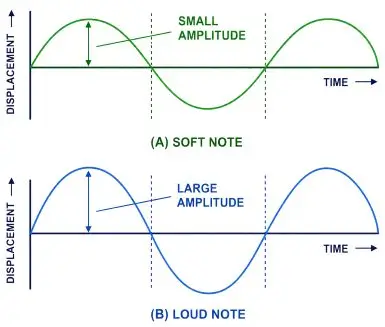
Factors Affecting Loudness
1. Amplitude of Vibration
Loudness is directly proportional to the square of the amplitude.
Loudness ∝ Amplitude2
- Larger amplitude ⇒ Louder sound
- Smaller amplitude ⇒ Softer sound
- Double amplitude ⇒ Four times louder.
- Half amplitude ⇒ One-fourth loudness.
2. Distance from the Source
Loudness decreases as the distance from the source increases.
- Closer to the source ⇒ Louder sound
3. Surface Area of the Vibrating Body
A larger vibrating surface sets more air particles into vibration and produces a louder sound.
Examples:
- School bell
- Temple bell
- Sound box of guitar
4. Density of the Medium
Denser media transmit sound more effectively, making it appear louder.
5. Presence of Resonant Bodies
Resonant bodies increase the intensity of sound and make it louder.
Example: Sound box of a guitar.
Intensity of Sound
- Definition:
The intensity of sound is the amount of sound energy passing normally through unit area per second. - SI Unit: Watt per square metre (W m–2)
- Minimum audible intensity: I0 = 10–12 W m–2
Loudness vs Intensity
| Loudness | Intensity |
| Subjective property | Objective property |
| Depends on listener | Measurable quantity |
| Unit: Phon | Unit: W m–2 |
Relationship Between Loudness and Intensity
According to Weber–Fechner Law,
dB
Where
- L = Loudness
- I = Intensity
- K = Constant
Sound Level Formula
where
- I = Intensity of sound
- I0 = 10–12 W m–2
***Note
Units: Phon (unit of loudness) and Decibel (dB) (unit of sound level).
Important Fact
A change of 1 dB corresponds to nearly 26% change in intensity.
Decibel (dB)
The sound level is measured in decibel (dB).
Important Facts
- 0 dB ⇒ Minimum audible sound (pin drop sound)
- Soft whisper ⇒ 30 dB
- Safe hearing range ⇒ 0 – 80 dB
- Above 120 dB ⇒ Harmful to ears
Noise Pollution
Noise pollution is caused by unwanted, unpleasant and excessively loud sounds.
Sources
- Loudspeakers
- Vehicle horns
- Factories
- Construction sites
- Aircraft
- Industrial machines
Harmful Effects
- Hearing loss
- Headache
- High blood pressure
- Stress
- Lack of concentration
- Sleep disturbance
2. Pitch (Shrillness)
Definition:
Pitch is the characteristic of sound by which an acute (shrill) sound can be distinguished from a grave (flat or deep) sound.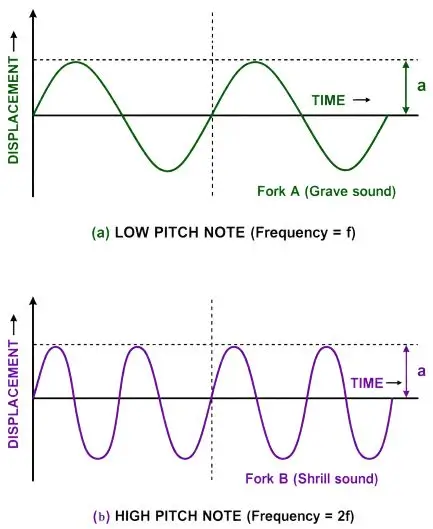
Pitch depends directly on Frequency (f):
- Higher Frequency ⇒ Higher Pitch ⇒ Shrill sound (e.g., flute, whistle, female voice).
- Lower Frequency ⇒ Lower Pitch ⇒ Flat/Grave sound (e.g., bass drum, male voice).
Examples
- Women’s voice has higher pitch than men’s voice.
- Thin strings produce higher pitch.
- Short strings produce higher pitch.
- Greater tension in strings produces higher pitch.
- A shorter air column in a flute gives a higher pitch.
Change of Pitch in Musical Instruments
(i) Stringed Instruments
Pitch depends on:
- Thickness of string (thinner → higher pitch)
- Tension in string (more tension → higher pitch)
- Length of vibrating string (shorter → higher pitch)
- Examples: Guitar, Sitar, Piano
(ii) Wind Instruments
Pitch depends on the length of vibrating air column.
- Shorter air column → higher pitch
- Longer air column → lower pitch
- Examples: Flute, Shehnai, Bugle
(iii) Membrane Instruments
Pitch depends on:
- Size of membrane (small size → higher pitch)
- Tension of membrane (more tight → higher pitch)
- Examples: Tabla, Drum, Dholak
Subjective Nature of Pitch
- Pitch depends on the sensation experienced by the listener.
- Different people may perceive the same sound differently.
Objective Nature of Frequency
- Frequency is measurable.
- It depends only on the source and not on the listener.
Difference Between Pitch and Frequency
| Pitch | Frequency |
| Subjective | Objective |
| Sensation | Measurable quantity |
| Depends on listener | Depends on source |
| No SI unit | SI Unit: Hertz (Hz) |
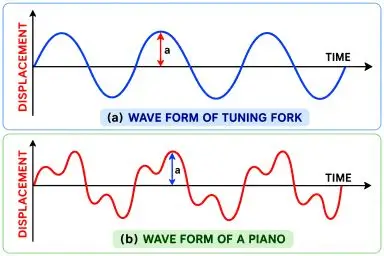
3. Quality (Timbre)
Definition:
Quality or timbre is the characteristic of sound that distinguishes two sounds having the same loudness and pitch but produced by different sources.
Quality Depends Upon
- Quality depends on the waveform.
- Different waveforms produce different sound qualities.
Why Different Instruments Sound Different?
Although a piano and a flute may produce the same frequency and loudness, they have different waveforms.
Therefore, they sound different.
Principal and Subsidiary Vibrations
Musical instruments generally produce a combination of vibrations.
Principal Vibration:
- Lowest frequency
- Maximum amplitude
Subsidiary Vibrations:
- Higher frequencies
- Smaller amplitudes
- Multiples of the principal frequency
These combine to produce a unique waveform.
Recognition of Sound Sources
Every source has its own characteristic waveform.
Therefore, we can recognize
- Different musical instruments
- Different people’s voices
even if they have the same pitch and loudness.
Factors Determining Sound Characteristics Characteristic
| Loudness | Amplitude |
| Pitch | Frequency |
| Quality | Waveform |
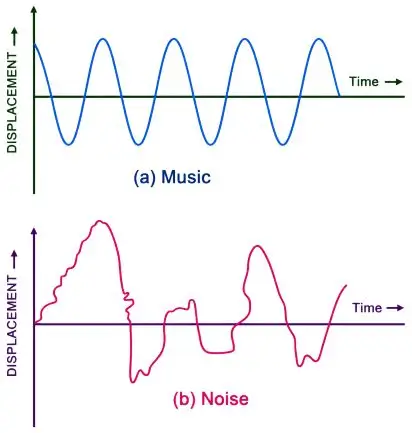
Music
Music is a pleasant sound produced by regular, periodic vibrations.
Characteristics
- Pleasant
- Continuous
- Periodic
- Regular waveform
- Sound level usually between 10 dB and 30 dB
Examples
- Piano
- Violin
- Guitar
- Flute
- Tuning fork
Noise
Noise is an unpleasant sound produced by irregular vibrations.
Characteristics
- Harsh
- Discontinuous
- Irregular waveform
- Non-periodic
- Usually above 120 dB
Examples
- Aircraft
- Road roller
- Factory machines
- Loud traffic
Difference Between Music and Noise
| Music | Noise |
| Pleasant | Unpleasant |
| Regular vibrations | Irregular vibrations |
| Periodic | Non-periodic |
| Regular waveform | Irregular waveform |
| Low sound level | High sound level |
Important Formulae – Sound
| Formula | Description |
| Wave equation | |
| Frequency | |
| Echo time | |
| Distance by echo | |
| Speed of sound | |
| Loudness relation | |
| Sound level | |
| Loudness ∝ Amplitude2 | Loudness relation |
| Distance relation |
ICSE Class 10 Physics Chapter 7 Sound Notes PDF Download
Students can download the ICSE Class 10 Physics Chapter 7 Sound Notes PDF for offline study and quick revision. The PDF is useful for last-minute preparation and helps you revise the complete chapter anytime.
Conclusion
The ICSE Class 10 Physics Chapter 7 Sound Notes provide a complete and easy-to-understand revision resource for students. Study these notes thoroughly, practice previous year questions, and revise the formulas regularly to perform well in the ICSE Board Examination. Download the PDF and start your preparation today.
You can also visit:
ICSE Class 10 Physics Notes
| ☛ ICSE Class 10 Physics Chapter 1 – Force Notes |
| ☛ ICSE Class 10 Physics Chapter 2 – Work, Energy and Power Notes |
| ☛ ICSE Class 10 Physics Chapter 3 – Machines Notes |
| ☛ ICSE Class 10 Physics Chapter 4 – Refraction of Light at Plane Surfaces Notes |
| ☛ ICSE Class 10 Physics Chapter 5 – Refraction through Lens Notes |
| ☛ ICSE Class 10 Physics Chapter 6 – Spectrum Notes |
| ☛ ICSE Class 10 Physics Chapter 7 – Sound Notes |
| ☛ ICSE Class 10 Physics Chapter 8 – Current Electricity Notes |
| ☛ ICSE Class 10 Physics Chapter 9 – Electrical Power and Household Circuits Notes |
| ☛ ICSE Class 10 Physics Chapter 10 – Electro-magnetism Notes |
| ☛ ICSE Class 10 Physics Chapter 11 – Calorimetry Notes |
| ☛ ICSE Class 10 Physics Chapter 12 – Radioactivity Notes |
Official Website:
Students can visit the official CISCE website for more details and updates.