Introduction
Refraction of light is one of the most important topics in ICSE Class 10 Physics, and it often carries a good weightage in the board exam. This chapter, Refraction of Light at Plane Surfaces, explains how light bends when it passes from one medium to another and covers concepts like refractive index, apparent depth, and lateral shift.
Rohit Academy offers expert-curated ICSE Class 10 Physics Study Materials including ICSE Refraction of Light at Plane Surfaces Chapter Notes, diagrams, and key formulas for better understanding.
If you are preparing from the Selina ICSE Physics Class 10 textbook, this article will help you revise important definitions, formulas, and solved examples in a simple way.
Study materials related to chapter 4
SECTION A : REFRACTION , LAWS OF REFRACTION AND REFRACTIVE INDEX
Introduction
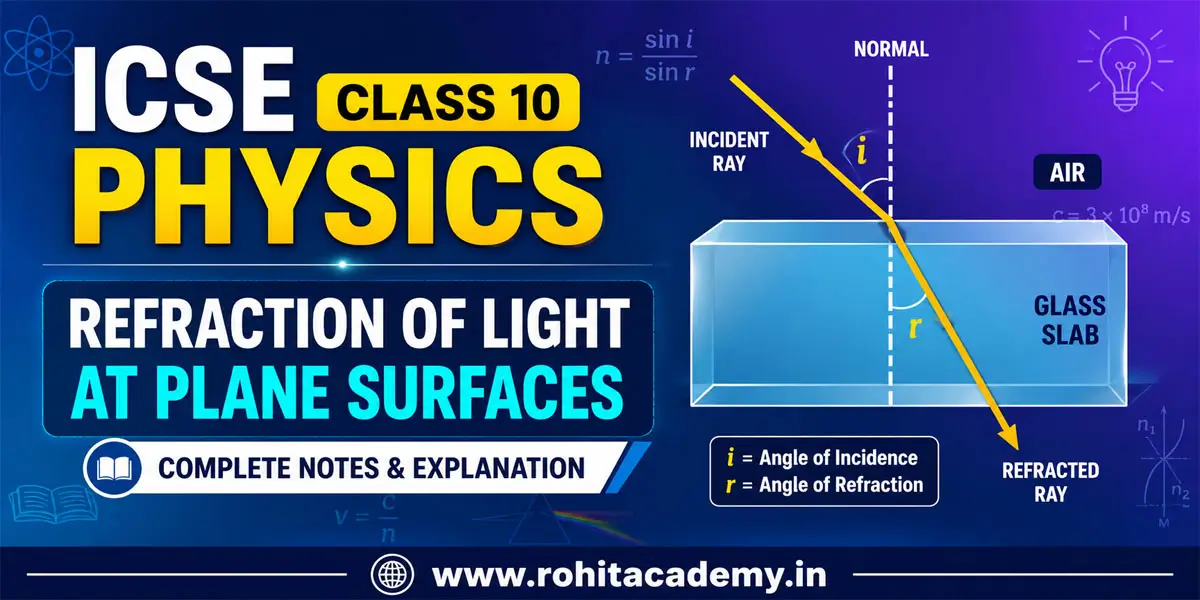
When light travels from one transparent medium to another, its speed changes. Due to this change in speed, the path of light bends. This phenomenon is called refraction of light.
Definition:
Refraction is the change in the direction of light when it passes from one transparent medium to another.

Important Terms
- Incident Ray: The ray of light falling on the surface separating two media.
- Refracted Ray: The ray of light that enters the second medium after refraction.
- Normal: An imaginary line drawn perpendicular to the surface at the point of incidence.
- Angle of Incidence (i): The angle between the incident ray and the normal.
- Angle of Refraction (r): The angle between the refracted ray and the normal.
Medium
A transparent substance through which light travels is called a medium.
- Optically Rarer Medium: A medium in which light travels faster is called an optically rarer medium.
- Optically Denser Medium: A medium in which light travels slower is called an optically denser medium.
RULES OF REFRACTION
Rule 1 : Rarer Medium → Denser Medium [Trick: RDTN]
Examples: Air → Water, Air → Glass

- Speed of light decreases.
- Light bends towards the normal.
- Angle of refraction is less than angle of incidence.
\(i > r\)
Angle of deviation, \(\delta=i-r\)
Rule 2 : Denser Medium → Rarer Medium [Trick: DRAN]
Examples: Glass → Air, Water → Air

- Speed of light increases.
- Light bends away from the normal.
- Angle of refraction is greater than angle of incidence.
\(r > i\)
Angle of deviation, \(\delta=r-i\)
Rule 3 : Normal Incidence
When: ∠i = 0°
Then:∠r = 0°
- The ray passes undeviated.
- No change in direction.
- \(\delta=0°\)

Cause of Refraction
Refraction occurs because the speed of light changes when it enters another medium.
- Rarer → Denser: Speed decreases, so light bends towards the normal (RTDN).
- Denser → Rarer: Speed increases, so light bends away from the normal (DRAN).
***Note
- Even when a light ray is incident normally and does not bend, its speed changes on entering another medium because the optical density of the two media is different.
LAWS OF REFRACTION OF LIGHT (Snell’s Law)
- First Law: The incident ray, refracted ray and the normal at the point of incidence lie in the same plane.
- Second Law: For a given pair of media, ratio of sine of angle of incidence to the sine of angle of refraction is always constant.
\(\frac{\sin{i}}{\sin{r}}=constant\)
This constant is called the refractive index.
REFRACTIVE INDEX
Definition
The refractive index of a medium is the ratio of the speed of light in vacuum to the speed of light in that medium.
Where:
- μ = Refractive index
- c = Speed of light in vacuum
- V = Speed of light in the medium
Important Facts
- Refractive index has no unit.
- It is always greater than or equal to 1.
- For air: μ = 1
Refractive Index and Speed
Therefore
- Greater refractive index → lower speed of light.
- Lower refractive index → higher speed of light.
Common Refractive Indices
| Substance | Refractive Index |
| Air (Lowest) | 1.00 |
| Ice | 1.31 |
| Water | 1.33 |
| Alcohol | 1.37 |
| Glass | 1.50 |
| Quartz | 1.54 |
| Diamond (Highest) | 2.41 |
***Note
- The refractive index of diamond is 2.41. It means that light travels in air 2.41 times faster than in diamond.
- Lower Refractive Index (e.g., air):
- Speed of light is faster
- Light bends less (less deviation)
- Higher Refractive Index (e.g., glass, diamond):
- Speed of light is slower
- Light bends more (more deviation)
Relative Refractive Index
The refractive index of medium 2 with respect to medium 1 is:
1μ2
Relationship Between Two Relative Refractive Indices
1μ2 × 2μ1 = 1
Or, 1μ2 = 1/2μ1
Example
If refractive index of glass with respect to air is: airμglass = 3/2
Then refractive index of air with respect to glass is : glassμair = 2/3
Conditions for No Refraction
Refraction does not occur when:
- The incident ray falls normally (perpendicularly) on the surface.
- The two media have the same refractive index.
Factors Affecting Refractive Index
- Nature of the Medium
- Rarer medium → Higher speed of light → Lower refractive index
- Denser medium → Lower speed of light → Higher refractive index
- Temperature
- As temperature increases, the speed of light in the medium generally increases.
- Therefore, the refractive index decreases.
- Wavelength (Colour) of Light
- In a medium, red light travels fastest and violet light travels slowest.
- Refractive index is maximum for violet light and minimum for red light.
Quick Facts
- Violet light deviates the most.
- Red light deviates the least.
Relationship Between Speed, Frequency and Wavelength
- Relation:
Where:
- v = speed of light
- f = frequency
- λ = wavelength
During Refraction
- Frequency remains unchanged.
- From rarer → denser medium:
- Speed decreases
- Wavelength decreases
- From denser → rarer medium:
- Speed increases
- Wavelength increases
Important Note
𝑊𝑎𝑣𝑒𝑙𝑒𝑛𝑔𝑡ℎ ∝ 𝑉𝑒𝑙𝑜𝑐𝑖𝑡𝑦 ∝ \(\frac{1}{Refractive\ Index}\)
Therefore:
- Red Light → Maximum wavelength → Maximum speed → Least deviation → Lowest refractive index
- Violet Light → Minimum wavelength → Minimum speed → Maximum deviation → Highest refractive index
Principle of Reversibility of Light
The path followed by a light ray is reversible.
Statement:
If a ray travels from A to B through a set of media, it can travel back from B to A along the same path.
1μ2 × 2μ1 = 1

REFRACTION OF LIGHT THROUGH A RECTANGULAR GLASS BLOCK

When light enters a glass block:
- It bends towards the normal.
- Travels inside the glass.
- At the second surface it bends away from the normal.
- Emerges parallel to the incident ray.
Important Result
Angle of emergence (e) = angle of incidence (i)
Lateral Displacement
Although the emergent ray is parallel to the incident ray, it is shifted sideways.
This perpendicular distance is called lateral displacement.
Definition
The perpendicular distance between the emergent ray and the original path of the incident ray is called lateral displacement.
Factors Affecting Lateral Displacement
- Thickness of Glass Block
Greater thickness → Greater lateral displacement - Angle of Incidence
Greater angle of incidence → Greater displacement - Refractive Index
Greater refractive index → Greater displacement - Colour (Wavelength)
Violet light → Maximum displacementRed light → Minimum displacement
Colour and Refractive Index
In a medium:
- Speed of red light is maximum.
- Speed of violet light is minimum.
Therefore:
Refractive Index of Violet > Refractive Index of Red
Hence:
- Violet light bends more.
- Red light bends less.
Multiple images in a thick plane glass plate or thick mirror

When an object is viewed through a thick glass plate or thick mirror:
- Several images are formed due to repeated reflections.
- The second image is the brightest.
- Brightness decreases for successive images.
Reason
The second image is formed after strong reflection from the silvered surface.
SECTION B : REFRACTION OF LIGHT THROUGH A PRISM
Prism
Definition
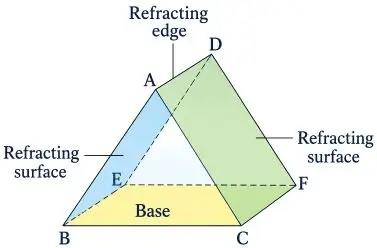
A prism is a transparent refracting medium bounded by five plane surfaces having a triangular cross-section.
Parts of a Prism
- Refracting Surfaces – The two inclined triangular faces through which light enters and emerges.
- Refracting Edge – The line where the two refracting surfaces meet.
- Angle of Prism (A) – The angle between the two refracting surfaces.
- Base of Prism – The face opposite the refracting edge.
Important Notes
- The two refracting surfaces are not parallel.
- They are inclined to each other at the angle of prism (A).
- In ray diagrams, only the triangular principal section of the prism is usually shown.
Refraction Through a Glass Prism
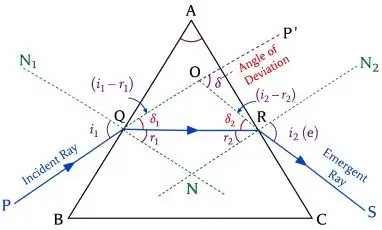
When a ray enters a prism:
At First Surface
- Light passes from air to glass.
- It bends towards the normal.
At Second Surface
- Light passes from glass to air.
- It bends away from the normal.
Result
The emergent ray is deviated towards the base of the prism.
***Note
If a ray of light is incident normally (perpendicularly) on a surface, then the angle of incidence is 0°.
Important Terms
- Incident Ray: The ray entering the prism.
- Refracted Ray: The ray travelling inside the prism.
- Emergent Ray: The ray coming out of the prism.
Angle of Deviation (δ)
Definition
The angle between the direction of the incident ray produced forward and the emergent ray produced backward is called the angle of deviation.
Formula for Angle of Deviation
For a prism,
- \(\delta=\ \left(i_1+\ i_2\right)-\ A\)
- \(\delta=\ \left(i+e\right)-\ A\)
Where:
- i1 = Angle of incidence
- i2 = Angle of emergence
- A = Angle of prism
Relation Inside Prism
r1 + r2 = A
Where:
- r1 = Angle of refraction at first face
- r2 = Angle of incidence at second face
Difference Between Prism and Glass Slab
| Glass Slab | Prism |
| Opposite faces are parallel | Refracting faces are inclined |
| Emergent ray is parallel to incident ray | Emergent ray is not parallel |
| Produces lateral displacement | Produces angular deviation |
| No net deviation in direction | Deviates light towards base |
Factors Affecting Angle of Deviation
The angle of deviation depends upon:
1. Angle of Incidence (i)
As angle of incidence increases:
- Deviation first decreases.
- Becomes minimum.
- Then increases again.
2. Material of Prism (Refractive Index)
Higher refractive index → Greater deviation.
Example:
μflint > μcrown
Therefore:
Flint glass prism produces greater deviation than crown glass prism.
3. Angle of Prism (A)
Greater angle of prism → Greater deviation.
4. Colour (Wavelength) of Light
Deviation depends on colour.
- Violet light deviates most.
- Red light deviates least.
Because
μviolet > μred
***Note
\(Deviation\;(\delta)\;\propto Refractive\;Index\;(\mu)\;\propto\;Angle\;of\;prism\;(A)\;\propto\;\frac1{wavelength\;\;of\;\;light\;(\lambda)}\)
i – δ Curve

When angle of incidence is plotted against angle of deviation:
- Deviation decreases initially.
- Reaches a minimum value.
- Then increases.
This graph is called the i–δ curve.
Minimum Deviation
The least value of deviation produced by a prism is called minimum deviation.
Conditions for Minimum Deviation
At minimum deviation:
1. i1 = i2
Angle of incidence equals angle of emergence.
2. r1 = r2
3. The refracted ray inside the prism becomes parallel to the base.
Formula for Minimum Deviation
\({\delta}_{min}=\ 2i \ -\ A\)
Where:
- δmin = angle of incidence at minimum deviation
- A = angle of prism
Behaviour of Different Colours
Red Light
- Highest speed in glass.
- Lowest refractive index.
- Least deviation.
Violet Light
- Lowest speed in glass.
- Highest refractive index.
- Maximum deviation.
Important Results
| Colour | Refractive Index | Deviation |
| Violet | Maximum | Maximum |
| Red | Minimum | Minimum |
Image Formation Through a Prism
A prism forms a virtual image of an object.
The image appears:
- Shifted towards the apex of the prism.
- Upright.
- Virtual.
SECTION C : SIMPLE APPLICATIONS OF REFRACTION OF LIGHT
Real and Apparent Depth
Phenomenon
When an object is placed in a denser medium and viewed from a rarer medium, it appears to be at a depth less than its actual depth due to refraction.
Example:
- Coin in water
- Fish in pond
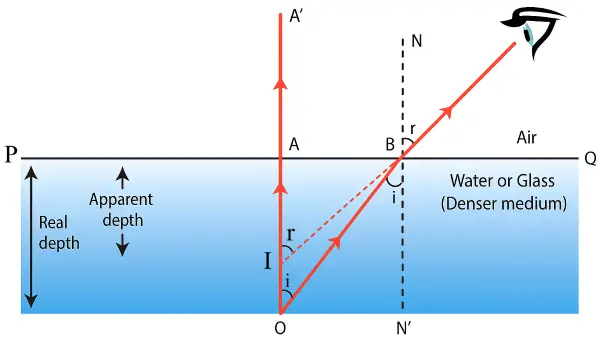
- Real Depth: Actual depth of the object below the surface.
- Apparent Depth: Depth at which the object appears to be present.
Since the object appears raised,
Apparent Depth < Real Depth
Why Does It Happen?
Light travels:
- Water/Glass → Air
It bends away from the normal.
The refracted rays appear to come from a point above the actual object.
Hence the object appears raised.
Relationship Between Real and Apparent Depth
\(\mu=\frac{Real\operatorname{Depth}}{Apparent\ Depth}\)
Therefore,
Apparent Depth
Real depth = aμm × apparent depth
Shift Produced
The upward shift of the image is:
Shift = real depth – apparent depth
Refractive Index, \({{}_a\mu}_m=\frac{Real\;depth}{Apparent\;depth}\)
\(Apparent\;depth\;=\;\frac{Real\;depth}{{{}_a\mu}_m}\)
\(Real\;depth={{}_a\mu}_m\;\times\;Apparent\;depth\)
Shift = real depth – apparent depth
\(Shift\;=\;real\;depth\;\times\left(1-\frac1{{{}_a\mu}_m}\right)\)
Factors Affecting Apparent Shift
The shift depends upon:
1. Refractive Index
Greater refractive index → Greater shift.
2. Thickness / Depth
Greater depth → Greater shift.
3. Colour of Light
Since refractive index depends on colour:
μviolet > μred
Therefore:
- Violet light produces greater shift.
- Red light produces smaller shift.
***Note
Shift ∝ Refractive Index (μ) ∝ \(\frac{1}{wavelength\ (\mathbf{\lambda})}\)
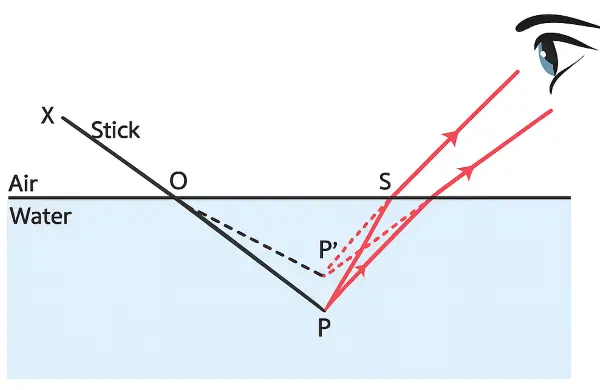
Apparent Bending of a Stick Under Water
Observation
When a straight stick or pencil is partially immersed obliquely in water and viewed from air, it appears bent at the water surface.
The immersed portion appears:
- Raised upward
- Shortened
- Bent at the interface
Reason
Light from the submerged part travels from:
- Water (denser medium) → Air (rarer medium)
Hence, it bends away from the normal due to refraction.
The refracted rays appear to come from a point above the actual position.
Therefore, the underwater portion appears raised and the stick seems bent.
Important Conclusion
The immersed portion of the stick:
- Appears shorter
- Appears raised
- Appears bent at the water surface
Consequences of Refraction of Light
Some common examples:
1. Twinkling of Stars
Stars twinkle due to continuous changes in the refractive index of atmospheric air.
2. Advanced Sunrise and Delayed Sunset
The Sun is seen:
- A few minutes before actual sunrise.
- A few minutes after actual sunset.
This is due to atmospheric refraction.
3. Coin in a Vessel Becomes Visible
A coin hidden below the rim of a vessel becomes visible when water is poured into it.
4. Print Appears Raised
Printed letters appear slightly raised when viewed through a glass slab.
5. Objects Below Glass Appear Raised
Objects beneath a glass slab appear closer than their actual position.
6. Water Tank Appears Shallow
The apparent depth is less than the real depth.
7. Legs Appear Shorter in Water
A person standing in water appears to have shortened legs because the submerged portion is raised.
SECTION D : CRITICAL ANGLE AND TOTAL INTERNAL REFLECTION
Refraction from Denser to Rarer Medium
Case 1 : When i < C (small angle)
- When, angle i < angle C
- Then, angle i < angle r
- Both refraction and weak reflection occur.

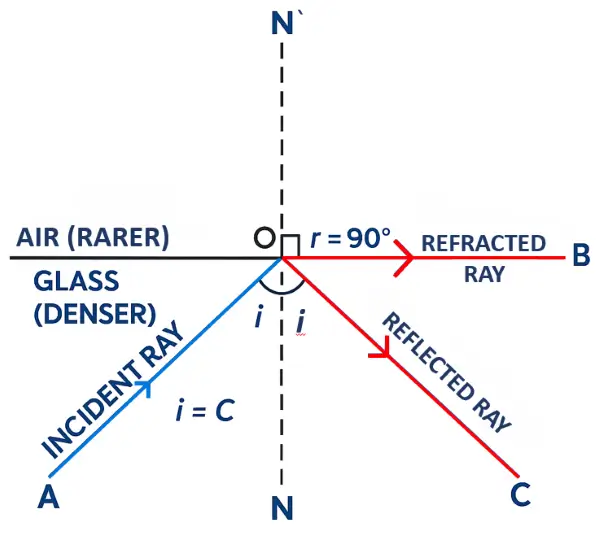
Case 2 : When i = C (critical angle)
- When, angle i = angle C
- Then, angle r = 90°
- Refracted ray travels along the surface
Definition of Critical Angle:
The angle of incidence in the denser medium for which the angle of refraction in the rarer medium becomes 90° is called the critical angle (C).
***Note
Critical angle for diamond is 24°, means that, when light travels from diamond to air with an angle of incidence of 24°, the angle of refraction becomes 90°.
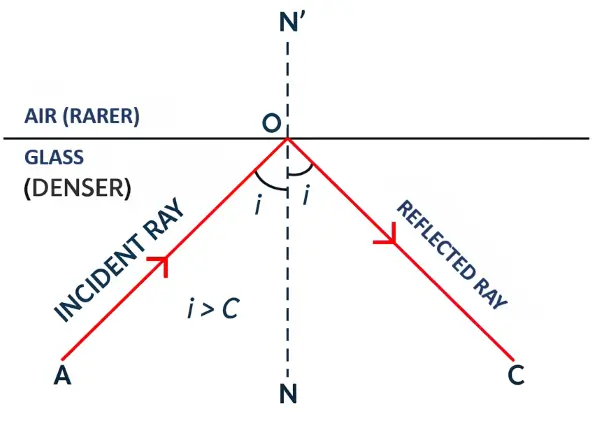
Case 3 : When i > C (greater angle)
- No refraction occurs.
- Entire light is reflected back into the denser medium.
- This phenomenon is called Total Internal Reflection (TIR).
Total Internal Reflection (TIR)
Definition:
When a light ray travels from a denser medium to a rarer medium and strikes the interface at an angle greater than the critical angle, it is completely reflected back into the denser medium. This phenomenon is called total internal reflection.
Relation Between Critical Angle and Refractive Index
\({{}_a\mu}_g=\frac1{\sin\;C}\)
\(\sin\;C=\frac1{{{}_a\mu}_g}\)
Examples
Glass
μ = 1.5
sin C
C = 42°
Water
μ = 4/3
sin C
C = 49°
Critical Angles of Common Substances
| Substance | Refractive Index | Critical Angle |
| Water | 1.33 | 49° |
| Turpentine | 1.47 | 43° |
| Glass | 1.50 | 42° |
| Flint Glass | 1.58 | 39° |
| Diamond | 2.41 | 25° |
Factors Affecting Critical Angle
Critical angle depends upon:
1. Colour of Light
As wavelength increases:
- Refractive index decreases.
- Critical angle increases.
Therefore:
- Violet → minimum critical angle
- Red → maximum critical angle
2. Temperature
As temperature increases:
- Refractive index decreases.
- Critical angle increases.
Conditions for Total Internal Reflection
The following two conditions must be satisfied:
- Light must travel from a denser medium to a rarer medium.
- The angle of incidence must be greater than the critical angle for the pair of media.
Characteristics of Total Internal Reflection
- 100% reflection occurs.
- No refraction takes place.
- No loss of light energy.
- Reflected beam is very bright.
Refraction and TIR at Different Angles
| When i = 0° | Ray passes undeviated |
| When i < C | Refraction and reflection occur simultaneously. |
| When i = C | Refracted ray grazes the interface |
| When i > C | Total internal reflection occurs |
Total Internal Reflection in a Prism
Certain prisms are designed to use total internal reflection instead of mirrors.
Advantages:
- 100% reflection
- Brighter image
- No silver coating required
Total Internal Reflection in a Prism
Total internal reflection in three different prisms :
- Right angled isosceles prism or total reflecting prism (45°, 90°, 45°)
- Equilateral triangle (each angle 60°)
- Right angled prism (30°, 90°, 60°)
1. Right angled isosceles prism or total reflecting prism (45°, 90°, 45°)
(i) To deviate a ray of light through 90°
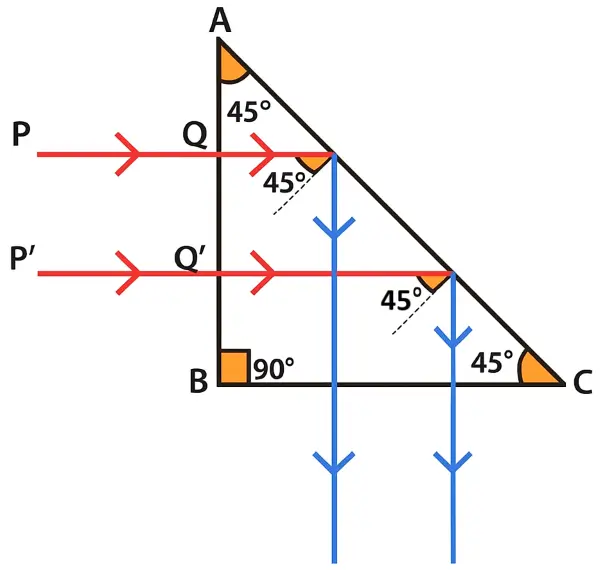
- \(\angle i=45°\)
- \(\angle i_c=42°\) (Say)
- Light enters normally at face AB → No deviation (No Refraction)
- Hits face AC at 45° (i > critical angle) → Total Internal Reflection (TIR) occurs.
- Ray is reflected at 90° from the original path.
Used in: Periscopes
(ii) To deviate a ray of light through 180°
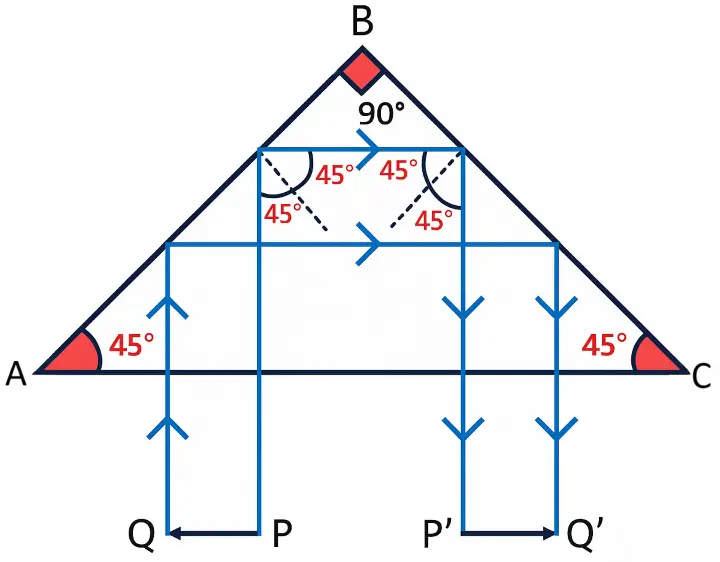
- \(\angle i=45°\)
- \(\angle i_c=42°\) (Say)
- Light enters normally on face AC.
- Two TIRs occur: first at AB, then at BC (both 45°)
- Emerges opposite to incident direction.
- Total deviation = 180°
- No refraction, No Deviation occurs
Used in: Binoculars, cameras.
(iii) To erect an inverted image without deviation (Erecting prism)
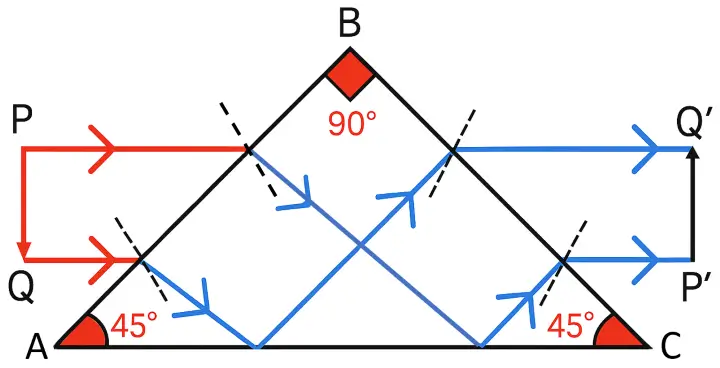
- Light enters parallel to face AC.
- TIR at face AB, then refracted at face AC.
- The face AC behaves like a mirror due to TIR.
- No deviation in direction, but inverted image becomes erect.
Used in: Slide projectors.
2. Equilateral triangle (each angle 60°)

- \(\angle i=45°\)
- \(\angle i_c=42°\) (Say)
- TIR takes place, No refraction
- Prism ABC, all angles = 60°.
- Light incident normally on face AB → passes undeviated.
- Strikes face AC at 60° → TIR occurs.
- Then strikes face BC at 60° → TIR occurs again.
- Emerges undeviated → net deviation = 60°.
3. Right angled prism (30°, 90°, 60°)
(i) Incident normally on face BC (side opposite to 30°)
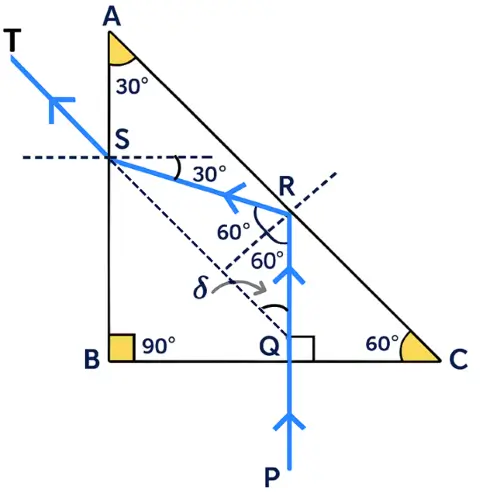
- At face AC: TIR because (\angle i=60° (i>c)\); light ray passing from Denser to rarer medium
- At face BC: No deviation
- At face AB: No TIR because \(i < c\); only refraction;
\(\angle i=30°\) and \(c=42°\)
(ii) Incident normally on face AB (side opposite to 60°)

- Condition: Light ray incident normally on face AB of the prism.
- Result: No total internal reflection.
- Reason: The angle of incidence inside the prism is 30°, which is less than the critical angle (42°).
- Outcome: Light ray gets refracted, not reflected.
(iii) Incident normally on face AC (side opposite to 90°)

- Condition: Light incident normally on the hypotenuse face (AC) below the foot of the perpendicular from the opposite corner.
- Result: Total internal reflection takes place.
- Outcome: Ray gets deviated by an angle > 60°.
Total Internal Reflecting Prism vs Plane Mirror
| Total Internal Reflection | Plane Mirror |
| 100% reflection | Less than 100% reflection |
| No energy loss | Energy loss occurs |
| Very bright image | Comparatively less bright image |
| Brightness remains unchanged | Brightness decreases with age |
| No silver coating needed | Requires silver coating |
Consequences of Total Internal Reflection
1. Mirage
A driver may see a pool of water on a hot road due to total internal reflection.
2. Empty Test Tube Appears Silvery
An empty test tube immersed in water shines like a mirror.
3. Cracks in Glass Shine
Cracks in glass often appear bright because of total internal reflection.
4. Sparkling of Diamonds
Diamonds have a very small critical angle.
Light undergoes repeated total internal reflections inside the diamond, producing brilliance.
5. Optical Fibre Communication
Optical fibres transmit light signals over long distances by repeated total internal reflection with almost no loss of energy.
ICSE Class 10 Physics Notes PDF – Refraction of Light at Plane Surfaces
Download free ICSE Class 10 Physics notes on Refraction of Light at Plane Surfaces in PDF format. Includes formulas, solved numericals, and Selina textbook solutions for quick exam revision.
Exam Preparation Tips
- Memorize laws of refraction and key formulas.
- Practice Selina ICSE Physics Chapter 4 solved examples as similar questions often appear in board exams.
- Understand real-life examples of refraction like a straw appearing bent in water, or a coin seeming closer than it is.
You can also visit :
ICSE Class 10 Physics Notes
| ☛ ICSE Class 10 Physics Chapter 1 – Force Notes |
| ☛ ICSE Class 10 Physics Chapter 2 – Work, Energy and Power Notes |
| ☛ ICSE Class 10 Physics Chapter 3 – Machines Notes |
| ☛ ICSE Class 10 Physics Chapter 4 – Refraction of Light at Plane Surfaces Notes |
| ☛ ICSE Class 10 Physics Chapter 5 – Refraction through Lens Notes Notes |
| ☛ ICSE Class 10 Physics Chapter 6 – Spectrum Notes |
| ☛ ICSE Class 10 Physics Chapter 7 – Sound Notes |
| ☛ ICSE Class 10 Physics Chapter 8 – Current Electricity Notes |
| ☛ ICSE Class 10 Physics Chapter 9 – Electrical Power and Household Circuits Notes |
| ☛ ICSE Class 10 Physics Chapter 10 – Electro-magnetism Notes |
| ☛ ICSE Class 10 Physics Chapter 11 – Calorimetry Notes |
| ☛ ICSE Class 10 Physics Chapter 12 – Radioactivity Notes |
Official Website:
Students can visit the official CISCE website for more details and updates.