ICSE Class 10 Spectrum Notes – Physics Revision Guide
Prepare for your ICSE Class 10 Physics examination with these complete Spectrum Notes based on the latest ICSE syllabus. These notes cover every important concept including the electromagnetic spectrum, infrared rays, ultraviolet rays, X-rays, gamma rays, visible spectrum, properties, uses, detection methods, and previous year exam questions in an easy-to-understand format.
Our ICSE Class 10 Physics Chapter 6 Spectrum Notes PDF are specially designed for quick revision and board exam preparation. Each topic is explained with simple language, diagrams, tables, memory tricks, and important points frequently asked in ICSE examinations.
Study Support by Rohit Academy
Rohit Academy offers expert-curated ICSE Class 10 Physics Study Materials including ICSE Spectrum Chapter Notes, diagrams, and key formulas for better understanding.
Study materials related to chapter 6 : Spectrum
To help you prepare the entire chapter thoroughly, explore the following study resources related to Chapter 6 Spectrum:
Section A : Deviation, Dispersion and Spectrum
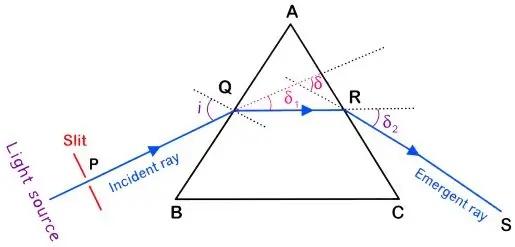
Deviation Produced by a Triangular Prism
Definition
Deviation is the change in the direction of a light ray when it passes through a prism.
Formula:
Total deviation (δ) = δ1 + δ2
Where:
- δ1 = Deviation at the first surface
- δ2 = Deviation at the second surface
Factors affecting deviation by a prism :
(i) Angle of incidence (i) : deviation first decreases, becomes minimum at the angle of minimum deviation, then increases as i increases.
(ii) Angle of prism (A) : larger A gives larger deviation.
(iii) Refractive index / colour (μ or λ) : higher μ (shorter wavelength) gives larger deviation.
Dependence of deviation on the colour (or wavelength) of light
- When white light passes through a prism, different colours deviate by different amounts because the refractive index of the prism varies with the wavelength of light.
- Different colours travel with different speeds inside glass.
- Shorter wavelength → Higher refractive index → Greater deviation
- Longer wavelength → Lower refractive index → Smaller deviation
- Colour is a subjective property of light and is determined by its wavelength.
***Note
- Red colour ⇨ Highest Wavelength ⇨ Maximum Velocity ⇨ Least Deviation ⇨ least frequency
- Violet colour ⇨ least Wavelength ⇨ Minimum Velocity ⇨ maximum Deviation ⇨ maximum frequency
Order of Deviation
| Colour | Deviation |
| Violet | Maximum |
| Indigo | High |
| Blue | High |
| Green | Moderate |
| Yellow | Less |
| Orange | Lower |
| Red | Minimum |
Colours of White Light
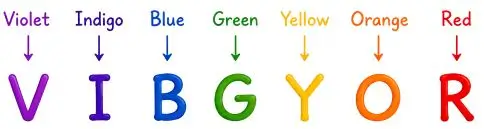
White light consists of seven colours.
Wavelength and Frequency of Colours
| Colour | Wavelength (Approx.) | Frequency (Approx.) |
| Violet | 400 – 446 nm | Highest |
| Indigo | 446 – 464 nm | High |
| Blue | 464 – 500 nm | High |
| Green | 500 – 578 nm | Medium |
| Yellow | 578 – 592 nm | Medium |
| Orange | 592 – 620 nm | Low |
| Red | 620 – 800 nm | Lowest |
Remember
- Shortest wavelength: Violet (≈400 nm)
- Longest wavelength: Red (≈800 nm)
- Highest frequency: Violet
- Lowest frequency: Red
- Maximum deviation: Violet
- Minimum deviation: Red
Relation Between Wavelength and Frequency
Formula
c = fλ
Where,
- c = Speed of light
- f = Frequency
- λ = Wavelength
Dispersion of White Light
Definition
Dispersion is the splitting of white light into its constituent colours when it passes through a prism.
Spectrum
Definition
The band of seven colours obtained on passing white light through a prism is called the spectrum.
Newton’s Prism Experiment
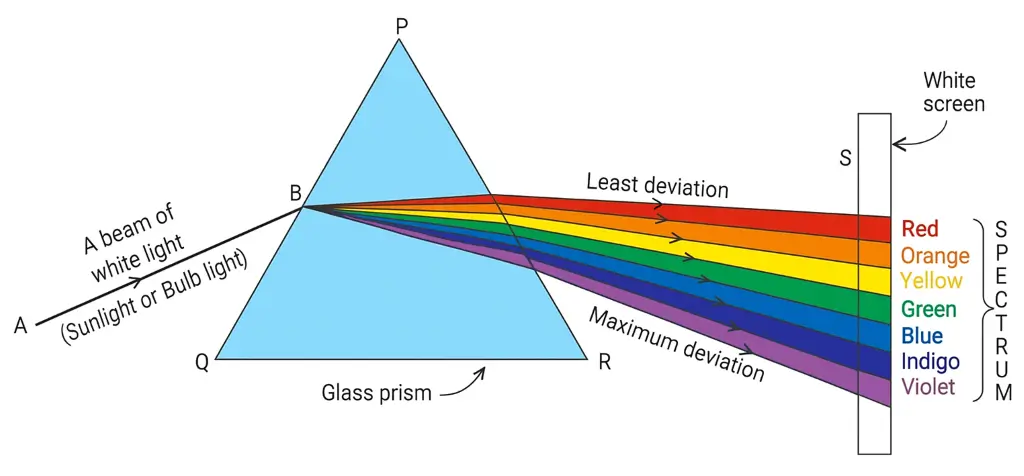
Sir Isaac Newton passed sunlight through a small opening and then through a glass prism.
Observation
A band of seven colours appeared on a white screen.
Conclusion
- White light is a mixture of seven colours.
- Each colour has a different wavelength.
- White light is polychromatic.
Cause of Dispersion
- Light of different colours has different wavelengths and speeds in glass.
- Different colours deviate by different angles at the first surface of the prism.
- Violet deviates the most; Red deviates the least.
- At the second surface, only refraction occurs → colours spread further to form the spectrum.
Important Notes
- Dispersion occurs at the first surface of the prism.
- Refraction takes place at both surfaces.
- A prism does not create colours.
- It only separates colours already present in white light.
Speed of Light in Glass
- Speed is maximum for red light.
- Speed is minimum for violet light.
As wavelength increases,
- Speed increases
- Refractive index decreases
Section B : Electromagnetic Spectrum and its Broad Classification
Electromagnetic Spectrum
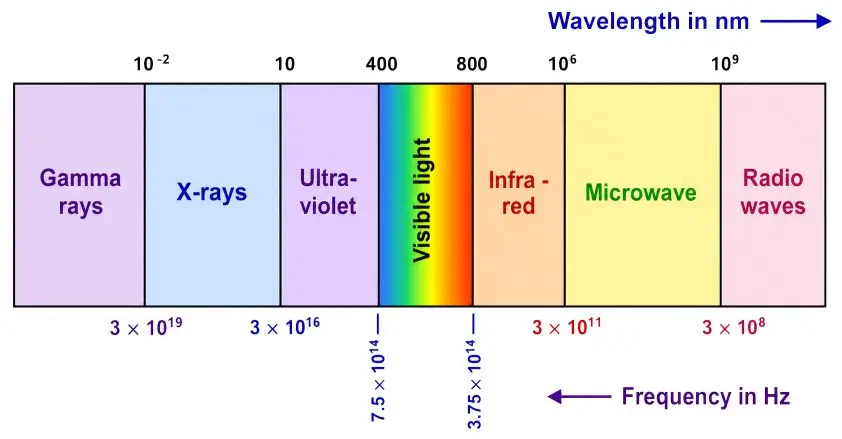
- The Electromagnetic Spectrum (EMS) is the complete range of electromagnetic waves arranged according to their wavelength or frequency.
- The visible spectrum is only a small part of the electromagnetic spectrum. Waves beyond the visible region are called the invisible spectrum.
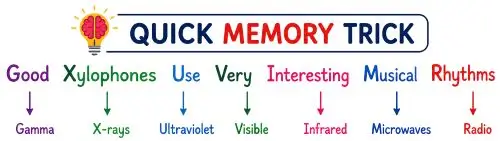
Order of Electromagnetic Waves
Increasing Wavelength (Decreasing Frequency)
- Gamma Rays
- X-rays
- Ultraviolet Rays
- Visible Light
- Infrared Rays
- Microwaves
- Radio Waves
Increasing Frequency (Decreasing Wavelength)
Radio Waves → Microwaves → Infrared → Visible Light → Ultraviolet → X-rays → Gamma Rays
Electromagnetic Wave Formula
c = fλ
Where:
- c = Speed of light = 3 × 10⁸ m/s
- f = Frequency
- λ = Wavelength
***Note:
Frequency remains unchanged because it is determined by the source of the wave.
Properties Common to All Electromagnetic Waves
- They do not require a material medium.
- They travel in vacuum at 3 × 10⁸ m/s.
- They are transverse waves.
- They obey reflection and refraction.
- Their frequency remains constant when entering another medium.
- They are not deflected by electric or magnetic fields.
Units
- 1 nm = 10–9 m
- 1 Å = 10–10 m
- 1 nm = 10 Å
Ranges of electromagnetic waves
| Name of the wave | Wavelength | Frequency |
| Gamma rays | \(Less\ than\ 0.1\ Å\) \(\left(or,\ 0.01\ nm\right)\) | \(Greater\ than\ 3\times{10}^{19}\ \ Hz\) |
| X-rays | \(0.1\ Å\ to\ 100\ Å\)\(\left(or,\ \ 0.01\ nm\ to\ 10\ nm\right)\) | \(3\times{10}^{19}\ to\ \ 3\times{10}^{16}\ Hz\) |
| Ultraviolet | \(100\ Å\ to\ 4000 Å\)\(\left(or,\ \ 10\ nm\ to\ 400\ nm\right)\) | \(3\times{10}^{16}\ to\ \ 7.5\times{10}^{14}\ Hz\) |
| Visible Light | \(4000\ Å\ to\ 8000 Å\)\(\ \left(or,\ \ 400\ nm\ to\ 800\ nm\right)\) | \(7.5\ \times{10}^{14}\ to\ \ 3.75\times{10}^{14}\ Hz\) |
| Infrared waves | \(8000\ Å\ to\ 10^7 Å\)\(\left(or,\ \ 800\ nm\ to\ {10}^6\ nm\right)\) | \(3.75\ \times{10}^{14}\ \ to\ \ 3\times{10}^{11}\ Hz\) |
| Microwaves | \(10^7\ Å\ to\ 10^{11} Å\)\(\left(or,\ \ {10}^6\ nm\ to\ {10}^{10}\ nm\right)\) | \(3\ \times{10}^{11}\ \ to\ \ 3\times{10}^7\ Hz\) |
| Radio waves | \(more\ than\ 10^{11} Å\)\(\left(or,\ \ {10}^{10}\ nm\right)\) | \(below\ 3\ \times{10}^7\) |
1. Gamma rays
❖ Source of gamma rays:
- Radioactive substances
- Cosmic rays
❖ Properties of gamma rays:
- Shortest wavelength
- Most energetic electromagnetic radiations
- Highest frequency
- Highest penetrating power
- Cause fluorescence
- Can pass through thick metal sheets
- Harmful to living tissues
❖ Uses of gamma rays:
- Cancer treatment (Radiotherapy)
- Detecting cracks in metal
- Industrial radiography
2. X-rays
❖ Source of X-rays:
- Produced when fast electrons strike a heavy metal target
❖ Method of detection of X-rays:
- X-rays are detected by the fluorescence produced on a zinc sulphide screen.
❖ Properties of X-rays:
- Highly penetrating
- Affect photographic plates
- Cause fluorescence
- Pass through flesh but are absorbed by bones
❖ Uses of X-rays:
- Detect bone fractures
- Dental diagnosis
- CT Scan
- To study the atomic arrangement in crystals and complex molecules
- Security scanning
3. Ultraviolet radiations
❖ Source of UV:
- Sun
- Electric arc
- Mercury vapour lamp
- Electric sparks
❖ Method of detection of UV:
- UV rays are detected by their chemical effect on silver chloride, dyes, and photographic plates.
- The ultraviolet spectrum is obtained using a quartz prism, as quartz transmits UV rays, whereas glass absorbs them.
❖ Properties of UV:
- Pass through quartz
- Absorbed by glass
- Cause fluorescence
- Affect photographic plates
- Chemically active
- Scattered by dust
❖ Harmful Effects of UV:
- Skin cancer
- Eye damage
- Sunburn
❖ Uses of UV:
- Sterilization
- Detect fake currency
- Detect purity of gems
- Vitamin D production
4. Visible Light
❖ Source of Visible Light:
- Sun
- Electric bulb
- Flame
- White hot objects
❖ Method of detection of Visible Light:
- Seen by human eye
❖ Uses of Visible Light:
- Vision
- Photography
- Photosynthesis
- Optical instruments
5. Infrared waves
❖ Source of Infrared waves:
- Hot bodies
- Heated iron
- Fire
- Sun
❖ Method of detection of Infrared waves:
- Blackened bulb thermometer – Shows a rise in temperature due to the heating effect of infrared rays.
- Thermopile – Produces a deflection when infrared rays fall on it.
- Rock-salt prism – Used to obtain the infrared spectrum because glass absorbs infrared rays.
❖ Properties of Infrared waves:
- Strong heating effect
- Less scattered by atmosphere
- Pass through rock salt
- Absorbed by glass
- Detected using thermopile
❖ Harmful Effects of Infrared waves:
- High exposure may cause skin burns.
❖ Uses of Infrared waves:
- TV remote controls – Used to transmit signals to electronic devices.
- Night photography – Used to take photographs in darkness.
- Physiotherapy – Used for heat treatment to relieve pain and improve blood circulation.
- Infrared lamps – Used in dark rooms for photographic development.
- Fog photography – Used because infrared rays are scattered less by fog and mist.
- Military signalling – Used for secret communication as infrared rays are invisible.
6. Microwaves
❖ Source of Microwaves:
- Crystal oscillators
- Electronic devices
❖ Uses of Microwaves:
- Satellite communication.
- Atomic and molecular structure analysis.
- Microwave ovens (cooking).
- Radar communication.
7. Radio waves
❖ Properties of Radio waves:
- Longest wavelength
- Lowest frequency
- Lowest energy
❖ Uses of Radio waves:
- Radio broadcasting
- Television transmission
- Radar communication
- Wireless communication
Important Points for Exams
- Shortest wavelength: Gamma rays
- Longest wavelength: Radio waves
- Highest frequency: Gamma rays
- Lowest frequency: Radio waves
- Highest energy: Gamma rays
- Lowest energy: Radio waves
- Visible light range: 400 – 800 nm
- Speed of all electromagnetic waves in vacuum: 3 × 10⁸ m/s
- Ultraviolet rays pass through quartz but not glass.
- Infrared rays pass through rock salt but are absorbed by glass.
- Microwaves are used in satellite communication and microwave ovens.
- Radio waves are used for radio and television broadcasting.
Section C : Scattering of light and its applications
SCATTERING OF LIGHT
Definition
Scattering of light is the process in which light is absorbed by tiny particles and then re-emitted in different directions.
It occurs due to the presence of air molecules, dust particles, smoke, and tiny water droplets in the Earth’s atmosphere.
Dependence of colour of scattered light
- If particles are very fine, they scatter mainly the blue colour of light (shorter wavelength).
- Medium sized particles scatter mainly the red colour (longer wavelength).
- Even larger particles scatter all the colours of light that is why it appears white.
Rayleigh’s Law of Scattering
For particles smaller than the wavelength of light,
Where:
- I = Intensity of scattered light
- λ = Wavelength of light
Conclusion
- Shorter wavelength → More scattering
- Longer wavelength → Less scattering
Therefore,
- Violet light is scattered the most.
- Red light is scattered the least.
Why Does Violet Scatter More?
- Violet has the shortest wavelength (≈400 nm).
- Red has the longest wavelength (≈800 nm).
- Since scattering is inversely proportional to the fourth power of wavelength, violet is scattered much more than red.
When Does Rayleigh’s Law Apply?
The relation is valid only when the scattering particles are smaller than the wavelength of the incident light.
If the particles are larger than the wavelength (such as water droplets in clouds), all colours are scattered almost equally.
Applications of Scattering of Light
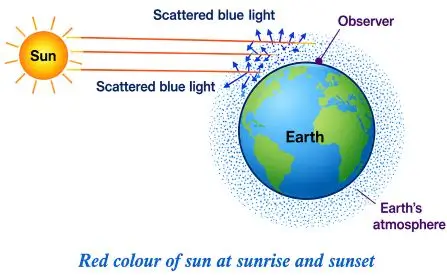
1. Red Colour of the Sun at Sunrise and Sunset
❖ Reason
- During sunrise and sunset, sunlight travels the longest distance through the atmosphere.
- Blue and violet light are scattered away before reaching our eyes.
- Mostly red light reaches the observer.
❖ Result
- The Sun appears red or orange.
2. White Colour of the Sky at Noon
❖ Reason
- At noon, the Sun is nearly overhead.
- Sunlight travels the shortest distance through the atmosphere.
- Very little scattering occurs.
❖ Result
- The sky appears white.
3. Blue Colour of the Sky
❖ Reason
- The upper layer of atmosphere contains very fine particles of water vapours and gases. These particles scatter short-wavelength light (blue and violet) more than red light.
- The scattered blue light reaches our eyes from all directions.
❖ Result
- The sky appears blue.
4. Black Sky in the Absence of Atmosphere
❖ Reason
Without an atmosphere:
- No air molecules are present.
- No scattering occurs.
❖ Result
- The sky appears black, as seen from the Moon or outer space.
5. White Colour of Clouds
❖ Reason
Clouds contain:
- Water droplets
- Ice crystals
- Dust particles
These particles are larger than the wavelength of visible light, so they scatter all colours equally.
❖ Result
- Clouds appear white.
6. Why is Red Light Used for Danger Signals?
❖ Reason
- Red light has the longest wavelength.
- It is scattered the least.
- It can travel a greater distance through fog, smoke, rain, and dust.
❖ Applications
- Traffic signals
- Railway signals
- Warning lights
- Emergency vehicles
ICSE Class 10 Spectrum Physics Notes PDF Download
To help you revise quickly, we are providing ICSE Class 10 Spectrum Physics Notes PDF Download with key concepts, Selina Solutions, and important questions.
Final Tip for ICSE Students
Revise the ICSE Class 10 Spectrum Physics Notes PDF daily, practice diagrams, and solve numericals regularly. With consistent preparation, you can easily score full marks in this chapter.
You can also visit:
ICSE Class 10 Physics Notes
| ☛ ICSE Class 10 Physics Chapter 1 – Force Notes |
| ☛ ICSE Class 10 Physics Chapter 2 – Work, Energy and Power Notes |
| ☛ ICSE Class 10 Physics Chapter 3 – Machines Notes |
| ☛ ICSE Class 10 Physics Chapter 4 – Refraction of Light at Plane Surfaces Notes |
| ☛ ICSE Class 10 Physics Chapter 5 – Refraction through Lens Notes |
| ☛ ICSE Class 10 Physics Chapter 6 – Spectrum Notes |
| ☛ ICSE Class 10 Physics Chapter 7 – Sound Notes |
| ☛ ICSE Class 10 Physics Chapter 8 – Current Electricity Notes |
| ☛ ICSE Class 10 Physics Chapter 9 – Electrical Power and Household Circuits Notes |
| ☛ ICSE Class 10 Physics Chapter 10 – Electro-magnetism Notes |
| ☛ ICSE Class 10 Physics Chapter 11 – Calorimetry Notes |
| ☛ ICSE Class 10 Physics Chapter 12 – Radioactivity Notes |
Official Websites