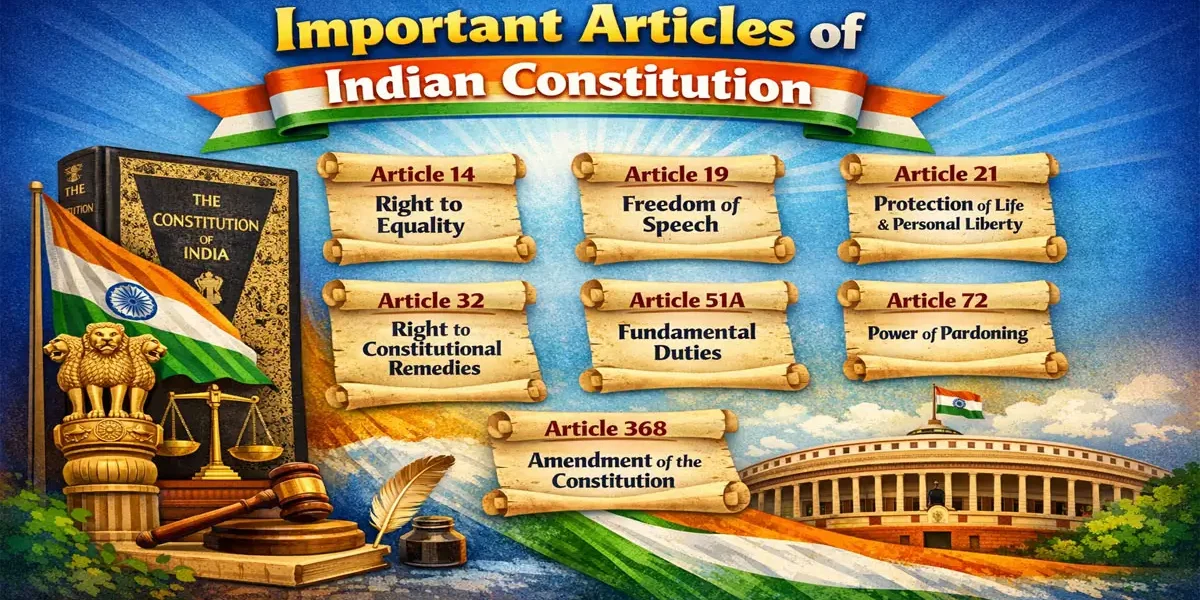
Indian Constitution Articles List
The Indian Constitution is the backbone of India’s democratic system. It is one of the longest written constitutions in the world and contains numerous Articles that define the structure, powers, and functions of the government, along with the rights and duties of citizens.
For students preparing for competitive exams like UPSC, SSC, WBPSC, understanding the important Articles of the Indian Constitution is extremely crucial. In this article, we will cover a complete list of important Articles with detailed explanations in a simple and easy-to-understand manner.
Overview of Indian Constitution
The Constitution is divided into different Parts, and each Part contains several Articles dealing with specific subjects.
- Adopted: 26 November 1949
- Enforced: 26 January 1950
- Present Structure: 25 Parts, 12 Schedules, 448 Articles
Static GK Notes and Exam Support by Rohit Academy:
Rohit Academy offers simplified Static GK notes designed for easy comprehension, ideal for competitive exams such as UPSC, SSC, banking, railways, and state-level tests. Free study resources are available to support students across these exams. Some frequently asked questions related to this topic are provided below, which are very important for exam preparation. Check Rohit Academy’s official website or platform for access.
Parts of the Indian Constitution
| Part | Subject | Articles |
| Part I | Union and its Territory | Article 1–4 |
| Part II | Citizenship | Article 5–11 |
| Part III | Fundamental Rights | Article 12–35 |
| Part IV | Directive Principles of State Policy | Article 36–51 |
| Part IV-A | Fundamental Duties | Article 51A |
| Part V | The Union | Article 52–151 |
| Part VI | The States | Article 152–237 |
| Part VII | Repealed by 7th Amendment Act, 1956 | — |
| Part VIII | Union Territories | Article 239–242 |
| Part IX | Panchayats | Article 243–243O |
| Part IX-A | Municipalities | Article 243P–243ZG |
| Part IX-B | Co-operative Societies | Article 243ZH–243ZT |
| Part X | Scheduled and Tribal Areas | Article 244–244A |
| Part XI | Relations between Union and States | Article 245–263 |
| Part XII | Finance, Property, Contracts and Suits | Article 264–300A |
| Part XIII | Trade, Commerce and Intercourse within India | Article 301–307 |
| Part XIV | Services under the Union and States | Article 308–323 |
| Part XIV-A | Tribunals | Article 323A–323B |
| Part XV | Elections | Article 324–329A |
| Part XVI | Special Provisions for Certain Classes | Article 330–342 |
| Part XVII | Official Language | Article 343–351 |
| Part XVIII | Emergency Provisions | Article 352–360 |
| Part XIX | Miscellaneous | Article 361–367 |
| Part XX | Amendment of the Constitution | Article 368 |
| Part XXI | Temporary, Transitional and Special Provisions | Article 369–392 |
| Part XXII | Short Title, Commencement, Authoritative Text in Hindi and Repeals | Article 393–395 |
Important Articles of Indian Constitution
🔹 Fundamental Rights (Part III)
- Article 12 – Definition of State
- Article 13 – Laws inconsistent with Fundamental Rights
- Article 14 – Equality before law
- Article 15 – Prohibition of discrimination
- Article 16 – Equality in public employment
- Article 17 – Abolition of untouchability
- Article 18 – Abolition of titles
👉 Freedom Rights
- Article 19 – Six freedoms (speech, movement, etc.)
- Article 20 – Protection in criminal cases
- Article 21 – Right to life & personal liberty
- Article 21A – Right to elementary education (added by the 86th Amendment).
👉 Against Exploitation
- Article 23 – Prohibition of human trafficking
- Article 24 – Prohibition of child labour
👉 Freedom of Religion
- Article 25–28 – Religious freedom
👉 Cultural & Educational Rights
- Article 29–30 – Minority rights
👉 Constitutional Remedies
- Article 32 – Right to Constitutional Remedies (Dr. B.R. Ambedkar called this the “Heart and Soul” of the Constitution)
🔹 Directive Principles of State Policy (Part IV)
- Article 36–51 – DPSP
- Article 38 – Social order for welfare
- Article 39 – Equal livelihood, prevention of wealth concentration
- 39A – Free legal aid
- Article 40 – Panchayati Raj
- Article 44 – Uniform Civil Code
- Article 45 – Early childhood education
- Article 48A – Protection of environment
🔹 Fundamental Duties (Part IVA)
- Article 51A – Lists the 11 Fundamental Duties (Added by the 42nd Amendment).
🔹 Union Executive
- Article 52 – President of India
- Article 53 – Executive power of Union
- Article 54–55 – Election of President
- Article 61 – Impeachment of President
- Article 63 – Vice-President
- Article 74 – Council of Ministers
- Article 75 – PM & Ministers
🔹 Parliament
- Article 79 – Parliament structure
- Article 80 – Rajya Sabha
- Article 81 – Lok Sabha
- Article 85 – Sessions of Parliament
- Article 86 – President’s address
- Article 100 – Voting in Houses
- Article 108 – Joint sitting
🔹 Judiciary
- Article 124 – Supreme Court
- Article 129 – SC as Court of Record
- Article 136 – Special Leave Petition (SLP)
- Article 141 – Law declared by SC binding
- Article 142 – Complete justice
- Article 143 – Advisory jurisdiction
👉 High Court
- Article 214 – High Courts
- Article 226 – Writ jurisdiction
🔹 Emergency Provisions
- Article 352 – National Emergency
- Article 356 – President’s Rule
- Article 360 – Financial Emergency
🔹 Other Important Articles
- Article 300A – Right to Property (Legal right)
- Article 312 – All India Services
- Article 315 – UPSC
- Article 324 – Election Commission
- Article 326 – Adult suffrage (Voting rights)
- Article 368 – Amendment of Constitution
Important Constitutional Bodies & Misc
| Article | Subject Matter | Why Important? |
| Article 280 | Finance Commission | Decides tax sharing between Union & States |
| Article 300A | Right to Property | Now a legal right (not Fundamental Right) |
| Article 312 | All-India Services | Creation of IAS, IPS, IFoS |
| Article 315 | Public Service Commissions | UPSC & State PSCs |
| Article 324 | Election Commission | Conducts all elections |
| Article 338 | National Commission for SCs | Safeguards SC rights |
| Article 343 | Official Language | Hindi in Devanagari script |
| Article 368 | Amendment of Constitution | Procedure to amend Constitution |
Schedules of Indian Constitution
| Schedules | Features of Schedules |
| First Schedule | Names of States & Union Territories, Their territorial jurisdiction |
| Second Schedule | Salaries, allowances & privileges of: ● President & Governors ● Lok Sabha Speaker & Deputy Speaker ● Rajya Sabha Chairman & Deputy Chairman ● State Assembly Speakers ● Judges of SC & High Courts ● Comptroller and Auditor General (CAG) |
| Third Schedule | Forms of Oaths & Affirmations for: ● Ministers (Union & State) ● MPs & MLAs ● Judges (SC & HC) ● Election candidates |
| Fourth Schedule | Allocation of seats in Rajya Sabha (States & UTs) |
| Fifth Schedule | Administration & control of: ● Scheduled Areas ● Scheduled Tribes |
| Sixth Schedule | Administration of Tribal Areas (Assam, Meghalaya, Tripura, Mizoram) |
| Seventh Schedule | Division of powers between Centre & State: ● Union List ● State List● Concurrent List |
| Eighth Schedule | List of 22 Official Languages of India |
| Ninth Schedule | ● Laws protected from Judicial Review ● Added by 1st Amendment Act, 1951 |
| Tenth Schedule | Anti-Defection LawDisqualification of MPs & MLAs |
| Eleventh Schedule | ● Powers of Panchayats ● Contains 29 subjects ● Added by 73rd Amendment (1992) |
| Twelfth Schedule | ● Powers of Municipalities ● Contains 18 subjects ● Added by 74th Amendment (1992) |
Important Articles of Indian Constitution PDF
Importance of These Articles for Exams:
These Articles are frequently asked in exams like:
- UPSC Civil Services
- SSC CGL / CHSL
- WBPSC
- State PCS
Common Question Examples:
- Article 21 deals with? → Right to Life
- Article 32 is called? → Heart and Soul
- Article 356 relates to? → President’s Rule
You Can Also Visit:
| Complete List of Static GK |
| Study Materials for Competitive Examination |
| List of Important Articles of Indian Constitution in Hindi |
| List of Important Articles of Indian Constitution in Bengali |
Official Websites:
By clicking the following link, you can visit the official website of the respective organization.
- NCERT
- Union Public Service Commission (UPSC)
- Staff Selection Commission (SSC)
- Railway Requirement Board (RRB
- Uttar Pradesh Public Service Commission (UPPSC)
- Uttar Pradesh Subordinate Services Selection Commission (UPSSSC)
- Bihar Public Service Commission (BPSC)
- Public Service Commission, West Bengal (WBPSC)
- West Bengal Police Recruitment Board (WBPRB)
- Delhi Subordinate Services Selection Board (DSSSB)
Important Questions on Articles of Indian Constitution
Question 1
Which Article guarantees “Equality before Law”?
Answer: Article 14
Question 2
Which Article provides for “Equality of opportunity in public employment”?
Answer: Article 16
Question 3
Which Article abolishes untouchability?
Answer: Article 17
Question 4
Right to Freedom is given under which Article?
Answer: Article 19
Question 5
Which Article is known as the “Heart and Soul of the Constitution”?
Answer: Article 32
Question 6
Right to Education is provided under which Article of the Indian Constitution?
Answer: Article 21A
Question 7
The Right to Education was inserted by which Constitutional Amendment?
Answer: 86th Amendment → Article 21A
Question 8
Under which Article can the Supreme Court issue writs?
Answer: Article 32
Question 9
Uniform Civil Code is mentioned in which Article?
Answer: Article 44
Question 10
Free legal aid is provided under which Article?
Answer: Article 39A
Question 11
Fundamental Duties are included in which Article
Answer: Article 51A
Question 12
Writ jurisdiction of High Court is given under which Article?
Answer: Article 226
Question 13
Special Leave Petition (SLP) is related to which Article?
Answer: Article 136
Question 14
National Emergency is declared under which Article?
Answer: Article 352
Question 15
Which Article deals with President’s Rule in a State?
Answer: Article 356
Question 16
Financial Emergency is declared under:
Answer: Article 360
Question 17
Election Commission is mentioned under which Article?
Answer: Article 324
Question 18
Amendment of the Constitution is done under which Article?
Answer: Article 368
Question 19
Right to Property is a legal right under which Article?
Answer: Legal Right – Article 300A
Important Questions on Schedules of Indian Constitution
Question 20
Which of the following is dealt with in the 7th Schedule of the Indian Constitution?
Answer: Division of Powers
Question 21
How many languages are included in the 8th Schedule of the Indian Constitution?
Answer: 22
Question 22
The Anti-Defection Law is provided under which Schedule of the Indian Constitution?
Answer: 10th Schedule
Question 23
Panchayati Raj institutions are mentioned under which Schedule of the Indian Constitution?
Answer: 11th Schedule
Question 24
Provisions related to Municipalities are given under which Schedule of the Indian Constitution?
Answer: 12th Schedule
Question 25
Laws protected from judicial review are included in which Schedule of the Indian Constitution?
Answer: 9th Schedule
Question 26
Salaries and allowances of constitutional authorities are mentioned in which Schedule of the Indian Constitution?
Answer: 2nd Schedule
Question 27
Forms of oath and affirmation are provided in which Schedule of the Indian Constitution?
Answer: 3rd Schedule
Question 28
Scheduled Areas and Scheduled Tribes are dealt with under which Schedule of the Indian Constitution?
Answer: 5th Schedule
Question 29
The administration of tribal areas in Assam, Meghalaya, Tripura and Mizoram is provided under which Schedule?
Answer: 6th Schedule
Question 30
The Ninth Schedule was added to the Indian Constitution by which Amendment?
Answer: 1st Amendment, 1951
Question 31
How many subjects are included in the Eleventh Schedule?
Answer: 29
Question 32
How many subjects are included in the Twelfth Schedule?
Answer: 18
Question 33
The allocation of seats in the Rajya Sabha is provided under which Schedule?
Answer: 4th Schedule
Question 34
The names of States and Union Territories are mentioned in which Schedule of the Indian Constitution?
Answer: 1st Schedule