Selina Solutions for ICSE Class 10 Physics Exercise 5(D) – Refraction Through a Lens
Welcome to the complete Selina Solutions for ICSE Class 10 Physics Chapter 5 Exercise 5(D) – Refraction Through a Lens. This page provides accurate, step-by-step answers to all the questions from Exercise 5(D), helping students understand every concept clearly and prepare effectively for the ICSE Class 10 board examination.
Exercise 5(D) focuses on higher-level conceptual and numerical problems based on refraction through convex and concave lenses, lens formula, magnification, power of a lens, image formation, sign convention, and ray diagrams. Every solution is presented in a simple, exam-oriented format so that students can easily grasp the concepts and apply them in their examinations.
Study Support by Rohit Academy
Rohit Academy offers expert-curated ICSE Class 10 Physics Study Materials including ICSE Refraction Through a Lens Selina Solutions, diagrams, and key formulas for better understanding.
Study materials related to chapter 5: Refraction Through a Lens
(A) Multiple Choice Type
(Choose the correct answer from the options given below).
Question 1
The least distance of distinct vision of normal eye is:
(a) 25 mm (b) 25 cm
(c) 2.5 cm (d) 20 mm
Answer:
(b) 25 cm
Explanation:
The least distance of distinct vision (near point) of a normal adult eye is 25 cm. At this distance, the eye can see objects clearly without strain.
Question 2
A magnifying glass forms:
(a) a real and diminished image
(b) a real and magnified image
(c) a virtual and magnified image
(d) a virtual and diminished image
Answer:
(c) a virtual and magnified image
Explanation:
A magnifying glass is a convex lens. When the object is placed between the optical centre and the principal focus, it produces a virtual, erect, and magnified image.
Question 3
The maximum magnifying power of a convex lens of focal length 5 cm can be:
(a) 25 (b) 10
(c) 1 (d) 6
Answer:
(d) 6
Explanation:
The maximum magnifying power of a simple microscope is:
where,
- D = 25 cm (least distance of distinct vision)
- f = 5 cm
M = 1 + 25/5 = 1 + 5 = 6
Hence, the correct answer is 6.
Question 4
The human eye is not able to see an object distinctly if it subtends an angle:
(a) equal to 10′ (b) less than 1′
(c) more than 1′ (d) more than 5’
Answer:
(b) less than 1′
Explanation:
The human eye can distinguish two points only if they subtend an angle of about 1 minute (1′) at the eye. If the angle is less than 1′, the points appear as a single point.
Question 5
A simple microscope uses a:
(a) convex lens of short focal length
(b) convex lens of large focal length
(c) concave lens of short focal length
(d) concave lens of large focal length
Answer:
(a) convex lens of short focal length
Explanation:
A simple microscope consists of a convex lens with a short focal length. A shorter focal length provides a higher magnifying power.
Question 6
Magnifying power of a microscope is given as:
(a) (b)
(c) (d)
Answer:
(d)
Explanation:
For a simple microscope, when the final image is formed at the least distance of distinct vision, the magnifying power is:
where D = 25 cm and f is the focal length of the lens.
Question 7
A person suffering from long sightedness wears spectacles having a …………… lens and a person suffering from short sightedness wears spectacles having …………… lens.
(a) convex, convex
(b) concave, concave
(c) concave, convex
(d) convex, concave
Answer:
(d) convex, concave
Explanation:
- Long-sightedness (Hypermetropia) is corrected using a convex lens.
- Short-sightedness (Myopia) is corrected using a concave lens.
Therefore, the correct answer is convex, concave.
Question 8
A boy has two lenses A and B. When lens A is kept near a printed page, letters appear magnified. When lens B is used to see a distant object, an upright image is seen. The lenses A and B are:
(a) both are convex
(b) both are concave
(c) A ⟶ concave, B ⟶ convex
(d) A ⟶ convex, B ⟶ concave
Answer:
(d) A → convex, B → concave
Explanation:
- Lens A magnifies nearby objects, so it is a convex lens (used as a magnifying glass).
- Lens B forms an upright and diminished image of distant objects, which is a property of a concave lens.
Hence, Lens A is convex and Lens B is concave.
(B) Short Questions
Question 1
What is a magnifying glass? State its two uses.
Answer:
A magnifying glass or simple microscope is a convex lens of short focal length used to produce a virtual, erect, and magnified image of a small object.
Uses:
- To read small print in books, newspapers, maps, etc.
- To examine small objects such as stamps, coins, insects, jewellery, and watch parts.
Question 2
Where is the object placed with respect to the principal focus of a magnifying glass, so as to see its enlarged image? Where is the image obtained?
Answer:
The object is placed between the optical centre and the principal focus (F) of the convex lens.
The image formed is:
- Virtual
- Erect
- Magnified
It is obtained on the same side of the lens as the object.
Question 3
Write an expression for the magnifying power of a simple microscope. How can it be increased?
Answer:
The magnifying power of a simple microscope is:
Where,
- M = Magnifying power
- D = Least distance of distinct vision (25 cm)
- f = Focal length of the lens
Magnifying power can be increased by using a convex lens of shorter focal length, because a smaller value of f increases the value of M.
Question 4
State two applications each of a convex and a concave lens.
Answer:
Applications of a Convex Lens
- Used as a magnifying glass (simple microscope).
- Used in cameras, projectors, microscopes, and telescopes to form images.
Applications of a Concave Lens
- Used in spectacles to correct myopia (short-sightedness).
- Used in door viewers (peepholes) to obtain a wide field of view.
Question 5
How will you differentiate between a convex and a concave lens by looking at (i) a distant object, (ii) a printed page?
Answer:
(i) By looking at a distant object:
- Convex lens: Produces an inverted image of the distant object.
- Concave lens: Produces an erect and diminished image of the distant object.
(ii) By looking at a printed page:
- Convex lens: If held close to the page, the letters appear magnified.
- Concave lens: The letters always appear diminished (smaller).
Question 6
What would be the effect of a change in the colour of incident light from violet to red on the focal length of the lens? Also what is the name given to this kind of a defect of lens?
Answer:
The focal length of the lens increases when the colour of the incident light changes from violet to red.
This is because:
- Violet light has a higher refractive index and is refracted more, so it has a shorter focal length.
- Red light has a lower refractive index and is refracted less, so it has a longer focal length.
This defect of a lens is called chromatic aberration.
Key Point:
fviolet < fred
because violet light bends more than red light.
(C) Long Questions
Question 1
Draw a neat labelled ray diagram to show the formation of an image by a magnifying glass. State three characteristics of the image.
Answer:
Ray Diagram: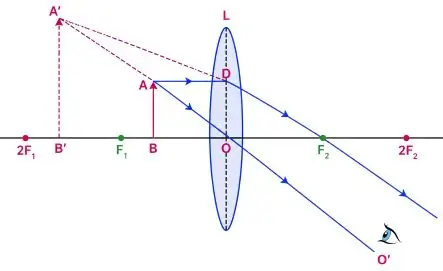
Characteristics of the image:
- Image is virtual
- Image is erect
- Image is magnified
Question 2
Describe in brief how would you determine the approximate focal length of a convex lens.
Answer:
Procedure:
- Hold the convex lens facing a distant object such as a tree or a building.
- Place a white screen (or a sheet of paper) behind the lens.
- Move the screen to and fro until a sharp, clear, and inverted image of the distant object is obtained.
- Measure the distance between the optical centre of the lens and the screen.
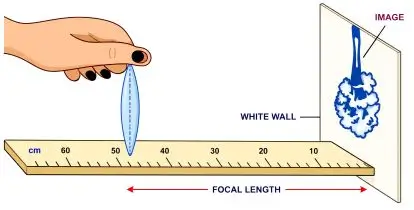
Conclusion:
Since the object is at a very large distance (approximately at infinity), the image is formed at the principal focus of the lens. Therefore, the measured distance between the lens and the screen gives the approximate focal length of the convex lens.
Question 3
The diagram in figure shows the experimental setup for determination of the focal length of a lens using a plane mirror.
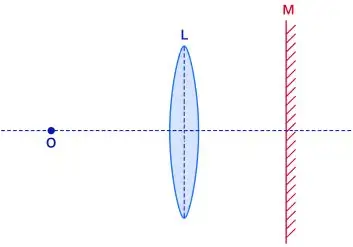
(i) Draw two rays from the point O of the object to show the formation of image I at O itself.
(ii) What is the size of the image I?
(iii) State two more characteristics of the image I.
(iv) Name the distance of the object O from the optical centre of the lens.
(v) To what point will the rays return if the mirror is moved away from the lens by a distance equal to the focal length of the lens?
Answer:
(i) The ray diagram below illustrates the formation of the image I at the same point O as the object.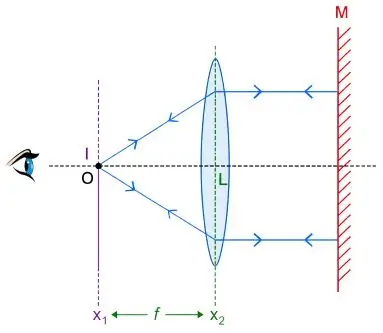
(ii) The image is the same size as the object.
(iii) The image I is inverted and real.
(iv) The distance is the focal length (f) of the convex lens.
(v) The image position remains unchanged even if the plane mirror is moved, provided the rays fall normally on the plane mirror M.
Question 4
Describe how you would determine the focal length of a converging lens, using a plane mirror and one pin. Draw a ray diagram to illustrate your answer.
Answer:
Apparatus Required:
- Convex (converging) lens
- Plane mirror
- One pin
- Vertical stand with clamp
- Metre scale and plumb line
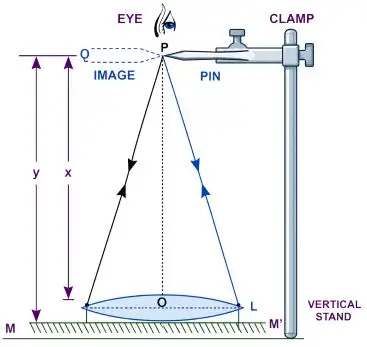
Procedure
- Place the convex lens horizontally on a plane mirror.
- Fix the pin vertically in the clamp so that its tip is exactly above the optical centre (O) of the lens.
- Adjust the height of the pin until the image of the pin coincides with the pin itself (no parallax is observed).
- Measure the distance x between the pin and the lens.
- Measure the distance y between the pin and the plane mirror.
- Calculate the focal length of the lens using:
Observation:
When there is no parallax between the pin and its image, the tip of the pin is at the principal focus of the convex lens.
Download Selina Solutions for ICSE Class 10 Physics Exercise 5(D) – Refraction Through a Lens
You can download free PDF solutions for Selina Class 10 Physics Exercise 5(D) to revise offline. These solutions are exam-ready and designed by subject experts.
Features of Our Selina Solutions
- Detailed step-by-step solutions
- Accurate calculations and explanations
- Easy-to-understand language
- Board exam-oriented approach
- Updated according to the latest ICSE syllabus
- Helpful for homework, revision, and self-study
- Prepared by experienced educators
Benefits for ICSE Students
These solutions help students:
- Master important lens concepts.
- Improve numerical-solving accuracy.
- Understand the correct use of formulas and sign conventions.
- Revise the complete chapter efficiently.
- Build confidence for school and board examinations.
Regular practice of these solutions will help students avoid common mistakes and improve their performance in Physics.
Why Choose Rohit Academy?
Rohit Academy offers comprehensive study resources for ICSE students, including:
- Chapter-wise Physics Notes
- Selina Concise Physics Solutions
- Previous Year Questions
- Important MCQs
- Assertion and Reason Questions
- Formula Sheets
- Sample Papers
- Free PDF Study Materials
All resources are designed in simple language to make learning easier and more effective.
Conclusion
The Selina Solutions for ICSE Class 10 Physics Exercise 5(D) – Refraction Through a Lens provide everything you need to prepare thoroughly for one of the most important chapters in ICSE Physics. Practice each question carefully, revise the formulas regularly, and strengthen your understanding of ray diagrams to maximize your score in the ICSE Board Examination.
Visit Rohit Academy regularly for the latest ICSE Class 10 Physics Notes, Selina Solutions, Previous Year Questions, MCQs, Sample Papers, and Free PDF Downloads to make your board exam preparation more effective.
You can also visit:
ICSE Class 10 Physics Notes
| ☛ ICSE Class 10 Physics Chapter 1 – Force Notes |
| ☛ ICSE Class 10 Physics Chapter 2 – Work, Energy and Power Notes |
| ☛ ICSE Class 10 Physics Chapter 3 – Machines Notes |
| ☛ ICSE Class 10 Physics Chapter 4 – Refraction of Light at Plane Surfaces Notes |
| ☛ ICSE Class 10 Physics Chapter 5 – Refraction through Lens Notes |
| ☛ ICSE Class 10 Physics Chapter 6 – Spectrum Notes |
| ☛ ICSE Class 10 Physics Chapter 7 – Sound Notes |
| ☛ ICSE Class 10 Physics Chapter 8 – Current Electricity Notes |
| ☛ ICSE Class 10 Physics Chapter 9 – Electrical Power and Household Circuits Notes |
| ☛ ICSE Class 10 Physics Chapter 10 – Electro-magnetism Notes |
| ☛ ICSE Class 10 Physics Chapter 11 – Calorimetry Notes |
| ☛ ICSE Class 10 Physics Chapter 12 – Radioactivity Notes |
Official Website:
Students can visit the official CISCE website for more details and updates.