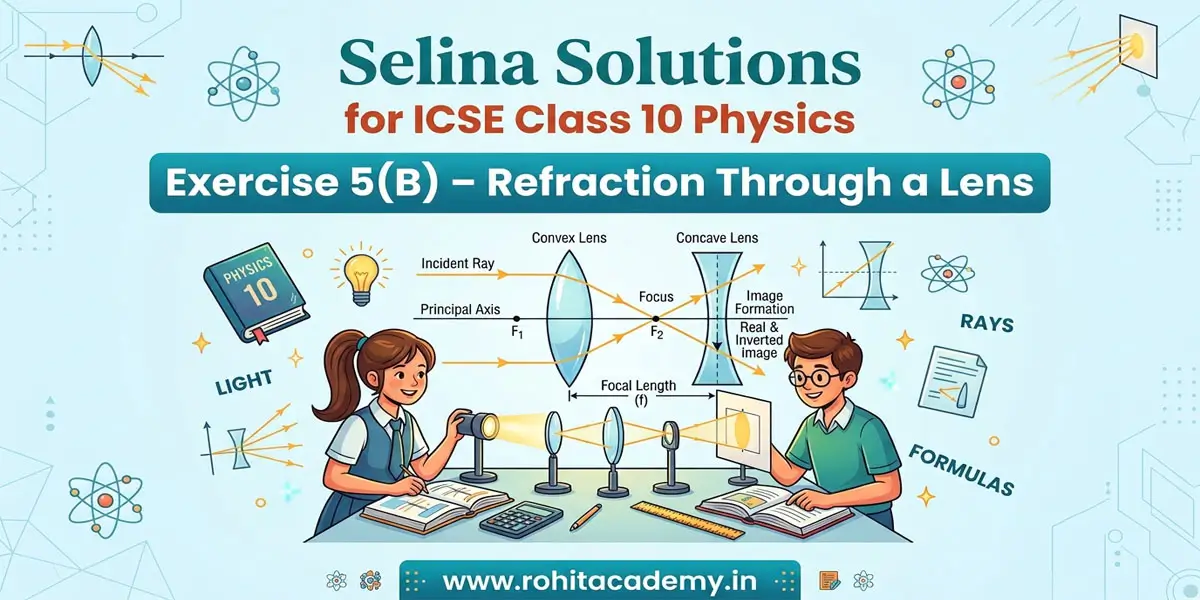
ICSE Class 10 Physics Selina Solutions – Chapter 5: Refraction Through a Lens Exercise 5(B)
Preparing for the ICSE Class 10 Physics examination becomes much easier with accurate and well-explained solutions. Exercise 5(B) of Chapter 5 – Refraction Through a Lens from the Selina Concise Physics textbook focuses on numerical problems and conceptual questions related to convex and concave lenses, sign convention, lens formula, magnification, image formation, and power of a lens.
On this page, you’ll find step-by-step Selina Solutions for ICSE Class 10 Physics Exercise 5(B) prepared according to the latest ICSE syllabus. Every answer is explained in a simple and student-friendly manner, making it easier to understand the concepts and score higher in board examinations.
Why Study Exercise 5(B)?
Exercise 5(B) helps students develop strong problem-solving skills by applying the concepts of refraction through lenses to numerical questions. Regular practice enables students to understand the relationship between object distance, image distance, focal length, magnification, and lens power.
These solutions simplify complex numerical problems with detailed calculations, helping students avoid common mistakes in examinations.
Study Support by Rohit Academy
Rohit Academy offers expert-curated ICSE Class 10 Physics Study Materials including ICSE Refraction Through a Lens Selina Solutions, diagrams, and key formulas for better understanding.
Study materials related to chapter 5: Refraction Through a Lens
(A) Multiple Choice Type
(Choose the correct answer from the options given below).
Question 1
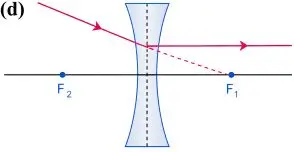
Which of the ray diagrams are correct?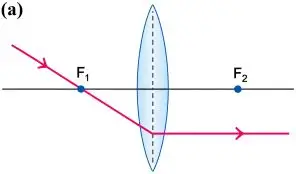
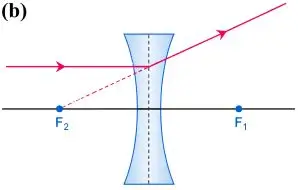
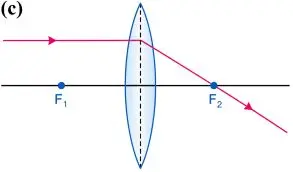
Answer:
Question 2
Identify the incorrect statement:-
(a) A real image is formed due to actual intersection of the rays refracted by the lens.
(b) A virtual image can be obtained on the screen.
(c) A virtual image is erect with respect to the object.
(d) A real image is inverted with respect to the object.
Answer:
(b) A virtual image can be obtained on the screen.
Explanation:
A virtual image cannot be obtained on a screen because it is formed by the apparent intersection of light rays, not by their actual intersection.
Question 3
A ray diagram for a convex lens is shown below. In this manner, a convex lens is used in:-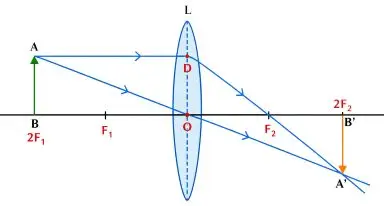
(a) camera
(b) cinema
(c) burning glass
(d) terrestrial telescope
Answer:
(d) terrestrial telescope
Question 4
For an object placed at a distance 20 cm in front of a convex lens, the image is at a distance 20 cm behind the lens. The focal length of the convex lens is:-
(a) 20 cm (b) 10 cm
(c) 15 cm (d) 40 cm
Answer:
(b) 10 cm
Explanation:
Using the lens formula:
Here,
u = −20 cm (object distance)
v = +20 cm (image distance)
Question 5
For the object placed between the optical centre and focus of a convex lens, the image is:
(a) real and enlarged
(b) real and diminished
(c) virtual and enlarged
(d) virtual and diminished
Answer:
(c) Virtual and enlarged
Explanation:
A convex lens forms a virtual, erect, and enlarged image when the object lies between the optical centre and the first focus.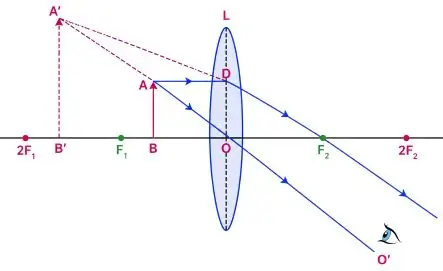
Question 6
A concave lens forms the image of an object which is:
(a) virtual, inverted, and diminished
(b) virtual, upright, and diminished
(c) virtual, inverted, and enlarged
(d) virtual, upright, and enlarged.
Answer:
(b) Virtual, upright, and diminished
Explanation:
A concave lens always forms a virtual, erect (upright), and diminished image.
Question 7
For a convex lens when the object is at 2F1, then image is formed at:
(a) F2
(b) 2F2
(c) beyond 2F2
(d) infinity
Answer:
(b) 2F2
Explanation:
For a convex lens, when the object is at 2F1, the image is formed at 2F2. It is real, inverted, and of the same size.
Question 8
A concave lens is used in:
(a) in slide projector
(b) as magnifying glass
(c) as burning glass
(d) in Galilean telescope
Answer:
(d) In a Galilean telescope
Explanation:
A concave lens is used in a Galilean telescope, as the image formed is virtual, erect and highly diminished.
Question 9
For a concave lens, when the object is at a distance equal to the focal length of the lens, the image is formed at:
(a) optical centre
(b) second focus
(c) first focus
(d) mid point between the optical centre and second focus of the lens
Answer:
(d) Midpoint between the optical centre and the second focus
Explanation:
For a concave lens, when the object is placed at a distance equal to the focal length, the image is formed midway between the optical centre and the second principal focus (F2) of the lens.
Question 10
A blue light beam forms an image of an object using a convex lens. If the blue light is replaced by red light, how will the image change?
(a) Image will shift closer to the lens and become smaller.
(b) Image will shift farther from the lens and become larger.
(c) The position of the image will not change, only its brightness changes.
(d) No change will be seen
Answer:
(b) Image will shift farther from the lens and become larger.
Explanation:
Since the refractive index of the lens is lower for red light than for blue light, the focal length increases. As a result, the image forms farther from the lens and is slightly larger.
Question 11
Assertion (A): The focal length of a lens does not change when red light is replaced by blue light.
Reason (R): The focal length of a lens depends on the refractive index of material of lens.
(a) both A and R are true and R is the correct explanation of A
(b) both A and R are true and R is not the correct explanation of A
(c) assertion is false but reason is true
(d) assertion is true but reason is false.
Answer:
(c) Assertion is false but Reason is true.
Explanation:
- Assertion (A) is false. The focal length does change with the colour of light because the refractive index of the lens material varies with wavelength. Blue light has a shorter focal length than red light.
- Reason (R) is True. The focal length depends on the refractive index of the lens material. Since the refractive index is different for different colours, the focal length also changes.
(B) Very Short Questions
Question 1
A lens forms an inverted image of an object.
(a) Name the kind of lens.
(b) State the nature of the image whether real or virtual?
Answer:
(a) The lens is a convex lens.
(b) The image formed is real.
Question 2
(a) Name the lens which always forms an erect and virtual image.
(b) State whether the image in part (a) is magnified or diminished.
Answer:
(a) A concave lens always forms an erect and virtual image.
(b) The image formed by a concave lens is always diminished.
Question 3
Can a concave lens form an image of size two times that of the object? Give reason?
Answer:
No, a concave lens cannot form an image that is twice the size of the object because it diverges the incident light rays and always forms a virtual, erect, and diminished image.
Question 4
Give two characteristics of the image formed by a concave lens.
Answer:
- The image is virtual and erect.
- The image is diminished.
Question 5
Give two characteristics of the virtual image formed by a convex lens.
Answer:
- The image is virtual and erect.
- The image is magnified (enlarged).
Question 6
Complete the following sentences:-
(a) An object is placed at a distance of more than 40 cm from a convex lens of focal length 20 cm. The image formed is real, inverted and ……………
(b) An object is placed at a distance 2f from a convex lens of focal length f. The size of the image formed is …………… that of the object.
(c) An object is placed at a distance 5 cm from a convex lens of focal length 10 cm. The image formed is virtual, upright and ……………
Answer:
(a) An object is placed at a distance of more than 40 cm from a convex lens of focal length 20 cm. The image formed is real, inverted and diminished.
(b) An object is placed at a distance 2f from a convex lens of focal length f. The image formed is equal to that of the object.
(c) An object is placed at a distance 5 cm from a convex lens of focal length 10 cm. The image formed is virtual, upright and magnified.
Question 7
State whether the following statements are ‘true’ or ‘false’ by writing T/F against them.
(a) A convex lens has a divergent action and a concave lens has a convergent action.
(b) A concave lens, if kept at a proper distance from an object, can form its real image.
(c) A ray of light incident parallel to the principal axis of a lens, passes undeviated after refraction.
(d) A ray of light incident at the optical centre of a lens, passes undeviated after refraction.
(e) A concave lens forms a magnified or diminished image depending on the distance of an object from it.
Answer:
(a) False
Correct Statement: A convex lens has a converging action, whereas a concave lens has a diverging action.
(b) False
Correct Statement: A concave lens always forms a virtual, erect, and diminished image of a real object. It cannot form a real image.
(c) False
Correct Statement: A ray of light incident parallel to the principal axis passes through (or appears to come from) the second principal focus after refraction through the lens.
(d) True
Statement: A ray of light incident at the optical centre of a lens passes undeviated after refraction.
(e) False
Correct Statement: A concave lens always forms a virtual, erect, and diminished image, irrespective of the object’s distance from the lens.
Question 8
Where must a point source of light be placed in front of a convex lens so as to obtain a parallel beam of light?
Answer:
The point source of light must be placed at the first principal focus (F1) of the convex lens.
(C) Short Questions
Question 1
What are the three principal rays that are drawn to construct the ray diagram for the image formed by a lens? Draw diagrams to support your answer.
Answer:
❖ Rule 1: Through the Optical Centre
- A ray passing through the optical centre (O) passes undeviated.

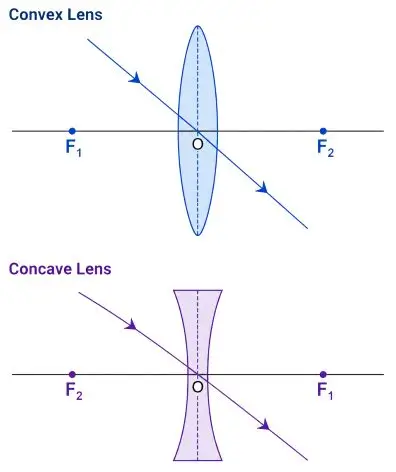
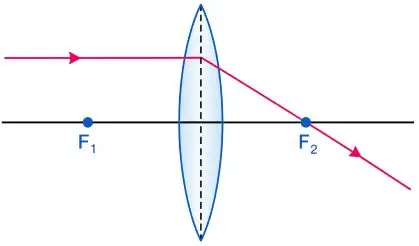
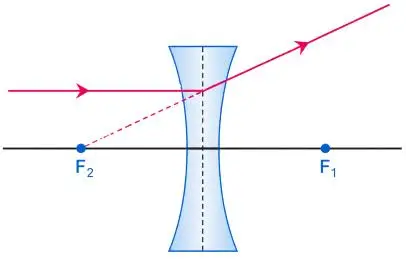
❖ Rule 2: Parallel to the Principal Axis
- In a convex lens: A ray parallel to the principal axis after refraction passes through second focus (F2).
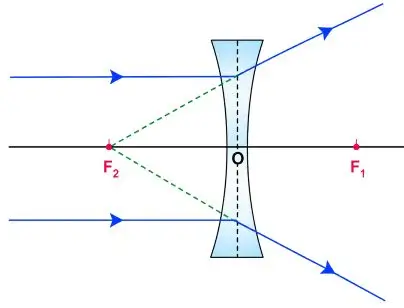
- In a concave lens: A ray parallel to the principal axis after refraction appears to be coming from the second focus (F2).
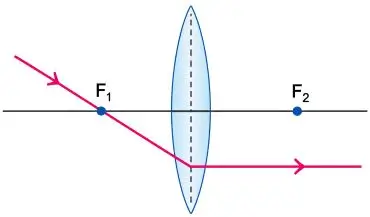
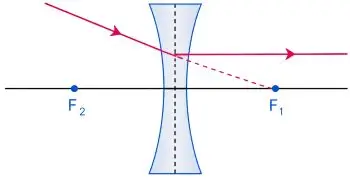
❖ Rule 3: Through (or Towards) the First Focus
- In a convex lens: A ray passing through focus after refraction becomes parallel to the principal axis.
- In a concave lens: A ray appears to be going towards focus after refraction becomes parallel to the principal axis.
Question 2
In the diagrams below, XX’ represents the principal axis, O the optical centre and F the focus of the lens. Complete the path of the rays A and B as they emerge out of the lens.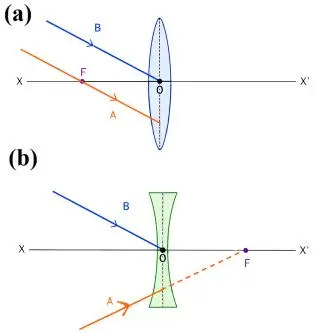
Answer:
The completed ray diagrams below illustrate the paths of rays A and B after they emerge from the lens.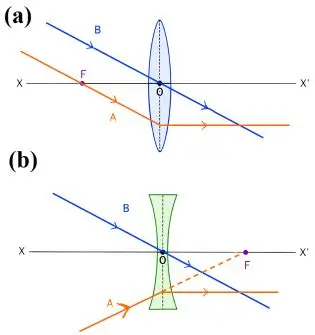
Question 3
Distinguish between a real and a virtual image.
Answer:
| Real Image | Virtual Image |
| Formed when refracted rays actually meet. | Formed when refracted rays appear to meet |
| Can be obtained on a screen | Cannot be obtained on a screen |
| Inverted | Erect |
| Usually formed by a convex lens | Formed by a concave lens and convex lens (object within focus) |
Question 4
A lens forms an upright and magnified image of an object.
(a) Name the lens.
(b) Draw a labelled ray diagram to show the image formation.
Answer:
(a) The lens is a convex lens.
(b) Below labelled ray diagram shows the image formation:
Question 5
In each of the following cases, where must an object be placed in front of a convex lens so that the image formed is,
(a) at infinity,
(b) of the same size as the object,
(c) inverted and enlarged,
(d) upright and enlarged?
Answer:
(a) The object must be placed at the first principal focus (F1) of the convex lens.
(b) The object must be placed at twice the focal length (2F1) of the convex lens.
(c) The object must be placed between the first principal focus (F1) and twice the focal length (2F1).
(d) The object must be placed between the optical centre (O) and the first principal focus (F1) of the convex lens.
Question 6
Complete the following table:-
| Type of lens | Position of object | Nature of image | Size of image |
| Convex | Between the optical centre and focus | ||
| Convex | At focus | ||
| Concave | At infinity | ||
| Concave | At any distance |
Answer:
| Type of lens | Position of object | Nature of image | Size of image |
| Convex | Between the optical centre and focus | Virtual and upright | Magnified |
| Convex | At focus | Real and inverted | Highly magnified |
| Concave | At infinity | Virtual and upright | Highly diminished |
| Concave | At any distance | Virtual and upright | Diminished |
(D) Long Questions
Question 1
Study the diagram given below.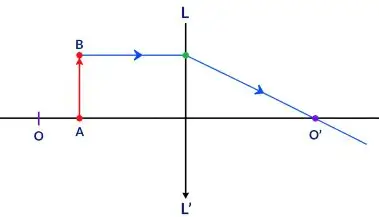
(a) Name the lens LL’.
(b) What are the points O and O’ called?
(c) Complete the diagram to form the image of the object AB.
(d) State the three characteristics of the image.
(e) Name a device in which this action of lens is used.
Answer:
(a) Convex lens
(b) O and O′ are the first principal focus (F1) and second principal focus (F2) of the convex lens, respectively.
(c) Completed diagram showing the formation of the image of the object AB is given below: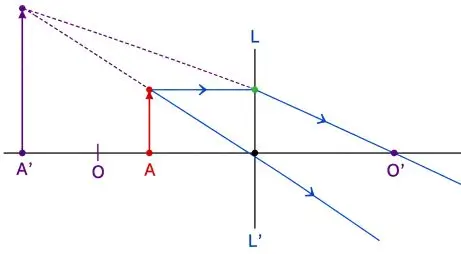
(d) Three characteristics of the image is:
- Virtual
- Erect
- Magnified (enlarged)
(e) Magnifying glass (simple microscope)
Question 2
Study the diagram below.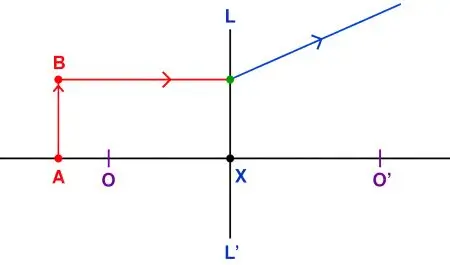
(i) Name the lens LL’.
(ii) What are the points O and O’ called?
(iii) Complete the diagram to form the image of the object AB.
(iv) State three characteristics of the image.
Answer:
(i) Concave lens
(ii) O and O′ are the second principal focus (F2) and first principal focus (F1) of the concave lens.
(iii) Below is the completed diagram showing the image of the object AB: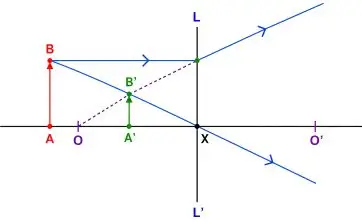
(iv) Three characteristics of the image are:
- Virtual
- Erect (upright)
- Diminished (smaller than the object)
Question 3
The diagram in below figure shows an object AB and a converging lens L with foci F1 and F2.
(a) Draw two rays from the object AB and complete the diagram to locate the position of the image CD. Also mark on the diagram the position of eye from where the image can be viewed.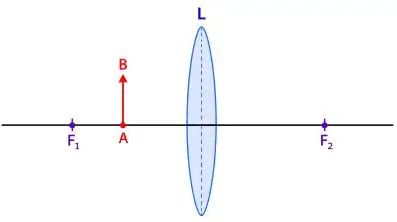
(b) State three characteristics of the image in relation to the object.
Answer:
(a) The completed ray diagram below shows the position of the image CD and the position of the eye from which the image can be viewed.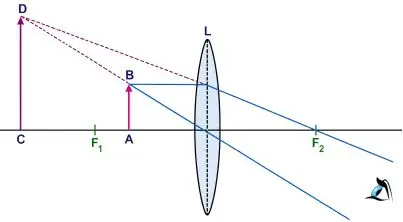
(b) Three characteristics of the image are:
- Virtual
- Erect (upright)
- Magnified (enlarged)
Question 4
The diagram given in below figure shows the position of an object OA in relation to a converging lens L whose foci are at F1 and F2.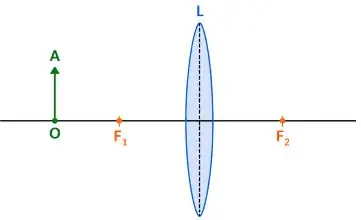
(i) Draw two rays to locate the position of the image.
(ii) State the position of the image with reference to the lens.
(iii) Describe the three characteristics of the image.
(iv) Describe how the distance of the image from the lens and its size change as the object is moved towards F1.
Answer:
(i) Below ray diagram shows the position of the image: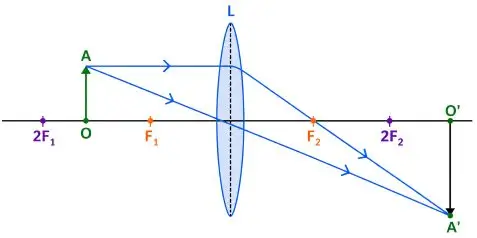
(ii) The image is formed between the second principal focus (F2) and twice the focal length (2F2) on the other side of the lens.
(iii) The three characteristics of this image are magnified, real and inverted.
(iv) When the object move towards F1, the image will shift away from F2 and it will be magnified.
The image will form at infinity and it is highly magnified at F1.
Between F1 and optical centre, the image will form on the same side of the object and will be magnified.
Question 5
A converging lens forms the image of an object placed in front of it, beyond 2F2 of the lens.
(a) Where is the object placed?
(b) Draw a ray diagram to show the formation of an image.
(c) State three characteristics of the image.
Answer:
(a) The object is placed between F1 and 2F1.
(b) Below is the ray diagram showing an object placed between F1 and 2F1 of the lens and its image is formed beyond 2F2 of the lens: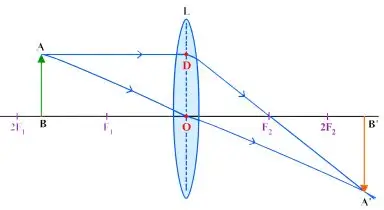
(c) The image is:
- Real
- Inverted
- Enlarged (magnified)
Question 6
A convex lens forms an image of an object equal to the size of the object.
(a) Where is the object placed in front of the lens?
(b) Draw a diagram to illustrate it.
(c) State two more characteristics of the image.
Answer:
(a) The object is placed at 2F1.
(b) Below diagram illustrates the formation of an image equal in size of the object by a convex lens:
(c) The image is:
- Real
- Inverted
Question 7
A lens forms an erect, magnified and virtual image of an object.
(a) Name the kind of lens.
(b) Where is the object placed in relation to the lens?
(c) Draw a ray diagram to show the formation of image.
(d) Name the device which uses this principle.
Answer:
(a) Convex lens
(b) The object is placed between the optical centre (O) and the first principal focus (F1).
(c) Below ray diagram shows the formation of the image:
(d) Magnifying glass (Simple Microscope)
Question 8
A lens forms an image between the object and the lens.
(a) Name the lens.
(b) Draw a ray diagram to show the formation of such an image.
(c) State three characteristics of the image.
Answer:
(a) Concave lens
(b) Below ray diagram shows the formation of the image: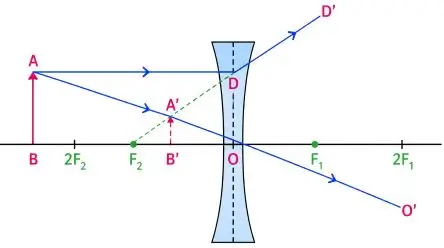
(c) The image is:
- Virtual
- Erect
- Diminished
Question 9
Classify as real or virtual, the image of a candle flame formed on a screen by a convex lens. Draw a ray diagram to illustrate how an image is formed.
Answer:
When the candle is placed beyond 2F1 of a convex lens, the image is formed between F2 and 2F2 on the opposite side of the lens.
The image formed is real, inverted, and diminished.
In the ray diagram shown below, AB represents the candle, and A′B′ represents its real, inverted, and diminished image formed between F₂ and 2F2.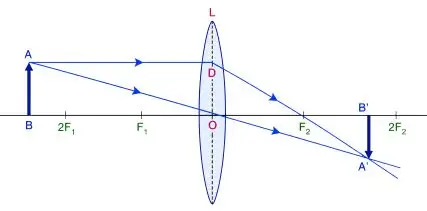
Question 10
Show by a ray diagram that a diverging lens cannot form a real image of an object placed anywhere on its principal axis.
Answer:
When an object is placed at any finite distance in front of a concave (diverging) lens, the image formed is always virtual, erect, and diminished. Therefore, a concave lens cannot produce a real image of a real object.
Question 11
Draw a ray diagram to show how a converging lens can form a real and enlarged image of an object.
Answer:
When the object is placed between the first principal focus (F1) and twice the focal length (2F1) of a convex lens, the image is formed beyond 2F2 on the other side of the lens.
The image formed is real, inverted, and enlarged (magnified).
Question 12
A lens forms an upright and diminished image of an object placed at its focal point. Name the lens and draw a ray diagram to show the formation of an image.
Answer:
It is a concave lens.
Below ray diagram shows the formation of an image by a concave lens:
Question 13
Draw a ray diagram to show how a converging lens is used as a magnifying glass to observe a small object. Mark on your diagram the foci of the lens and the position of the eye.
Answer:
When an object is placed between the convex lens and its first principal focus (F1), the image is formed on the same side of the lens as the object. The image formed is virtual, erect, and enlarged (magnified). Since the image is magnified, a convex (converging) lens can be used as a magnifying glass (simple microscope).
Question 14
Draw a ray diagram to show how a converging lens can form an image of the Sun. Hence give a reason for the term ‘burning glass’ for a converging lens used in this manner.
Answer:
Below ray diagram shows how a converging lens can form an image of the Sun: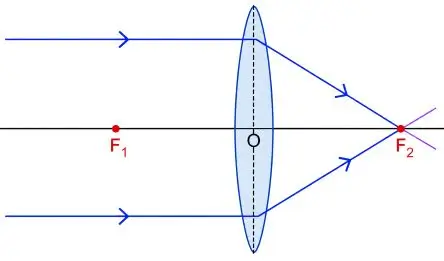
Reason:
A convex lens concentrates the Sun’s rays at its focus, producing intense heat that can ignite combustible materials. Hence, it is called a burning glass.
Question 15
State the changes in the position, size and nature of the image when the object is brought from infinity up to the convex lens. Illustrate your answer by drawing ray diagrams.
Answer:
Case 1: Object at Infinity (𝑢 = ∞)
- Position of Image: At the second principal focus (F2).
- Nature of image: Real and Inverted
- Size of image: Highly diminished (point-sized)
- Ray diagram:
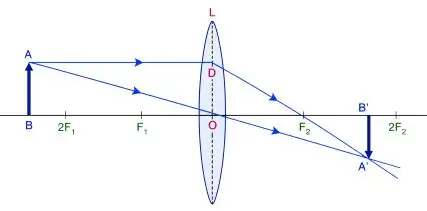
Case 2: Object Beyond 2F1 (𝑢 > 2𝑓)
- Position of Image: Between F2 and 2F2.
- Nature of image: Real and Inverted
- Size of image: Diminished
- Ray diagram:
Case 3: Object at 2F1 (u = 2f)
- Position of Image: At 2F2
- Nature of image: Real and Inverted
- Size of image: Same size as the object
- Ray diagram:
Case 4: Object Between F1 and 2F1
- Position of Image: Beyond 2F2.
- Nature of image: Real and Inverted
- Size of image: Magnified
- Ray diagram:
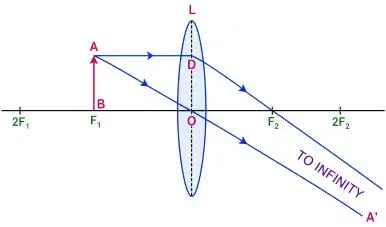
Case 5: Object at F1 (𝑢 = 𝑓)
- Position of Image: At infinity.
- Nature of image: Real and Inverted
- Size of image: Highly magnified
- Ray diagram:
Case 6: Object Between Lens and F1 (𝑢 < 𝑓)
- Position of Image: On the same side of the lens as the object.
- Nature of image: Virtual and erect
- Size of image: Magnified
- Ray diagram:
Question 16
State the changes in the position, size and nature of the image when the object is brought from infinity up to the concave lens. Illustrate your answer by drawing ray diagrams.
Answer:
Case 1: Object at Infinity
- Position of Image: At F2 (same side as object)
- Nature of Image: Virtual and erect
- Size of Image: Highly diminished
- Ray diagram:
Case 2: Object at Any Finite Distance
- Position of Image: Between the optical centre (O) and the focus (F2)
- Nature of Image: Virtual and erect
- Size of image: Diminished
- Ray diagram:
Download Selina Solutions for ICSE Class 10 Physics Exercise 5(B) – Refraction Through a Lens
You can download free PDF solutions for Selina Class 10 Physics Exercise 5(B) to revise offline. These solutions are exam-ready and designed by subject experts.
Features of Our Selina Solutions
- Step-by-step solutions for every question
- Simple and easy-to-understand explanations
- Accurate numerical calculations
- Exam-oriented approach
- Latest ICSE syllabus coverage
- Helpful diagrams wherever required
- Suitable for quick revision before exams
Benefits for ICSE Students
Our solutions are designed to help students understand every concept in a systematic manner. Practising these questions regularly will improve accuracy, speed, and confidence while solving board examination numericals.
Students will also become familiar with the proper use of sign convention, which is one of the most important aspects of solving lens-related numerical problems.
Why Choose Rohit Academy?
At Rohit Academy, we provide high-quality study materials specially designed for ICSE students. Along with Selina Solutions, students can access:
- Chapter-wise Physics Notes
- Previous Year Questions
- Important MCQs
- Assertion and Reason Questions
- Numerical Practice Sets
- Revision Notes
- Free PDF Study Materials
All content is prepared in simple language to help students understand concepts quickly and perform well in examinations.
Conclusion
The Selina Solutions for ICSE Class 10 Physics Exercise 5(B) – Refraction Through a Lens serve as a complete study companion for mastering lens numericals and theoretical concepts. Practice every question carefully, revise the formulas regularly, and solve previous years’ questions to strengthen your preparation for the ICSE Board Examination.
Stay connected with Rohit Academy for more ICSE Class 10 Physics Notes, Selina Solutions, Chapter-wise MCQs, Previous Year Questions, and Free PDF Downloads to achieve excellent results in your board exams.
You can also visit:
ICSE Class 10 Physics Notes
| ☛ ICSE Class 10 Physics Chapter 1 – Force Notes |
| ☛ ICSE Class 10 Physics Chapter 2 – Work, Energy and Power Notes |
| ☛ ICSE Class 10 Physics Chapter 3 – Machines Notes |
| ☛ ICSE Class 10 Physics Chapter 4 – Refraction of Light at Plane Surfaces Notes |
| ☛ ICSE Class 10 Physics Chapter 5 – Refraction through Lens Notes |
| ☛ ICSE Class 10 Physics Chapter 6 – Spectrum Notes |
| ☛ ICSE Class 10 Physics Chapter 7 – Sound Notes |
| ☛ ICSE Class 10 Physics Chapter 8 – Current Electricity Notes |
| ☛ ICSE Class 10 Physics Chapter 9 – Electrical Power and Household Circuits Notes |
| ☛ ICSE Class 10 Physics Chapter 10 – Electro-magnetism Notes |
| ☛ ICSE Class 10 Physics Chapter 11 – Calorimetry Notes |
| ☛ ICSE Class 10 Physics Chapter 12 – Radioactivity Notes |
Official Website:
Students can visit the official CISCE website for more details and updates.