ICSE Class 10 Physics Selina Solutions – Chapter 7: Sound Exercise 7(C)
Looking for ICSE Class 10 Physics Chapter 7: Sound Exercise 7(C) – Selina Solutions? This page provides complete, accurate, and step-by-step solutions to all the questions from Exercise 7(C) of the Selina Concise Physics textbook. Each answer is explained in simple language according to the latest ICSE syllabus and examination pattern, making it an excellent resource for school exams and the ICSE Board Examination.
Exercise 7(C) mainly consists of numerical and application-based questions from the chapter Sound. Students are required to apply concepts such as speed of sound, frequency, wavelength, time period, echo, resonance, ultrasonic waves, and SONAR to solve problems accurately. These questions are important from the ICSE examination point of view and help develop analytical and problem-solving skills.
Study Support by Rohit Academy
Rohit Academy offers expert-curated ICSE Class 10 Physics Study Materials including ICSE Sound Selina Solutions, diagrams, and key formulas for better understanding.
Study materials related to chapter 7: Sound
To help you prepare the entire chapter thoroughly, explore the following study resources related to Chapter 7: Sound:
(A) Multiple Choice Type
(Choose the correct answer from the options given below).
Question 1
The intensity of a sound wave in air is proportional to the:
(a) square of amplitude of vibrations
(b) square of frequency of vibrations
(c) density of air
(d) all of the above
Answer:
(d) All of the above
Explanation:
The intensity of a sound wave is directly proportional to the square of the amplitude, square of the frequency, and the density of the medium (air). Hence, all of the above are correct.
Question 2
For normal ears, sensitivity is maximum at the frequency :
(a) 5 kHz (b) 10 kHz
(c) 1 kHz (d) 500 Hz
Answer:
(c) 1 kHz
Explanation:
The human ear is highly sensitive to sounds around 1 kHz. Therefore, the correct answer is 1 kHz.
Question 3
By reducing the amplitude of a sound wave, its :
(a) pitch decreases (b) loudness decreases
(c) loudness increases (d) pitch increases
Answer:
(b) loudness decreases
Explanation:
Amplitude determines the loudness of sound. Lower amplitude means the sound becomes softer. Pitch depends on frequency, not amplitude.
Question 4
Sounds above …………… are termed as noise pollution.
(a) 75 dB (b) 120 dB
(c) 100 dB (d) 80 dB
Answer:
(d) 80 dB
Explanation:
Continuous sounds above 80 dB are generally considered noise pollution and can be harmful with prolonged exposure.
Question 5
Two sounds of the same loudness and same pitch produced by two different instruments differ in their:
(a) amplitudes (b) frequencies
(c) waveforms (d) all the above
Answer:
(c) waveforms
Explanation:
If loudness and pitch are the same, amplitude and frequency are the same. The difference lies in the waveform (quality or timbre).
Question 6
Instruments A and B are producing sounds of the same amplitude, same waveform but frequencies F and 2F respectively. Which of the following statements is correct ?
(a) both A and B differ in quality
(b) B is grave but A is shrill
(c) A is grave but B is shrill
(d) B is louder than A
Answer:
(c) A is grave but B is shrill
Explanation:
A higher frequency means a higher pitch (shrill sound). Since B has twice the frequency of A, B is shrill while A is grave.
Question 7
Which of the following statements is incorrect with respect to music ?
(a) It is pleasant to the ears.
(b) Its waveform is irregular.
(c) The sound level is low.
(d) It is produced by periodic vibrations.
Answer:
(b) Its waveform is irregular.
Explanation:
Music is produced by periodic vibrations, so its waveform is regular. Irregular waveforms are characteristic of noise.
Question 8
Out of the following, which instrument emits a monotone?
(a) guitar
(b) flute
(c) piano
(d) tuning fork
Answer:
(d) tuning fork
Explanation:
A tuning fork produces nearly a pure tone (single frequency), called a monotone.
Question 9
The pitch of a note depends on :
(a) frequency (b) amplitude
(c) waveform (d) loudness
Answer:
(a) frequency
Explanation:
Pitch depends solely on the frequency of vibration. Higher frequency means higher pitch.
Question 10
The voice of a woman is of …………… pitch than that of a man.
(a) lower (b) higher
(c) equal (d) cannot say
Answer:
(b) higher
Explanation:
Women’s vocal cords vibrate faster than men’s, producing higher-frequency (higher-pitch) sounds.
Question 11
The quality of a musical sound depends on :
(a) number of subsidiary notes
(b) relative amplitudes
(c) both the number of subsidiary notes and their relative amplitudes
(d) none of the above
Answer:
(c) both the number of subsidiary notes and their relative amplitudes
Explanation:
The quality (timbre) of sound depends on:
- the number of overtones (subsidiary notes), and
- their relative amplitudes.
Question 12
Two identical guitars are tuned to the same frequency. One is played close to the sound hole and the other close to the bridge (near the end of the strings). Both are played with the same force. The reason for difference in the two sounds is :
(a) Pitch changes as plucking point affects frequency.
(b) Loudness changes.
(c) There is no difference at all.
(d) Timbre changes due to harmonics.
Answer:
(d) Timbre changes due to harmonics.
Explanation:
Plucking at different positions changes the strength of the harmonics (overtones), changing the quality (timbre) of the sound. The pitch remains the same.
Question 13
Assertion (A): When we start filling an empty pitcher with water, the pitch of the sound produced goes on decreasing.
Reason (R): The pitch of sound increases with increase in frequency.
(a) both A and R are true and R is the correct explanation of A
(b) both A and R are true and R is not the correct explanation of A
(c) assertion is false but reason is true.
(d) assertion is true but reason is false.
Answer:
(c) assertion is false but reason is true.
Explanation:
- Assertion is false: As the water level rises, the air column becomes shorter, so its natural frequency increases and the pitch increases, not decreases.
- Reason is true: Pitch is directly proportional to frequency.
(B) Very Short Questions
Question 1
(a) Which of the following quantity determines the loudness of a sound wave?
(i) wavelength,
(ii) frequency, and
(iii) amplitude.
(b) How is loudness related to the quantity mentioned above in the part (a)?
Answer:
(a) Amplitude
(b) Loudness is directly proportional to the square of the amplitude ( L ∝ A2).
Question 2
If the amplitude of a wave is doubled, what will be the effect on its loudness?
Answer:
The loudness becomes four times.
Question 3
Two waves of the same pitch have amplitudes in the ratio 1 : 3. What will be the ratio of their (i) loudness and (ii) frequencies?
Answer:
(i) Loudness – 1 : 9
(ii) Frequencies – 1 : 1
Question 4
Name the unit in which the loudness of sound is measured?
Answer:
phon
Question 5
Name the unit used to measure the sound level.
Answer:
Decibel (dB)
Question 6
What is the safe limit of sound level in dB for our ears?
Answer:
Below 80 dB
Question 7
Name the subjective property of sound related to its frequency.
Answer:
Pitch
Question 8
The frequencies of notes given by flute, guitar and trumpet are respectively 400 Hz, 200 Hz and 500 Hz. Which one of these has the highest pitch?
Answer:
Trumpet (500 Hz)
Question 9
Complete the following sentences :-
(i) The pitch of sound increases, if its frequency ……………
(ii) If the amplitude of the sound is halved, it’s loudness becomes ……………
Answer:
(i) The pitch of sound increases if its frequency increases.
(ii) If the amplitude of the sound is halved, its loudness becomes one-fourth.
Question 10
Name the characteristic which enables one to distinguish the sound of two musical instruments even if they are of the same pitch and same loudness.
Answer:
Quality (Timbre)
Question 11
Which characteristic of sound makes it possible to recognise a person by his voice without seeing him?
Answer:
Quality (Timbre)
Question 12
State the factor that determines
(i) the pitch of a note,
(ii) the loudness of the sound heard, and
(iii) the quality of the note.
Answer:
(i) Pitch of a note – Frequency
(ii) Loudness of sound – Amplitude
(iii) Quality of the note – Waveform
Question 13
Name the characteristic of sound affected due to a change in its (i) amplitude, (ii) wave form, and (iii) frequency.
Answer:
(i) Amplitude – Loudness
(ii) Waveform – Quality (Timbre)
(iii) Frequency – Pitch
Question 14
The sketches I to IV in below figure show sound waves, all formed in the same time interval.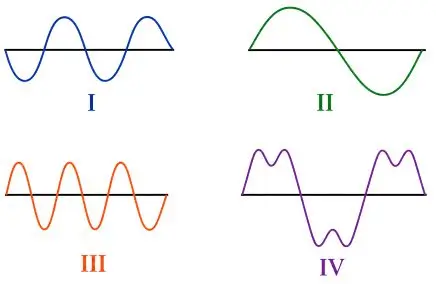
Which diagram shows:
(i) a note from a musical instrument,
(ii) a soft (or feeble) note,
(iii) a bass (or low frequency) note.
Answer:
(i) A note from a musical instrument: IV
Reason: It is a complex periodic waveform (contains harmonics/overtones), which is characteristic of musical instruments.
(ii) A soft (or feeble) note: I
Reason: It has the smallest amplitude, so its loudness is the least.
(iii) A bass (or low-frequency) note: II
Reason: It has the lowest frequency (fewest vibrations in the same time interval), so its pitch is the lowest (bass).
Question 15
Below figure shows wave patterns of three sounds A, B and C. Name the characteristic of sound which is the same between (i) A and B, (ii) B and C, and (iii) C and A.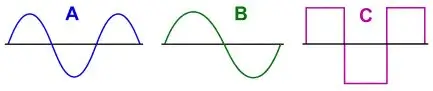
Answer:
(i) A and B: Loudness and Quality (Timbre)
Reason: A and B have the same amplitude (same loudness) and the same waveform (same quality).
(ii) B and C: None
Reason: B and C differ in amplitude, waveform, and frequency. Therefore, none of the characteristics are the same.
(iii) C and A: Pitch
Reason: C and A have the same frequency, so they have the same pitch.
(C) Short Questions
Question 1
Name three characteristics of a musical sound.
Answer:
The three characteristics of a musical sound are:
- Loudness
- Pitch (or shrillness)
- Quality (or timbre)
Question 2
Why is the loudness of the sound heard by a plucked wire increased when it is mounted on a sound board?
Answer:
The soundboard vibrates with the wire, increasing the vibrating area and the intensity of sound. Hence, the sound becomes louder.
Question 3
Define the term intensity of a sound wave. State the unit in which it is measured.
Answer:
Intensity is the sound energy passing per second through unit area held perpendicular to the direction of propagation.SI Unit: Watt per square metre (W m–2).
Question 4
How is the loudness of sound related to the intensity of wave producing it?
Answer:
Relationship between loudness (L) and intensity (I) is given by:
L = K log10I
where, K is constant of proportionality.
Hence, loudness increases with the increase in intensity, but not in same proportion.
Question 5
Comment on the statement ‘loudness of sound is of subjective nature, while intensity is of objective nature’.
Answer:
Loudness depends on the sensitivity of the listener’s ear, so it is subjective. Intensity is a measurable physical quantity, so it is objective.
Question 6
State three factors which affect the loudness of a sound heard by a listener.
Answer:
The loudness of sound heard by a listener depends on the following factors:
- Amplitude of vibration
- Distance from the source
- Area of the vibrating surface
Question 7
The bells of a temple are big in size. Why?
Answer:
Large bells have a larger vibrating surface and produce louder sound that can be heard from a long distance.
Question 8
What is meant by noise pollution? Name one source of sound causing noise pollution.
Answer:
Noise pollution is the presence of unwanted or excessive sound that causes discomfort or harm.
One source: Vehicle horns.
Question 9
What determines the pitch of a sound?
Answer:
The frequency of vibration determines the pitch of a sound.
Question 10
Name and define the characteristic which enables one to distinguish two sounds of same loudness, but of different frequencies, given by the same instrument.
Answer:
Pitch – It is the characteristic of sound that distinguishes a high-frequency (shrill) sound from a low-frequency (grave) sound.
Question 11
How is it possible to detect the filling of a bottle under a water tap by hearing the sound at a distance?
Answer:
As the bottle fills, the air column becomes shorter, increasing the frequency (pitch) of the sound. This change in pitch indicates the water level.
Question 12
Two identical guitars are played by two persons to give notes of the same loudness and pitch. Will they differ in quality? Give a reason for your answer.
Answer:
Yes. If the strings are plucked at different positions, different harmonics are produced, changing the quality (timbre) of the sound.
Question 13
State one difference between a musical note and noise.
Answer:
| Musical note | Noise |
| It is regular, smooth and pleasant to the ears. | It is harsh, discordant and unpleasant to the ears. |
(D) Long Questions
Question 1
How does the wave pattern of a loud note differ from the soft note? Draw a diagram.
Answer:
A loud note has a greater amplitude than a soft note, while both may have the same frequency (pitch).
Diagram: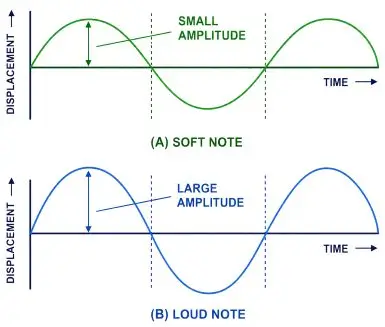
Question 2
Draw a diagram to show the wave pattern of a high pitch note and a low pitch note, but of the same loudness.
Answer:
A high-pitch note has a higher frequency, while a low-pitch note has a lower frequency. Both have the same amplitude (same loudness).
Diagram: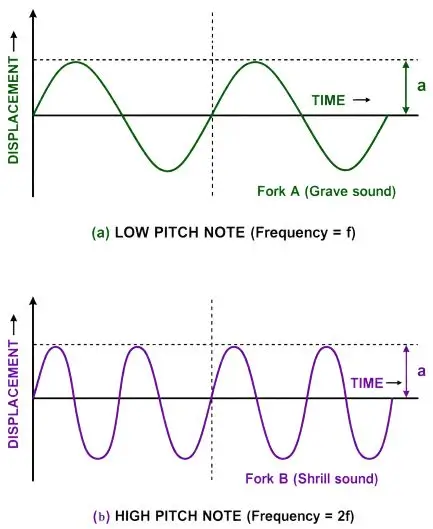
Question 3
The diagram below shows three different modes of vibration P, Q and R of the same string of a given length.
(a) Which vibration will produce a louder sound and why?
(b) Which vibration will produce a sound of maximum shrillness (or pitch) and why?
(c) What is the ratio of the wavelength of vibrations P and R?
Answer:
(a) R will produce the louder sound because it has the maximum amplitude of vibration. Greater amplitude produces greater loudness.
(b) P will have the maximum shrillness (highest pitch) because it has the highest frequency.
(c) Let l be the length of the string.
Wavelength of P (λP) =
Wavelength of R (λR) = 2l
Therefore, ratio of λP : λR
Hence, λP : λR = 1 : 3
Question 4
How does the two sounds of the same loudness and same pitch produced by different instruments differ? Draw diagrams to illustrate your answer.
Answer:
Two sounds having the same loudness and same pitch but produced by different instruments differ in their quality (timbre). This is because their waveforms are different due to the presence of different harmonics (overtones).
Diagrams: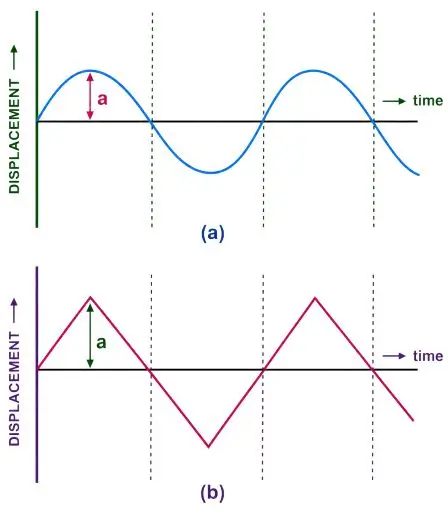
Explanation:
- Amplitude is the same → Same loudness.
- Frequency is the same → Same pitch.
- Waveform is different → Different quality (timbre).
Question 5
Two musical notes of the same pitch and same loudness are played on two different instruments. Their wave patterns are as shown in figure below.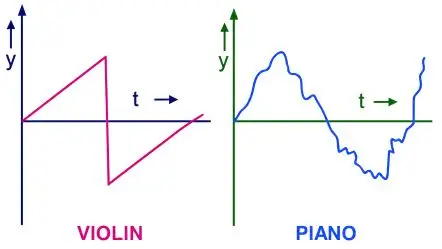
Explain why are the wave patterns different.
Answer:
Although the two notes have the same pitch (same frequency) and same loudness (same amplitude), they are produced by different musical instruments. Hence, they have different waveforms due to different harmonics (overtones). Therefore, the quality (timbre) of the two sounds is different, resulting in different wave patterns.
Question 6
A microphone is connected to the Y-input of a C.R.O. Three different sounds are made in turn in front of the microphone. Their traces (a), (b) and (c) produced on the screen are shown in below figure.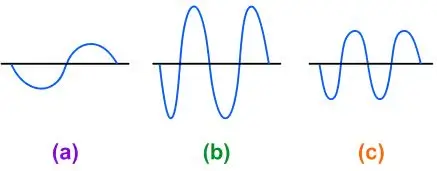
(i) Which trace is due to the loudest sound? Give reason for your answer.
(ii) Which trace is due to the sound with the lowest pitch? Explain your answer.
Answer:
(i) (b)
Reason: Trace (b) has the maximum amplitude. Greater amplitude means greater loudness.
(ii) (a)
Reason: Trace (a) has the lowest frequency (fewest vibrations in the same time interval). Since pitch depends on frequency, it has the lowest pitch.
Question 7
In what respect does the wave pattern of a noise and music differ? Draw diagrams to explain your answer.
Answer:
The wave pattern of music is regular (periodic), whereas the wave pattern of noise is irregular (non-periodic).
Diagrams: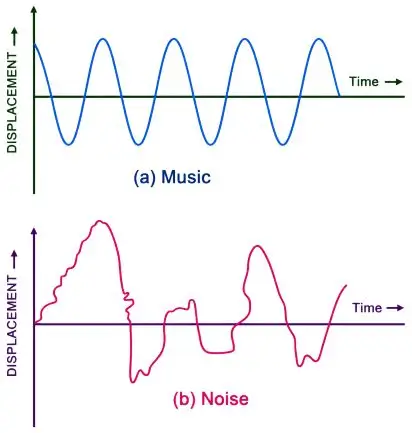
Explanation:
- Music: Produced by periodic vibrations, so the waveform is regular and pleasant to hear.
- Noise: Produced by irregular vibrations, so the waveform is irregular and unpleasant to hear.
Download Selina Solutions for ICSE Class 10 Physics Exercise 7(C) – Sound
Students can download the ICSE Class 10 Physics Chapter 7: Sound Exercise 7(C) Selina Solutions PDF for free and revise offline anytime. These exam-oriented solutions are prepared by experienced subject experts and follow the latest ICSE syllabus.
Why Choose These Selina Solutions?
- Prepared according to the latest ICSE Class 10 Physics syllabus.
- Detailed step-by-step solutions for all numerical and theory questions.
- Simple and easy-to-understand language.
- Helpful for homework, assignments, school tests, and board exams.
- Covers important formulas, concepts, and application-based questions.
- Ideal for quick revision before examinations.
- Free, reliable, and regularly updated study material.
- Trusted learning resource from Rohit Academy.
Practice these ICSE Class 10 Physics Chapter 7: Sound Exercise 7(C) – Selina Solutions regularly to improve your conceptual understanding, enhance your numerical solving skills, and score excellent marks in the ICSE Class 10 Physics Board Examination.
You can also visit:
ICSE Class 10 Physics Notes
| ☛ ICSE Class 10 Physics Chapter 1 – Force Notes |
| ☛ ICSE Class 10 Physics Chapter 2 – Work, Energy and Power Notes |
| ☛ ICSE Class 10 Physics Chapter 3 – Machines Notes |
| ☛ ICSE Class 10 Physics Chapter 4 – Refraction of Light at Plane Surfaces Notes |
| ☛ ICSE Class 10 Physics Chapter 5 – Refraction through Lens Notes |
| ☛ ICSE Class 10 Physics Chapter 6 – Spectrum Notes |
| ☛ ICSE Class 10 Physics Chapter 7 – Sound Notes |
| ☛ ICSE Class 10 Physics Chapter 8 – Current Electricity Notes |
| ☛ ICSE Class 10 Physics Chapter 9 – Electrical Power and Household Circuits Notes |
| ☛ ICSE Class 10 Physics Chapter 10 – Electro-magnetism Notes |
| ☛ ICSE Class 10 Physics Chapter 11 – Calorimetry Notes |
| ☛ ICSE Class 10 Physics Chapter 12 – Radioactivity Notes |
Official Website:
Students can visit the official CISCE website for more details and updates.