ICSE Class 10 Physics Selina Solutions – Chapter 7: Sound Exercise 7(B)
Looking for ICSE Class 10 Physics Chapter 7: Sound Exercise 7(B) – Selina Solutions? This page provides accurate, step-by-step solutions to all the questions of Exercise 7(B) in simple and easy-to-understand language. These answers are prepared according to the latest ICSE syllabus and exam pattern, making them ideal for school exams as well as the ICSE Board Examination.
Exercise 7(B) focuses on important concepts related to echo, reverberation, resonance, natural frequency, forced vibrations, ultrasonic sound, SONAR, and applications of sound. These topics are frequently asked in ICSE examinations and require a clear conceptual understanding. Our detailed explanations help students understand the reasoning behind each answer, enabling them to solve similar questions confidently.
The solutions are written in a student-friendly format so that learners can revise quickly, complete homework accurately, and strengthen their preparation for board exams. Each answer follows the Selina textbook and highlights the key concepts that are important from an examination point of view.
Study Support by Rohit Academy
Rohit Academy offers expert-curated ICSE Class 10 Physics Study Materials including ICSE Sound Selina Solutions, diagrams, and key formulas for better understanding.
Study materials related to chapter 7: Sound
To help you prepare the entire chapter thoroughly, explore the following study resources related to Chapter 7: Sound:
(A) Multiple Choice Type
(Choose the correct answer from the options given below).
Question 1
The period (or frequency) of natural vibrations depends on :
(a) shape (b) size
(c) external force (d) both (a) and (b)
Answer:
(d) both (a) and (b)
Explanation:
The natural frequency (or period) of a body depends on its shape and size (and also the material of the body). It does not depend on the external force.
Question 2
The natural frequency of a simple pendulum of length 1.0 m on earth’s surface is :
[Take g = 9.8 m/s2]
(a) 0.5 Hz (b) 100 Hz
(c) 50 Hz (d) 5 Hz
Answer:
(a) 0.5 Hz
Explanation:
Given,
- length = 1.0 m
- g = 9.8 m s–2
We know,
frequency (f)
Substituting we get,
frequency (f) = 0.49 Hz ≈ 0.5 Hz
Hence, the natural frequency is 0.5 Hz.
Question 3
A wire stretched between two fixed supports, is plucked exactly in the middle and then released. It executes (neglect the resistance of the medium) :
(a) resonant vibrations (b) natural vibrations
(c) damped vibrations (d) forced
Answer:
(b) natural vibrations
Explanation:
After being plucked and released, the string vibrates on its own at its natural frequency. No external periodic force acts on it.
Question 4
In an organ pipe with one closed end, the frequencies of different modes are in the ratio :
(a) 1 : 2 : 3 … (b) 1 : 3 : 5 …
(c) 1 : 2 : 4 … (d) 2 : 4 : 6
Answer:
(b) 1 : 3 : 5 …
Explanation:
A closed organ pipe produces only odd harmonics. Therefore, the frequencies are in the ratio:
1 : 3 : 5 : 7 …
Question 5
The frequency f of a vibration in a stretched string depends on :
(a) length l (b) radius r
(c) tension T (d) all of these
Answer:
(d) all of these
Explanation:
The frequency of a stretched string depends on:
- Length of the string
- Radius (or thickness) of the string
- Tension in the string
Question 6
The frequency f of the note produced by a string can be increased by :
(a) decreasing the length l of the string
(b) decreasing the radius r of the string
(c) increasing the tension T of the string
(d) All of these
Answer:
(d) All of these
Explanation:
Frequency increases when:
- Length decreases
- Radius (thickness) decreases
- Tension increases
All these increase the frequency of vibration.
Question 7
If l is the length of the string stretched between its ends, the wavelength of different modes in Figure (1), (2) and (3) will be :
(a) 2l/2, 2l, 2l/3 (b) 2l/3, 2l/2, 2l
(c) 2l, 2l/2, 2l/3 (d) 2l, 2l/3, 2l/2
Answer:
(c) 2l, 2l/2, 2l/3
Explanation:
- In Figure (1): l = λ/2, Hence λ = 2l
- In Figure (2): l = λ, Hence λ = l = 2l/2
- In Figure (3): l = 3λ/2, Hence λ = 2l/3
Hence, the wavelengths corresponding to Figures (1), (2), and (3) are:
2l, 2l/2, and 2l/3.
Therefore, the correct answer is (c) 2l, 2l/2, 2l/3.
Question 8
A slim branch of a tree is pulled and released. It makes …………… vibrations.
(a) damped (b) natural
(c) forced (d) resonant
Answer:
(a) damped
Explanation:
Due to air resistance and internal friction, the amplitude gradually decreases. Hence, the vibrations are damped vibrations.
Question 9
A body is vibrating under the influence of an external periodic force of frequency exactly equal to the natural frequency of the vibrations of the body. It executes :
(a) damped vibrations (b) forced vibrations
(c) resonant vibrations (d) natural vibrations
Answer:
(c) resonant vibrations
Explanation:
When the frequency of the external force becomes equal to the natural frequency of the body, resonance occurs and the body vibrates with maximum amplitude.
Question 10
At resonance, a loud sound is heard because the body vibrating with a large …………… sends forth a large amount of energy in the medium.
(a) amplitude (b) frequency
(c) wavelength (d) time period
Answer:
(a) amplitude
Explanation:
At resonance, the vibrating body attains maximum amplitude, transferring more energy to the surrounding air and producing a louder sound.
Question 11
The sound box of a musical instrument is so constructed that the air column inside it has a natural frequency …………… that of the string stretched in it.
(a) greater than (b) smaller than
(c) equal to (d) cannot say
Answer:
(c) equal to
Explanation:
The natural frequency of the air column is made equal to that of the string so that resonance occurs, producing a louder sound.
Question 12
Column X shows the kind of vibrations and column Y shows their examples.
| X | Y |
| (A) Natural vibration | (1) A tuning fork when stroked on a rubber pad. |
| (B) Damped vibrations | (2) When a guitarist plucks or strums the guitar strings with his/her fingers. |
| (C) Forced vibrations | (3) When a troop crosses a suspension bridge. |
| (D) Resonant vibrations | (4) A load suspended from a spring. |
Choose the correct pairing:
(a) A—(4) B—(2) C—(3) D—(1)
(b) A—(4) B—(1) C—(2) D—(3)
(C) A—(4) B—(3) C—(1) D—(2)
(d) A—(2) B—(3) C—(4) D—(1)
Answer:
(b) A—(4), B—(1), C—(2), D—(3)
Explanation:
- Natural vibrations → Load suspended from a spring.
- Damped vibrations → Tuning fork on a rubber pad (amplitude decreases quickly).
- Forced vibrations → Guitar strings vibrate due to continuous plucking/strumming.
- Resonant vibrations → Suspension bridge may resonate when soldiers march in step.
Question 13
A singer can shatter a glass by singing at a particular pitch. The correct reason for the same is:
(a) The speed of sound is more in glass than in air.
(b) Glass absorbs the sound waves.
(c) The frequency of the singer’s voice matches the natural frequency of the glass, causing resonance.
(d) None of the above.
Answer:
(c) The frequency of the singer’s voice matches the natural frequency of the glass, causing resonance.
Explanation:
When the singer produces a note whose frequency matches the natural frequency of the glass, resonance occurs. The glass vibrates with a very large amplitude and may shatter if the vibrations become strong enough.
(B) Very Short Questions
Question 1
(a) Name one factor on which the frequency of sound emitted due to vibrations in an air column depends.
(b) How does the frequency depend on the factor stated in part (a)?
Answer:
(a) The length of the air column.
(b) The frequency is inversely proportional to the length of the air column. Thus, as the length of the air column decreases, the frequency increases.
Question 2
State one way of increasing the frequency of a note produced by an air column.
Answer:
The frequency can be increased by decreasing the length of the vibrating air column.
Question 3
How does the frequency of sound given by a stretched string depend on its (a) length, (b) tension?
Answer:
(a) The frequency is inversely proportional to the length of the string. A shorter string produces a higher frequency.
(b) The frequency increases with an increase in the tension of the string.
Question 4
A tuning fork is vibrating in air. State whether the vibrations are natural or damped.
Answer:
The vibrations are damped vibrations.
Explanation:
Due to air resistance, the amplitude of vibration gradually decreases with time.
Question 5
State the condition for the resonance to occur.
Answer:
Resonance occurs when the frequency of the external periodic force is equal to the natural frequency of the body.
Question 6
Complete the following sentence:-Resonance is a special case of …………… vibrations, when frequency of the driving force is …………… natural frequency of the driven body.
Answer:
Resonance is a special case of forced vibrations, when the frequency of the driving force is equal to the natural frequency of the driven body.
(C) Short Questions
Question 1
What do you understand by the natural vibrations of a body? Give one example.
Answer:
Natural (or free) vibrations are the periodic vibrations performed by a body without the action of any external periodic force.
Example:
A body fixed at one end, when slightly displaced from its mean (rest) position and then released, vibrates on its own. These vibrations are called natural (or free) vibrations.
Question 2
What is meant by the natural frequency of vibrations of a body? Name one factor on which it depends?
Answer:
The natural frequency is the frequency with which a body vibrates freely after being disturbed. It depends on the shape and size of the body (or the material of the body).
Question 3
State one condition for a body to execute the natural vibrations.
Answer:
The body must be displaced from its mean position and then allowed to vibrate freely without any external periodic force.
Question 4
State two ways of increasing the frequency of vibrations of a stretched string.
Answer:
- Decrease the length of the string.
- Increase the tension in the string.
Question 5
What adjustments would you make for tuning a stringed instrument for it to emit a note of a desired frequency?
Answer:
The desired frequency can be obtained by adjusting the length and tension of the string.
Question 6
A blade, fixed at one end, is made to vibrate by pressing its other end and then releasing it. State one way in which the frequency of vibrations of the blade can be lowered.
Answer:
Increase the vibrating length of the blade.
Question 7
How does the medium affect the amplitude of the natural vibrations of a body?
Answer:
The resistance of the medium gradually decreases the amplitude of the natural vibrations, causing them to become damped.
Question 8
What are forced vibrations? Give one example to illustrate your answer.
Answer:
Forced vibrations are the vibrations produced in a body due to the action of an external periodic force. The body vibrates with the frequency of the external force.
Example: The soundboard of a guitar vibrates due to the vibrating strings.
Question 9
On keeping the stem of a vibrating tuning fork on the surface of a table, a loud sound is heard. Give reason.
Answer:
The table is forced to vibrate by the tuning fork. Since the table has a much larger vibrating surface, it sets more air into vibration and produces a louder sound.
Question 10
State two differences between natural and forced vibrations.
Answer:
| Natural Vibrations | Forced Vibrations |
| Produced without any external periodic force. | Produced due to an external periodic force. |
| Frequency is equal to the natural frequency of the body. | Frequency is equal to the frequency of the external force. |
Question 11
State two differences between forced and resonant vibrations.
Answer:
| Forced Vibrations | Resonant Vibrations |
| Occur due to any external periodic force. | Occur when the external frequency equals the natural frequency. |
| Amplitude is generally small. | Amplitude is maximum. |
Question 12
Why is a loud sound heard at resonance?
Answer:
At resonance, the vibrating body attains maximum amplitude and transfers maximum energy to the surrounding air, producing a loud sound.
Question 13
When a troop crosses a suspension bridge, the soldiers are asked to break their steps. Why?
Answer:
If the soldiers march in step, the frequency of their footsteps may match the natural frequency of the bridge, causing resonance. This may produce large vibrations and damage or even collapse the bridge.
Question 14
Why are the stringed instruments like guitar provided with a hollow sound box?
Answer:
The hollow sound box contains an air column whose natural frequency is nearly equal to that of the vibrating string. Resonance occurs, increasing the amplitude and making the sound louder.
Question 15
How do you tune your radio set to a particular station? Name the phenomenon involved in doing so and define it.
Answer:
A radio is tuned by adjusting the tuning circuit so that its natural frequency becomes equal to the frequency of the desired radio station.
The phenomenon involved is resonance.
Resonance is the phenomenon in which a body vibrates with maximum amplitude when the frequency of the external periodic force becomes equal to its natural frequency.
(D) Long Questions
Question 1
(a) Draw a graph between displacement and time for a body executing natural vibrations.
(b) Where can a body execute the natural vibrations?
Answer:
(a) Below is the graph between displacement and time for a body executing natural vibrations: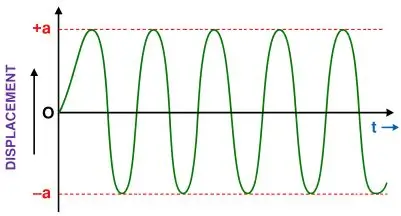
(b) Natural (or free) vibrations can occur only in the absence of any external force or resistance. Ideally, such vibrations occur in a vacuum, where there is no air resistance to reduce the amplitude.
Question 2
The diagram in below figure shows three ways in which a string of length l in an instrument can vibrate.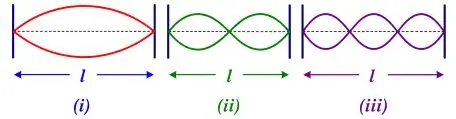
(a) Which of the diagram shows the principal note?
(b) Which vibration has a frequency four times that of the first ?
(c) Which vibration is of longest wavelength ?
(d) What is the ratio of frequency of vibrations in diagrams (i) and (ii) ?
Answer:
(a) The principal note is produced in diagram (i), where the string vibrates in its first harmonic (fundamental mode).
(b) The vibration shown in diagram (iii) has a frequency four times that of the first harmonic.
(c) The vibration shown in diagram (i) has the longest wavelength.
(d) Let the frequency of the vibration in diagram (i) be f.
Then, the frequency of the vibration in diagram (ii) is 2f.
Therefore,
Frequency ratio = f : 2f = 1 : 2
Hence, the ratio of the frequencies of vibrations in diagrams (i) and (ii) is 1 : 2.
Question 3
Explain why strings of different thickness are provided on stringed instrument.
[Hint : Natural frequency of vibration of a stretched string is inversely proportional to the radius (or thickness) of the string, so notes of different frequencies can be obtained by producing vibrations in different strings.]
Answer:
The natural frequency of a stretched string is inversely proportional to its thickness (radius). A thinner string vibrates with a higher frequency and produces a higher-pitched note, while a thicker string vibrates with a lower frequency and produces a lower-pitched note. Therefore, stringed instruments are provided with strings of different thicknesses to produce notes of different frequencies.
Question 4
What are damped vibrations? How do they differ from free vibrations? Give one example of each.
Answer:
Damped vibrations are vibrations in which the amplitude gradually decreases with time due to the resistance of the surrounding medium.
Differences:
| Free (Natural) Vibrations | Damped Vibrations |
| Amplitude remains constant. | Amplitude gradually decreases. |
| No energy is lost. | Energy is continuously lost due to resistance. |
Examples:
- Free vibrations: A stretched guitar string vibrating in vacuum.
- Damped vibrations: A tuning fork vibrating in air.
Question 5
The diagram in below figure shows the displacement-time graph of a vibrating body.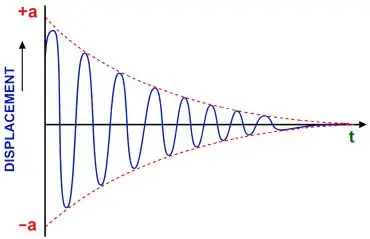
(i) Name the kind of vibrations.
(ii) Give one example of such vibration.
(iii) Why is the amplitude of vibrations gradually decreasing?
(iv) What happens to the vibrations of the body after some time?
Answer:
(i) The vibrations are damped vibrations.
(ii) A tuning fork vibrating in air is an example of damped vibrations.
(iii) The amplitude gradually decreases due to the resistance of the surrounding medium (air) and internal friction, which continuously dissipate the energy of the vibrating body.
(iv) After some time, when the body has lost all its energy, it stops vibrating.
Question 6
Draw a sketch showing displacement against time for a body executing the damped vibrations.
Answer:
The displacement of a body executing damped vibrations, against time is shown below.
Question 7
What is meant by resonance? Describe a simple experiment to illustrate the phenomenon of resonance and explain it.
Answer:
Resonance is the phenomenon in which a body vibrates with maximum amplitude when the frequency of the external periodic force becomes equal to its natural frequency.
Experiment: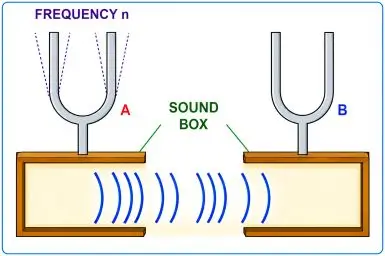
Take two identical tuning forks mounted on resonance boxes and place them facing each other. Strike one tuning fork with a rubber hammer. After a few seconds, stop the first tuning fork by touching it gently. The second tuning fork is found to be vibrating and producing sound.
Explanation:
The sound waves from the first tuning fork force the second tuning fork to vibrate. Since both tuning forks have the same natural frequency, resonance occurs, and the second tuning fork vibrates with a large amplitude.
Question 8
Below figure shows two tuning forks A and B of the same frequency mounted on two separate sound boxes with their open ends facing each other. The fork A is set into vibration. (a) Describe your observation. (b) State the principle illustrated by this experiment.
Answer:
(a) Observation: When tuning fork A is struck, it starts vibrating and produces sound waves. These sound waves reach tuning fork B, causing B to start vibrating and produce sound without being struck. If fork A is then stopped by touching it, fork B continues to vibrate and its sound can be heard for a short time.
(b) Principle illustrated: This experiment demonstrates the principle of resonance.
Explanation: Since both tuning forks have the same natural frequency, the vibrations produced by fork A force fork B to vibrate with maximum amplitude. This phenomenon is called resonance.
Question 9
In below figure, A, B, C and D are the four pendulums suspended from the same elastic string XY. The lengths of pendulum A and D are equal, while the length of pendulum B is shorter and of the pendulum C is longer. Pendulum A is set into vibrations.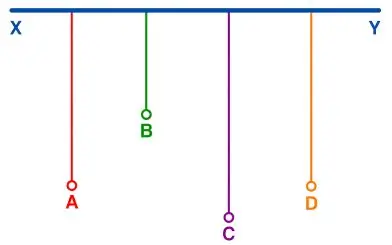
(a) What is your observation about the vibrations of pendulum D?
(b) Give reason for your observation in part (a).
(c) What type of vibrations take place in pendulums B and C?
(d) Give reason for the answer in part (C).
Answer:
(a) Pendulum D vibrates with the maximum amplitude.
(b) Pendulums A and D have the same length, so they have the same natural frequency. When pendulum A vibrates, it forces pendulum D to vibrate. Since their natural frequencies are equal, resonance occurs, and pendulum D vibrates with maximum amplitude.
(c) Pendulums B and C execute forced vibrations.
(d) Pendulums B and C have different lengths from pendulum A, so their natural frequencies are different. They are forced to vibrate by the vibrations transmitted through the elastic string XY, but since resonance does not occur, they vibrate with small amplitudes. Therefore, they undergo forced vibrations.
Question 10
A vibrating tuning fork, held over an air column of a given length with its one end closed, produces a loud audible sound. Name the phenomenon responsible for it and explain the observation.
Answer:
The phenomenon is resonance. When the length of the air column is such that its natural frequency becomes equal to the frequency of the vibrating tuning fork, resonance occurs. The air column vibrates with maximum amplitude, producing a loud sound.
Question 11
In below figure, A, B, C and D represent the test tubes each of height 20 cm which are filled with water up to heights of 12 cm, 14 cm, 16 cm and 18 cm respectively. If a vibrating tuning fork is placed over the mouth of test tube D, a loud sound is heard.
(a) Describe the observations with the tubes A, B and C when the vibrating tuning fork is placed over the mouth of these tubes.
(b) Give the reason for your observation in each tube.
(c) State the principle illustrated by the above experiment.
Answer:
(a) Observations:
- Test tube A: A faint sound is heard.
- Test tube B: A slightly louder sound than A is heard.
- Test tube C: A louder sound than A and B is heard, but not as loud as in D.
(b) Reasons:
- Test tube A: The natural frequency of the air column does not match the frequency of the tuning fork. Hence, resonance does not occur.
- Test tube B: The natural frequency of the air column is closer to the tuning fork’s frequency, but resonance still does not occur.
- Test tube C: The natural frequency is even closer to that of the tuning fork, so the sound is louder, but complete resonance is still not achieved.
- Test tube D: The natural frequency of the air column becomes equal to the frequency of the tuning fork. Therefore, resonance occurs, producing a loud sound.
(c) The experiment illustrates the principle of resonance.
Principle:
When the frequency of an external periodic force becomes equal to the natural frequency of a body, the body vibrates with maximum amplitude. This phenomenon is called resonance.
Download Selina Solutions for ICSE Class 10 Physics Exercise 7(B) – Sound
Students can also download the ICSE Class 10 Physics Chapter 7: Sound Exercise 7(B) Selina Solutions PDF for free and revise anytime, even without an internet connection. The solutions are prepared in an exam-oriented format by experienced subject experts to ensure accuracy and clarity.
Why Choose These Selina Solutions?
- Based on the latest ICSE Class 10 Physics syllabus.
- Accurate and well-explained answers.
- Easy language for better understanding.
- Helpful for school tests, assignments, and board exams.
- Ideal for quick revision before examinations.
You can also visit:
ICSE Class 10 Physics Notes
| ☛ ICSE Class 10 Physics Chapter 1 – Force Notes |
| ☛ ICSE Class 10 Physics Chapter 2 – Work, Energy and Power Notes |
| ☛ ICSE Class 10 Physics Chapter 3 – Machines Notes |
| ☛ ICSE Class 10 Physics Chapter 4 – Refraction of Light at Plane Surfaces Notes |
| ☛ ICSE Class 10 Physics Chapter 5 – Refraction through Lens Notes |
| ☛ ICSE Class 10 Physics Chapter 6 – Spectrum Notes |
| ☛ ICSE Class 10 Physics Chapter 7 – Sound Notes |
| ☛ ICSE Class 10 Physics Chapter 8 – Current Electricity Notes |
| ☛ ICSE Class 10 Physics Chapter 9 – Electrical Power and Household Circuits Notes |
| ☛ ICSE Class 10 Physics Chapter 10 – Electro-magnetism Notes |
| ☛ ICSE Class 10 Physics Chapter 11 – Calorimetry Notes |
| ☛ ICSE Class 10 Physics Chapter 12 – Radioactivity Notes |
Official Website:
Students can visit the official CISCE website for more details and updates.