Selina Solutions for ICSE Class 10 Physics Exercise 5(C) – Refraction Through a Lens
Looking for Selina Solutions for ICSE Class 10 Physics Exercise 5(C) – Refraction Through a Lens? You have come to the right place. This page provides comprehensive, step-by-step solutions to all the questions in Exercise 5(C) of the Selina Concise Physics textbook. The solutions are prepared according to the latest ICSE syllabus and board examination pattern, making them an excellent resource for students aiming to score high marks.
Exercise 5(C) focuses on advanced applications of refraction through a lens, including conceptual questions, numerical problems, and ray diagrams. The solutions are explained in simple language to help students understand every concept clearly and solve board-level questions with confidence.
Study Support by Rohit Academy
Rohit Academy offers expert-curated ICSE Class 10 Physics Study Materials including ICSE Refraction Through a Lens Selina Solutions, diagrams, and key formulas for better understanding.
Study materials related to chapter 5: Refraction Through a Lens
(A) Multiple Choice Type
(Choose the correct answer from the options given below).
Question 1
The correct lens formula is:
(a) (b)
(c) (d)
Answer:
(c)
Explanation:
The lens formula under the Cartesian sign convention is:
It relates the focal length (f), object distance (u), and image distance (v) of a lens.
Question 2
Identify the wrong statement.
(a) For a convex lens, u is always negative.
(b) For a convex lens, f is always positive.
(c) For a convex lens, v is positive for a virtual image and negative for a real image.
(d) For a concave lens, u, v and f all are
Answer:
For a convex lens, v is positive for a virtual image and negative for a real image.
Explanation:
For a convex lens:
- Real image: v is positive.
- Virtual image: v is negative.
Option (c) states the opposite, so it is incorrect.
Question 3
For a convex lens, the value of magnification m is:
(a) positive
(b) negative
(c) both positive as well as negative
(d) none
Answer:
(c) both positive as well as negative
Explanation:
- Positive magnification: Virtual, erect image.
- Negative magnification: Real, inverted image.
Hence, a convex lens can have both positive and negative magnification.
Question 4
If the magnification produced by a lens is -0.5, the correct statement is:
(a) the lens is concave
(b) the image is virtual
(c) the image is magnified
(d) the image is real and diminished formed by a convex lens
Answer:
(d) the image is real and diminished formed by a convex lens
Explanation:
- Negative magnification means the image is real and inverted.
- Magnitude 0.5 < 1 means the image is diminished.
Only a convex lens can produce such an image.
Question 5
The numerical value of magnification m is always …………… for a concave lens.
(a) equal to 1 (b) less than 1
(c) more than 1 (d) variable
Answer:
(b) less than 1
Explanation:
A concave lens always forms a virtual, erect, and diminished image.
Therefore,
m < 1
Question 6
If a lens deviates a ray towards its centre, its power is …………… and if it deviates the ray away from its centre, its power is ……………
(a) positive, positive (b) negative, negative
(c) negative, positive (d) positive, negative
Answer:
(d) positive, negative
Explanation:
- Convex lens: Bends rays towards the principal axis → Positive power.
- Concave lens: Bends rays away from the principal axis → Negative power.
Question 7
On reducing the focal length of a lens, its power:-
(a) decreases
(b) increases
(c) does not change
(d) first increases then decreases.
Answer:
(b) increases
Explanation:
Power is inversely proportional to focal length.
Hence, when focal length decreases, power increases.
Question 8
The lens of power + 1.0 D is:
(a) convex of focal length 1.0 cm
(b) convex of focal length 1.0 m
(c) concave of focal length 1.0 cm
(d) concave of focal length 1.0 m.
Answer:
(b) convex of focal length 1.0 m
Explanation:
For P = + 1 D
f = 1 m
Positive power indicates a convex lens.
Question 9
Linear magnification m is given by:
(a)
(b )
(c)
(d)
Answer:
(c)
Explanation:
The formula for linear magnification of a lens is:
Question 10
If a lens is placed in water instead of air, its power:
(a) increases
(b) decreases
(c) remains the same
(d) can both increase or decrease
Answer:
(b) decreases
Explanation:
The refractive index difference between the lens and water is smaller than that between the lens and air.
Therefore, the lens bends light less strongly, so its focal length increases and its power decreases.
(B) Very Short Questions
Question 1
The focal length of a lens is (i) positive, (ii) negative. In each case, state the kind of lens.
Answer:
- (i) Positive focal length (+f): Convex (converging) lens.
- (ii) Negative focal length (−f): Concave (diverging) lens.
Question 2
What information about the nature of the image (i) real or virtual, (ii) erect or inverted, do you get from the sign of magnification + or − ?
Answer:
- Positive (+) magnification: The image is virtual and erect.
- Negative (−) magnification: The image is real and inverted.
Question 3
How is the power of a lens related to its focal length?
Answer:
The power of a lens is the reciprocal of its focal length (in metres).
where:
- P = Power (in dioptre)
- f = Focal length (in metre)
Question 4
How does the power of a lens change if its focal length is doubled?
Answer:
Since,
if the focal length is doubled, the power becomes half of its original value.
Question 5
How is the sign (+ or −) of power of a lens related to its divergent or convergent action?
Answer:
- Positive (+) power: Converging (convex) lens.
- Negative (−) power: Diverging (concave) lens.
Question 6
The power of a lens is negative. State whether it is convex or concave?
Answer:
A lens with negative power is a concave (diverging) lens.
Question 7
Which lens has more power : a thick lens or a thin lens?
Answer:
A thick lens has more power because it has a shorter focal length.
(C) Short Questions
Question 1
State the sign convention to measure the distances for a lens.
Answer:
Rules of Sign Convention:
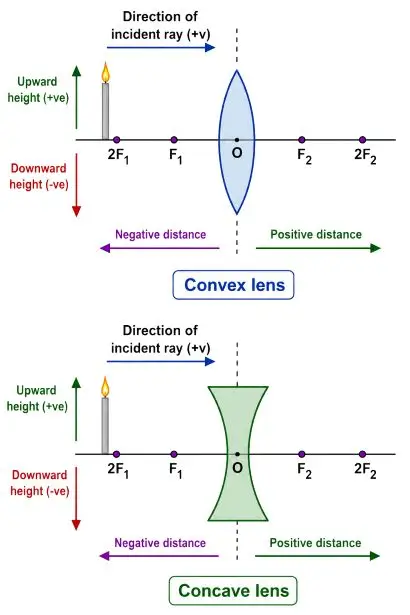
- The optical centre (O) of the lens is taken as the origin.
- All distances are measured from the optical centre.
- Distances measured to the right of the optical centre (along the positive x-axis) are positive (+).
- Distances measured to the left of the optical centre (along the negative x-axis) are negative (−).
- Heights measured above the principal axis (along the positive y-axis) are positive.
- Heights measured below the principal axis (along the negative y-axis) are negative.
Question 2
Write the lens formula explaining the meaning of the symbols used.
Answer:
The lens formula is:
where:
- f = Focal length of the lens
- u = Object distance from the optical centre
- v = Image distance from the optical centre
Question 3
What do you understand by the term magnification? Write an expression for it for a lens, explaining the meaning of the symbols used.
Answer:
Magnification is the ratio of the height of the image to the height of the object.
where:
- m = Magnification
- h2 = Height of the image
- h1 = Height of the object
Question 4
Define the term power of a lens. In what unit is it expressed?
Answer:
The power of a lens is the reciprocal of its focal length.
The S.I. unit of power is dioptre (D).
Question 5
What is the power of a glass plate? Give reason
Answer:
The power of a glass plate is zero (0 D).
Reason:
A glass plate does not converge or diverge light rays because its two faces are parallel. Therefore, its focal length is infinite.
Question 6
A lens of power +2.5 D is kept in contact with another lens of power −2.5 D. What will be the power of the combination of the two lenses? How will the combination behave?
Answer:
Power of the combination:
P = P1 + P2 = +2.5 + (−2.5) = 0 D
Therefore, the power of the combination is 0 D.
Behaviour:
The combination behaves like a plane glass plate, as it neither converges nor diverges light rays.
(D) Numericals
Question 1
(a) At what position a candle of length 3 cm be placed in front of a convex lens so that its image of length 6 cm be obtained on a screen placed at a distance 30 cm behind the lens?
(b) What is the focal length of the lens in part (a)?
Solution:
(a) Given,
- Object height (h1) = 3 cm
- Image height (h2) = – 6 cm
- Image distance (v) = +30 cm
Magnification:
Also,
Therefore, the candle should be placed 15 cm in front of the lens.
(b) Using the lens formula:
Hence, the focal length of the lens is 10 cm.
Question 2
A concave lens forms the image of an object kept at a distance 20 cm in front of it, at a distance 10 cm on the side of the object.
(a) What is the nature of the image?
(b) Find the focal length of the lens.
Solution:
(a) Since the lens is a concave lens, it forms an image that is virtual, erect, and diminished. The image is virtual because it is formed on the same side of the lens as the object.
(b) Given,
- u = – 20 cm
- v = – 10 cm
Using the lens formula:
Therefore, the focal length of the lens is – 20 cm.
Question 3
The focal length of a convex lens is 25 cm. At what distance from the optical centre of the lens an object be placed to obtain a virtual image of twice the size?
Solution:
Given: f = +25 cm
Virtual image is twice the object.
m = +2
v = 2u
Using the lens formula:
Therefore, the object should be placed 12.5 cm in front of the lens.
Question 4
Where should an object be placed in front of a convex lens of focal length 0.12 m to obtain a real image of size three times the size of the object, on the screen?
Solution:
Given:
f = 0.12 m = 12 cm
Real image three times the object.
m = – 3
v = – 3 u
Using the lens formula:
Therefore, the object should be placed 16 cm in front of the lens.
Question 5
An illuminated object lies at a distance 1.0 m from a screen. A convex lens is used to form an image of the object on the screen placed at a distance of 75 cm from the lens.
Find:-
(i) the focal length of lens, and
(ii) the magnification.
Solution:
Given,
- Object-screen distance = 100 cm
- Image distance (v) = 75 cm
- Object distance (u) = – 25 cm
Using the lens formula:
Therefore, focal length of the lens is 18.75 cm.
Magnification:
Therefore, the magnification is – 3.
Question 6
A lens forms the image of an object placed at a distance 15 cm from it, at a distance 60 cm in front of it.
Find:-
(i) the focal length,
(ii) the magnification, and
(iii) the nature of image.
Solution:
Given:
u = – 15 cm
v = – 60 cm
(i) Using the lens formula:
Therefore, focal length of the lens is 20 cm.
(ii) Magnification:
Therefore, the magnification is 4.
(iii) The nature of the image is erect, virtual and magnified.
Question 7
A lens forms the image of an object placed at a distance of 45 cm from it on a screen placed at a distance 90 cm on the other side of it.
(a) Name the kind of lens.
(b) Find : (i) the focal length of lens, and (ii) the magnification of the image.
Solution:
Given:
u = – 45 cm
v = +90 cm
(a) Since the image is formed on the other side of the lens, it is a real image. Therefore, the lens is a convex lens.
(b) Using the lens formula:
Therefore, focal length of the lens is 30 cm.
(c) Magnification:
Therefore, the magnification is –2.
Question 8
A convex lens forms an inverted image of size same as that of the object which is placed at a distance 60 cm in front of the lens.
Find:-
(a) the position of image, and
(b) the focal length of the lens
Solution:
(a) Same size inverted image.
m = – 1
u = – 60 cm
v = m × u
v = +60 cm
Hence, position of the image is 60 cm behind the lens.
(b) Using the lens formula:
Therefore, the focal length of the given lens is 30 cm.
Question 9
A concave lens forms an erect image of rd the size of the object which is placed at a distance 30 cm in front of the lens. Find:
(a) the position of the image, and
(b) the focal length of the lens.
Solution:
(a) Given:
u = – 30 cm
m
Therefore, the image is formed at 10 cm in front of the lens.
(b) Using the lens formula:
Therefore, the focal length is 15 cm.
Question 10
The power of a lens is +2.0 D. Find its focal length and state the kind of the lens?
Solution:
Power = +2 D
f = 0.5 m = 50 cm
Therefore, the focal length is 50 cm.
Since the power of the lens is positive, the lens is a convex (converging) lens.
Question 11
Express the power (with sign) of a concave lens of focal length 20 cm.
Solution:
As we know,
Power (P)
Given: Focal length = 20 cm = 0.2 m
Since the lens is concave, its focal length is taken as –20 cm = –0.2 m.
Substituting the value of focal length into the formula:
D
Since a concave lens has a negative focal length, its power is also negative.
Hence, the power of the lens is –5 D.
Question 12
The focal length of a convex lens is 25 cm. Express its power with sign.
Solution:
As we know,
Power (P)
Given:
Focal length = 25 cm = 0.25 m
P
P = 4 D
Since the focal length is positive, the lens is convex in nature. Therefore, the power of the lens is also positive.
Hence, the power of the lens is +4 D.
Question 13
The power of a lens is – 2.0 D. Find its focal length and its kind.
Solution:
As we know,
Power (P)
Given:
Power of the lens = – 2.0 D Since the power is negative, the lens is concave in nature.
Substituting the given value into the formula:
Therefore, the focal length of the lens is –50 cm, and the lens used is concave in nature.
Question 14
The magnification by a lens is –3. Name the lens and state how are u and v related?
Solution:
Magnification (m) = –3
Since the magnification is negative, the image formed is real and inverted.
Since the magnitude of the magnification is greater than 1, the image formed is magnified.
Since the image formed is real, inverted, and magnified, the lens used is a convex lens.
As we know that,
The lens is convex in nature and the image distance v = –3 u.
Question 15
The magnification by a lens is +0.5. Name the lens and state how are u and v related?
Solution:
Given,
Magnification (m) = +0.5
Since the magnification is positive, the image formed is virtual and erect. Since the magnitude of the magnification is less than 1, the image formed is diminished.
Since the image formed is virtual, erect, and diminished, the lens used is a concave lens.
As we know that,
The lens is concave in nature and the image distance v = 0.5u.
Question 16
A photographer needs a lens with a focal length of 0.2 m for close up shots. What is the power of the lens required? How does a lens with higher power affect the focussing capability of a camera?
Solution:
Given,
Focal length (f) = 0.2 m
So,
P 5 D
A lens with greater power has a shorter focal length, enabling it to focus light from nearby objects more effectively. Therefore, it is more suitable for viewing or capturing close-up objects.
Question 17
A concave lens has a focal length of 30 cm. Find the position and magnification (m) of the image for an object placed in front of it at a distance of 30 cm. State whether the image is real or virtual?
Solution:
Given:
- f = –30 cm
- u = –30 cm
Using the lens formula:
Therefore, the image is formed 15 cm in front of the lens.
Magnification:
Therefore, the magnification is +0.5.
Hence, the image is virtual and erect, as the magnification is positive.
Question 18
Find the position and magnification of the image of an object placed at distance of 8.0 cm in front of a convex lens of focal length 10.0 cm. Is the image erect or inverted?
Solution:
Given:
- u = –8 cm
- f = +10 cm
Using the lens formula:
Therefore, the image is formed 40 cm in front of the lens.
Magnification:
Therefore, the magnification is +5.0.
Therefore, the image is virtual, erect and magnified.
Download Selina Solutions for ICSE Class 10 Physics Exercise 5(C) – Refraction Through a Lens
You can download free PDF solutions for Selina Class 10 Physics Exercise 5(C) to revise offline. These solutions are exam-ready and designed by subject experts.
Features of Our Selina Solutions
- Accurate and reliable answers
- Step-by-step explanations
- Easy-to-understand language
- Detailed numerical solutions
- Exam-oriented approach
- Fully updated according to the latest ICSE syllabus
- Helpful for revision and self-study
Benefits for Students
These solutions help students:
- Build a strong understanding of lens concepts.
- Improve problem-solving speed and accuracy.
- Learn the correct application of formulas.
- Avoid common mistakes in numerical calculations.
- Prepare confidently for school tests and the ICSE Board Examination.
Why Choose Rohit Academy?
Rohit Academy provides high-quality study materials designed specifically for ICSE students. Along with Selina Solutions, students can access:
- Chapter-wise Physics Notes
- Previous Year Questions
- Important MCQs
- Assertion and Reason Questions
- Formula Sheets
- Revision Notes
- Free PDF Study Materials
Every resource is prepared in a student-friendly format to make learning simple and effective.
Conclusion
The Selina Solutions for ICSE Class 10 Physics Exercise 5(C) – Refraction Through a Lens are an excellent resource for mastering one of the most important chapters in ICSE Physics. Study each solution carefully, practise the numerical questions regularly, and revise the ray diagrams to strengthen your preparation for the board examination.
Explore Rohit Academy for more ICSE Class 10 Physics Notes, Selina Solutions, MCQs, Previous Year Questions, Sample Papers, and Free PDF Downloads to boost your exam preparation and achieve outstanding results.
You can also visit:
ICSE Class 10 Physics Notes
| ☛ ICSE Class 10 Physics Chapter 1 – Force Notes |
| ☛ ICSE Class 10 Physics Chapter 2 – Work, Energy and Power Notes |
| ☛ ICSE Class 10 Physics Chapter 3 – Machines Notes |
| ☛ ICSE Class 10 Physics Chapter 4 – Refraction of Light at Plane Surfaces Notes |
| ☛ ICSE Class 10 Physics Chapter 5 – Refraction through Lens Notes |
| ☛ ICSE Class 10 Physics Chapter 6 – Spectrum Notes |
| ☛ ICSE Class 10 Physics Chapter 7 – Sound Notes |
| ☛ ICSE Class 10 Physics Chapter 8 – Current Electricity Notes |
| ☛ ICSE Class 10 Physics Chapter 9 – Electrical Power and Household Circuits Notes |
| ☛ ICSE Class 10 Physics Chapter 10 – Electro-magnetism Notes |
| ☛ ICSE Class 10 Physics Chapter 11 – Calorimetry Notes |
| ☛ ICSE Class 10 Physics Chapter 12 – Radioactivity Notes |
Official Website:
Students can visit the official CISCE website for more details and updates.