ICSE Class 10 Physics Selina Solutions – Chapter 5: Refraction Through a Lens Exercise 5(A)
ICSE Class 10 Physics Chapter 5 Refraction Through a Lens Exercise 5(A) Selina Solutions provide detailed, step-by-step answers to all textbook questions based on the latest Selina Concise Physics syllabus. This exercise introduces the fundamental concepts of refraction through lenses, including convex and concave lenses, principal focus, focal length, optical centre, image formation, sign convention, and ray diagrams.
Whether you are preparing for your school examinations, unit tests, or the ICSE Board Examination, these solutions will help you strengthen your conceptual understanding and improve your problem-solving skills.
Why Study Exercise 5(A) Solutions?
Exercise 5(A) introduces students to the fundamental concepts of refraction through lenses. By practising these questions, students can:
- Understand the difference between convex and concave lenses.
- Learn image formation using ray diagrams.
- Solve numerical problems based on the lens formula.
- Understand magnification and image characteristics.
- Prepare effectively for ICSE board examinations.
Study Support by Rohit Academy
Rohit Academy offers expert-curated ICSE Class 10 Physics Study Materials including ICSE Refraction Through a Lens Selina Solutions, diagrams, and key formulas for better understanding.
Study materials related to chapter 5: Refraction Through a Lens
(A) Multiple Choice Type
(Choose the correct answer from the options given below).
Question 1
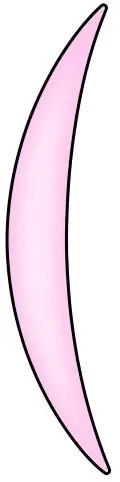
The given figure shows a kind of a lens.
It is a:
(a) convex lens
(b) biconvex lens
(c) concave lens
(d) concavo-convex
Answer:
(d) Convexo-concave lens
Explanation:
- Convex lens → thicker at the centre than the edges.
- Biconvex lens → both surfaces are convex.
- Concave lens → thinner at the centre.
- Convexo-concave lens → one surface is convex and the other is concave (as shown in the figure).
Question 2
The incorrect statement is:
(a) both convexo-concave and concavo-convex lenses have one surface concave and the other surface convex.
(b) a convexo-concave lens is thicker in the middle and has a converging action.
(c) A concavo-convex lens is thicker in the middle and has a converging action.
(d) a convexo-concave lens is thinner in the middle and has a diverging action.
Answer:
(c) a convexo-concave lens is thicker in the middle and has a converging action.
Explanation:
A convexo-concave lens has one convex surface and one concave surface. When it is thicker at the centre than at the edges, it behaves as a converging lens.
Question 3
A convex lens in its upper part has a prism with its base …………… and a concave lens in its upper part has a prism with its base …………… .
(a) downward, upward
(b) upward, downward
(c) upward, upward
(d) downward, downward
Answer:
(a) downward, upward
Explanation:
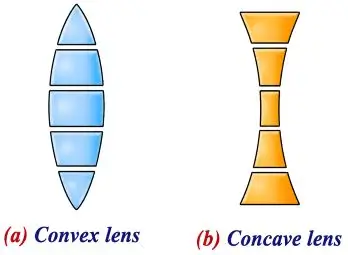
The upper part of a convex lens behaves like a prism with its base directed downward, whereas the upper part of a concave lens behaves like a prism with its base directed upward, as shown in the figure below.
Question 4
The correct differences between a convex and concave lens are:
(1) convex lens is thin in the middle and concave lens is thick in the middle.
(2) convex lens converges the incident rays towards the principal axis whereas concave lens diverges
(3) convex lens has a virtual focus and concave lens has a real focus.
(a) (1)
(b) (3)
(c) (1), (2) and (3)
(d) (2)
Answer:
(d) (2) convex lens converges the incident rays towards the principal axis whereas concave lens diverges
Question 5
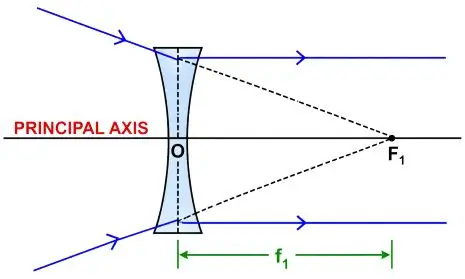
A ray of light after refraction through a lens emerges parallel to the principal axis of the lens. The incident ray passes through:
(a) its optical centre
(b) its first focus
(c) its second focus
(d) the centre of curvature of the first surface.
Answer:
(b) its first focus
Explanation:
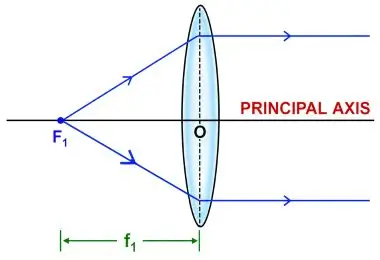
A ray passing through the first principal focus emerges parallel to the principal axis after refraction.
Convex Lens:
Concave Lens:
Question 6
A ray of light incident on a lens parallel to its principal axis, after refraction passes through or appears to come from:
(a) its first focus
(b) its optical centre
(c) its second focus
(d) the centre of curvature of its second surface.
Answer:
(c) its second focus
Explanation:
- Convex lens: passes through the second focus.

- Concave lens: appears to come from the second focus.
Question 7
A lens is called equi-convex or equi-concave when:
(a) the radius of curvature of first surface of lens is greater than the radius of curvature of the second surface.
(b) the radius of curvature of the second surface of the lens is greater than the radius of curvature of the first surface.
(c) the radius of curvature of the two surfaces of the lens are equal.
(d) none of the above
Answer:
(c) the radius of curvature of the two surfaces of the lens are equal.
Question 8
The focal length of a lens depends upon:
(a) the refractive index of the material of lens relative to its surrounding medium
(b) the amount of light entering the lens
(c) the radius of curvature of the two surfaces of lens
(d) both (a) and (c)
Answer:
(d) both (a) and (c)
Explanation:
The focal length depends upon:
- Refractive index of lens material
- Radius of curvature of both surfaces
Question 9
If a lens is placed in water instead of air, its focal length:
(a) increases
(b) decreases
(c) remains the same
(d) can both increase or decrease
Answer:
(a) increases
Explanation:
The refractive index difference between the lens and water decreases, reducing the lens’s power. Since Power , focal length increases.
Question 10
If half part of a convex lens is covered, the focal length …………… but the intensity of the image …………… .
(a) increases, decreases
(b) decreases, increases
(c) does not change, increases (d) does not change, decreases
Answer:
(d) does not change, decreases
Explanation:
The focal length remains unchanged because the curvature is unchanged. Less light passes through, so image brightness decreases.
Question 11
The focal length of a thin convex lens is …………… than that of a thick lens.
(a) less (b) more
(c) same (d) none of the above
Answer:
(b) more
Explanation:
A thin lens has less curvature, so its power is less and focal length is greater.
Question 12
The radius of the sphere whose part is the lens’ surface is called the …………… of that surface.
(a) centre of curvature
(b) focal length
(c) pole
(d) radius of curvature
Answer:
(d) radius of curvature
Question 13
Identify the incorrect statement:
(a) if the medium on both sides of a lens is same, its first and second focal lengths are equal, i.e. f1 = f2 (numerically).
(b) when we say focal length of a lens, we mean the first focal length of the lens.
(c) a convex lens has a real focus.
(d) a concave lens has a virtual focus.
Answer:
(b) When we say focal length of a lens, we mean the first focal length.
Explanation:
Normally, “focal length” refers to either principal focal length (they are numerically equal in the same medium), not specifically the first focal length.
Question 14
A convex lens of focal length f is divided into two equal parts by a plane parallel to the principal axis. The focal length of each part will be:
(a) 2f (b) f/2
(c) f (d) infinite
Answer:
(c) f
Explanation:
Cutting the lens parallel to the principal axis changes only the aperture, not the curvature. Therefore, the focal length of each half remains the same.
(B) Very Short Questions
Question 1
What is a lens?
Answer:
A lens is a transparent refracting medium bounded by two spherical surfaces or one spherical surface and one plane surface, which refracts light to form images.
Question 2
Which lens is converging:-
(i) an equiconcave lens or an equiconvex lens.
(ii) a concavo-convex lens or a convexo-concave lens?
Answer:
(i) Equiconvex lens
(ii) Convexo-concave lens
Question 3
State the condition when a lens is called equiconvex or equi-concave.
Answer:
A lens is called equiconvex or equiconcave when the radii of curvature of its two spherical surfaces are equal.
Question 4
Define the term focal length of a lens.
Answer:
The focal length of a lens is the distance between its optical centre and its principal focus.
Question 5
What do you mean by focal plane of a lens?
Answer:
The focal plane is a plane perpendicular to the principal axis and passing through the principal focus of the lens.
Question 6
State the condition for each of the following:-
(a) a lens has both its focal lengths equal.
(b) a ray passes undeviated through the lens.
Answer:
(a) When the medium on both sides of the lens is the same (e.g., air).
(b) When the ray passes through the optical centre of the lens.
Question 7
Complete the following sentences:-
(a) If half part of a convex lens is covered, the focal length …………… change, but the intensity of image …………….
(b) The focal length of a thin convex lens is …………… than that of a thick convex lens.
(c) A tumbler filled with water behaves as a …………… lens.
Answer:
(a) If half part of a convex lens is covered, the focal length does not change, but the intensity of the image decreases.
(b) The focal length of a thin convex lens is greater than that of a thick convex lens.
(c) A tumbler filled with water behaves as a convex lens.
(C) Short Questions
Question 1
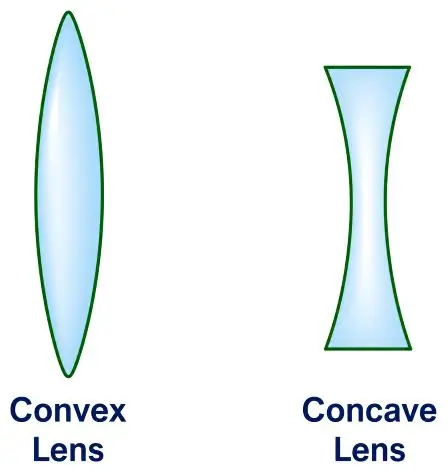
Name the two kinds of lens? Draw diagrams to illustrate them.
Answer:
The two kinds of lenses are:
- Convex lens (Converging lens)
- Concave lens (Diverging lens)
Question 2
State difference between a convex and a concave lens in their:-
(a) appearance, and
(b) action on the incident light.
Answer:
(a) Appearance:
- Convex lens: Thicker at the centre and thinner at the edges.
- Concave lens: Thinner at the centre and thicker at the edges.
(b) Action on light:
- Convex lens: Converges parallel rays to a point.
- Concave lens: Diverges parallel rays.
Question 3
Define the term principal axis of a lens.
Answer:
The line joining the centres of curvature of the two surfaces of the lens is called the principal axis.
Question 4
Explain optical centre of a lens with the help of proper diagram(s).
Answer:
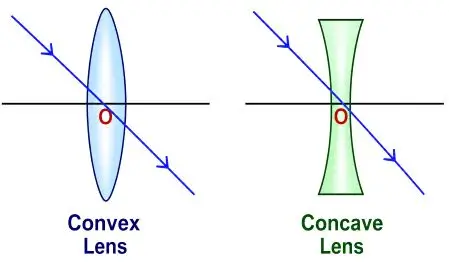
The optical centre is the point on the principal axis through which a ray of light passes without any deviation.
Question 5
A ray of light incident at a point on the principal axis of a convex lens passes undeviated through the lens.
(a) What special name is given to this point on the principal axis?
(b) Draw a labelled diagram to support the answer in part (a).
Answer:
(a) The special point is called the Optical Centre.
(b) The labelled diagrams below show the optical centre of a convex lens and a concave lens.
Question 6
Define the term principal foci of a convex lens and illustrate your answer with the aid of proper diagrams.
Answer:
A convex lens has two principal foci.
- First principal focus (F1): A point on the principal axis from which a ray, after refraction, emerges parallel to the principal axis.
- Second principal focus (F2): A point on the principal axis where rays parallel to the principal axis converge after refraction.
Question 7
Define the term principal foci of a concave lens and show them with the help of proper diagrams.
Answer:
A concave lens has two principal foci.
- First principal focus (F1): A point from which rays directed towards the lens emerge parallel to the principal axis after refraction.
- Second principal focus (F2): A point from which rays parallel to the principal axis appear to diverge after refraction.
Question 8
What happens to the size and intensity of the image if a part of a lens is covered?
Answer:
- Size of the image: Remains unchanged.
- Intensity (brightness): Decreases because less light passes through the lens.
Question 9
Draw a diagram to represent the second focus of a concave lens.
Answer:
The diagram below illustrates the second principal focus (F2) of a concave lens.
Question 10
Draw a diagram to represent the second focus of a convex lens.
Answer:
The diagram below illustrates the second principal focus (F2) of a convex lens.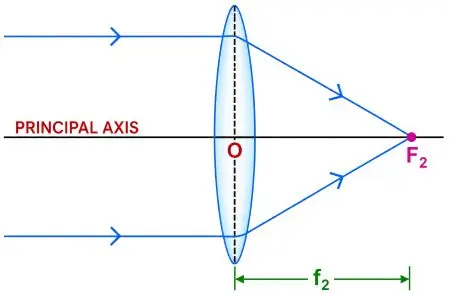
(D) Long Questions
Question 1
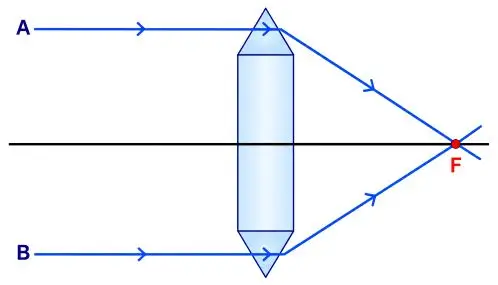
Show by a diagram the refraction of two light rays incident parallel to the principal axis on a convex lens by treating it as a combination of a glass slab and two triangular glass prisms.
Answer:
The diagram below illustrates the refraction of two light rays incident parallel to the principal axis of a convex lens. The convex lens is represented as a combination of a glass slab and two triangular glass prisms.
Question 2
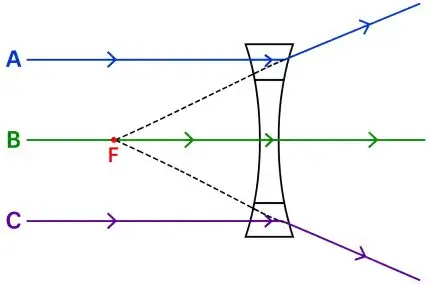
Show by a diagram, the refraction of two light rays incident parallel to the principal axis on a concave lens by treating it as a combination of a glass slab and two triangular glass prisms.
Answer:
The diagram below illustrates the refraction of two light rays incident parallel to the principal axis of a concave lens. The concave lens is represented as a combination of a glass slab and two triangular glass prisms.
Question 3
How does the action of the convex lens differ from that of a concave lens on a parallel beam of light incident on them? Draw diagrams to illustrate your answer.
Answer:
| Convex Lens | Concave Lens |
| Converges a parallel beam of light. | Diverges a parallel beam of light. |
| Parallel rays meet at the second principal focus (F2). | Parallel rays appear to come from the second principal focus (F2). |
| It is called a converging lens. | It is called a diverging lens. |
Convergent action of Convex lens is shown in the below diagram: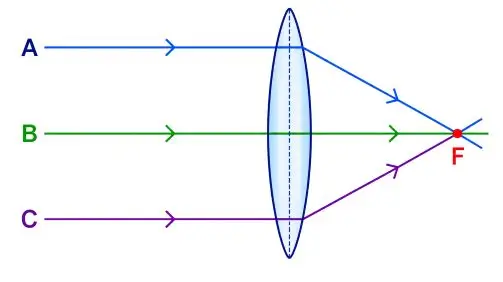
Divergent action of Concave lens is shown in the below diagram:
Question 4
A ray of light, after refraction through a concave lens emerges parallel to the principal axis.
(a) Draw a ray diagram to show the incident ray and its corresponding emergent ray.
(b) The incident ray when produced meets the principal axis at a point F. Name the point F.
Answer:
(a) Below diagram shows the incident ray and its corresponding emergent ray:
(b) The incident ray when produced meets the principal axis at a point F, which is called as the first focus.
Question 5
A ray of light after refraction through a convex lens emerges parallel to the principal axis.
(a) Draw a ray diagram to show it.
(b) The incident ray passes through a point F on the principal axis. Name the point F.
Answer:
(a) Below ray diagram shows the incident ray and its corresponding emergent ray:
(b) The point through which the incident ray passes is known as the first focus.
Question 6
A beam of light incident on a convex lens parallel to its principal axis converges at a point F on the principal axis. Name the point F. Draw a ray diagram to show it.
Answer:
The point F is called the Second Principal Focus (F2) of the convex lens.
Below ray diagram shows the second focus of a convex lens:
Question 7
A beam of light incident on a thin concave lens parallel to its principal axis diverges and appears to come from a point F on the principal axis. Name the point F. Draw a ray diagram to show it.
Answer:
The point F₂ is called the Second Principal Focus of the concave lens.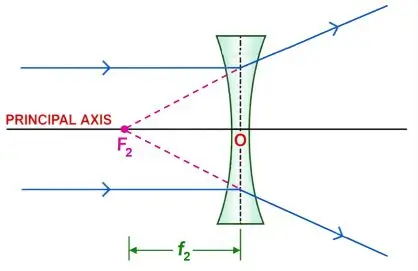
Question 8
A parallel oblique beam of light falls on a
(i) convex lens,
(ii) concave lens.
Draw a diagram in each case to show the refraction of light through the lens.
Answer:
(i) Below diagram shows the refraction of a parallel oblique beam of light by a convex lens: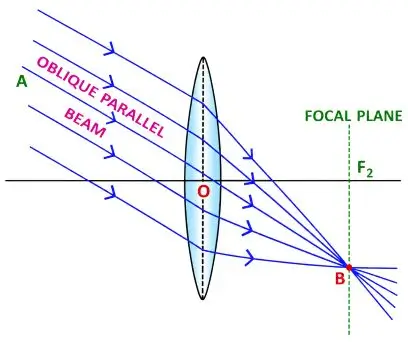
(ii) Below diagram shows the refraction of a parallel oblique beam of light by a concave lens: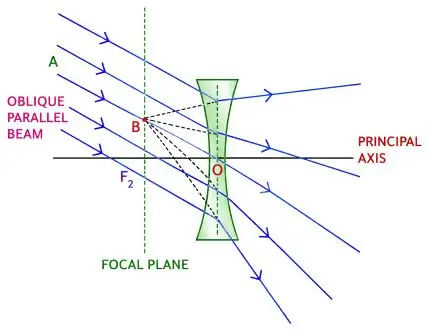
Question 9
The diagram below shows a lens as a combination of a glass slab and two prisms.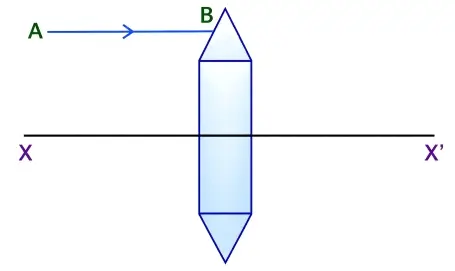
(i) Name the lens formed by the combination.
(ii) What is the line XX’ called?
(iii) Complete the ray diagram and show the path of the incident ray AB after passing through the lens.
(iv) The final emergent ray will either meet XX’ at a point or appear to come from a point on XX’. Label the point as F. What is this point called?
Answer:
(i) The lens formed by the combination is a convex lens.
(ii) The line XX′ is called the principal axis of the lens.
(iii) The incident ray AB, which is parallel to the principal axis, is refracted by the convex lens and passes through the second principal focus (F2) on the other side of the lens.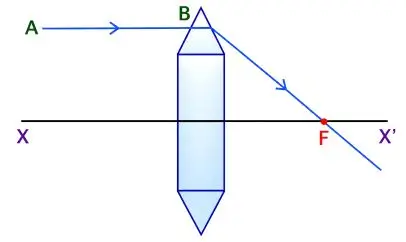
(iv) The point F where the emergent ray meets the principal axis is called the Second Principal Focus (F2) of the convex lens.
Question 10
The diagram below shows a lens as a combination of a glass slab and two prisms.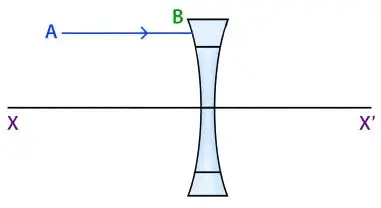
(i) Name the lens formed by the combination.
(ii) What is the line XX’ called?
(iii) Complete the path of the incident ray AB after passing through the lens.
(iv) The final emergent ray either meets XX’ at a point or appears to come from a point on XX’. Label it as F. What is this point called?
Answer:
(i) The lens formed by the combination is a concave lens.
(ii) The line XX′ is called the principal axis of the lens.
(iii) The incident ray AB, which is parallel to the principal axis, is refracted by the concave lens and diverges after passing through the lens. When the emergent ray is produced backward, it appears to come from the second principal focus (F₂) on the principal axis.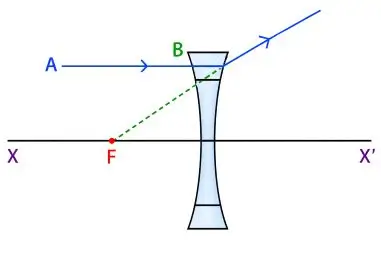
(iv) The point F from which the emergent ray appears to come is called the Second Principal Focus (F₂) of the concave lens.
Question 11
In below figures (a) and (b), F1 and F2 are the positions of the two foci of thin lenses. Draw the path taken by the light ray AB after it emerges from each lens.
(a) Figure a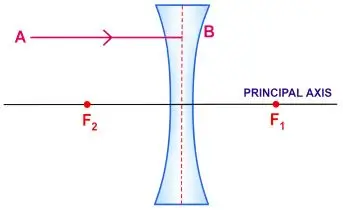
(b) Figure b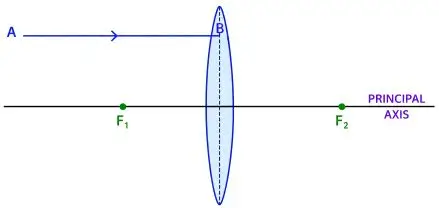
Answer:
(a) The ray diagram below illustrates the path of the light ray AB after it passes through the thin concave lens.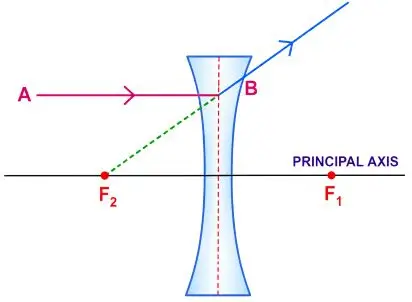
(b) The ray diagram below illustrates the path of the light ray AB after it passes through the thin convex lens.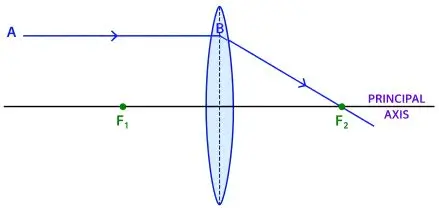
Question 12
In below figures (a) and (b), F1 and F2 are the two foci of thin lenses and AB is the incident ray. Complete the diagram to show the path of the ray AB after refraction through each lens.
(a) Figure a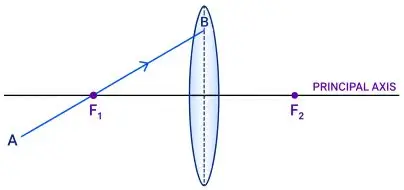
(b) Figure b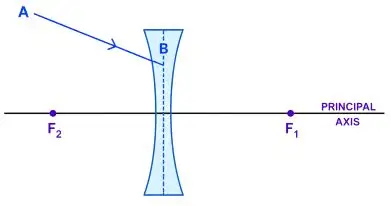
Answer:
(a) The ray diagram below illustrates the path of the light ray AB after refraction through the thin convex lens.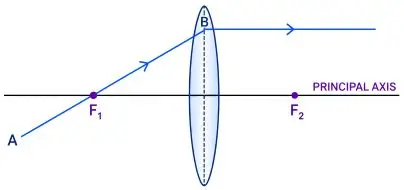
(b) The ray diagram below illustrates the path of the light ray AB after refraction through the thin concave lens.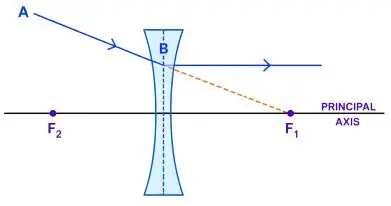
Question 13
Complete the path of the rays of light incident on a convex lens of refractive index μ1, when it is kept in medium of different refractive index μ2.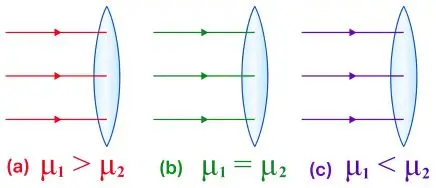
Answer:
(a) When the refractive index of the lens is greater than that of the surrounding medium, the convex lens behaves as a converging lens. Hence, the incident parallel rays converge after refraction and meet at the second principal focus (F2).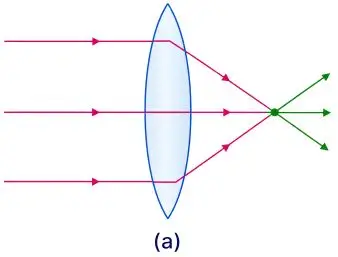
(b) When the refractive index of the lens is equal to that of the surrounding medium, no refraction takes place. Therefore, the rays pass straight through the lens without deviation.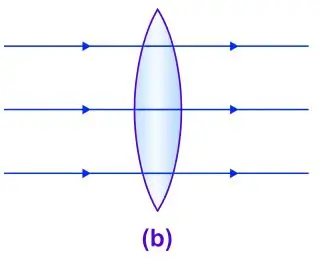
(b) When the refractive index of the lens is less than that of the surrounding medium, the convex lens behaves as a diverging lens. Hence, the incident parallel rays diverge after refraction and appear to come from the second principal focus (F2) on the incident side of the lens.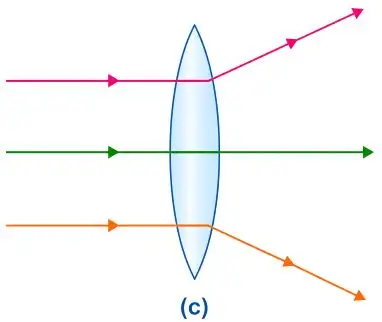
Download Selina Solutions for ICSE Class 10 Physics Exercise 5(A) – Refraction Through a Lens
You can download free PDF solutions for Selina Class 10 Physics Exercise 5(A) to revise offline. These solutions are exam-ready and designed by subject experts.
Benefits for ICSE Students
These solutions are designed to help students build strong fundamentals in optics. Regular practice will improve analytical thinking, numerical-solving skills, and confidence in drawing ray diagrams. Since questions related to lenses frequently appear in ICSE examinations, mastering Exercise 5(A) can significantly improve your exam performance.
Who Can Use These Solutions?
These solutions are ideal for:
- ICSE Class 10 students
- School examination preparation
- ICSE Board exam revision
- Teachers preparing classroom notes
- Parents helping students with homework
Features of Our Selina Solutions
- Accurate and error-free answers
- Step-by-step explanations
- Easy-to-understand language
- Exam-oriented solutions
- Latest ICSE syllabus coverage
- Helpful for quick revision
- Suitable for self-study
Conclusion
The Selina Solutions for ICSE Class 10 Physics Exercise 5(A) – Refraction Through a Lens provide a complete learning resource for students preparing for the ICSE examination. Study each solution carefully, practise the numerical problems, and revise the ray diagrams regularly to achieve excellent marks in Physics.
Continue exploring Rohit Academy for more ICSE Class 10 Physics Notes, Selina Solutions, Previous Year Questions, MCQs, and PDF Study Materials available free of cost.
You can also visit:
ICSE Class 10 Physics Notes
| ☛ ICSE Class 10 Physics Chapter 1 – Force Notes |
| ☛ ICSE Class 10 Physics Chapter 2 – Work, Energy and Power Notes |
| ☛ ICSE Class 10 Physics Chapter 3 – Machines Notes |
| ☛ ICSE Class 10 Physics Chapter 4 – Refraction of Light at Plane Surfaces Notes |
| ☛ ICSE Class 10 Physics Chapter 5 – Refraction through Lens Notes |
| ☛ ICSE Class 10 Physics Chapter 6 – Spectrum Notes |
| ☛ ICSE Class 10 Physics Chapter 7 – Sound Notes |
| ☛ ICSE Class 10 Physics Chapter 8 – Current Electricity Notes |
| ☛ ICSE Class 10 Physics Chapter 9 – Electrical Power and Household Circuits Notes |
| ☛ ICSE Class 10 Physics Chapter 10 – Electro-magnetism Notes |
| ☛ ICSE Class 10 Physics Chapter 11 – Calorimetry Notes |
| ☛ ICSE Class 10 Physics Chapter 12 – Radioactivity Notes |
Official Website:
Students can visit the official CISCE website for more details and updates.