Introduction
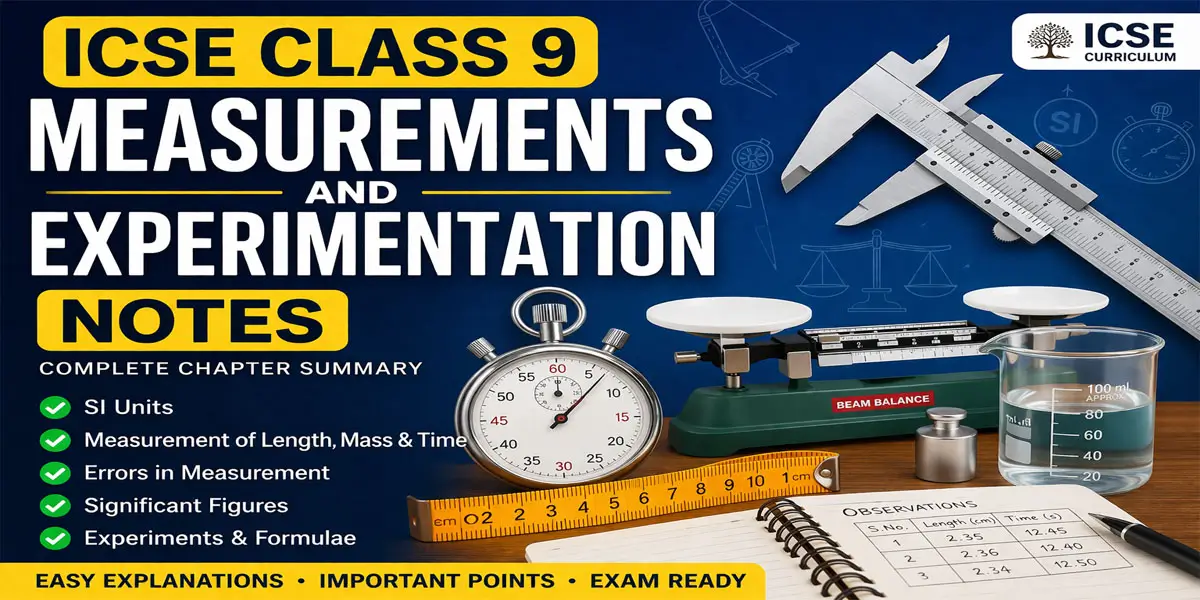
Measurements and Experimentation is the first chapter of ICSE Class 9 Physics. It introduces students to physical quantities, SI units, measurement techniques, errors, and scientific experimentation. Understanding this chapter is essential for building a strong foundation in Physics.
This article provides clear, exam-oriented notes for quick revision and better understanding.
Study Support by Rohit Academy
Rohit Academy offers expert-curated ICSE Class 9 Physics Study Materials including ICSE Measurements and Experimentation Chapter Notes, diagrams, and key formulas for better understanding.
Study materials related to chapter 1
| ☛ Class 9 Chapter 1 Force Ex 1(A) Solutions |
| ☛ Class 9 Chapter 1 Force Ex 1(B) Solutions |
| ☛ Class 9 Chapter 1 Force Ex 1(C) Solutions |
Section A : Systems of Units and Units in S.I. System
👉 Physical Quantity : A physical quantity is a quantity that can be measured.
Examples: Length, Mass, Time, Temperature, Volume
👉 Each physical quantity consists of:
● Numerical value
● Unit
👉 Physical quantity = (numerical value) x (unit)
Example: 5 m → 5 is numerical value, m is unit.
👉 Measurement is the process of comparing an unknown physical quantity with a known standard quantity of the same kind.
👉 A unit is a standard quantity used for measuring a physical quantity.
Characteristics of a Good Unit:
- Should be of convenient size
- Must be well-defined
- Should be reproducible
- Must be constant everywhere (independent of time and place)
Types of Units
- Fundamental (Basic) Units:
- Units that do not depend on other units.
- There are 7 fundamental and 2 complementary units.
- Examples: Length (metre), Mass (kilogram), Time (second), Temperature (kelvin), Electric current (ampere), Luminous intensity (candela), Amount of substance (mole)
2. Derived Units
👉 Units that are derived from fundamental units.
👉 Examples:
- Area = length × breadth → m²
- Volume = length³ → m³
- Speed = distance/time → m/s
- Force = mass × acceleration → newton (N)
Systems of Units
| System | Length | Mass | Time |
| CGS (French System) | cm | g | s |
| FPS (British System) | ft | lb | s |
| MKS (Metric System) | m | kg | s |
- These systems are now replaced by SI System.
Some prefix used for big measurement
| Prefix | Symbol | Meaning |
| deca | da | 101 |
| hecto | h | 102 |
| kilo | k | 103 |
| mega | M | 106 |
| giga | G | 109 |
Some prefix used for small measurement
| Prefix | Symbol | Meaning |
| deci | d | 10−1 |
| centi | c | 10−2 |
| milli | m | 10−3 |
| micro | 𝜇 | 10−6 |
| nano | n | 10−9 |
Units of Length
❖ SI Unit: metre (m)
❖ Smaller Units:
- 1 cm = 10−2 m
- 1 mm = 10−3 m
- 1 μm = 10−6 m
- 1 nm = 10−9 m
- Angstrom (Å) : 1 Å = 10−10 m = 10−1 nm
- Fermi : 1 Fermi = 10−15 m
❖ Larger Units:
- 1 km = 1000 m
- 1 AU = Mean distance between the earth and sun.
1 AU = 1.496 × 10¹¹ metre - 1 Light Year = Distance travelled by light in 1 year
1 ly = 9.46 × 10¹⁵ m = 9.46 × 10¹² km - 1 Parsec ≈ 3.26 light years
***Note
Smallest unit of length is Fermi and biggest unit of length is Parsec.
Units of Mass
❖ SI Unit: kilogram (kg)
❖ Smaller Units:
- 1 g = 10−3 kg
- 1 mg = 10−6 kg
❖ Larger Units:
- 1 quintal = 100 kg
- 1 tonne = 1000 kg
❖ Atomic Mass Unit: 1 a.m.u = 1.66 × 10⁻²⁷ kg
Units of time
- SI unit → second (s)
- 1 minute = 60 s
- 1 hour = 3600 s
- 1 day = 86400 s
- Smaller units: millisecond = 10−3 s; microsecond = 10−6 s; 1 shake = 10−8 s; nanosecond = 10−9 s
- Month : on an average 30 days constitute a month.
- Lunar month : It is time taken by the moon in one revolution round the earth. It is 29.5 days.
- Year : It is time taken by the earth to completes one revolution around the sun.
One year = 365 days - Leap year : a leap year is the year in which the month of February is of 29 days.
1 leap year = 366 days - 1 decade = 10 years
- 1 century = 100 years
- 1 millennium = 1000 years
Section B : Measurements of Length
Least Count of an Instrument
- The least count is the smallest measurement that can be taken accurately with an instrument.
- Smaller least count → greater accuracy.
❖ Examples:
- Metre rule → 1 mm (0.1 cm)
- Vernier calipers → 0.01 cm
- Screw gauge → 0.001 cm
Measurement of Length using Metre Rule
- A metre rule has 100 cm divisions
- Each cm divided into 10 parts
- Smallest division = 1 mm
- Accuracy limited to 0.1 cm
Vernier Calipers
❖ Uses
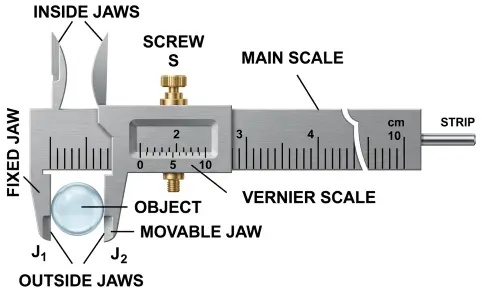
Vernier calipers are used to measure:
- Length of rod
- External diameter
- Internal diameter
- Depth of beaker
❖ Main Parts of Vernier Calipers
- Outside jaws – measure external diameter
- Inside jaws – measure internal diameter
- Strip – measure depth
- Main scale – Gives main reading
- Vernier scale – Gives precise reading
❖ Principle of Vernier
- Vernier calipers use two scales:
◦ Main scale (fixed)
◦ Vernier scale (movable)
- Length of n vernier divisions = (n − 1) main scale divisions
❖ Least Count of Vernier Calipers
Least count = \(\frac{Value\ of\ one\ main\ scale\operatorname{division}}{Total\ divisions\ on\ vernier\ scale}\)
OR, Least count = 1 MSD − 1 VSD
Vernier Reading Formula
Observed reading = Main scale reading + Vernier scale reading
Where,
Vernier scale reading = p × Least count
(p = coinciding vernier division)
Zero Error in Vernier Calipers
❖ Positive Zero Error
- Vernier zero is right of main scale zero
- Error is positive
- Subtract from observed reading
❖ Negative Zero Error
- Vernier zero is left of main scale zero
- Error is negative
- Add to observed reading
Correction for Zero Error
Correct reading = Observed reading − Zero error (with sign)
Screw Gauge
❖ Principle of Screw Gauge
A screw gauge works on the principle of a screw.
Rotating the screw causes linear motion.
❖ Uses
- Diameter of wire
- Thickness of paper
- Small dimensions
❖ Accuracy: up to 0.001 cm
Main Parts of a Screw Gauge and Their Functions
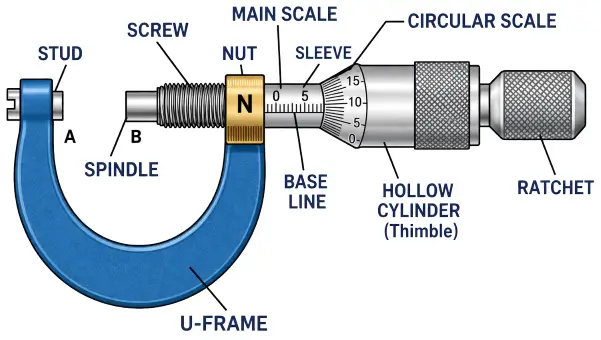
- Frame – Supports all parts of the screw gauge.
- Anvil – Fixed surface on which the object is placed.
- Spindle – Movable part that presses the object against the anvil.
- Sleeve (Pitch scale/Main scale) – Shows main scale reading in mm.
- Thimble (Circular scale) – Shows fractional reading.
- Ratchet – Applies uniform pressure for accurate measurement.
- Lock nut – Locks the spindle in position.
Pitch of Screw
- Pitch = Distance moved by screw in one complete rotation
- Usually:
Pitch = 1 mm
or 0.5 mm
Least Count of Screw Gauge
- Least count = Pitch ÷ Total divisions on circular scale
Example: Pitch = 1 mm
Circular divisions = 100
L.C. = 1/100 mm = 0.01 mm = 0.001 cm
Reading of Screw Gauge
Observed reading = Main scale reading + Circular scale reading
Circular scale reading = p × Least count
(p = circular scale division coinciding with base line)
Zero Error in Screw Gauge
❖ Positive Zero Error
- Zero of circular scale is below base line
- Subtract error
❖ Negative Zero Error
- Zero of circular scale is above base line
- Add error
Correction Formula
Correct reading = Observed reading − Zero error (with sign)
Backlash Error
- Occurs due to wear of screw threads
- Screw does not move immediately when direction reversed
How to Avoid
- Rotate screw in one direction only
- If reversing, rotate further and then take reading
Comparison of Instruments
| Instrument | Least Count | Accuracy |
| Metre rule | 0.1 cm | Low |
| Vernier calipers | 0.01 cm | Medium |
| Screw gauge | 0.001 cm | High |
- Smaller least count → more accurate measurement.
Section C : Measurement of Time and Simple Pendulum
Simple Pendulum
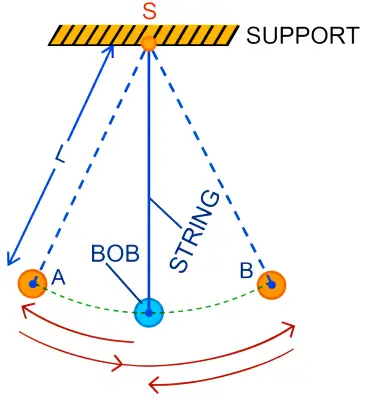
A simple pendulum consists of:
- A small heavy bob (mass)
- Suspended by a light, inextensible string
- Fixed at a rigid support
***Note
Pendulum used in the pendulum clock is not a simple pendulum, but it is a compound pendulum.
Terms related to simple pendulum
- Oscillation : One complete to and fro motion of the bob of pendulum is called one oscillation.
Example: From mean → right → mean → left → mean
- Amplitude (A) : Maximum displacement from mean position is called the amplitude. It is measured in metre(m).
- Frequency (f) : The number of oscillations made in one second is called the frequency. Its unit is per second (s−1) or hertz (Hz).
- Time period : The time taken to complete one oscillation is the time period. It is denoted by the symbol T. Its unit is in second (s).
Relationship between time period and frequency
\(f\ =\ \frac{1}{T}\)
or, \(T\ =\ \frac{1}{f}\)
Relation between time period, effective length and acceleration due to gravity
\(T\ =\ 2\pi\sqrt{\frac{\operatorname{l}}{g}}\)
Also, \(\operatorname{T}^2=\frac{{4\pi}^2\operatorname{l}}{g}\)
Where:
- T = Time period
- l = Length of pendulum
- g = Acceleration due to gravity
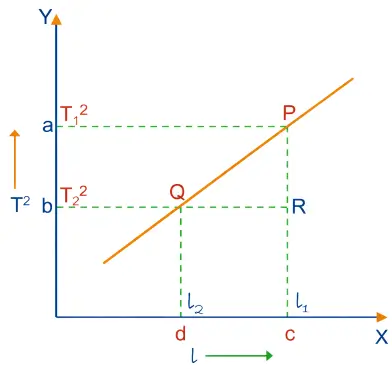
Graph Relationship
- Graph of T2 vs l is a straight line
- Shows:
T2 ∝ l
Factors Affecting Time Period
Depends On:
(i) Length (l):
- \(T\ \propto\ \sqrt l\)
- Longer pendulum → More time
(ii) Gravity (g):
- \(T\propto\frac{1}{\sqrt g}\)
- Lower gravity → More time
Does NOT Depend On:
- Mass of bob
- Material of bob
- Amplitude (if small)
Practical Observations
- In winter: Pendulum contracts → Time period decreases → Clock runs fast
- In summer: Expansion → Time period increases → Clock runs slow
- On mountains: g decreases → Time period increases → Clock slows
Seconds Pendulum
- Time period = 2 seconds
- Time for one side swing = 1 second
- Length ≈ 1 metre (at g = 9.8 m/s²)
ICSE Class 9 Physics Chapter 1 – Measurements and Experimentation Notes PDF
You can download simplified ICSE Physics Measurements and Experimentation Notes PDF including diagrams and key concepts for quick revision. These notes are useful for last-minute exam prep.
Exam Tips
- Learn SI units carefully
- Practice least count questions
- Remember error types
- Draw neat diagrams
- Write units in answers
You can also visit :
ICSE Class 9 Physics Notes
| ☛ ICSE Class 9 Physics Chapter 1 – Measurements and Experimentation Notes |
| ☛ ICSE Class 9 Physics Chapter 2 – Motion in One Dimension Notes |
| ☛ ICSE Class 9 Physics Chapter 3 – Laws of Motion Notes |
| ☛ ICSE Class 9 Physics Chapter 4 – Pressure in Fluids and its Transmission Notes |
| ☛ ICSE Class 9 Physics Chapter 5 – Upthrust in Fluids, Archimedes’ Principle and Floatation Notes |
| ☛ ICSE Class 9 Physics Chapter 6 – Heat and Energy Notes |
| ☛ ICSE Class 9 Physics Chapter 7 – Reflection of Light Notes |
| ☛ ICSE Class 9 Physics Chapter 8 – Propagation of Sound Waves Notes |
| ☛ ICSE Class 9 Physics Chapter 9 – Current Electricity Notes |
| ☛ ICSE Class 9 Physics Chapter 10 – Magnetism Notes |
Conclusion
ICSE Class 9 Physics Chapter 1 – Measurements and Experimentation is an important chapter that forms the base of Physics. Students should revise concepts and practice questions regularly to score well in exams.
Official Website:
Students can visit the official CISCE website for more details and updates.