
Introduction
Understanding Measurements and Experimentation is the foundation of Physics. In ICSE Class 9, this chapter helps students learn about physical quantities, SI units, accuracy, errors, and measuring instruments.
In this article, you will get Selina Solutions for Class 9 Physics Exercise 1(B) with clear explanations and step-by-step answers to help you score high marks.
Study Support by Rohit Academy
Rohit Academy offers expert-curated ICSE Class 9 Physics Study Materials including ICSE Measurements and Experimentation Chapter Notes, diagrams, and key formulas for better understanding.
Study materials related to chapter 1 Measurements and Experimentation
(A) Multiple Choice Type
(Choose the correct answer from the options given below).
Question 1
The strip of a vernier callipers is used to measure :
(a) Length of a wire
(b) Depth of a beaker
(c) Internal diameter of a sphere
(d) Diameter of a hollow sphere
Answer:
(b) Depth of a beaker
Question 2
On bringing the two jaws of a vernier callipers together, the 6th division of vernier scale coincides with the main scale. If the least count of the vernier callipers is 0.01 cm, then its zero error is:
(a) +0.06 cm (b) +0.6 cm
(c) +0.006 cm (d) +0.001 cm
Answer:
(a) +0.06 cm
Explanation:
Zero error = +6 x Least count = +6 x 0.01 = +0.06 cm
Question 3
A microscope has its main scale with 20 divisions in 1 cm and vernier scale with 25 divisions, the length of which is equal to the length of 24 divisions of main scale. The least count of microscope is :
(a) 0.002 cm (b) 0.001 cm
(c) 0.02 cm (d) 0.01 cm
Answer:
(a) 0.002 cm
Question 4
Identify the correct use of the thimble of a screw gauge :
(a) To read length correct up to 0.01 mm.
(b) To read length correct up to 1 mm.
(c) To mark main scale and base line.
(d) To mark circular scale.
Answer:
(d) To mark circular scale.
Question 5
The circular head of a screw gauge is divided into 50 divisions and the screw moves 1 mm ahead in two revolutions of the circular head. Its pitch would be :
(a) 0.05 cm (b) 0.001 cm
(c) 0.5 cm (d) 0.01 cm
Answer:
(a) 0.05 cm
Explanation:
Circular head = 50 divisions
Screw moves 1 mm in 2 revolutions
Pitch = Distance moved in one revolution
Pitch = 1 mm / 2
Pitch = 0.5 mm
Convert to cm:
0.5 mm = 0.05 cm
Question 6
Identify the incorrect statement from the following:
(a) A screw gauge is used to measure very small dimensions like the thickness of a wire or sheet.
(b) Vernier callipers is used to measure larger dimensions like the diameter of a sphere, internal or
external diameter lengths, etc.
(c) Vernier callipers works on the principle of a sliding scale to measure fractional parts of a main scale.
(d) Vernier callipers has a higher precision with a larger least count whereas screw gauge has a lower precision with a smaller least count.
Answer:
(d) Vernier callipers has a higher precision with a larger least count whereas screw gauge has a lower precision with a smaller least count.
(B) Very Short Questions
Question 1
Define the least count of an instrument.
Answer:
The least count of an instrument is the smallest measurement that can be measured accurately using that instrument.
Question 2
How can you decrease the least count of a vernier callipers?
Answer:
The least count of a vernier callipers can be decreased by:
1. Increasing the number of divisions on the vernier scale.
2. Decreasing the value of one main scale division.
Question 3
Define the term ‘Vernier constant’.
Answer:
The Vernier constant is the difference between the value of one main scale division and one vernier scale division.
It is equal to the least count of the vernier callipers.
Question 4
When is a vernier callipers said to be free from zero error?
Answer:
A vernier callipers is free from zero error when the zero of the vernier scale coincides exactly with the zero of the main scale when the jaws are closed.
Question 5
Name the part of the vernier callipers which is used to measure the following:
(a) external diameter of a tube,
(b) internal diameter of a mug,
(c) depth of a small bottle,
(d) thickness of a pencil.
Answer:
(a) External diameter of a tube → Outer jaws
(b) Internal diameter of a mug → Inner jaws
(c) Depth of a small bottle → Strip
(d) Thickness of a pencil → Outer jaws
Question 6
State the difference between positive and negative zero error of a vernier callipers.
Answer:
Positive zero error:
● Vernier zero lies to the right of main scale zero
● Correction is subtracted
Negative zero error:
● Vernier zero lies to the left of main scale zero
● Correction is added
Question 7
Define the pitch of a screw gauge.
Answer:
Pitch of a screw gauge is the distance moved by the screw in one complete rotation of the circular head.
Question 8
State one use of a screw gauge.
Answer:
A screw gauge is used to measure very small thickness, such as the diameter of a wire or thickness of a sheet.
Question 9
State the purpose of ratchet in a screw gauge.
Answer:
The purpose of a ratchet in a screw gauge is to advance the screw by turning it till the object is gently held between the stud and the spindle of the screw.
Question 10
State the difference between positive and negative zero error of a screw gauge.
Answer:
Positive zero error:
● Circular scale zero is below reference line
● Correction is subtracted
Negative zero error:
● Circular scale zero is above reference line
● Correction is added
Question 11
Name the instrument which can measure accurately the following :
(a) the diameter of a needle,
(b) the thickness of a paper,
(c) the internal diameter of the neck of a water bottle,
(d) the diameter of a pencil.
Answer:
(a) Diameter of a needle → Screw gauge
(b) Thickness of a paper → Screw gauge
(c) Internal diameter of neck of water bottle → Vernier callipers
(d) Diameter of a pencil → Vernier callipers
Question 12
Which of the following measures a small length to a high accuracy : metre rule, vernier callipers, screw gauge?
Answer:
A screw gauge measures a small length to a high accuracy.
Question 13
Name the instrument which has the least count :
(a) 0.1 mm
(b) 1 mm
(c) 0.01 mm.
Answer:
(a) 0.1 mm → Vernier callipers
(b) 1 mm → Metre rule
(c) 0.01 mm → Screw gauge
(C) Short Answer Type
Question 1
Explain the meaning of the term ‘least count of an instrument’ by taking a suitable example.
Answer:
The least count of an instrument is the smallest value that can be measured accurately by the instrument.
Example: A metre rule has smallest division of 1 mm, so its least count is 1 mm.
Question 2
boy makes a ruler with graduation in cm on it (i.e., 100 divisions in 1 m). To what accuracy this ruler can measure ? How can this accuracy be increased ?
Answer:
The ruler made by the boy has its zero mark at one end and the 100 cm mark at the other end. It has 100 equal divisions in one metre, so the value of one small division is 1 cm.
Therefore, the ruler can measure length accurately up to 1 cm.
To increase the accuracy, each centimetre can be further divided into 10 equal parts, so that the least count becomes 1 mm, allowing more precise measurements.
Question 3
A boy measures the length of a pencil and expresses it to be 2.6 cm. What is the accuracy of his measurement? Can he write it as 2.60 cm?
Answer:
Given, the length of the pencil is 2.6 cm.
Since the measurement is recorded up to one decimal place, it indicates that the instrument used has a least count of 0.1 cm, such as a metre rule. Hence, the measurement is accurate up to 0.1 cm.
No, it cannot be written as 2.60 cm, because that would imply the length has been measured up to two decimal places (0.01 cm), which requires a vernier callipers or screw gauge, not a metre rule.
Question 4
Define least count of a vernier callipers. How do you determine it?
Answer:
Least count of a vernier callipers is the smallest length measured by it.
It is determined by: Least Count = Value of 1 main scale division − Value of 1 vernier scale division
Or, Least Count \(=\frac{Value\ of\ 1\operatorname{MSD}}{Number\ of\ divisions\ on\ vernier\ scale}\)
Question 5
A vernier callipers has a zero error +0.06 cm. Draw a neat labelled diagram to represent it.
Answer:
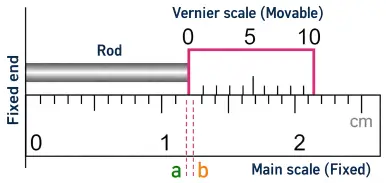
Below diagram shows a vernier callipers with a zero error of +0.06 cm.
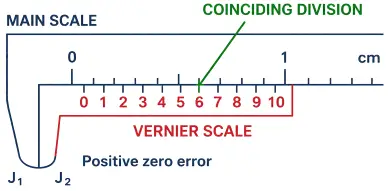
The least count of the vernier callipers shown in the diagram is 0.01 cm, and the 6th division of the vernier scale coincides with a main scale division.
Zero error = Number of coinciding division × Least count
Zero error = 6 × 0.01 cm
Zero error = 0.06 cm
Hence, the zero error is +0.06 cm.
Question 6
State three uses of a vernier callipers.
Answer:
- Measuring external diameter of objects
- Measuring internal diameter of hollow objects
- Measuring depth of vessels
Question 7
Name the two scales of a vernier callipers and explain, how it is used to measure a length correct up to 0.01 cm.
Answer:
Two scales:
- Main scale
- Vernier scale
The main scale measures whole cm and mm.
The vernier scale measures fractional part.
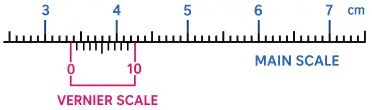
When one vernier division coincides with main scale division, the fractional reading is obtained.
Typical least count = 0.01 cm, hence measurement is accurate up to 0.01 cm.
Question 8
Explain the terms :
(i) pitch, and
(ii) least count of a screw gauge.
How are they determined?
Answer:
(i) Pitch
Distance moved by the screw in one complete rotation.
Pitch \(=\frac{Distance\ moved\ }{Number\ of\ rotations}\)
(ii) Least Count
Smallest measurement measurable by screw gauge
Least Count \(=\frac{\operatorname{Pitch}}{Number\ of\ divisions\ on\ circular\ scale}\)
Question 9
How can the least count of a screw gauge be decreased?
Answer:
Least count can be decreased by:
- Increasing number of circular scale divisions
- Decreasing pitch of screw
Question 10
What do you mean by zero error of a screw gauge? How is it accounted for?
Answer:
When the anvil and spindle touch and zero of circular scale does not coincide with reference line, the error is called zero error.
It is accounted by:
Correct reading = Observed reading − zero error
Question 11
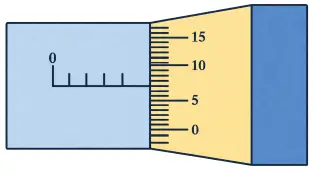
A screw gauge has a least count 0.001 cm and zero error + 0.007 cm. Draw a neat diagram to represent it.
Answer:
Below diagram shows a screw gauge with least count 0.001 cm and zero error + 0.007 cm:
Question 12
What is backlash error? Why is it caused? How is it avoided?
Answer:
Backlash error occurs when the screw is rotated backwards and due to wear, the screw does not move immediately.
Cause:
● Wear and tear of threads
Avoided by:
● Always rotating screw in same directions while taking reading
(D) Long Answer Type
Question 1
What is meant by zero error of a vernier callipers? How is it determined? Draw neat diagrams to explain it. How is it taken in account to get the correct measurement?
Answer:
Sometimes, due to mechanical error in a vernier callipers, the zero of the vernier scale does not coincide with the zero of the main scale when the jaws are closed. In such a case, the vernier callipers is said to have zero error.
To determine the zero error, close the jaws of the vernier callipers and observe which division of the vernier scale coincides with any division of the main scale. The number of this coinciding vernier division multiplied by the least count gives the zero error.
For example, if the least count is 0.01 cm and the 6th division of the vernier scale coincides with a main scale division, then:
Zero error = Number of coinciding division × Least count
Zero error = 6 × 0.01 cm
Zero error = 0.06 cm
Hence, the zero error is +0.06 cm.
To obtain the correct measurement, the zero error (with proper sign) is subtracted from the observed reading. Correct reading = Observed reading − Zero error (with sign)
Question 2
Draw a neat labelled diagram of a vernier callipers. Name its main parts and state their functions.
Answer:
A neat labelled diagram of a vernier callipers is shown below:
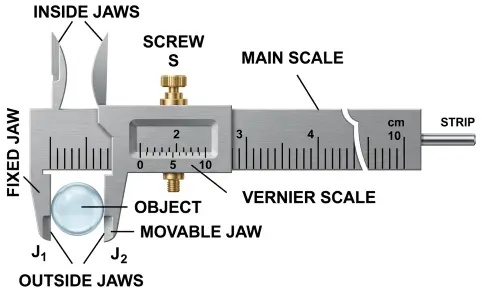
Main parts and functions of a vernier callipers:
- Main scale – Measures the main reading in cm and mm.
- Vernier scale – Measures the fractional part of the reading.
- Outer jaws – Used to measure external diameter or thickness.
- Inner jaws – Used to measure internal diameter.
- Depth rod – Used to measure depth of holes or containers.
- Lock screw – Holds the slider in position while taking reading.
Question 3
Describe in steps, how would you use a vernier callipers to measure the length of a small rod?
Answer:
Steps to measure the length of a small rod using vernier callipers:
- Check zero error by closing the jaws and note it, if any.
- Open the outer jaws of the vernier callipers.
- Place the rod between the outer jaws.
- Close the jaws gently so that they just touch the ends of the rod.
- Tighten the lock screw to fix the position.
- Note the main scale reading just to the left of the vernier zero.
- Find the vernier coincidence (which vernier division matches a main scale division).
- Calculate reading
- Total reading = Main scale reading + (Vernier coincidence × Least count)
- Apply zero correction (if any) to obtain the correct length.
Question 4
Draw a neat and labelled diagram of a screw gauge. Name its main parts and state their functions.
Answer:
Below is the diagram of a screw gauge with all its parts labelled:
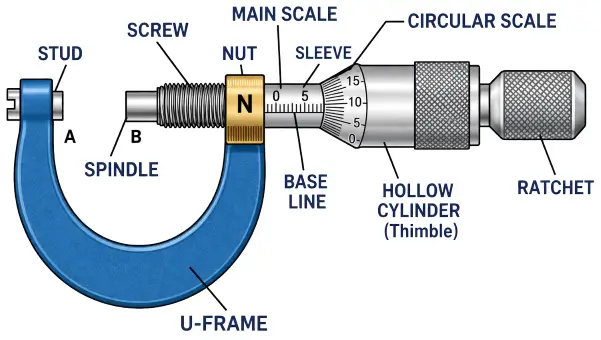
Main Parts of a Screw Gauge and Their Functions:
- Frame – Supports all parts of the screw gauge.
- Anvil – Fixed surface on which the object is placed.
- Spindle – Movable part that presses the object against the anvil.
- Sleeve (Pitch scale/Main scale) – Shows main scale reading in mm.
- Thimble (Circular scale) – Shows fractional reading.
- Ratchet – Applies uniform pressure for accurate measurement.
- Lock nut – Locks the spindle in position.
Question 5
Describe the procedure to measure the diameter of a wire with the help of a screw gauge.
Answer:
Procedure to measure the diameter of a wire using a screw gauge:
- Check zero error by closing the anvil and spindle gently and note it, if present.
- Place the wire between the anvil and spindle.
- Rotate the ratchet until the wire is held gently between the two faces.
- Tighten using ratchet only to ensure uniform pressure.
- Note the main scale reading on the sleeve.
- Note the circular scale reading on the thimble coinciding with the reference line.
- Calculate total reading
- Observed reading = Main scale reading + (Circular scale reading × Least count)
● Apply zero correction (if any). - Repeat the measurement at different points and take the mean value for accuracy.
(E) Numericals
Question 1
A stop watch has 10 divisions graduated between the 0 and 5s marks. What is its least count?
Solution:
Given,
Total time between 0 and 5 s = 5 seconds
Number of divisions between them = 10
Least count (L.C.) = \(\frac{Value\ of\ one\ div\ (x)}{Total\ no.\ of\ div\ on\ stop\ watch\ (n)}\)
⇒ L.C.= \(\frac{5}{10}\)
⇒ L.C.= \(\frac{1}{2}\)
⇒ L.C. = 0.5 s
Hence, least count of stop watch is 0.5 s.
Question 2
A vernier has 10 divisions and they are equal to 9 divisions of main scale in length. If the main scale is calibrated in mm, what is its least count?
Solution:
Given,
Total number of divisions on vernier = 10
Value of one main scale division (x) = 1 mm
As we know,
L.C. = \(\frac{Value\ of\ 1\ main\ scale\ div\ (x)}{Total\ no.\ of\ div\ on\ vernier\ (n)}\)
⇒ L.C.= \(\frac{1\ mm}{10}\)
⇒ L.C. = 0.1 mm
⇒ L.C. = 0.01 cm
Hence, least count of the vernier callipers is 0.01 cm.
Question 3
A microscope is provided with a main scale graduated with 20 divisions in 1 cm and a vernier scale with 50 divisions on it of length same as of 49 divisions of main scale. Find the least count of the microscope.
Solution:
Given,
20 divisions = 1 cm
∴ 1 division = 1/20
⇒ 1 division = 0.05 cm
Hence, value of one main scale division = 0.05 cm
Total number of divisions = 50
As we know,
L.C.= \(\frac{Value\ of\ 1\ main\ scale\ div\ (x)}{Total\ no.\ of\ div\ on\ vernier\ (n)}\)
L.C.= \(\frac{0.05}{50}\)
L.C.= 0.001 cm
Hence, least count of the microscope is 0.001 cm.
Question 4
A boy uses a vernier callipers to measure the thickness of his pencil. He measures it to be 1.4 mm. If the zero error of vernier callipers is +0.02 cm, what is the correct thickness of pencil?
Solution:
Given,
Thickness of the pencil = 1.4 mm
Zero error of the vernier callipers = +0.02 cm = +0.2 mm
As we know,
Correct reading = observed reading – zero error (with sign)
Correct reading = 1.4mm – 0.2mm
Correct reading = 1.2mm
Hence, correct thickness of pencil is 1.2 mm.
Question 5
A vernier callipers has its main scale graduated in mm and 10 divisions on its vernier scale are equal in length to 9 mm. When the two jaws are in contact, the zero of vernier scale is ahead of zero of main scale and 3rd division of vernier scale coincides with a main scale division.
Find :
(i) the least count and
(ii) the zero error of the vernier callipers.
Solution:
(i) L.C.= \(\frac{Value\ of\ 1\ main\ scale\ div\left(x\right)}{Total\ no.\ \ of\ div\ on\ vernier\left(n\right)}\)
Value of one main scale division = 1 mm
Number of divisions on vernier scale = 10
Least count = 1 mm / 10 = 0.1 mm = 0.01 cm
Therefore, least count of the vernier callipers = 0.01 cm
(ii) Zero error = Least count × Coinciding division
Least count = 0.01 cm
Coinciding division = 3
Zero error = 0.01 × 3 = 0.03 cm
Therefore, zero error of the vernier callipers = + 0.03 cm
Question 6
The main scale of a vernier callipers is calibrated in mm and 19 divisions of main scale are equal in length to 20 divisions of vernier scale. In measuring the diameter of a cylinder by this instrument, the main scale reads 35 divisions and the 4th division of vernier scale coincides with a main scale division.
Find :
(i) least count and
(ii) radius of cylinder.
Solution:
(i) Least count = \(\frac{Value\ of\ one\ main\ scale\operatorname{division}}{Number\ of\ divisions\ on\ vernier\ scale}\)
Value of one main scale division = 1 mm
Number of divisions on vernier scale = 20
Least count = 1 / 20 mm = 0.05 mm = 0.005 cm
Therefore, least count of the vernier callipers = 0.005 cm
(ii) Vernier scale reading = Least count × Coinciding division
= 0.005 × 4 = 0.02 cm
Main scale reading = 3.5 cm
Diameter = Main scale reading + Vernier scale reading
= 3.5 + 0.02
= 3.52 cm
Radius = Diameter / 2
= 3.52 / 2
= 1.76 cm
Therefore, radius of the cylinder = 1.76 cm
Question 7
In a vernier callipers, there are 10 divisions on the vernier scale and 1 cm on the main scale is divided in 10 parts. While measuring a length, the zero of the vernier lies just ahead of 1.8 cm mark and 4th division of vernier coincides with a main scale division.
(a) Find the length
(b) If zero error of vernier callipers is –0.02 cm, what is the correct length?
Solution:
(a) Least count = \(\frac{Value\ of\ one\ main\ scale\operatorname{division}}{Number\ of\ divisions\ on\ vernier\ scale}\)
Value of one main scale division = 1 mm
Number of divisions on vernier scale = 10
Least count = 1 / 10 mm = 0.1 mm = 0.01 cm
Vernier scale reading = Coinciding division × Least count
= 4 × 0.01 cm = 0.04 cm
Main scale reading = 1.8 cm
Total reading = Main scale reading + Vernier scale reading
= 1.8 + 0.04
= 1.84 cm
Therefore, length = 1.84 cm
(b) Correct reading = Observed reading − Zero error
Observed reading = 1.84 cm
Zero error = −0.02 cm
Correct reading = 1.84 − (−0.02)
= 1.84 + 0.02
= 1.86 cm
Therefore, correct length = 1.86 cm
Question 8
Vernier scale readings are as shown in the figures given below. Give the actual reading provided :
(a) the instrument has a zero error of +0.02 cm.
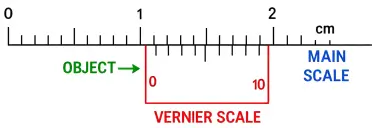
(b) the instrument has a zero error of -0.03 cm.
Solution:
(a) Main scale reading (MSR) = 1.0 cm
Value of one main scale division = 0.1 cm
Number of divisions on vernier scale = 10
Least count = 0.1 / 10 = 0.01 cm
Vernier scale reading (VSR) = 6 × 0.01 = 0.06 cm
Observed reading = MSR + VSR = 1.0 + 0.06 = 1.06 cm
Zero error = +0.02 cm
Zero correction = −0.02 cm
Actual reading = 1.06 − 0.02 = 1.04 cm
Therefore, actual reading = 1.04 cm
(b) Main scale reading (MSR) = 1.0 cm
Least count = 0.01 cm
Vernier scale reading (VSR) = 4 × 0.01 = 0.04 cm
Observed reading = MSR + VSR = 1.0 + 0.04 = 1.04 cm
Zero error = −0.03 cm
Zero correction = +0.03 cm
Actual reading = 1.04 + 0.03 = 1.07 cm
Therefore, actual reading = 1.07 cm
Question 9
While measuring the length of a rod with a vernier callipers, figure below shows the position of its scales. What is the length of the rod?
Solution:
Least count = \(\frac{Value\ of\ one\ main\ scale\operatorname{division}}{Number\ of\ divisions\ on\ vernier\ scale}\)
Number of main scale divisions in 1 cm = 10
Value of 1 main scale division = 1/10 cm = 0.1 cm
Number of divisions on vernier scale = 10
Least count = 0.1 / 10 = 0.01 cm
Therefore, least count = 0.01 cm
Main scale reading = 3.3 cm
Coinciding division = 6
Vernier scale reading = Coinciding division × Least count
= 6 × 0.01
= 0.06 cm
Observed reading = Main scale reading + Vernier scale reading
= 3.3 cm + 0.06 cm
= 3.36 cm
Therefore, length of the rod = 3.36 cm
Question 10
The pitch of a screw gauge is 0.5 mm and the head scale is divided in 100 parts. What is the least count of screw gauge?
Solution:
Least count = \(\frac{\operatorname{Pitch}}{Number\ of\ divisions\ on\ circular\ head}\)
Pitch = 0.5 mm
Number of divisions on circular head = 100
Least count = 0.5 / 100 = 0.005 mm = 0.0005 cm
Therefore, least count of the screw gauge = 0.005 mm or 0.0005 cm
Question 11
The thimble of a screw gauge has 50 divisions. The spindle advances 1 mm when the screw is turned through two revolutions.
(i) What is the pitch of the screw gauge?
(ii) What is the least count of the screw gauge?
Solution:
(i) Pitch = distance moved by the screw in one complete revolution.
Distance covered in two revolutions = 1 mm
Pitch = 1/2 mm = 0.5 mm Therefore, pitch of the screw gauge = 0.5 mm
(ii) Least count = \(\frac{\operatorname{Pitch}}{Number\ of\ divisions\ on\ circular\ head}\)
Pitch = 0.5 mm
Number of divisions on circular head = 50
Least count = 0.5 / 50
= 0.01 mm
Therefore, least count of the screw gauge = 0.01 mm
Question 12
The pitch of a screw gauge is 1 mm and its circular scale has 100 divisions. In measurement of the diameter of a wire, the main scale reads 2 mm and 45th mark on circular scale coincides with the base line.
Find :
(i) The least count, and
(ii) The diameter of the wire.
Solution:
(i) Least count = \(\frac{\operatorname{Pitch}}{Number\ of\ divisions\ on\ circular\ head}\)
Pitch = 1 mm
Number of divisions on circular head = 100
Least count = 1 / 100 mm
= 0.01 mm
= 0.001 cm
Therefore, least count of the screw gauge = 0.001 cm
(ii) Circular scale reading = p × Least count
= 45 × 0.001 cm
= 0.045 cm
Main scale reading = 2 mm = 0.2 cm
Diameter of the wire = Main scale reading + Circular scale reading
= 0.2 cm + 0.045 cm
= 0.245 cm Therefore, diameter of the wire = 0.245 cm
Question 13
When a screw gauge of least count 0.01 mm is used to measure the diameter of a wire, the reading on the sleeve is found to be 1 mm and the reading on the thimble is found to be 27 divisions.
(i) What is the diameter of the wire in cm?
(ii) If the zero error is +0.005 cm, what is the correct diameter?
Solution:
(i) Reading on thimble = p × Least count
= 27 × 0.001 cm
= 0.027 cm
Reading on sleeve = 1 mm = 0.1 cm
Diameter of the wire = Reading on sleeve + Reading on thimble
= 0.1 cm + 0.027 cm
= 0.127 cm
Therefore, diameter of the wire = 0.127 cm
(ii) Correct reading = Observed reading − Zero error
Observed reading = 0.127 cm
Zero error = +0.005 cm
Correct reading = 0.127 − 0.005
= 0.122 cm
Therefore, correct diameter of the wire = 0.122 cm
Question 14
A screw gauge has 50 divisions on its circular scale and its screw moves by 1 mm on turning it by two rotations. When the flat end of the screw is in contact with the stud, the zero of circular scale lies below the base line and 4th division of circular scale is in line with the base line.
Find :
(i) the pitch,
(ii) the least count and
(iii) the zero error, of the screw gauge.
Solution:
(i) Pitch = distance moved by the screw in one complete revolution.
Distance covered in two revolutions = 1 mm
Pitch = 1/2 mm = 0.5 mm
Therefore, pitch of the screw gauge = 0.5 mm
(ii) Least count = \(\frac{\operatorname{Pitch}}{Number\ of\ divisions\ on\ circular\ head}\)
Pitch = 0.5 mm
Number of divisions on circular head = 50
Least count = 0.5 / 50 = 0.01 mm
Therefore, least count of the screw gauge = 0.01 mm
(ii) Zero error = Coinciding division × Least count
Coinciding division = 4
Least count = 0.01 mm
Zero error = 4 × 0.01
= +0.04 mm
Therefore, zero error of the screw gauge = +0.04 mm
Question 15
Two micrometers are shown in figures given below. Give the actual reading shown provided :
(a) The least count of the instrument = 0.001 cm and zero error = +0.05 mm.
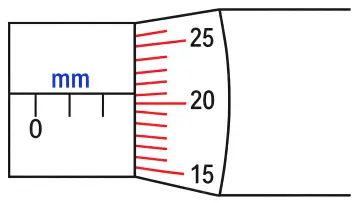
The least count of the instrument = 0.001 cm and zero error = −0.021 cm.
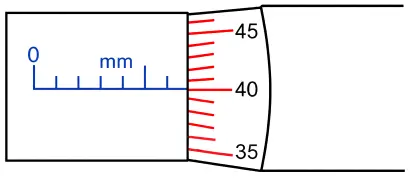
Solution:
(a) Given,
Least count = 0.001 cm
Zero error = +0.05 mm = +0.005 cm
Main scale reading (MSR) = 3 mm = 0.3 cm
Circular scale reading (CSR) = 21 × Least count
= 21 × 0.001 cm = 0.021 cm
Observed reading = MSR + CSR
= 0.3 + 0.021
= 0.321 cm
Zero correction = −0.005 cm
Actual reading = Observed reading + Zero correction
= 0.321 − 0.005
= 0.316 cm
Therefore, the actual reading = 0.316 cm
(b) Given,
Least count = 0.001 cm
Zero error = −0.021 cm
Main scale reading (MSR) = 6 mm = 0.6 cm
Circular scale reading (CSR) = 41 × Least count
= 41 × 0.001 cm
= 0.041 cm
Observed reading = MSR + CSR
= 0.6 + 0.041
= 0.641 cm
Zero correction = +0.021 cm
Actual reading = Observed reading + Zero correction
= 0.641 + 0.021
= 0.662 cm
Therefore, the actual reading = 0.662 cm
Question 16
Figure below shows the reading obtained while measuring the diameter of a wire with a screw gauge. The screw advances by 1 division on main scale when circular head is rotated once.
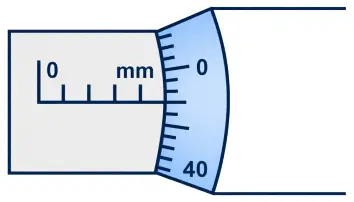
Find :
(i) pitch of the screw gauge,
(ii) least count of the screw gauge, and
(iii) the diameter of the wire.
Solution:
(i) Pitch = distance moved by the screw in one complete revolution.
Distance moved in one revolution = 1 mm
Therefore, Pitch = 1 mm
(ii) Least count = \(\frac{\operatorname{Pitch}}{Number\ of\ divisions\ on\ circular\ head}\)
Pitch = 1 mm
Number of divisions on circular head = 50
Least count = 1/50 = 0.02 mm
Therefore, Least count = 0.02 mm
(iii) Circular scale reading = p × Least count
= 47 × 0.02
= 0.94 mm
Diameter of wire = Main scale reading + Circular scale reading
= 4 mm + 0.94 mm
= 4.94 mm Therefore, Diameter of the wire = 4.94 mm
Question 17
A screw has a pitch equal to 0.5 mm. What should be the number of division on its head so as to read correct up to 0.001 mm with its help?
Solution:
Given,
Pitch = 0.5 mm
L.C. = 0.001 mm
As we know,
Least count = \(\frac{\operatorname{Pitch}}{Number\ of\ divisions\ on\ circular\ head}\)
⇒ 0.001 mm = \(\frac{0.5}{Number\ of\ divisions\ on\ circular\ head}\)
⇒ Total no. of div on circular head = 0.5/0.001
⇒ Total no. of div on circular head = 500
Hence, total number of divisions on circular head is 500.
Download PDF of Selina Solutions for Class 9 Physics Exercise 1(B) – Measurements and Experimentation
💡 Exam Tips
- Always write units with answers
- Learn definitions word-to-word (ICSE marking is strict)
- Practice numericals on least count
- Draw neat diagrams of instruments
🔥 Why These Solutions Matter
- Based on latest ICSE syllabus
- Simple language for quick understanding
- Helps in board exam preparation
- Improves conceptual clarity
Conclusion
These Selina Solutions for Class 9 Physics Exercise 1(B) will help you master the basics of measurement and experimentation. Practice regularly and revise key definitions to score excellent marks in exams.
You can also visit :
ICSE Class 9 Physics Notes
| ☛ ICSE Class 9 Physics Chapter 1 – Measurements and Experimentation Notes |
| ☛ ICSE Class 9 Physics Chapter 2 – Motion in One Dimension Notes |
| ☛ ICSE Class 9 Physics Chapter 3 – Laws of Motion Notes |
| ☛ ICSE Class 9 Physics Chapter 4 – Pressure in Fluids and its Transmission Notes |
| ☛ ICSE Class 9 Physics Chapter 5 – Upthrust in Fluids, Archimedes’ Principle and Floatation Notes |
| ☛ ICSE Class 9 Physics Chapter 6 – Heat and Energy Notes |
| ☛ ICSE Class 9 Physics Chapter 7 – Reflection of Light Notes |
| ☛ ICSE Class 9 Physics Chapter 8 – Propagation of Sound Waves Notes |
| ☛ ICSE Class 9 Physics Chapter 9 – Current Electricity Notes |
| ☛ ICSE Class 9 Physics Chapter 10 – Magnetism Notes |
Official Website:
Students can visit the official CISCE website for more details and updates.