Introduction
The chapter Measurements and Experimentation is one of the most important topics in ICSE Class 9 Physics. Exercise 1(C) mainly focuses on numericals, unit conversions, errors, and measuring instruments.
In this article, you will get Selina Solutions for Class 9 Physics Exercise 1(C) with step-by-step explanations to help you understand concepts clearly and score high in exams.
Study Support by Rohit Academy
Rohit Academy offers expert-curated ICSE Class 9 Physics Study Materials including ICSE Measurements and Experimentation Chapter Notes, diagrams, and key formulas for better understanding.
Study materials related to chapter 1 Measurements and Experimentation
(A) Multiple Choice Type
(Choose the correct answer from the options given below).
Question 1
The pendulum used in a clock is:
(a) Simple pendulum
(b) Compound pendulum
(c) Second pendulum
(d) None of these
Answer:
(c) Second pendulum
Question 2
The effective length of a pendulum is related with time period as :
(a) T2 ∝ l2 (b) T3 ∝ l
(c) T2 ∝ l (d) T ∝ l3
Answer:
(c) T2 ∝ l
Question 3
A simple pendulum is made by suspending a bob of mass 1 kg by a string of length l. Now if the length of this pendulum is increased to 4l, then its time period T will :
(a) remain the same (b) become twice
(c) become four times (d) become half
Answer:
(b) become twice
Question 4
The time period of a seconds’ pendulum clock is :
(a) 1 s (b) 2 s
(c) 1 min (d) 12 h
Answer:
(b) 2 s
Question 5
Time period of a simple pendulum is given by :
(a) \(T=2\pi\sqrt{\frac{\operatorname{g}}{l}}\) (b) \(T=2\pi\sqrt{\frac{l}{g}}\)
(c) \(T=4\pi\sqrt{\frac{l}{g}}\) (d) \(T=4\pi\sqrt{\frac{g}{l}}\)
Answer:
(b) \(T=2\pi\sqrt{\frac{l}{g}}\)
Question 6
The time period of a simple pendulum depends on:
(a) Length of pendulum
(b) Amplitude of oscillation
(c) Mass of bob
(d) All of the above
Answer:
(a) Length of pendulum
Question 7
The time period of two pendulums of length 1 m and 16 m are in ratio :
(a) 1 : 16 (b) 1 : 4
(c) 16 : 1 (d) 4 : 1
Answer:
(b) 1 : 4
Question 8
The length of a simple pendulum is made one-fourth. Its time period becomes :
(a) four times (b) one-fourth
(c) double (d) half
Answer:
(d) half
Question 9
The length of a seconds’ pendulum is nearly :
(a) 0.5 m (b) 9.8 m
(c) 1.0 m (d) 2.0 m
Answer:
(c) 1.0 m
Question 10
Identify the incorrect statement(s) from the following :
(a) The time period of oscillations depends on the extent of swing on either side.
(b) The time period of oscillations is directly proportional to the square root of acceleration due to
gravity.
(c) The time period of oscillations is inversely proportional to the square root of its effective length.
(d) The time period of oscillations does not depend on the mass or material of the suspended body.
(a) (II) and (III)
(b) Only (II)
(c) Only (IV)
(d) (I), (II) and (III)
Answer:
(d) (I), (II) and (III)
(B) Very Short Questions
Question 1
Define ‘amplitude of oscillation’.
Answer:
The maximum displacement of the bob from its mean position on either side is called the amplitude of oscillation.
Question 2
Define the terms: (i) oscillation (ii) amplitude (iii) frequency, and (iv) time period as related to a simple pendulum.
Answer:
(i) Oscillation : One complete to and fro motion of the bob of pendulum is called one oscillation.
(ii) Amplitude : The maximum displacement of the bob from its mean position on either side, is called the amplitude of oscillation. It is denoted by the letter a or A and is measured in metre(m).
(iii) Frequency : The number of oscillations made in one second is called the frequency. It is denoted by f or n. Its unit is per second (s-1) or hertz (Hz).
(iv) Time period : The time taken to complete one oscillation is the time period. It is denoted by the symbol T. Its unit is in second (s).
Question 3
Name two factors on which the time period of a simple pendulum does not depend.
Answer:
Two factors on which time period does NOT depend:
● Mass of the bob
● Amplitude of oscillation (for small oscillations)
Question 4
How is the time period of a simple pendulum affected, if at all, in the following situations:
(a) The length is made four times,
(b) The acceleration due to gravity is reduced to one-fourth.
Answer:
(a) Length made four times:
\(T\ \propto\ \sqrt l\)
Time period becomes twice.
(b) g reduced to one-fourth:
\(T\ \propto\ \frac{1}{\sqrt g}\)
Time period becomes twice.
Question 5
How are the time period T and frequency f of an oscillation of a simple pendulum related?
Answer:
Relation between time period and frequency:
\(f=\frac{1}{T}\)
Question 6
Two simple pendulum A and B have equal lengths, but heir bobs weigh 50 gf and 100 gf respectively. What would be the ratio of their time periods? Give reason for your answer.
Answer:
As we know that,
\(T=2\pi\sqrt{\frac{l}{g}}\)
Where,
- T = time period,
- l = effective length of the pendulum, and
- g = acceleration due to gravity.
From the above relation, we see that the time period does not depend on the weight (mass) of the bob.
Since the lengths of both pendulums are equal, their time periods will be equal.
Therefore,
T1 : T2 = 1 : 1
Question 7
What is a seconds’ pendulum?
Answer:
A seconds’ pendulum is a pendulum whose time period is 2 seconds (1 second each side).
Question 8
State the numerical value of the frequency of oscillation of a seconds’ pendulum. Does it depend on the amplitude of oscillation?
Answer:
As we know that,
f = 1 / T
For a seconds’ pendulum,
T = 2 s
Substituting the value of T, we get
f = 1 / 2
f = 0.5 s⁻¹
Hence, the numerical value of the frequency of oscillation of a seconds’ pendulum is 0.5 s⁻¹ (or 0.5 Hz).
No, it does not depend on the amplitude of oscillation.
(C) Short Answer Type
Question 1
What is a simple pendulum? Is the pendulum used in a pendulum clock simple pendulum? Give reason to your answer.
Answer:
A simple pendulum consists of a small heavy bob suspended by a light, inextensible string from a fixed support, so that it can oscillate freely in a vertical plane.
No, the pendulum used in a pendulum clock is not a simple pendulum.
Reason:
In a simple pendulum, the bob is treated as a point mass and the string is massless. But in a pendulum clock, the bob has a definite size and is attached to a rigid rod having mass. Hence, it is actually a compound pendulum, not a simple pendulum.
Question 2
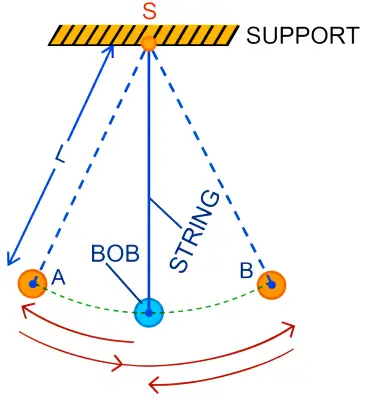
Draw a neat diagram of a simple pendulum. Show on it the effective length of the pendulum and its one oscillation.
Answer:
The diagram below shows the effective length and one oscillation of a simple pendulum.
Question 3
Name two factors on which the time period of a simple pendulum depends. Write the relation for the time period in terms of the above named factors.
Answer:
The time period of a simple pendulum depends on:
- Effective length of the pendulum
- Acceleration due to gravity
The relation between time period and these factors is:
\(T=2\pi\sqrt{\frac{l}{g}}\)
Where,
- T = time period,
- l = effective length of the pendulum, and
- g = acceleration due to gravity.
Question 4
How do you measure the time period of a given pendulum? Why do you note the time for more than one oscillation?
Answer:
To measure the time period of a given pendulum, the bob is displaced slightly from its mean position and released. Using a stopwatch, the time taken for a certain number of oscillations (say 20 or 30) is noted. The time period is then calculated by dividing the total time by the number of oscillations.
Time period, T = \(\frac{Total\ time\operatorname{taken}}{Number\ of\ oscillations}\)
The time for more than one oscillation is noted to reduce the error in measurement, since the time for one oscillation is very small and human reaction time may cause inaccuracy.
Question 5
Two simple pendulums A and B have lengths 1.0 m and 4.0 m respectively at a certain place. Which pendulum will make more oscillations in 1 minute? Explain your answer.
Answer:
The time period of a simple pendulum is given by
\(T=2\pi\sqrt{\frac{l}{g}}\)
Thus, \(T\ \propto\sqrt l\)
For pendulum A,
l1 = 1.0 m
For pendulum B,
l2 = 4.0 m
\(\frac{T_1}{T_2}=\sqrt{\frac{l_1}{l_2}}\)
\(=\sqrt{\frac{1}{4}}\)
\(=\frac{1}{2}\)
So, T1 : T2 = 1 : 2
Hence, pendulum A has a smaller time period. Therefore, it will complete more oscillations in 1 minute.
Conclusion: Pendulum A will make more oscillations in 1 minute.
Question 6
State how does the time period of a simple pendulum depend on :
(a) length of pendulum,
(b) mass of bob,
(c) amplitude of oscillation and
(d) acceleration due to gravity.
Answer:
The time period of a simple pendulum:
(a) Length of pendulum:
The time period is directly proportional to the square root of its length.
\(T\ \propto\sqrt l\)
(b) Mass of bob:
The time period is independent of the mass of the bob.
(c) Amplitude of oscillation:
The time period is independent of amplitude for small oscillations.
(d) Acceleration due to gravity:
The time period is inversely proportional to the square root of acceleration due to gravity.
\(T\ \propto\frac{1}{\sqrt g}\)
(D) Long Answer Type
Question 1
How does the time period (T) of a simple pendulum depend on its length (l)? Draw a graph showing the variation of T2 with l. How will you use this graph to determine the value of g (acceleration due to gravity)?
Answer:
The time period of a simple pendulum is given by
\(T=2\pi\sqrt{\frac{l}{g}}\)
Hence, \(T\ \propto\sqrt l\)
Squaring both sides,
T2 ∝ l
Thus, the square of time period is directly proportional to the length of the pendulum.
Graph:
A graph of T2 (on Y-axis) versus l (on X-axis) is a straight line passing through the origin.
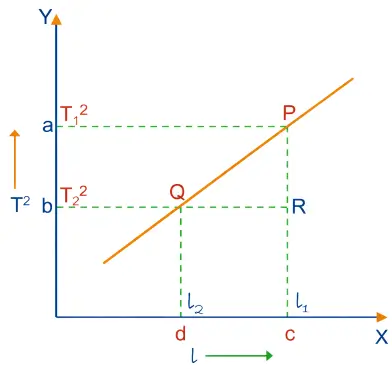
Determination of g:
From the relation
\(T^2={4\pi}^2\frac{l}{g}\)
The slope of the graph of T2 versus l is
Slope \(=\frac{T^2}{I}=\frac{{4\pi}^2}{g}\)
Therefore,
\(g=\frac{{4\pi}^2}{slope}\)
Thus, by finding the slope of the straight line graph, the value of acceleration due to gravity (g) can be calculated.
(E) Numericals
Question 1
A simple pendulum completes 40 oscillations in one minute.
Find its :
(a) frequency,
(b) time period.
Solution:
Total time = 60 s Number of oscillations = 40
(a) Frequency:
\(f=\frac{Number\ of\ oscillations}{time}\)
\(f=\frac{40}{60}\)
\(f=\frac{2}{3}\ s^{-1}=0.67\ Hz\)
(b) Time period:
\(T=\frac{1}{f}=\frac{1}{0.67}=1.5\ s\)
Question 2
The time period of a simple pendulum is 2 s. What is its frequency? What name is given to such a pendulum?
Solution:
Given, T = 2 s
Frequency
\(f=\frac{1}{T}=\frac{1}{2}=\ 0.5\ Hz\)
Such a pendulum is called a seconds’ pendulum.
Question 3
A seconds’ pendulum is taken to a place where acceleration due to gravity falls to one-forth. How is the time period of the pendulum affected, if at all? Give reason. What will be its new time period?
Solution:
\(T\propto\frac{1}{\sqrt g}\)
If g becomes one-fourth,
T’ =\(\frac{T}{\sqrt{\frac{1}{4}}}\) = 2T
Time period becomes twice.
Original T = 2 s
New time period
T’ = 2 × 2 = 4 s
Question 4
Find the length of a seconds’ pendulum at a place where g = 10 m s–2 (Take π = 3.14).
Solution:
For seconds’ pendulum, T = 2 s
\(T=2\pi\sqrt{\frac{\operatorname{l}}{g}}\)
\(2=2\pi\sqrt{\frac{\operatorname{l}}{10}}\)
\(1=\pi\sqrt{\frac{\operatorname{l}}{10}}\)
\(\frac{1}{\pi}=\sqrt{\frac{\operatorname{l}}{10}}\)
Squaring both sides,
\( \frac{1}{\pi^2}=\frac{\operatorname{l}}{10}\)
\(l=\frac{10}{\pi^2}\)
\(l=\frac{10}{\left(3.14\right)^2} \left[\because\mu=3.14\right]\)
\(l=\frac{10}{9.86}\)
l ≈ 1.01 m
Question 5
Compare the time periods of two pendulums of length 1 m and 9 m.
Solution:
\(T_1:T_2=\sqrt{l_1}\ :\ \sqrt{l_2}\)
\(=\sqrt1\ :\ \sqrt9\)
\(=1\ :\ 3\)
Question 6
A pendulum completes 2 oscillations in 5 s.
(a) What is its time period? (b) If g = 9.8 m s–2, find its length.
Solution:
(a) 2 oscillations in 5 s
Time period
T = 5 / 2 = 2.5 s
(b) \(T=2\pi\sqrt{\frac{\operatorname{l}}{g}}\)
\(2.5=2\pi\sqrt{\frac{\operatorname{l}}{9.8}}\)
\(\frac{2.5}{2\pi}=\sqrt{\frac{\operatorname{l}}{9.8}}\)
Squaring both sides,
\(\frac{6.25}{{4\pi}^2}=\frac{l}{9.8}\)
\(\frac{6.25}{{4\ \times\ \left(3.14\right)}^2}=\frac{l}{9.8}\)
\(\frac{6.25\ \times\ 9.8}{4\ \times\ 9.86}=l\)
l ≈ 1.55 m
Question 7
The time periods of two simple pendulums at a place are in the ratio 2 : 1. What will be the ratio of their lengths?
Solution:
T₁ : T₂ = 2 : 1
Since \(T\propto\sqrt l\)
\(\sqrt{l_1}\ :\ \sqrt{l_2}=2\ :\ 1\)
Squaring, l1 : l2 = 4 : 1
Question 8
It takes 0.2 s for a pendulum bob to move from mean position to one end. What is the time period of pendulum?
Solution:
Time from mean to one extreme = T/4
Given = 0.2 s
T/4 = 0.2
T = 0.8 s
Question 9
How much time does the bob of a seconds’ pendulum take to move from one extreme of its oscillation to the other extreme?
Solution:
Seconds pendulum → T = 2 s
Time from one extreme to other extreme = T/2
= 2 / 2
= 1 s
(F) Assertion Reason Type
Question 1
Assertion (A) : The unit used to measure speed is an example of a derived unit.
Reason (R) : Derived units can neither be changed nor can be related to any other fundamental unit.
(a) Both A and R are true and R is the correct explanation of A
(b) Both A and R are true and R is not the correct explanation of A
(c) Assertion is false but reason is true
(d) Assertion is true but reason is false
Answer:
(d) Assertion is true but reason is false
Question 2
Assertion (A) : Smaller the least count of an instrument, more precise the measurement made by using it.
Reason (R) : Least count of an instrument is the smallest measurement that can be taken accurately with it.
(a) Both A and R are true and R is the correct explanation of A
(b) Both A and R are true and R is not the correct explanation of A
(c) Assertion is false but reason is true
(d) Assertion is true but reason is false
Answer:
(a) Both A and R are true and R is the correct explanation of A
Question 3
Assertion (A) : The least count of a screw gauge can be decreased by increasing the pitch and decreasing the total number of divisions on circular scale.
Reason (R) : Least count of screw gauge is directly proportional to pitch of the screw gauge.
(a) Both A and R are true and R is the correct explanation of A
(b) Both A and R are true and R is not the correct explanation of A
(c) Assertion is false but reason is true
(d) Assertion is true but reason is false
Answer:
(c) Assertion is false but reason is true
Question 4
Assertion (A) : A pendulum clock goes slow (i.e., the time period of oscillation increases) when it is taken to mines.
Reason (R) : This is due to increase in the value of acceleration due to gravity g.
(a) Both A and R are true and R is the correct explanation of A
(b) Both A and R are true and R is not the correct explanation of A
(c) Assertion is false but reason is true
(d) Assertion is true but reason is false
Answer:
(d) Assertion is true but reason is false
(G) Case study
Question 1
During a Physics practical, Ayush and Reema measured the length of a metal rod using two measuring instruments A and B. Ayush used instrument A and obtained a reading of 25.4 cm, while Reema used instrument B and obtained a reading of 25.36 cm.
(a) Why did Ayush and Reema get different values for the same length?
(b) Which measuring instrument is more accurate, A or B?
(c) Can you identify the measuring instruments A and B?
(d) Why is it important to use S.I. units while recording measurements?
Answer:
(a) Ayush and Reema obtained different values because the two instruments have different least counts (precision). The instrument with smaller least count gives a more precise reading.
(b) Instrument B is more accurate because it gives the reading 25.36 cm, which is more precise than 25.4 cm.
(c) Instrument A is likely a metre scale (least count = 0.1 cm), and Instrument B is likely a vernier calipers (least count = 0.01 cm).
(d) It is important to use S.I. units because they are standardized units used worldwide, which ensure uniformity, consistency, and easy comparison of measurements.
Question 2
A student performs an experiment to study the dependence of the time period (T) of a simple pendulum on its length. The length of the pendulum is changed each time. For every length, the time taken for 20 oscillations is recorded.
Note: The experiment is carried out in a school laboratory using the same bob.
The recorded observations are as follows:
| Length (m) | Time taken for 20 oscillation (s) |
| 0.40 | 25.4 |
| 0.60 | 31.0 |
| 0.90 | 38.0 |
| 1.00 | 40.2 |
(a) Calculate the time period for each length of the pendulum.
(b) Draw a graph between T2 and the length of the pendulum.
(c) What conclusion can be drawn from the graph?
(d) Which physical parameter can be calculated using the slope of the above graph?
(e) If the same experiment is conducted on the Moon, would the graph remain the same? Give reason
Answer:
(a) Time period for each length:
Time period, T \(=\frac{Time\ for\ 20\ oscillations}{20}\)
| Length (m) | Time for 20 oscillations (s) | Time period T (s) |
| 0.40 | 25.4 | T = \(\frac{25.4}{20}\) = 1.27 |
| 0.60 | 31.0 | T = \(\frac{31.0}{20}\) = 1.55 |
| 0.90 | 38.0 | T = \(\frac{38.0}{20}\) = 1.90 |
| 1.00 | 40.2 | T = \(\frac{40.2}{20}\) = 2.01 |
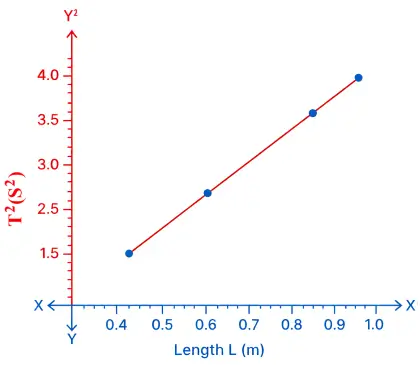
(b) The table below shows length (l) and T2:
| Length (m) | T (s) | T² (s²) |
| 0.40 | 1.27 | 1.61 |
| 0.60 | 1.55 | 2.40 |
| 0.90 | 1.90 | 3.61 |
| 1.00 | 2.01 | 4.04 |
The graph between T2 and the length (l) of the pendulum is shown below :
(c) Conclusion:
The graph shows that:
T2 ∝ l
i.e., the square of time period is directly proportional to the length of the pendulum.
(d) Physical parameter from slope:
Slope \(=\frac{T^2}{I}=\frac{{4\pi}^2}{g}\)
Using slope, we can calculate acceleration due to gravity (g).
(e) Experiment on the Moon:
No, the graph will not remain the same.
Reason:
On the Moon, the value of g is smaller, so time period increases. Thus, values of T2 will increase, and the slope of the graph will change.
Download PDF of Selina Solutions for Class 9 Physics Exercise 1(C) – Measurements and Experimentation
Quick Tricks for Exams
- Always convert values into SI units first
- Use scientific notation for large/small numbers
- Write answers with correct units
- Learn formulas thoroughly
- Practice instrument-based numericals
🔥 Why This Article Helps
- Covers important numericals
- Simple step-by-step explanations
- Based on latest ICSE syllabus
- Perfect for exam revision
📝 Conclusion
These Selina Solutions for Class 9 Physics Exercise 1(C) will help you master numericals, unit conversions, and measurement concepts. Regular practice of these problems will boost your confidence and improve exam performance.
You can also visit :
ICSE Class 9 Physics Notes
| ☛ ICSE Class 9 Physics Chapter 1 – Measurements and Experimentation Notes |
| ☛ ICSE Class 9 Physics Chapter 2 – Motion in One Dimension Notes |
| ☛ ICSE Class 9 Physics Chapter 3 – Laws of Motion Notes |
| ☛ ICSE Class 9 Physics Chapter 4 – Pressure in Fluids and its Transmission Notes |
| ☛ ICSE Class 9 Physics Chapter 5 – Upthrust in Fluids, Archimedes’ Principle and Floatation Notes |
| ☛ ICSE Class 9 Physics Chapter 6 – Heat and Energy Notes |
| ☛ ICSE Class 9 Physics Chapter 7 – Reflection of Light Notes |
| ☛ ICSE Class 9 Physics Chapter 8 – Propagation of Sound Waves Notes |
| ☛ ICSE Class 9 Physics Chapter 9 – Current Electricity Notes |
| ☛ ICSE Class 9 Physics Chapter 10 – Magnetism Notes |
Official Website:
Students can visit the official CISCE website for more details and updates.