Introduction
Matter is everything around us that occupies space and has mass. Air, water, soil, wood, iron, and even our body are made of matter. In ICSE Class 7 Chemistry, Matter and Its Composition is an important chapter because it introduces students to atoms, molecules, elements, compounds, and mixtures. These concepts form the foundation of chemistry.
In this article, you can read complete ICSE Class 7 Chemistry Matter and Its Composition Notes and download the PDF for exam preparation.
Study Support by Rohit Academy
Rohit Academy offers expert-curated ICSE Class 7 Chemistry Study Materials including ICSE Matter and Its Composition Chapter Notes, diagrams, and key formulas for better understanding.
You can also visit:
| ☛ ICSE Class 7 Chemistry Chapter 1: Matter and Its Composition Selina Solutions |
| ☛ ICSE Class 7 Physics |
| ☛ ICSE Class 7 Chemistry |
| ☛ ICSE Class 7 Mathematics |
| ☛ ICSE Class 7 Biology |
Matter and Its Composition Notes ICSE Class 7 Chemistry
Introduction
Everything around us is made up of matter. Objects like water, air, soil, wood, plants, animals, books, and clothes are all examples of matter.
Definition of Matter
- Matter is anything that has mass, occupies space, and can be perceived by our senses.
- Examples: Water, Air, Stone, Milk, Wood
Properties of Matter
1. Matter Has Mass
Mass is the quantity of matter present in a body.
Example
- When marbles are added to a glass of water, the total weight increases. This proves that marbles have mass.
- Air also has mass. An inflated balloon weighs more than a deflated balloon.
2. Matter Occupies Space
Matter takes up space. The space occupied by matter is called volume.
Example
- When a spoon is dipped in water, the water level rises.
- Water already fills space in a glass, so extra water overflows.
Air also occupies space because a balloon inside a closed bottle cannot inflate properly.
Composition of Matter
Matter is made up of extremely small particles called atoms.
Atom
An atom is the smallest unit of matter that shows all the properties of that matter.
Examples
- Hydrogen atom
- Oxygen atom
- Carbon atom
Molecule
Atoms combine together to form molecules.
Definition
A molecule is the smallest particle of matter that can exist independently.
Examples
- Hydrogen molecule → H2
- Nitrogen molecule → N2
- Water molecule → H2O
- Carbon dioxide molecule → CO2
Characteristics of Particles of Matter
1. Particles Have Space Between Them
There are gaps between particles called intermolecular spaces.
Example
When sugar dissolves in water, the water level does not rise because sugar particles occupy spaces between water molecules.
2. Particles Attract Each Other
Particles of matter are held together by intermolecular force of attraction.
Examples
- Wood is hard because particles are strongly attracted.
- Chalk breaks easily because attraction is weaker.
- Water droplets are spherical because water molecules stick together.
3. Particles Are in Continuous Motion
Particles of matter move continuously in random motion.
Example
A drop of blue ink spreads throughout water on its own.
This movement increases with temperature.
Kinetic Energy
Kinetic energy is the energy possessed by a body due to its motion.
Particles move faster at higher temperatures because they gain kinetic energy.
- Increase in temperature → increases kinetic energy
- Decrease in temperature → decreases kinetic energy
States of Matter
There are three main states of matter:
- Solid
- Liquid
- Gas
Solids
A solid is a state of matter which has a definite shape and definite volume.
Characteristics of Solids
- Definite shape
- Definite volume
- Particles are tightly packed
- Strong intermolecular force
- Very little intermolecular space
- Cannot flow
- Nearly incompressible
Examples
- Iron
- Stone
- Wood
- Coal
Liquids
A liquid is a state of matter which has a definite volume but no definite shape.
Characteristics of Liquids
- Definite volume
- No definite shape
- Take the shape of the container
- Particles are loosely packed
- Can flow
- Slightly compressible
Examples
- Water
- Milk
- Oil
- Alcohol
Liquids are called fluids because they can flow.
Gases
A gas is a state of matter which has neither definite shape nor definite volume.
Characteristics of Gases
- No definite shape
- No definite volume
- Particles are far apart
- Weak intermolecular force
- Highly compressible
- Flow in all directions
Examples
- Oxygen
- Nitrogen
- Carbon dioxide
- Hydrogen
Gases spread quickly due to rapid movement of particles.
***Note
Solids, liquids and gases differ in their physical state because of differences in intermolecular force of attraction and intermolecular spaces between their particles.
Diffusion
The mixing of particles of one substance with another substance on their own is called diffusion.
Example
Perfume smell spreads throughout a room.
Diffusion is:
- Slow in solids
- Faster in liquids
Fastest in gases
Fluids
Substances that can flow are called fluids.
Fluids include:
- Liquids
- Gases
Comparison of Solids, Liquids and Gases
| Property | Solids | Liquids | Gases |
| Shape | Fixed | No fixed shape | No fixed shape |
| Volume | Fixed | Fixed | No fixed volume |
| Particle Arrangement | Closely packed | Moderately packed | Far apart |
| Intermolecular Space | Very small | Moderate | Very large |
| Force of Attraction | Strong | Moderate | Weak |
| Compressibility | Very low | Low | High |
| Movement of Particles | Vibrate only | Move freely | Move rapidly |
| Diffusion | Very slow | Slow | Fast |
Interconversion of States of Matter
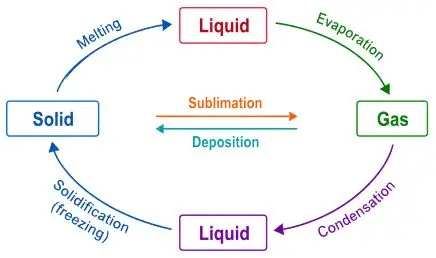
The process by which matter changes from one state to another without changing its chemical composition is called interconversion of states of matter.
This happens due to:
- change in temperature
- change in pressure
Change of State by Heating
- Melting or Fusion: The process in which a solid changes into liquid on heating is called melting or fusion.
- Melting Point: The temperature at which a solid changes into liquid is called melting point.
Example
Ice → Water (at 0 °C)
- Vaporisation or Evaporation: The process in which a liquid changes into gas is called vaporisation or evaporation.
- Boiling Point: The temperature at which a liquid changes into gas is called boiling point.
Example:
Water → Steam (at 100 °C)
Change of State by Cooling
- Condensation or Liquefaction: The process in which gas changes into liquid on cooling is called condensation.
Example
Steam → Water
- Freezing or Solidification: The process in which liquid changes into solid on cooling is called freezing or solidification.
- Freezing Point: The temperature at which a liquid changes into solid is called freezing point.
Example
Water → Ice
- Sublimation: The process in which a solid directly changes into gas without passing through the liquid state is called sublimation.
Examples: Camphor, Naphthalene, Iodine, Ammonium chloride
The reverse process is called deposition.
Effect of Pressure
Increasing pressure can change gases into liquids.
Examples
- LPG cylinders
- Liquid carbon dioxide
- Liquid oxygen
Download ICSE Class 7 Chemistry Matter and Its Composition Notes PDF
Students searching for ICSE Class 7 Chemistry Matter and Its Composition Notes PDF Download can use these notes for free study support. Save the PDF and revise anytime on mobile or computer.
Importance of Studying Matter and Its Composition
Understanding matter helps students:
- Learn the basic structure of substances.
- Understand chemical reactions.
- Identify elements and compounds.
- Build a strong chemistry foundation.
- Prepare for higher classes.
Conclusion
Matter and Its Composition is one of the most important chapters in ICSE Class 7 Chemistry. Students should understand the concepts of atoms, molecules, elements, compounds, and mixtures properly because these topics are used in advanced chemistry chapters. Use these notes for revision and download the PDF for quick study before exams.
ICSE Class 7 Chemistry Notes
| ☛ ICSE Class 7 Chemistry Chapter 1 – Matter and Its Composition Notes |
| ☛ ICSE Class 7 Chemistry Chapter 2 – Physical and Chemical Changes Notes |
| ☛ ICSE Class 7 Chemistry Chapter 3 – Elements, Compounds and Mixtures Notes |
| ☛ ICSE Class 7 Chemistry Chapter 4 – Atomic Structure Notes |
| ☛ ICSE Class 7 Chemistry Chapter 5 – Language of Chemistry Notes |
| ☛ ICSE Class 7 Chemistry Chapter 6 – Metals and Non-metals Notes |
| ☛ ICSE Class 7Chemistry Chapter 7 – Air and Atmosphere Notes |
Official Website:
Students can visit the official CISCE website for more details and updates.