Introduction
Physical and Chemical Changes is an important chapter in ICSE Class 7 Chemistry. In this chapter, students learn about different types of changes occurring around us, their characteristics, examples, and differences. Understanding this chapter helps students identify whether a change is physical or chemical in nature and prepares them for school examinations.
Students can use these notes for quick revision and download the PDF for easy study anytime.
Study Support by Rohit Academy
Rohit Academy offers expert-curated ICSE Class 7 Chemistry Study Materials including ICSE Physical and Chemical Changes Chapter Notes, diagrams, and key formulas for better understanding.
You can also visit:
| ☛ ICSE Class 7 Chemistry Chapter 2: Physical and Chemical Changes Selina Solutions |
| ☛ ICSE Class 7 Physics |
| ☛ ICSE Class 7 Chemistry |
| ☛ ICSE Class 7 Mathematics |
| ☛ ICSE Class 7 Biology |
Physical and Chemical Changes Notes ICSE Class 7 Chemistry
Introduction
Change is a natural process that occurs all around us. Changes may occur naturally or may be caused by human activities. During a change, substances may show differences in colour, shape, size, hardness, state, position, etc.
Examples of Changes
- Ripening of mango
- Growth of plants
- Melting of wax
- Freezing of water
- Burning of fuel
- Cooking of food
- Rusting of iron
Types of Changes
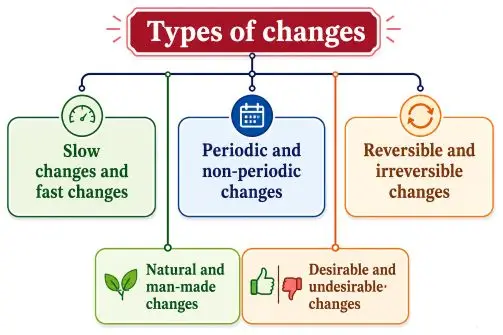
1. Slow and Fast Changes
Slow Changes
Changes that take a long time to complete are called slow changes.
Examples
- Growth of a child
- Germination of seeds
- Rusting of iron
- Formation of fossil fuels
- Change of seasons
Fast Changes
Changes that occur in a very short time are called fast changes.
Examples
- Burning of paper
- Bursting of crackers
- Lighting of an electric bulb
- Bursting of a balloon
- Evaporation of petrol (volatile in nature)
2. Natural and Man-made Changes
Natural Changes
Changes that occur on their own in nature are called natural changes.
Examples
- Day and night
- Change of seasons
- Earthquakes
- Growth of plants
- Volcanic eruptions
Man-made Changes
Changes caused by human beings are called man-made changes.
Examples
- Making paper boats
- Formation of steel
- Cooking food
- Preparing flatbread
3. Periodic and Non-periodic Changes
Periodic Changes
Changes that repeat after regular intervals of time are called periodic changes.
Examples
- Day and night
- Change of seasons
- Tides in the sea
- Full moon and new moon
Non-periodic Changes
Changes that do not occur regularly are called non-periodic changes.
Examples
- Earthquakes
- Landslides
- Thunderstorms
- Sudden rainfall
4. Desirable and Undesirable Changes
Desirable Changes
Changes that are useful to us are called desirable changes.
Examples
- Cooking food
- Ripening of fruits
- Formation of curd
- Photosynthesis
Undesirable Changes
Changes that are harmful are called undesirable changes.
Examples
- Rusting of iron
- Food spoilage
- Floods
- Epidemics
5. Reversible and Irreversible Changes
Reversible Changes
Changes that can be reversed to get the original substance back are called reversible changes.
Examples
- Melting of ice
- Stretching a rubber band
- Dissolving salt in water
- Boiling and condensation of water
Irreversible Changes
Changes that cannot be reversed are called irreversible changes.
Examples
- Burning of paper
- Cooking food
- Ripening of fruits
- Rusting of iron
Physical Change
A physical change is a temporary change in which no new substance is formed. Only physical properties such as shape, size, colour, or state may change.
Characteristics of Physical Changes
- No new substance is formed.
- Chemical composition remains the same.
- Usually temporary and reversible.
- Only physical properties change.
- Energy may or may not be involved.
Examples of Physical Changes
- Melting of ice
- Drying of clothes
- Dissolving sugar in water
- Glowing of an electric bulb
- Cutting paper into pieces
- Sublimation of ammonium chloride
Interconversion of States of Matter
Changing matter from one state to another is a physical change because no new substance is formed.
Example 1: Ice to Water
- Ice melts into water on heating.
- Water freezes back into ice on cooling.
Example 2: Water to Steam
- Water changes into steam on boiling.
- Steam changes back into water on cooling.
Important Terms Related to Physical Change
- Melting: The process in which a solid changes into liquid on heating.
- Melting Point: The temperature at which a solid starts melting.
Example: Ice melts at 0°C - Freezing: The process in which a liquid changes into solid on cooling.
- Freezing Point: The temperature at which a liquid changes into solid.
Example: Water freezes at 0°C - Boiling: The process in which a liquid changes into vapour on heating at a fixed temperature.
- Boiling Point: The temperature at which a liquid starts changing into vapour.
Example: Water boils at 100°C - Evaporation: The process in which a liquid changes into vapour at temperatures below its boiling point.
Characteristics of Evaporation
- Slow process
- Occurs only at the surface
- Takes place at all temperatures below boiling point
- Condensation: The process in which vapour changes into liquid on cooling.
Example: Formation of water droplets
- Condensation Point: The temperature at which gas changes into liquid.
- Sublimation: The process in which a solid changes directly into gas without changing into liquid is called sublimation.
Examples: Ammonium chloride, Camphor, Naphthalene balls, Iodine, Dry ice (solid carbon dioxide)
Dissolving
Mixing of a solute with a solvent to form a solution.
Example: Sugar in water
Difference Between Evaporation and Boiling
| Evaporation | Boiling |
| Slow process | Fast process |
| Takes place from surface only | Takes place throughout the liquid |
| Occurs at all temperatures | Occurs at fixed temperature |
| No bubbles formed | Bubbles are formed |
Reversible and Irreversible Physical Changes
Reversible Physical Change
A change that can be reversed to get back the original substance.
Examples
- Ice to water
- Stretching a rubber band
- Folding paper
- Boiling water
Irreversible Physical Change
A physical change in which the original form cannot be obtained back easily.
Examples
- Cutting a carrot into pieces
- Cutting paper into small bits
Chemical Change
A chemical change is a permanent change in which one or more new substances are formed with different properties.
Characteristics of Chemical Changes
- The change is permanent.
- New substances are formed.
- Composition and properties change.
- Energy is absorbed or released.
- The original substance cannot be obtained easily.
Examples of Chemical Changes
- Burning of paper
- Burning of sugar
- Rusting of iron
- Cooking food
- Souring of milk
- Respiration
- Boiling an egg
Chemical Reaction
A chemical change is also called a chemical reaction.
Terms Used
- Reactants → Original substances
- Products → New substances formed
Reaction: Reactants → Products
Burning
Burning is a chemical change in which a substance reacts with oxygen to form new substances along with the release of heat and light.
Examples
- Burning of coal
- Burning of candle
- Burning of paper
- Burning of fuel
Burning of Paper
When paper burns, it changes into ash and forms a new substance. The change cannot be reversed. Therefore, it is a chemical change.
Burning of Sugar
When sugar is heated, it melts, turns brown, and finally becomes black charcoal. New substances are formed, so it is a chemical change.
Rusting of Iron
Rusting is a chemical process in which iron reacts with oxygen in the presence of moisture to form a reddish-brown substance called rust.
Conditions Necessary for Rusting
- Presence of oxygen
- Presence of water or moisture
Important Point
Rust is a hydrated oxide of iron.
Characteristics of Rusting
- A new substance (rust) is formed.
- The change is permanent and irreversible.
- Rust is non-magnetic.
Prevention of Rusting
- Painting
- Oiling or greasing
- Galvanization
- Electroplating
Respiration
Respiration is a chemical process in living beings in which oxygen reacts with food to release energy.
Equation of Respiration
Glucose + Oxygen → Carbon dioxide + Water + Energy
Importance
- Releases energy needed for life activities.
- Occurs in all living organisms.
Digestion of Food
Digestion is the process in which complex food substances are broken into simpler substances by enzymes.
Why is Digestion a Chemical Change?
- New substances are formed.
- Original food cannot be obtained back.
- Energy is released.
Formation of Curd from Milk
Explanation
Milk changes into curd due to the action of bacteria.
Why is it a Chemical Change?
- Curd cannot be converted back into milk.
- Properties of curd differ from milk.
- It is permanent and irreversible.
Type of Change
- Slow change
- Desirable change
- Irreversible change
Heating of Iron and Sulphur
Observation
When iron and sulphur are heated together, a new substance called iron sulphide is formed.
Properties of Iron Sulphide
- Black in colour
- Non-magnetic
- Does not dissolve in carbon disulphide
Why is it a Chemical Change?
- A new substance is formed.
- Properties are completely different from iron and sulphur.
Signs of a Chemical Change
A chemical change is usually identified by:
1. Change in Colour
Examples
- Ripening of fruits
- Burning of sugar
2. Evolution of Gas
Example
Zinc + Hydrochloric acid → Zinc chloride + Hydrogen gas
Testing of Hydrogen gas
Hydrogen gas burns with a characteristic “pop” sound when tested with a burning matchstick.
3. Change in Energy
Energy may be released or absorbed in the form of:
- Heat
- Light
- Sound
Example
Bursting of crackers releases heat, light, and sound.
Dissolution of Quick Lime in Water
Observation
When quick lime is added to water:
- Heat is produced
- A new substance called slaked lime is formed
Why is it a Chemical Change?
- New substance is formed
- Large amount of heat is evolved
Zinc and Dilute Hydrochloric Acid
Observation
- When zinc reacts with dilute hydrochloric acid:
- Bubbles of hydrogen gas are produced
- Heat is released
Equation
Zinc + Hydrochloric acid → Zinc chloride + Hydrogen
Energy Required for Chemical Changes
Different forms of energy are needed for chemical changes.
Examples
- Heat is needed for cooking food.
- Light is needed for photosynthesis.
- Electricity is used to decompose water.
Importance of Chemical Changes
- Cooking makes food edible.
- Medicines, soaps, detergents, paints, and fertilizers are produced through chemical changes.
- Extraction of metals involves chemical changes.
- Burning of fuels provides energy.
- Life processes such as respiration and digestion are chemical changes.
Simultaneous Physical and Chemical Change
Burning of a Candle
Physical Change
- Wax melts into liquid wax.
Chemical Change
- Wax vapour burns to form:
- Carbon dioxide
- Water vapour
Thus, burning of a candle involves both physical and chemical changes.
Differences Between Physical and Chemical Changes
| Physical Change | Chemical Change |
| Temporary change | Permanent change |
| No new substance formed | New substances formed |
| Usually reversible | Usually irreversible |
| Only physical properties change | Chemical composition changes |
| Less energy change | Large energy change |
| Original substance can often be recovered | Original substance cannot be recovered easily |
Download ICSE Class 7 Chemistry Matter and Its Composition Notes PDF
Students searching for ICSE Class 7 Chemistry Matter and Its Composition Notes PDF Download can use these notes for free study support. Save the PDF and revise anytime on mobile or computer.
Conclusion
The chapter Physical and Chemical Changes helps students understand different changes occurring in daily life. Physical changes affect only the appearance or state of matter, whereas chemical changes produce entirely new substances. Proper understanding of examples, definitions, and differences is essential for scoring good marks in ICSE Class 7 Chemistry.
Students can revise these notes regularly and download the PDF for better exam preparation.
ICSE Class 7 Chemistry Notes
| ☛ ICSE Class 7 Chemistry Chapter 1 – Matter and Its Composition Notes |
| ☛ ICSE Class 7 Chemistry Chapter 2 – Physical and Chemical Changes Notes |
| ☛ ICSE Class 7 Chemistry Chapter 3 – Elements, Compounds and Mixtures Notes |
| ☛ ICSE Class 7 Chemistry Chapter 4 – Atomic Structure Notes |
| ☛ ICSE Class 7 Chemistry Chapter 5 – Language of Chemistry Notes |
| ☛ ICSE Class 7 Chemistry Chapter 6 – Metals and Non-metals Notes |
| ☛ ICSE Class 7Chemistry Chapter 7 – Air and Atmosphere Notes |
Official Website:
Students can visit the official CISCE website for more details and updates.