Introduction
Matter and Its Composition is the first chapter of ICSE Class 7 Chemistry in the Selina Concise Chemistry textbook. This chapter introduces students to the basic concepts of matter, atoms, molecules, elements, compounds, and mixtures. Understanding these concepts helps students build a strong foundation for higher chemistry topics.
In this article, you will get ICSE Class 7 Chemistry Chapter 1 Matter and Its Composition Selina Solutions, important definitions, explanations, and exam-oriented questions for better preparation.
Study Support by Rohit Academy
Rohit Academy offers expert-curated ICSE Class 7 Chemistry Study Materials including ICSE Matter and Its Composition Selina Solutions, diagrams, and key formulas for better understanding.
You can also visit:
| ☛ ICSE Class 7 Chemistry Chapter 1: Matter and Its Composition Notes |
| ☛ ICSE Class 7 Physics |
| ☛ ICSE Class 7 Chemistry |
| ☛ ICSE Class 7 Mathematics |
| ☛ ICSE Class 7 Biology |
(A) Objective Type Questions
Question 1
Choose the correct answer from the multiple choices given below.
Question 1(i)
The intermolecular forces are weakest in:
(a) solids (b) liquids
(c) gases (d) both (a) and (b)
Answer:
(c) gases
Explanation:
In gases, the particles are very far apart and move freely. Therefore, the force of attraction between the particles (intermolecular force) is the weakest.
Question 1(ii)
The intermolecular spaces are the least in:
(a) aluminium (b) water
(c) oxygen (d) carbon dioxide
Answer:
(a) aluminium
Explanation:
Aluminium is a solid. In solids, particles are packed very closely together, so intermolecular spaces are the least.
Question 1(iii)
The state of matter which has a definite volume but takes the shape of a container is:
(a) solids (b) liquids
(c) gases (d) none
Answer:
(b) liquids
Explanation:
Liquids have a fixed volume but no fixed shape. They take the shape of the container in which they are kept.
Question 1(iv)
Which of the following is transparent?
(a) Diamond (b) Graphite
(c) Wood (d) Coal
Answer:
(a) Diamond
Explanation:
Diamond allows light to pass through it clearly, so it is transparent. Graphite, wood, and coal are opaque substances.
Question 1(v)
The process by which a solid changes directly from the solid state to the gaseous state is called:
(a) diffusion (b) sublimation
(c) evaporation (d) melting
Answer:
(b) sublimation
Explanation:
Sublimation is the process in which a solid changes directly into gas without passing through the liquid state. Examples include camphor and naphthalene balls.
Assertion Reason Type
Question 2
The following questions are Assertion-Reason based questions. Choose the answer based on the codes given below.
Question 2(i)
Assertion (A): Matter exists in three states, i.e. solids, liquids and gases.
Reason (R): All matter can change from one state to another on changing temperature and pressure.
(a) Both A and R are true and R is the correct explanation of A.
(b) Both A and R are true but R is not the correct explanation of A.
(c) A is true but R is false.
(d) A is false but R is true.
Answer:
(c) A is true but R is false.
Explanation:
The assertion is true because matter exists mainly in three states — solid, liquid and gas.
The reason is false because not all types of matter can easily change from one state to another by changing temperature and pressure.
Question 2(ii)
Assertion (A): When a gas is cooled, the intermolecular gaps decrease.
Reason (R): The kinetic energy of the gaseous particles decrease upon cooling.
(a) Both A and R are true and R is the correct explanation of A.
(b) Both A and R are true but R is not the correct explanation of A.
(c) A is true but R is false.
(d) A is false but R is true.
Answer:
(a) Both A and R are true and R is the correct explanation of A.
Explanation:
Cooling reduces the kinetic energy of gas particles. As the particles move more slowly, they come closer together, reducing the intermolecular gaps.
Question 2(iii)
Assertion (A): Most of the liquids have their own shape.
Reason (R): Liquids can flow from a higher to lower level.
(a) Both A and R are true and R is the correct explanation of A.
(b) Both A and R are true but R is not the correct explanation of A.
(c) A is true but R is false.
(d) A is false but R is true.
Answer:
(d) A is false but R is true.
Explanation:
Liquids do not have a fixed shape; they take the shape of their container. However, liquids can flow from a higher level to a lower level, so the reason is true.
Question 2(iv)
Assertion (A): Particles of matter are always in a random motion.
Reason (R): Particles of matter possess kinetic energy.
(a) Both A and R are true and R is the correct explanation of A.
(b) Both A and R are true but R is not the correct explanation of A.
(c) A is true but R is false.
(d) A is false but R is true.
Answer:
(a) Both A and R are true and R is the correct explanation of A.
Explanation:
Particles of matter are always moving randomly because they possess kinetic energy. The kinetic energy causes continuous motion of particles.
Question 2(v)
Assertion (A): A piece of wood is a hard solid, while that of chalk is a soft solid.
Reason (R): In solids, the intermolecular forces of attraction are very strong.
(a) Both A and R are true and R is the correct explanation of A.
(b) Both A and R are true but R is not the correct explanation of A.
(c) A is true but R is false.
(d) A is false but R is true.
Answer:
(b) Both A and R are true but R is not the correct explanation of A.
Explanation:
Wood is harder than chalk due to differences in their internal structure and bonding. Although intermolecular forces are generally strong in solids, this does not explain why one solid is hard and another is soft.
Fill in the blanks
Question 3
Fill in the blanks:
(a) Air is a matter because it has _____ and _______ and it can be ______.
(b) The molecules are made up of ______.
(c) The quantity of matter in an object is called its ______.
(d) The state of matter with definite volume and definite shape is called ______.
(e) The substances which can flow are called ______.
Answer:
(a) Air is a matter because it has mass and occupies space and it can be felt.
(b) The molecules are made up of atoms.
(c) The quantity of matter in an object is called its mass.
(d) The state of matter with definite volume and definite shape is called solid.
(e) The substances which can flow are called fluids.
True or False
Question 4
Write whether the following statements are true or false.
(a) Solids can diffuse very fast.
(b) The quantity of matter in an object is called volume.
(c) Atoms combine to form molecules.
(d) Particles of matter can move because they possess kinetic energy.
(e) When a liquid is heated, it solidifies.
Answer:
(a) False
Correct Statement: Solids diffuse very slowly.
(b) False
Correct Statement: The quantity of matter in an object is called mass.
(c) True
(d) True
(e) False
Correct Statement: When a liquid is heated, it changes into vapour (gas).
Match the Columns
Question 5
Match the following:
| Column A | Column B |
| (a) Fluids | (i) space between the molecules |
| (b) Melting point | (ii) change of state from gas to liquid |
| (c) Atoms | (iii) substances which can flow |
| (d) Intermolecular space | (iv) the smallest particles of matter |
| (e) Condensation | (v) the temperature at which a solid changes to a liquid |
Answer:
| Column A | Column B |
| (a) Fluids | (iii) substances which can flow |
| (b) Melting point | (v) the temperature at which a solid changes to a liquid |
| (c) Atoms | (iv) the smallest particles of matter |
| (d) Intermolecular space | (i) space between the molecules |
| (e) Condensation | (ii) change of state from gas to liquid |
Question 6
Classify the following into solid, liquid and gas:
Coal, kerosene, wood, oxygen, sugar, blood, water vapour, milk, wax.
Answer:
- Solids: Coal, Wood, Sugar, Wax
- Liquids: Kerosene, Blood, Milk
- Gases: Oxygen, Water vapour
Question 7
Give appropriate terms for the following:
(a) The change of a solid into liquid.
(b) The force of attraction between the molecules of matter.
(c) The particles of matter which may or may not have independent existence.
(d) The process due to which a solid directly changes into its vapours.
(e) The change of vapour into a liquid.
Answer:
(a) Melting
(b) Intermolecular force of attraction
(c) Atoms
(d) Sublimation
(e) Condensation
(B) Short Answer Type Questions
Question 1
Give two examples for the following:
(a) substances which can flow
(b) substances which can sublime
(c) substances which can diffuse
Answer:
(a) Water, milk
(b) Camphor, naphthalene
(c) Perfume, ink
Question 2
Define matter.
Answer:
Anything which has mass and occupies space is called matter.
Question 3
Differentiate between an atom and a molecule.
Answer:
| Atom | Molecule |
| It is the smallest particle of an element. | It is formed by the combination of two or more atoms. |
| It may or may not exist independently. | It can exist independently. |
| Example: Helium atom | Example: Water molecule (H₂O) |
Question 4
What do you understand by:
(a) Intermolecular force of attraction? (b) Intermolecular space?
Answer:
(a) The force of attraction between the molecules of matter is called intermolecular force of attraction.
(b) The space between the molecules of matter is called intermolecular space.
Question 5
Why are liquids and gases called as fluids?
Answer:
Liquids and gases are called fluids because they can flow from one place to another.
(C) Long Answer Type Questions
Question 1
Define:
(a) Solid (b) Liquid (c) Gas
Answer:
(a) A solid is a state of matter which has a definite shape and definite volume.
(b) A liquid is a state of matter which has a definite volume but no definite shape.
(c) A gas is a state of matter which has neither definite shape nor definite volume.
Question 2
Write your observations and conclusions for the following:
(a) A few marbles are put in a glass half filled with water.
(b) Ice is kept at room temperature.
Answer:
(a) Observation:
The level of water rises after adding the marbles.
Conclusion:
Matter occupies space.
(b) Observation:
Ice melts and changes into water.
Conclusion:
Matter can change its state on heating.
Question 3
State three main characteristics of the particles of matter.
Answer:
- Particles of matter have intermolecular spaces.
- Particles of matter attract each other.
- Particles of matter are always in motion.
Question 4
(a) Define interconversion of states of matter.
(b) Why do solids, liquids and gases differ in their physical state?
(c) Under what conditions do solids, liquids and gases change their state?
Answer:
(a) The process by which matter changes from one state to another by changing temperature or pressure is called interconversion of states of matter.
(b) Solids, liquids and gases differ in their physical state because of differences in intermolecular force of attraction and intermolecular spaces between their particles.
(c) Solids, liquids and gases change their state on changing temperature and pressure.
Question 5
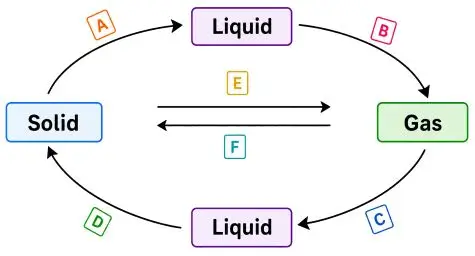
Name the processes marked as A, B, C, D, E and F.
Answer:
- A: Melting
- B: Vaporisation
- C: Condensation
- D: Freezing
- E: Sublimation
- F: Deposition
Question 6
Give reasons:
(a) When a stone is dipped in a glass containing some water, the level of water rises but when a spoon of sugar is added to it and stirred, the water level does not rise.
(b) A drop of ink added to water in a glass turns the whole water blue.
Answer:
(a) When a stone is dipped in water, it occupies space and displaces water, so the water level rises.
(b) But when sugar is added and stirred, the sugar particles dissolve and occupy the intermolecular spaces between water molecules, so the water level does not rise noticeably. A drop of ink spreads throughout the water due to diffusion. The particles of ink move randomly and mix with water particles, turning the whole water blue.
(D) Case Study
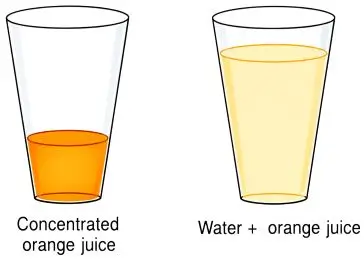
Sapna was making an orange flavoured drink. She poured 3–4 teaspoons of concentrated orange juice into a glass. She then added water until the glass was full and stirred it slowly.
(a) Explain how the orange juice spread into water?
(b) What is the effect of stirring?
(c) What is this intermixing of particles called?
Name the type of substances which show this phenomenon the fastest.
(d) “There is no more movement in the liquid in the glass once the orange colour of the juice has stopped spreading.”
Is this statement correct? Justify your answer.
Answer:
(a) The particles of orange juice moved continuously and mixed with the particles of water due to their random motion. Hence, the orange juice spread throughout the water.
(b) Stirring increases the rate of mixing and helps the orange juice spread faster in water.
(c) The intermixing of particles is called diffusion. Gases show diffusion the fastest.
(d) No, the statement is not correct.
The particles of liquid continue to move continuously even after the colour becomes uniform. The spreading stops only because the particles have mixed evenly throughout the liquid.
ICSE Class 7 Chemistry Matter and Its Composition Selina Solutions PDF Download
Download ICSE Class 7 Chemistry Matter and Its Composition Selina Solutions PDF with chapter-wise solved answers, explanations, and free study resources for easy exam preparation.
Conclusion
ICSE Class 7 Chemistry Chapter 1 Matter and Its Composition Selina Solutions helps students understand the basic concepts of chemistry such as matter, atoms, molecules, elements, compounds, and mixtures. Learning these concepts properly makes future chemistry chapters easier and improves exam preparation.
ICSE Class 7 Chemistry Selina Solutions
The Selina Concise Chemistry Class 7 book includes the following chapters:
| ☛ ICSE Class 7 Chemistry Chapter 1: Matter and Its Composition Selina Solutions |
| ☛ ICSE Class 7 Chemistry Chapter 2: Physical and Chemical Changes Selina Solutions |
| ☛ ICSE Class 7 Chemistry Chapter 3: Elements, Compounds and Mixtures Selina Solutions |
| ☛ ICSE Class 7 Chemistry Chapter 4: Atomic Structure Selina Solutions |
| ☛ ICSE Class 7 Chemistry Chapter 5: Language of Chemistry Selina Solutions |
| ☛ ICSE Class 7 Chemistry Chapter 6: Metals and Non-metals Transfer Selina Solutions |
| ☛ ICSE Class 7 Chemistry Chapter 7: Air and Atmosphere Selina Solutions |
Official Website:
Students can visit the official CISCE website for more details and updates.