Refraction Through a Lens Class 10 Physics PYQs
Preparing for the ICSE Class 10 Physics Board Examination? Practising previous year questions is one of the best ways to understand the exam pattern and improve your confidence. This page provides ICSE Class 10 Physics Chapter 5 – Refraction Through a Lens Previous Year Questions with Answers, carefully selected from past board examinations.
The questions cover all the important topics of the chapter, including ray diagrams, lens formula, sign convention, magnification, power of a lens, image formation, and numerical problems. These questions will help students identify frequently asked concepts and prepare effectively for the ICSE examination.
Study Support by Rohit Academy
Rohit Academy offers expert-curated ICSE Class 10 Physics Study Materials including ICSE Refraction Through a Lens Previous Year Questions, diagrams, and key formulas for better understanding.
Study materials related to chapter 5: Refraction Through a Lens
ICSE Class 10 Physics – Refraction of Light at Plane Surfaces: Previous Year Questions
Question 1
An object is placed in front of a converging lens at a distance greater than twice the focal length of the lens. Draw a ray diagram to show the formation of the image. [ICSE 2007]
Answer:
The object placed beyond 2F.
- Image Nature: Real and inverted.
- Image Size: Diminished.
- Image Position: Between F and 2F.
Question 2
Draw a ray diagram to illustrate the determination of the focal length of a convex lens using an auxiliary plane mirror. [ICSE 2008]
Answer: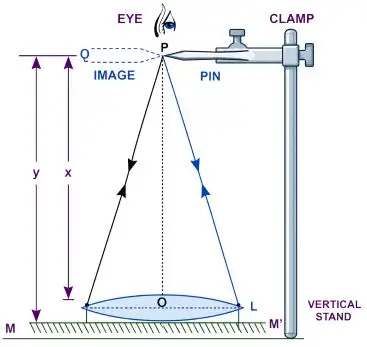
Question 3
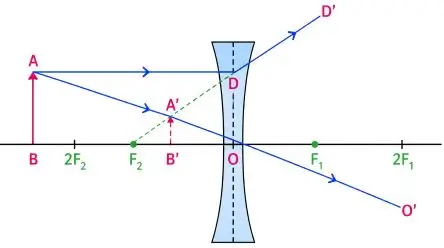
A linear object is placed on the axis of a lens. An image is formed by refraction in the lens. For all positions of the object on the axis of the lens, the positions of the image are always between the lens and the object.
(i) Name the lens.
(ii) Draw a ray diagram to show the formation of the image of an object placed in front of the lens at any position of your choice except infinity. [ICSE 2008]
Answer:
(i) The lens is a concave (diverging) lens because, for every position of the object, the image is always formed between the object and the lens.
(ii) The ray diagram below illustrates the formation of the image by a concave lens when the object is placed at any finite distance (except at infinity) in front of the lens.
Question 4
Copy and complete the following table:-
| Type of lens | Position of Object | Nature of Image | Size of Image |
| Convex | At F | ||
| Concave | At infinity |
Answer:
| Type of lens | Position of Object | Nature of Image | Size of Image |
| Convex | At F | Real and inverted | Highly magnified |
| Concave | At infinity | Virtual and upright | Highly magnified |
Question 5
(i) Copy and complete the diagram to show the formation of the image of the object AB.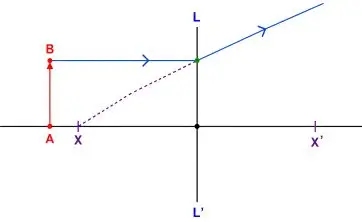
(ii) What is the name given to X? [ICSE 2009]
Answer:
(i) Below is the completed diagram showing the image of the object AB: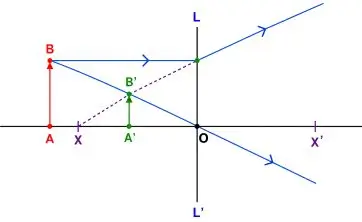
(ii) The name of X is principal focus.
Question 6
We can burn a piece of paper by focusing the sun rays by using of lens.
(i) Name the type of lens used for the above purpose.
(ii) Draw a ray diagram to support your answer. [ICSE 2010]
Answer:
(i) Convex lens.
(ii) Below ray diagram shows how a converging lens can form an image of the Sun: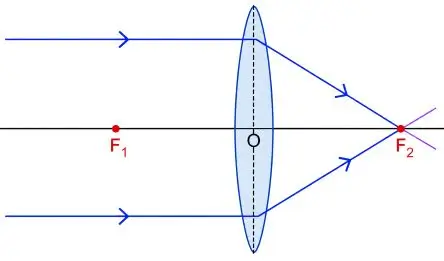
Question 7
An erect, magnified and virtual image is formed, when an object is placed between the optical centre and principal focus of a lens.
(i) Name the lens.
(ii) Draw a ray diagram to show the formation of the image with the above stated Characteristics. [ICSE 2010]
Answer:
(i) Convex lens
(ii) Below ray diagram shows the formation of the image: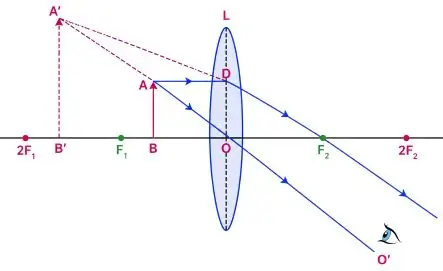
Question 8
(i) When does a ray of light falling on a lens pass through it undeviated?
(ii) Which lens can produce a real and inverted image of an object? [ICSE 2011]
Answer:
(i) A ray of light falling on the lens passes through it undeviated when it passes through the optical centre.
(ii) Convex lens
Question 9
An object is placed in front of a lens between its optical centre and the focus and forms a virtual, erect and diminished image.
(i) Name the lens which formed this image.
(ii) Draw a ray diagram to show the formation of the image with the above stated characteristics. [ICSE 2011]
Answer:
(i) Concave lens
(ii) Below ray diagram shows the formation of the image:
Question 10
You are provided with a printed piece of paper.
Using this paper how will you differentiate between a convex lens and a concave lens? [ICSE 2012]
Answer:
When the lens is held close to a printed page, a convex lens makes the letters appear magnified, whereas a concave lens makes the letters appear diminished.
Question 11
A converging lens is used to obtain an image of an object placed in front of it. The inverted image is formed between F2 and 2F2 of the lens.
(i) Where is the object placed?
(ii) Draw a ray diagram to illustrate the formation of the image obtained. [ICSE 2012]
Answer:
(i) Object is beyond 2F1.
(ii) Below ray diagram shows the formation of the image: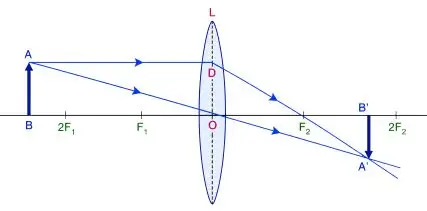
Question 12
An object AB is placed between 2F1 and F1 on the principal axis of a convex lens as shown in the diagram.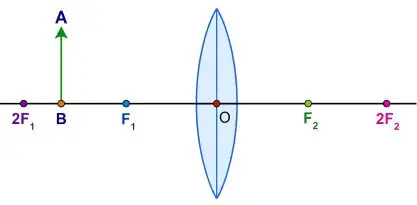
Copy the diagram and using three rays starting from point A, obtain the image of the object formed by the lens. [ICSE 2013]
Answer:
Diagram of convex lens: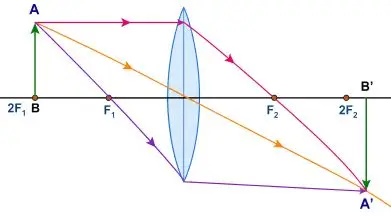
Question 13
Ranbir claims to have obtained an image twice the size of the object with a concave lens. Is he correct?
Give a reason for your answer. [ICSE 2014]
Answer:
No, Ranbir is not correct.
A concave lens always forms a virtual, erect, and diminished image of a real object. It cannot produce an image larger than the object under any position of the object.
Question 14
A lens forms an erect, magnified and virtual image of an object.
(i) Name the lens.
(ii) Draw a labelled ray diagram to show the image formation. [ICSE 2014]
Answer:
(i) Convex lens
(ii) Below ray diagram shows the formation of the image:
Question 15
(i) Define the power of a lens.
(ii) The lens mentioned in Q14 above is of focal length 25 cm. Calculate the power of the lens. [ICSE 2014]
Answer:
(i) Power of a Lens:
The power of a lens is the reciprocal of its focal length.
(ii) Since the given lens is a convex lens,
f = +25 cm = +0.25 m
Power of a lens,
P = +4 D
Therefore, the power of the lens is +4 D.
Question 16
(i) Where should an object be placed so that a real and inverted image of the same size as the object is obtained using a convex lens?
(ii) Draw a ray diagram to show the formation of the image as specified in the part 16 (i). [ICSE 2015]
Answer:
(i) When an object is placed at the centre of curvature (2F1) of a convex lens, a real, inverted image of the same size as the object is formed at 2F2 on the opposite side of the lens.
(ii) Below ray diagram shows the formation of the image: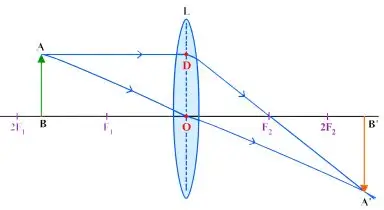
Question 17
A lens produces a virtual image between the object and the lens.
(i) Name the lens.
(ii) Draw a ray diagram to show the formation of this image. [ICSE 2016]
Answer:
(i) The lens is concave.
(ii) Below ray diagram shows the formation of this image:
Question 18
A lens forms an upright and diminished image of an object when the object is placed at the focal point of the given lens.
(i) Name the lens.
(ii) Draw a ray diagram to show the image formation. [ICSE 2017]
Answer:
(i) The lens is a concave lens (diverging lens).
(ii) Below ray diagram shows the formation of an image by a concave lens:
Question 19
State the position of the object in front of a converging lens if:
(i) It produces a real and same size image of the object.
(ii) It is used as a magnifying lens. [ICSE 2018]
Answer:
(i) The object is placed at twice the focal length (2F1) in front of the lens.
(ii) The object is placed between the optical centre and focus of the lens.
Question 20
An object is placed at a distance of 12 cm from a convex lens of focal length 8 cm.
Find:
(i) the position of the image
(ii) nature of the image [ICSE 2018]
Answer:
Given,
- u = –12 cm,
- f = +8 cm,
- v = ?
(i) Lens formula:
(Position of Image)
(ii) Nature of image: Real, inverted and magnified.
Question 21
The power of a lens is −5D.
(i) Find its focal length.
(ii) Name the type of lens. [ICSE 2018]
Answer:
(i) The power of lens = −5 D
Focal length (f)
f = − 0.2 m
f = − 20 cm
As the power is negative, the lens is concave.
Question 22
An object AB is placed between O and F1 on the principal axis of converging lens as shown in the diagram.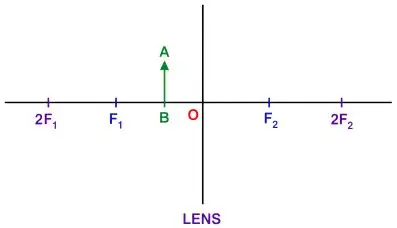
Copy the diagram and by using three standard rays starting from point A, obtain an image of the object AB. [ICSE 2018]
Answer:
A’B’ is the image formed.
Question 23
(i) If the lens is placed in water instead of air, how does its focal length change?
(ii) Which lens, thick or thin has greater focal length? [ICSE 2019]
Answer:
(i) Focal length of lens increases.
(ii) A thin lens has greater focal length as compared to a thick lens.
Question 24
A virtual, diminished image is formed when an object is placed between the optical centre and the principal focus of a lens.
(i) Name the type of lens which forms the above image.
(ii) Draw a ray diagram to show the formation of the image with the above stated characteristics. [ICSE 2019]
Answer:
(i) The lens is a concave lens (diverging lens).
(ii) Below ray diagram shows the formation of an image by a concave lens:
Question 25
An object is placed at a distance 24 cm in front of a convex lens of focal length 8 cm.
(i) What is the nature of the image so formed?
(ii) Calculate the distance of the image from the lens.
(iii) Calculate the magnification of the image. [ICSE 2019]
Answer:
(i) The image formed is real and inverted.
(ii) Given:
- Focal length, f = +8 cm
- Object distance, u = −24 cm
- Image distance, v = ?
Using the lens formula:
(Position of Image)
∴ The image is formed at a distance of 12 cm behind the lens.
(iii) Magnification:
The negative sign indicates that the image is inverted.
Question 26
Where should an object be placed in front of a convex lens in order to get:
(i) an enlarged real image
(ii) enlarged virtual image? [ICSE 2020]
Answer:
(i) The object should be placed between F1 and 2F1 of the convex lens.
(ii) The object should be placed between the optical centre (O) and the principal focus (F1) of the convex lens.
Question 27
A lens of focal length 20 cm forms an inverted image at a distance 60 cm from the lens.
(i) Identify the lens.
(ii) How far is the lens present in front of the object?
(iii) Calculate the magnification of the image. [ICSE 2020]
Answer:
(i) The lens used is a convex lens because it forms a real and inverted image.
(ii) Given:
- Focal length (f) = +20 cm
- Image distance (v) = +60 cm
- Object distance (u) = ?
Using the lens formula:
Substituting the given values:
Hence, the object is placed 30 cm in front of the lens.
(iii) Magnification:
Thus, the magnification is −2, indicating that the image is inverted and twice the size of the object.
Question 28
An object of height 10 cm is placed in front of a concave lens of focal length 20 cm at a distance 25 cm from the lens. Is it possible to capture this image on a screen? Select a correct option from the following: [ICSE 2021 Sem 1]
(a) Yes, as the image formed will be real.
(b) Yes, as the image formed will be erect.
(c) No, as the image formed will be virtual.
(d) No, as the image formed will be inverted.
Answer:
(c) No, as the image formed will be virtual.
Explanation:
A concave lens always forms a virtual, erect, and diminished image. Since a virtual image cannot be obtained on a screen, it is not possible to capture the image on a screen.
Question 29
Observe the diagram which shows the path of an incident ray through an optical plane LL’ of a lens.
The focal length of the lens is 20 cm. [ICSE 2021 Sem 1]
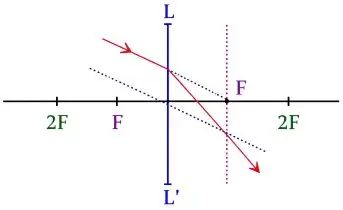
Question 29(i)
If an object is placed at a distance of 30 cm in front of this lens, then
(a) the image will be virtual
(b) the image will be diminished and inverted.
(c) the image will be diminished.
(d) the image will be real and magnified.
Answer:
(d) The image will be real and magnified.
Explanation:
Given:
• Focal length, f = +20 cm
• Object distance = 30 cm
Since the object is placed between F (20 cm) and 2F (40 cm) of a convex lens, the image formed is real, inverted, and magnified.
Question 29(ii)
This type of lens can be used
(a) to correct hypermetropia.
(b) to correct myopia.
(c) to diverge light.
(d) in the front door peepholes.
Answer:
(a) To correct hypermetropia.
Explanation:
A convex lens is used to correct hypermetropia (long-sightedness).
Question 29(iii)
An object is placed in front of this lens at a distance of 60 cm. Then the image distance from the lens with proper sign convention is:
(a) +60 cm (b) +30 cm
(c) –30 cm (d) +15 cm
Answer:
(b) +30 cm
Explanation:
Given:
- Focal length, f = +20 cm
- Object distance, u = −60 cm
Using the lens formula:
Question 29(iv)
An object is placed in front of this lens at a distance of 60 cm. Then the magnification of the image is:
(a) 0.25 (b) 1.25
(c) –0.5 (d) 1
Answer:
(c) −0.5
Explanation:
Magnification,
The negative sign indicates that the image is inverted.
Question 30
Choose the correct answer:-
A concave lens produces only _________ image. [ICSE 2023]
(a) real, enlarged (b) virtual, enlarged
(c) virtual, diminished (d) real, diminished
Answer:
(c) virtual, diminished
Explanation:
A concave lens always forms a virtual, erect, and diminished image for any position of the object. Since the image is virtual, it cannot be obtained on a screen.
Question 31
(a) Is it possible for a concave lens to form an image of size two times that of the object?
Write Yes or No.
(b) What will happen to the focal length of the lens if a part of the lens is covered with an opaque paper? [ICSE 2023]
Answer:
(a) No.
A concave lens always forms a virtual, erect, and diminished image. Therefore, it cannot form an image that is twice the size of the object.
(b) Covering a part of the lens with an opaque paper does not change its focal length. Only the brightness (intensity) of the image decreases because less light passes through the lens. The size and position of the image remain unchanged.
Question 32
A convex lens of focal length 10 cm is placed at a distance of 60 cm from a screen. How far from the lens should an object be placed so as to obtain a real image on the screen? [ICSE 2023]
Answer:
Given:
- Focal length, f = +10 cm
- Image distance, v = +60 cm
- Object distance, u = ?
Using the lens formula:
Substituting the given values:
Hence, the object should be placed 12 cm in front of the convex lens.
Question 33
Choose the correct answer:-
Linear magnification(m) produced by a concave lens is: [ICSE 2024]
(a) m < 1 (b) m > 1
(c) m = 1 (d) m = 2
Answer:
(a) m < 1
Explanation:
A concave lens always forms a virtual, erect, and diminished image. Therefore, the magnification is always positive but less than 1.
Question 34
(a) In a reading glass what is the position of the object with respect to the convex lens used?
(b) Why can we not use concave lens for the same purpose? [ICSE 2024]
Answer:
(a) In a reading glass, the object is placed between the optical centre (O) and the principal focus (F) of the convex lens (i.e., within its focal length). This produces a virtual, erect, and magnified image.
(b) A concave lens cannot be used as a reading glass because it always forms a virtual, erect, and diminished image. It does not produce a magnified image required for reading small print.
Question 35
The image of a candle flame placed at a distance of 36 cm from a spherical lens, is formed on a screen placed at a distance of 72 cm from the lens. Calculate the focal length of the lens and its power. [ICSE 2024]
Answer:
Given:
- Object distance, u = −36 cm
- Image distance, v = +72 cm
- Focal length, f = ?
Using the lens formula:
Substituting the given values:
∴ Focal length of the lens = +24 cm
Since the focal length is positive, the lens is a convex lens.
Power of the lens:
f = 24 cm = 0.24 m
P
P +4.17 D
∴ Power of the lens = +4.17 D
Question 36
Choose the correct answer:-
For a real image formed by a convex lens, the ratio of I : O = 2 : 5, then the object is:
(I is the height of the image and O is the height of the object) [ICSE 2025]
(a) between O and F (b) beyond 2F
(c) at F (d) between F and 2F
Answer:
(b) Beyond 2F
Explanation:
Given,
Image height : Object height = I : O = 2 : 5
Since the image is smaller than the object, the object must be placed beyond 2F.
Question 37
(a) An object is placed at 2F position of a convex lens. Draw a ray diagram showing the formation of the image.
(b) How will the size of the image change if we, ONLY replace the lens in the above arrangement with another lens of a greater focal length? [ICSE 2025]
Answer:
(a) Ray diagram showing the formation of the image when the object is placed at 2F position of a convex lens is shown below:
(b) If the convex lens is replaced by another lens of greater focal length while keeping the object at the same position, the object now lies between F and 2F of the new lens. Hence, the image formed will be larger (magnified) than the object.
Download ICSE Class 10 Physics Chapter 5 Refraction Through a Lens Previous Year Questions with Answers PDF
Students can download the ICSE Class 10 Physics Chapter 5 Refraction Through a Lens Previous Year Questions PDF for free and revise the chapter anytime. Regular practice of these questions will improve conceptual understanding and help you score higher marks in the ICSE Physics examination.
For more ICSE Notes, Previous Year Questions, Selina Solutions, MCQs, Numericals, Question Banks, Sample Papers, and Free PDF Downloads, visit Rohit Academy (www.rohitacademy.in) and prepare confidently for your board exams.
Why Practise Previous Year Questions?
Solving previous years’ questions offers several advantages:
- Understand the latest ICSE exam pattern.
- Identify important and frequently repeated questions.
- Improve speed and accuracy in solving numericals.
- Strengthen concepts related to convex and concave lenses.
- Build confidence before the board examination.
Who Should Use These Questions?
These study materials are ideal for:
- ICSE Class 10 students
- Teachers preparing classroom assignments
- Students revising before school tests and board examinations
- Anyone looking for chapter-wise ICSE Physics question banks
You can also visit:
ICSE Class 10 Physics Important Previous Year Questions
| ☛ Chapter 1 – Force Previous Year Questions |
| ☛ Chapter 2 – Work, Energy and Power Previous Year Questions |
| ☛ Chapter 3 – Machines Previous Year Questions |
| ☛ Chapter 4 – Refraction of Light at Plane Surfaces Previous Year Questions |
| ☛ Chapter 5 – Refraction through Lens Previous Year Questions |
| ☛ Chapter 6 – Spectrum Previous Year Questions |
| ☛ Chapter 7 – Sound Previous Year Questions |
| ☛ Chapter 8 – Current Electricity Previous Year Questions |
| ☛ Chapter 9 – Electrical Power and Household Circuits Previous Year Questions |
| ☛ Chapter 10 – Electro-magnetism Previous Year Questions |
| ☛ Chapter 11 – Calorimetry Previous Year Questions |
| ☛ Chapter 12 – Radioactivity Previous Year Questions |
Official Websites