Introduction
Are you searching for accurate and easy-to-understand Selina Solutions for ICSE Class 10 Chemistry Chapter 1 – Periodic Table, Periodic Properties and Variations of Properties? You have come to the right place. This chapter is one of the most important topics in the ICSE Chemistry syllabus and forms the foundation for understanding the behavior of elements and their chemical properties.
Our comprehensive Selina Solutions provide step-by-step answers to all exercise questions, helping students strengthen their conceptual understanding and score excellent marks in examinations.
Study Support by Rohit Academy
Rohit Academy offers expert-curated ICSE Class 10 Chemistry Study Materials including ICSE Periodic Table Selina Solutions, diagrams, and key formulas for better understanding.
Study materials related to chapter 1 : Periodic Table
| ☛ ICSE Class 10 Chemistry Chapter 1: Periodic Table Notes |
| ☛ ICSE Class 10 Chemistry Chapter 1: Periodic Table Previous Year Questions |
Intext Questions 1 [Page No: 5]
Question 1
(i) State modern periodic law.
(ii) Name the scientist who stated the law.
(iii) How many groups and periods does modern periodic table have?
Answer:
(i) Modern Periodic Law: The physical and chemical properties of elements are periodic functions of their atomic numbers.
(ii) The law was stated by Henry Moseley.
(iii) The modern periodic table has 18 groups and 7 periods.
Question 2
What are horizontal rows and vertical columns in a periodic table known as?
Answer:
- Horizontal rows are called Periods.
- Vertical columns are called Groups.
Question 3
Periodicity is observed due to similar ………. (number of valence electrons/atomic number/electronic configuration)
Answer:
Periodicity is observed due to similar electronic configuration.
Question 4
How does the electronic configuration in atoms change:
(i) in a period from left to right?
(ii) in a group from top to bottom?
Answer:
(i) On moving from left to right across a period, the number of electron shells remains the same, while the number of valence electrons increases by one with each successive element.
(ii) On moving from top to bottom in a group, the number of electron shells increases, whereas the number of valence electrons remains the same.
Question 5
Name two elements in each case :
(i) Alkali metals
(ii) Alkaline earth metals
(iii) Halogens
(iv) Inert Gas
Answer:
(i) Alkali metals: Lithium (Li), Sodium (Na)
(ii) Alkaline earth metals: Beryllium (Be), Magnesium (Mg)
(iii) Halogens: Fluorine (F), Chlorine (Cl)
(iii) Inert gases: Helium (He), Neon (Ne)
Question 6
Elements of group 1 and elements of group 17 both have valency 1. Explain.
Answer:
Group 1 elements have one electron in the outermost shell and lose it to attain stability, so their valency is 1.
Group 17 elements have seven electrons in the outermost shell and gain one electron to complete the octet, so their valency is also 1.
Question 7
Correct the statements.
(i) Elements in the same period have the same valency.
(ii) Valency depends upon the number of shells in an atom.
(iii) Copper and zinc are representative elements.
(iv) Transition elements are placed at extreme right of the periodic table.
Answer:
(i) Elements in the same group have the same valency.
(ii) Valency depends upon the number of valence electrons in an atom.
(iii) Copper and Zinc are transition elements.
(iv) Noble gases are placed at the extreme right of the periodic table.
Question 8
What do you understand by?
(i) Periodicity
(ii) Typical elements
(iii) Orbits
Answer:
(i) Periodicity: Repetition of similar properties of elements at regular intervals.
(ii) Typical elements: Elements of the second and third periods that represent the properties of their groups.
(iii) Orbits: Circular paths or shells around the nucleus in which electrons revolve.
Question 9
Name two elements that you would expect to show chemical reactions similar to calcium. What is the basis of your choice ?
Answer:
Beryllium (Be) and Magnesium (Mg) will show chemical reactions similar to Calcium (Ca) because they belong to the same Group 2 of the periodic table and have two valence electrons in their outermost shell.
Question 10
Name the (i) metals (ii) metalloids and (iii) non-metals in the first twenty elements.
Answer:
(i) Metals: Lithium (Li), Beryllium (Be), Sodium (Na), Magnesium (Mg), Aluminium (Al), Potassium (K), Calcium (Ca).
(ii) Metalloids: Boron (B), Silicon (Si).
(iii) Non-Metals: Hydrogen (H), Helium (He), Carbon (C), Nitrogen (N), Oxygen (O), Fluorine (F), Neon (Ne), Phosphorus (P), Sulphur (S), Chlorine (Cl), Argon (Ar).
Question 11
Fluorine, Chlorine and Bromine are put in one group on the basis of their similar properties.
(i) What are those similar properties ?
(ii) What is the common name of this group or family ?
Answer:
(i) Similar properties:
- Seven valence electrons
- Valency 1
- Form salts with metals
(ii) Common family name: Halogens
Question 12
What is the main characteristic of the last element in each period of the Periodic Table? What is the general name of such elements?
Answer:
The last element in each period has a completely filled outermost shell and is chemically inert.
These elements are called Noble Gases or Inert Gases.
Question 13
According to atomic structure, what determines which element will be the first and which will be the last in a period.
Answer:
The electronic configuration determines which element is first and which is last in a period.
Question 14
How do the following vary on moving from left to right in the third period of the periodic table :
(i) valence electrons and
(ii) valency
Answer:
(i) Valence electrons: Increase from 1 to 8.
(ii) Valency: Increases from 1 to 4 and then decreases from 4 to 0.
Question 15
Name the type of elements, which have their
(i) outermost shell complete
(ii) outermost shell incomplete
(iii) two outermost shell incomplete
(iv) one electron short of octet
(v) two electrons in the outermost orbit.
Answer:
(i) Outermost shell complete → Noble gases
(ii) Outermost shell incomplete → Representative elements
(iii) Two outermost shells incomplete → Transition elements
(iv) One electron short of octet → Halogens
(v) Two electrons in outermost orbit → Alkaline earth metals
Question 16
An element has 2 electrons in its N shell.
(i) What is its atomic number ?
(ii) State its position in periodic table
(iii) Is it a metal or a non-metal ?
(iv) State the name assigned to this group.
(v) What is the valency of this element ?
Answer:
(i) Atomic number = 20
(ii) Position = Group 2, Period 4
(iii) It is a metal
(iv) Group name = Alkaline Earth Metals
(v) Valency = 2
Question 17
Answer the following in respect of element \({_{16}^{32}}S\).
(i) Give its electronic configuration.
(ii) To which group and period does it belong ?
(iii) What is its valency ?
(iv) Is it a metal or a non-metal ?
(v) Is it a reducing agent or an oxidising agent ?
(vi) Give its formula with hydrogen.
Answer:
(i) Electronic configuration = 2, 8, 6
(ii) Group = 16, Period = 3
(iii) Valency = 2
(iv) Non-metal
(v) Oxidising agent
(vi) Formula with hydrogen = H2S
Question 18
Name:
(a) An alkali metal in period 3 and halogen in period 2.
(b) The noble gas with 3 shells.
(c) The non-metals present in period 2 and metals in period 3.
(d) The element of period 3 with valency 4.
(e) The element in period 3 which does not form oxide.
(f) The element of lower nuclear charge out of Be and Mg.
Answer:
(a) Alkali metal in Period 3 → Sodium (Na)
Halogen in Period 2 → Fluorine (F)
(b) Noble gas with 3 shells → Argon (Ar)
(c) Non-metals in Period 2 → Carbon (C), Nitrogen (N), Oxygen (O), Fluorine (F)
Metals in Period 3 → Sodium (Na), Magnesium (Mg), Aluminium (Al)
(d) Element of Period 3 with valency 4 → Silicon (Si)
(e) Element in Period 3 which does not form oxide → Argon (Ar)
(f) Lower nuclear charge out of Be and Mg → Beryllium (Be)
Question 19
The electronic configuration of the element T is 2, 8, 8, 1.
(i) What is the group number of T ?
(ii) What is the period number of T ?
(iii) How many valence electrons are there in an atom of T ?
(iv) What is the valency of T ?
(v) Is it a metal or a non-metal ?
Answer:
(i) Group number = 1
(ii) Period number = 4
(iii) Valence electrons = 1
(iv) Valency = 1
(v) Metal (Potassium)
Question 20
Match the atomic number 19, 15, 8, 4, and 2 with each of the following :
(i) A metal of valency one.
(ii) solid non-metal of period 3.
(iii) A rare gas.
(iv) A gaseous element with valency 2.
(v) An element of group 2.
Answer:
(i) A metal of valency one → Atomic number 19 (Potassium).
(ii) A solid non-metal of period 3 → Atomic number 15 (Phosphorus).
(iii) A rare gas → Atomic number 2 (Helium).
(iv) A gaseous element with valency 2 → Atomic number 8 (Oxygen).
(v) An element of group 2 → Atomic number 4 (Beryllium).
Intext Questions 2 [Page No: 10]
Question 1
What do you understand by atomic size ? State its unit.
Answer:
Atomic Size is the distance between the centre of the nucleus of an atom and its outermost shell.
Unit: Angstrom (Å) and Picometer (pm).
Question 2
Give the trends in atomic size on moving :
(i) Down the group,
(ii) Across the period left to right.
Answer:
(i) Down a group: Atomic size increases.
(ii) Across a period from left to right: Atomic size decreases.
Question 3
Arrange the elements of second and third period in increasing order of their atomic size (excluding noble gases).
Answer:
Second Period (Increasing atomic size):
F < O < N < C < B < Be < Li
Third Period (Increasing atomic size):
Cl < S < P < Si < Al < Mg < Na
Question 4
Why is the size of (i) neon greater than fluorine ? (ii) sodium is greater than magnesium ?
Answer:
Neon is larger than fluorine because neon has a completely filled outermost shell.
Sodium is larger than magnesium because across a period atomic size decreases due to increase in nuclear charge.
Question 5
(i) Which is greater in size ?
(a) An atom or a cation
(b) An atom or an anion
(c) Fe2+ or Fe3+
(d) Fluorine or oxygen
(ii) Which has maximum metallic character Na, Li or K.
Answer:
(i) (a) Atom > Cation
(b) Anion > Atom
(c) Fe²⁺ > Fe³⁺
(d) Oxygen > Fluorine
(ii) Potassium (K) has the maximum metallic character.
Question 6
Arrange:
(i) Be, Li, C, B, N, O, F (in increasing metallic character).
(ii) Si, Na, Al, Mg, Cl, P, S (in decreasing non-metallic character).
Answer:
(i) Increasing metallic character:
F < O < N < C < B < Be < Li
(ii) Decreasing non-metallic character:
Cl > S > P > Si > Al > Mg > Na
Question 7
State the trend in chemical reactivity :
(i) Across the third period from left to right,
(ii) Down the group.
(a) in group IA (1)
(b) in group VIIA (17)
Answer:
(i) Across the third period:
Metallic character decreases and non-metallic character increases.
(ii) (a) Group 1: Reactivity increases down the group.
(b) Group 17: Reactivity decreases down the group.
Question 8
A metal M forms an oxide having the formula M2O3. It belongs to third period. Write the atomic number and valency of the metal.
Answer:
M2O3 indicates valency = 3.
The third period element with valency 3 is Aluminium (Al).
Atomic number = 13
Valency = 3
Question 9
An element X belongs to 3rd period and 17th group, state
(i) No. of valence electrons in it.
(ii) Name of the element.
(iii) Name the family to which it belongs.
(iv) Write the formula of the compound formed when X reacts with \({_{13}^{27}}Y\)
Answer:
(i) 7
(ii) Chlorine (Cl)
(iii) Halogens Family
(iv) YX3 [AlCl3 (Aluminium Chloride)]
Question 10
The given table shows elements with same number of electrons in its valence shell.
| Elements | A | B | C |
| m.p. | 63.0 | 180.0 | 97.0 |
State :
(i) Whether these elements belong to same group or period.
(ii) Arrange them in order of increasing metallic character.
Answer:
(i) They belong to the same group.
(ii) Increasing metallic character:
A < C < B
Question 11
Which one of the following has the largest atomic radius?
(i) Sodium (ii) Potassium
(iii) Magnesium (iv) Aluminium
Answer:
Potassium (K)
Question 12
Which one has the largest size?
(i) Br (ii) I (iii) I– (iv) Cl
Answer:
I⁻ has the largest size.
Question 13
The metals of group 2 from top to bottom are Be, Mg, Ca, Sr, and Ba
(i) Which one of these elements will form ions most readily and why?
(ii) State the common feature in their electronic configuration.
Answer:
(i) Barium (Ba) forms ions most readily because it has the largest atomic size and least attraction for its valence electrons.
(ii) Common feature: All have two electrons in their outermost shell.
Question 14
Write the number of protons, neutrons and electronic configuration of \({_{19}^{39}}K,\ \ {_{15}^{31}}P\). Also state their position in the periodic table.
Answer:
For \({_\mathbf{19}^{\mathbf{39}}}\mathbf{K}\)
- Protons = 19
- Neutrons = 39 − 19 = 20
- Electronic configuration = 2, 8, 8, 1
Position:
- Group 1
- Period 4
For \({_\mathbf{15}^{\mathbf{31}}}\mathbf{P}\)
- Protons = 15
- Neutrons = 31 − 15 = 16
- Electronic configuration = 2, 8, 5
Position:
- Group 15
- Period 3
Question 15
Name the element which has:
(i) Two shells, both of which are completely filled with electrons ?
(ii) The electronic configuration 2, 8, 3 ?
(iii) A total of three shells with five electrons in its valence shell ?
(iv) A total of four shells with two electrons in its valence shell ?
(v) Twice as many electrons in its second shell as in its first shell ?
Answer:
(i) Neon (Ne)
(ii) Aluminium (Al)
(iii) Phosphorus (P)
(iv) Calcium (Ca)
(v) Carbon (C)
Question 16
An element Barium has atomic number 56. Look up its position in the Periodic Table and answer the following questions.
(i) Is it a metal or a non-metal ?
(ii) Is it more or less reactive than calcium ?
(iii) What is its valency ?
(iv) What will be the formula of its phosphate ?
(v) Is it larger or smaller than caesium (Cs) in size?
Answer:
(i) Metal.
(ii) Barium is more reactive than calcium.
(iii) Valency = 2.
(iv) Barium Phosphate Ba3(PO4)2.
(v) Barium is smaller in size then Caesium.
Question 17
In group I of the Periodic Table, three elements X, Y and Z have ionic radii 1.33 Å, 0.95 Å and 0.60 Å respectively. Giving a reason, arrange them in the order of increasing atomic numbers in the group.
Answer:
Increasing atomic number:
Z (0.60 Å) < Y (0.95 Å) < X (1.33 Å)
Reason: In Group 1, ionic radius increases down the group with increasing atomic number.
Question 18
Explain why are the following statements not correct:
(i) All groups contain metals and non-metals.
(ii) Atoms of elements in the same group have the same number of electron(s).
(iii) Non-metallic character decreases across a period with increase in atomic number.
(iv) Reactivity increases with atomic number in a group as well as in a period.
Answer:
(i) Incorrect because some groups contain only metals or only non-metals.
(ii) Incorrect because elements in the same group have the same number of valence electrons, not total electrons.
(iii) Incorrect because non-metallic character increases across a period.
(iv) Incorrect because reactivity does not always increase with atomic number; it depends on the group and nature of the element.
Question 19
(i) State the number of elements in Period 1, Period 2, and Period 3 of the periodic table. Name them.
(ii) What is the common feature of the electronic configuration of the elements at the end of Period 2 and Period 3 ?
(iii) If an element is in Group 17, it is likely to be …………… [metallic/non-metallic] in character, while with one electron in its outermost energy level (shell), then it is likely to be …………… [metallic/non-metallic].
Answer:
(i) Period 1: 2 elements
Hydrogen, Helium
Period 2: 8 elements
Lithium, Beryllium, Boron, Carbon, Nitrogen, Oxygen, Fluorine, Neon
Period 3: 8 elements
Sodium, Magnesium, Aluminium, Silicon, Phosphorus, Sulphur, Chlorine, Argon
(ii) The last elements of Period 2 and Period 3 have completely filled outermost shells.
(iii) Non-metallic , metallic
Question 20
Complete the following sentences choosing the correct word or words from those given in brackets at the end of each sentence:
(i) The properties of the elements are a periodic function of their …………… (atomic number, mass number, relative atomic mass).
(ii) Moving across a …………… of the Periodic Table the elements show increasing …………… character (group, period, metallic,
non-metallic).
(iii) The elements at the bottom of a group would be expected to show …………… metallic character than the element at the top
(less, more).
(iv) The similarities in the properties of a group of elements are because they have the same …………… (electronic configuration, number of outer electrons, atomic numbers)
Answer:
(i) Atomic number
(ii) Period, Non-metallic
(iii) More
(iv) Number of outer electrons
Question 21
Give reasons for the following:
(i) The size of a Cl− ion is greater than the size of a Cl atom.
(ii) Argon atom is bigger than chlorine atom.
(iii) Chlorine is less reactive than fluorine.
(iv) Inert gases do not form ion.
Answer:
(i) Cl⁻ ion has one extra electron, increasing electron-electron repulsion and size.
(ii) Argon has a completely filled outer shell, giving it a larger atomic radius than chlorine.
(iii) Fluorine is smaller in size and gains electrons more readily; therefore chlorine is less reactive.
(iv) Inert gases have completely filled valence shells and are stable, so they do not form ions.
Intext Questions 3 [Page No: 15]
Question 1
(a) Define the term ‘ionisation potential’.
(b) Represent it in the form of an equation. In which unit it is measured ?
Answer:
(a) Ionisation potential (or ionisation energy) is the minimum amount of energy required to remove the most loosely bound electron from an isolated gaseous atom.
(b) M (g) + I.E. ⟶ M+ (g) + e–
where, M is any element
Unit : kJ mol–1
Question 2
Ionisation Potential values depends on (a) atomic size (b) nuclear pull. Explain.
Answer:
(a) Atomic size:
Smaller the atomic size, greater is the ionisation potential because the valence electron is closer to the nucleus and is held more strongly.
(b) Nuclear pull
Greater the nuclear pull, higher is the ionisation potential because more energy is required to remove the electron.
Question 3
State the trends in ionisation energy:
(a) across the period, (b) down the group.
Answer:
(a) Across a period:
Ionisation energy generally increases from left to right.
(b) Down a group:
Ionisation energy generally decreases from top to bottom.
Question 4
Name the elements with highest and lowest ionisation energies in first three periods.
Answer:
| Period | Highest I.E. | Lowest I.E. |
| First | Helium | Hydrogen |
| Second | Neon | Lithium |
| Third | Argon | Sodium |
Question 5
(a) Arrange the elements of second and third periods in increasing order of their ionisation energy.
(b) The element with the highest ionisation potential is:
A. Hydrogen B. Caesium
C. Radon D. Helium
Answer:
(a) Second Period:
Li < Be < B < C < N < O < F < Ne.
Third Period:
Na < Mg < Al < Si < P < S < Cl < Ar.
(b) Helium
Question 6
(a) Define the term ‘electron affinity’. State its unit.
(b) Arrange the elements of second period in increasing order of their electron affinity. Name the elements which do not follow the trend in this period.
(c) Which has higher E.A., Fluorine or neon?
Answer:
(a) Electron affinity is the amount of energy released when an isolated gaseous atom gains an electron to form a negative ion.
Unit: kJ mol–1
(b) Ne < Be < N < B < Li < C < O < F
Exceptions:
Beryllium (Be), Nitrogen (N) and Neon (Ne) do not follow the general trend.
(c) Fluorine
Question 7
Electron affinity values generally ……… across the period left to right and ………. down the group top to bottom.
Answer:
Increases , Decreases.
Question 8
(a) Define the term ‘Electronegativity’. State its unit.
(b) Among the elements given below, the element with least Electronegativity is:
(i) Lithium (ii) Boron
(iii) Carbon (iv) Fluorine
(c) The most electronegative element from the following element is:
(i) Magnesium (ii) Chlorine
(iii) Aluminium (iv) Sulphur
Answer:
(a) Electronegativity is the tendency of an atom in a molecule to attract the shared pair of electrons towards itself.
Unit: No unit (it is a relative quantity).
(b) Lithium
(c) Chlorine
Question 9
Explain the following:
(a) Group 17 elements are strong non-metals, while group 1 elements are strong metals.
(b) Metallic character of elements decreases from left to right in a period while it increases in moving down a group.
(c) Halogens have a high electron affinity.
(d) The reducing power of an element increases down in the group while decreases in a period.
(e) Size of atoms progressively becomes smaller when we move from Sodium (Na) to Chlorine (Cl) in the third period of the Periodic Table.
Answer:
(a) Group 17 elements readily gain one electron and hence are strong non-metals. Group 1 elements readily lose one electron and hence are strong metals.
(b) Across a period, atomic size decreases and ionisation energy increases, making electron loss difficult. Down a group, atomic size increases and ionisation energy decreases, making electron loss easier.
(c) Halogens require only one electron to attain stable noble gas configuration; therefore, they have high electron affinity.
(d) Down a group, atoms lose electrons more easily. Across a period, electron loss becomes difficult due to increasing ionisation energy.
(e) Nuclear charge increases across the period while the number of shells remains the same, causing the atomic size to decrease.
Question 10
Name the periodic property which relates to the:
(a) amount of energy required to remove an electron from an isolated gaseous atom,
(b) character of element which loses one or more electrons when supplied with energy,
(c) tendency of an atom in a molecule to attract the shared pair of electrons.
Answer:
(a) Ionisation Energy (I.E.)
(b) Metallic Character.
(c) Electronegativity.
Question 11
This question refers to the elements of the Periodic Table with atomic numbers from 3 to 18. Some of the elements are shown by letters, but the letters are not the usual symbols of the elements.
| 3 | 4 | 5 | 6 | 7 | 8 | 9 | 10 |
| A | B | C | D | E | F | G | H |
| 11 | 12 | 13 | 14 | 15 | 16 | 17 | 18 |
| I | J | K | L | M | N | O | P |
Which of these:
(a) is the most electronegative element ?
(b) is a halogen ?
(c) is an alkali metal ?
(d) is an element with valency 4 ?
(e) has the least Ionisation Energy ?
(f) has the least atomic size in period 3 ?
Answer:
(a) Most electronegative element → G(9)
(b) A halogen → G(9) and O(17)
(c) An alkali metal → A(3) and I(11)
(d) Element with valency 4 → D(6) and L(14)
(e) Least ionisation energy → I(11)
(f) Least atomic size in Period 3 → O(17)
Question 12
A group of elements in the Periodic Table are given below (boron is the first member of the group and Thallium is the last).
Boron, Aluminium, Gallium, Indium, Thallium
Answer the following questions in relation to the above group of elements :
(i) Which element has the most metallic character ?
(ii) Which element would be expected to have the highest electronegativity ?
(iii) If the electronic configuration of aluminium is 2, 8, 3, how many electrons are there in the outer shell of thallium ?
(iv) The atomic number of boron is 5. Write the chemical formula of the compound formed when boron reacts with chlorine.
(v) Will the elements in the group to the right of this boron group be more metallic or less metallic in character ? Justify your answer.
Answer:
(i) Thallium (Tl)
(ii) Boron (B)
(iii) 3 electrons
(iv) BCl3
(v) They will be less metallic because metallic character decreases from left to right across a period due to increasing nuclear charge and decreasing atomic size.
Exercise Questions [Page No: 18]
Exercise Questions : (A) Multiple Choice Type
(Choose the correct answer from the options given below.)
Question 1
In the periodic table, alkali metals are placed in the group:
(a) 1 (b) 11
(c) 17 (d) 18
Answer:
(a) 1
Explanation:
Alkali metals (Li, Na, K, Rb, Cs, Fr) belong to Group 1 of the periodic table.
Question 2
Which of the following properties does not match with the elements of the halogen family?
(a) They have seven electrons in their valence shell.
(b) They are highly reactive chemically.
(c) They are metallic in nature.
(d) They are diatomic in their molecular form.
Answer:
(c) They are metallic in nature.
Explanation:
Halogens are non-metals, have 7 valence electrons, are highly reactive, and exist as diatomic molecules (F2, Cl2, etc.).
Question 3
With reference to the variation of properties in the Periodic Table, which of the following is generally true?
(a) Atomic size increases from left to right across a period.
(b) Ionization potential increases from left to right across a period.
(c) Electron affinity increases going down a group.
(d) Electronegativity increases going down a group.
Answer:
(b) Ionization potential increases from left to right across a period.
Explanation:
Across a period, atomic size decreases and nuclear charge increases, making electron removal more difficult.
Question 4
An element in period 3 whose electron affinity is zero is:
(a) Neon (b) Sulphur
(c) Sodium (d) Argon
Answer:
(d) Argon
Explanation:
Argon has a completely filled valence shell (octet) and therefore has almost zero electron affinity.
Question 5
The number of electrons in the valence shell of a halogen is:
(a) 1 (b) 3
(c) 5 (d) 7
Answer:
(d) 7
Explanation:
All Group 17 elements have 7 valence electrons.
Question 6
Among period 2 elements, the element which has highest electron affinity is:
(a) Lithium (b) Carbon
(c) Chlorine (d) Fluorine
Answer:
(d) Fluorine
Explanation:
Fluorine readily gains one electron to complete its octet and therefore has very high electron affinity.
Question 7
Ionisation potential increases over a period from left to right because :
(a) Atomic radius and nuclear charge increase
(b) Atomic radius and nuclear charge decrease
(c) Atomic radius increases and nuclear charge decreases
(d) Atomic radius decreases and nuclear charge increases
Answer:
(d) Atomic radius decreases and nuclear charge increases
Explanation:
Electrons are held more strongly due to increasing nuclear attraction.
Question 8
An element A belonging to period 3 and group II will have:
(a) 3 shells and 2 valence electrons
(b) 2 shells and 3 valence electrons
(c) 3 shells and 3 valence electrons
(d) 2 shells and 2 valence electrons
Answer:
(a) 3 shells and 2 valence electrons
Explanation:
Group 2 ⇒ 2 valence electrons.
Period 3 ⇒ 3 electron shells. Example: Magnesium (2,8,2).
Question 9
Among the elements given below, the element with the least electronegativity is:
(a) Lithium (b) Carbon
(c) Boron (d) Fluorine
Answer:
(a) Lithium
Explanation:
Electronegativity increases across a period from left to right. Lithium is the least electronegative among the given elements.
Question 10
An element with atomic number 19 will most likely combine chemically with the elements whose atomic number is:
(a) 17 (b) 11
(c) 28 (d) 20
Answer:
(a) 17
Explanation:
Atomic number 19 = Potassium (K).
Atomic number 17 = Chlorine (Cl).
K loses one electron and Cl gains one electron to form KCl.
Question 11
Parts (i) to (iv) refer to changes in the properties of elements on moving from left to right across a period of the Periodic Table. For each property, choose the correct answer.
(i) The non-metallic character of the elements :
(a) decreases,
(b) increases,
(c) remains the same,
(d) depends on the period
(ii) The electronegativity :
(a) depends on the number of valence electrons,
(b) remains the same,
(c) decreases,
(d) increases
(iii) The ionization potential :
(a) does up and down
(b) decreases
(c) increases
(d) remains the same
(iv) The atomic size :
(a) decreases,
(b) increases,
(c) remains the same,
(d) sometimes increases and sometimes decreases
Answer:
(i) (b) increases
Explanation:
Across a period, non-metallic character increases.
(ii) (d) increases
Explanation:
Atoms attract bonding electrons more strongly across a period.
(iii) (c) increases
Explanation:
Smaller atomic size and greater nuclear pull increase ionization energy.
(iv) (a) decreases
Explanation: Nuclear charge increases while the number of shells remains the same.
Question 12
In the periodic table while going down in the halogen group:
(a) reactivity will increase
(b) electronegativity will increase
(c) ionic radius will increase
(d) ionisation potential will increase
Answer:
(c) ionic radius will increase
Explanation:
Additional electron shells are added down the group, increasing ionic size.
Question 13
Electron affinity is the:
(a) Power of an atom to attract an electron to itself.
(b) Energy released when an electron is added to an isolated atom in the gaseous state.
(c) Energy absorbed when an electron is added to an isolated atom in the gaseous state.
(d) Energy required to remove an electron from an isolated gaseous atom.
Answer:
(b) Energy released when an electron is added to an isolated atom in the gaseous state.
Explanation:
Electron gain generally releases energy.
Question 14
Which of these statements gives the correct picture regarding halogens and alkali metals with respect to an increase in the atomic number?
(a) Reactivity decreases in alkali metals but increases in halogens.
(b) Reactivity increases in both.
(c) Reactivity decreases in both.
(d) Reactivity increases in alkali metals but decreases in halogens
Answer:
(d) Reactivity increases in alkali metals but decreases in halogens
Explanation:
Alkali metals lose electrons more easily down the group.
Halogens gain electrons less readily down the group.
Question 15
The correct order of increasing ionisation energy of Be, Mg, Ca, Sr is:
(a) Be, Mg, Ca, Sr (b) Ca, Mg, Be, Sr
(c) Sr, Ca, Mg, Be (d) Mg, Ca, Sr, Be
Answer:
(c) Sr, Ca, Mg, Be
Explanation:
Ionisation energy decreases down Group 2.
Therefore:
Sr < Ca < Mg < Be
Question 16
An element 13X combines with 17Y to form a compound. which of the following is true ?
P → X is a metal, Y is a metal.
Q → X is a metal, Y is a non-metal.
R → X losses electron(s), y gains electron(s).
(a) Only P (b) Only Q
(c) Both P and Q (d) Both Q and R
Answer:
(d) Both Q and R
Explanation:
Aluminium forms Al3+ and chlorine forms Cl⁻.
Question 17
Element ‘P’ has electronic configuration 2, 8, 8, 1. The number of chlorine atoms present in the chloride of ‘P’ is:
(a) 2 (b) 1
(c) 3 (d) 4
Answer:
(b) 1
Explanation:
The element is Potassium (K), valency = 1.
Chloride formed = KCl
One chlorine atom is present.
Question 18
Which of the following electronic configuration represents the most electropositive element ?
(a) 2, 1 (b) 2, 8, 1
(c) 2, 2 (d) 2, 8, 2
Answer:
(b) 2, 8, 1
Explanation:
2,8,1 corresponds to Sodium (Na), which loses its valence electron very easily and is more electropositive than the others.
Exercise Questions : Assertion-Reason Type
Question 19
Assertion (A): Second period consists of 8 elements.
Reason (R): Number of elements in each period is four times the number of atomic orbitals available in energy level that is being filled.
(a) Both A and R are true and R is the correct explanation of A.
(b) Both A and R are true but R is not the correct explanation of A.
(c) A is true but R is false.
(d) A is false but R is true.
Answer:
(c) A is true but R is false.
Explanation:
The second period contains 8 elements (Li to Ne), so the Assertion is true. The Reason is false because the number of elements in a period is determined by the formula 2n2, not by four times the number of atomic orbitals. Hence, A is true but R is false.
Question 20
Assertion (A): In a Dobereiner’s triad, the three elements present have the same difference of atomic masses.
Reason (R): Elements in a triad have similar properties.
(a) Both A and R are true and R is the correct explanation of A.
(b) Both A and R are true but R is not the correct explanation of A.
(c) A is true but R is false.
(d) A is false but R is true.
Answer:
(d) A is false but R is true.
Explanation:
In a Dobereiner’s triad, the atomic mass of the middle element is approximately the arithmetic mean of the other two, but the differences in atomic masses are not necessarily equal. However, elements in a triad do possess similar chemical properties.
Question 21
Assertion (A): Smaller the size of an atom greater is its electronegativity.
Reason (R): Electronegativity is the tendency of an atom to attract shared pair of electrons towards itself in a molecule.
(a) Both A and R are true and R is the correct explanation of A.
(b) Both A and R are true but R is not the correct explanation of A.
(c) A is true but R is false.
(d) A is false but R is true.
Answer:
(b) Both A and R are true but R is not the correct explanation of A.
Explanation:
Both statements are true. Smaller atoms exert a stronger pull on bonding electrons, resulting in higher electronegativity. The reason correctly defines electronegativity but does not explain why smaller atoms are more electronegative.
Question 22
Assertion (A): Hydrogen is placed in group I.
Reason (R): Hydrogen can gain an electron to achieve noble gas configuration.
(a) Both A and R are true and R is the correct explanation of A.
(b) Both A and R are true but R is not the correct explanation of A.
(c) A is true but R is false.
(d) A is false but R is true.
Answer:
(b) Both A and R are true but R is not the correct explanation of A.
Explanation:
Hydrogen is placed in Group 1 because it has one valence electron (1s1), similar to alkali metals. Although hydrogen can gain one electron to attain helium-like configuration, this is not the reason for its placement in Group 1.
Question 23
Assertion (A): Atomic size increases along a period.
Reason (R): Effective nuclear charge increases with atomic number.
(a) Both A and R are true and R is the correct explanation of A.
(b) Both A and R are true but R is not the correct explanation of A.
(c) A is true but R is false.
(d) A is false but R is true.
Answer:
(d) A is false but R is true.
Explanation:
Atomic size actually decreases from left to right across a period because effective nuclear charge increases, pulling electrons closer to the nucleus.
Question 24
Assertion (A): Elements in the same vertical column have similar properties.
Reason (R): Properties depend upon the number of electrons in the valence shell.
(a) Both A and R are true and R is the correct explanation of A.
(b) Both A and R are true but R is not the correct explanation of A.
(c) A is true but R is false.
(d) A is false but R is true.
Answer:
(a) Both A and R are true and R is the correct explanation of A.
Explanation:
Elements in the same group have the same number of valence electrons, and since chemical properties depend mainly on valence electrons, they exhibit similar properties.
Question 25
Assertion (A): Alkali metals do not form dipositive ions.
Reason (R): After loss of one electron, alkali metals achieve a stable electronic configuration of noble gases.
(a) Both A and R are true and R is the correct explanation of A.
(b) Both A and R are true but R is not the correct explanation of A.
(c) A is true but R is false.
(d) A is false but R is true.
Answer:
(a) Both A and R are true and R is the correct explanation of A.
Explanation:
Alkali metals have only one valence electron. By losing this electron, they attain a stable noble gas configuration. Removing a second electron would require very high energy, so they form only +1 ions and not +2 ions.
Exercise Questions : (B) Very Short Answer Type
Question 1
Select the correct word from the brackets:
(a) The element below sodium in the same group would be expected to have a …………… (lower/higher) electro-negativity than sodium and the element above chlorine would be expected to have a (lower/higher) ionization potential than chlorine.
(b) On moving down a group, the number of valence electrons …………… (remains the same/increases/ decreases).
(c) Metals are good …………… (oxidising agent/ reducing agent) because they are electron …………… (acceptors/donors).
(d) Down the group, electron affinity …………… [increases, decreases, remains same].
(e) Electronegativity across the period …………… [increases/ decreases].
(f) Non-metallic character down the group …………… [increases/ decreases].
(g) In a period, increase in electron affinity increases …………… (oxidation/reduction).
(h) On descending a group, …………… (increase/decrease) in ionisation potential as well as electron affinity …………… (increases/decreases) oxidising capacity.
(i) If an element has a low ionization energy then it is likely to be …………… (metallic/non metallic).
(j) If an element has seven electrons in its outermost shell then it is likely to have the …………… (largest/smallest) atomic size among all the elements in the same period.
Answer:
(a) The element below sodium in the same group would be expected to have a lower electro-negativity than sodium and the element above chlorine would be expected to have a higher ionization potential than chlorine.
(b) On moving down a group, the number of valence electrons remains the same.
(c) Metals are good reducing agent because they are electron donors.
(d) Down the group, electron affinity decreases.
(e) Electronegativity across the period increases.
(f) Non-metallic character down the group decreases.
(g) In a period, increase in electron affinity increases reduction.
(h) On descending a group, decrease in ionisation potential as well as electron affinity decreases oxidising capacity.
(i) If an element has a low ionization energy then it is likely to be metallic.
(j) If an element has seven electrons in its outermost shell then it is likely to have the smallest atomic size among all the elements in the same period.
Question 2
X[2, 8, 7] and Y[2, 8, 2] are two elements. Using this information, complete the following:
(a) …………… is the metallic element.
(b) Metal atoms tend to have a maximum of …………… electrons in the outermost shell.
(c) …………… is the reducing agent.
Answer:
(a) Y
(b) 3
(c) Y
Question 3
Rewrite the following sentences by using the correct symbol > (greater than) or < (less than) in the blanks given:
(a) The ionization potential of potassium is ………. that of sodium.
(b) The electronegativity of iodine is ………. that of chlorine.
Answer:
(a) The ionization potential of potassium is < (less than) that of Sodium.
(b) The electronegativity of iodine is < (less than) that of chlorine.
Question 4
Match the following:
| Column 1 | Column 2 |
| (a) 2, 8, 8, 1 | (i) Highest electron affinity |
| (b) 2, 7 | (ii) Period 2 Group 17 |
| (c) Chlorine | (iii) Inert gas |
| (d) Fluorine | (iv) Period 4 Group 1 |
| (e) Helium | (v) Highest electronegativity |
Answer:
| Column 1 | Column 2 |
| (a) 2, 8, 8, 1 | (iv) Period 4 Group 1 |
| (b) 2, 7 | (ii) Period 2 Group 17 |
| (c) Chlorine | (i) Highest electron affinity |
| (d) Fluorine | (v) Highest electronegativity |
| (e) Helium | (iii) Inert gas |
Question 5
In Period 3 of the Periodic Table, element B is placed to the left of element A. On the basis of this information, choose the correct word from the brackets to complete the following statements:
(a) The element B would have (lower/higher) metallic character than A.
(b) The element A would probably have (lesser/higher) electron affinity than B.
(c) The element A would have (greater/smaller) atomic size than B.
Answer:
(a) higher
(b) higher
(c) smaller
Question 6
There are three elements E, F and G with atomic numbers 19, 8 and 17, respectively.
Classify the elements as metals and non-metals.
Answer:
The electronic configurations of the given elements are:
- E (Atomic Number 19): 2, 8, 8, 1 → Metal
- F (Atomic Number 8): 2, 6 → Non-metals
- G (Atomic Number 17): 2, 8, 7 → Non-metals
Question 7
Arrange the following as per instructions given in the brackets.
(a) Mg, Cl, Na, S, Si (decreasing order of atomic size)
(b) Cs, Na, Li, K, Rb (increasing metallic character)
(c) Na, K, Cl, S, Si (increasing ionisation potential)
(d) Cl, F, Br, I (increasing electron affinity)
(e) Cs, Na, Li, K, Rb (decreasing electronegativity)
(f) K, Pb, Ca, Zn (increasing reactivity)
(g) Li, K, Na, H (decreasing order of their potential ionisation)
Answer:
(a) Na > Mg > Si > S > Cl.
(b) Li < Na < K < Rb < Cs.
(c) K < Na < Si < S < Cl.
(d) I < Br < F* < Cl.
Flourine (F) is an exception.
(e) Li > Na > K > Rb > Cs.
(f) Pb < Zn < Ca < K.
(g) H > Li > Na > K.
Question 8
The electronegativities (according to Pauling) of the elements in Period 3 of the Periodic Table are as follows with the elements arranged in alphabetical order:
| Al | Cl | Mg | Na | P | S | Si |
| 1.5 | 3.0 | 1.2 | 0.9 | 2.1 | 2.5 | 1.8 |
Arrange the elements in the order in which they occur in the Periodic Table from left to right.
(The group 1 element first, followed by the group 2 element and so on, up to group 7).
Answer:
Arrangement from left to right in Period 3:
Na → Mg → Al → Si → P → S → Cl
Question 9
Name the metal present in period 3, group 1 of the periodic table.
Answer:
Sodium (Na)
Question 10
Give one word or phrase for — the amount of energy released when an atom in the gaseous state accepts an electron to form an anion.
Answer:
Electron Affinity
Question 11
The formula of an ion of an element A is A2+. Element A probably belongs to which group?
Answer:
Group 2 (IIA)
Reason: A2+ indicates loss of two electrons.
Question 12
State the group and period of the element having three shells with three electrons in the valence shell.
Answer:
Group 13, Period 3
Question 13
The electron affinity of an element X is greater than that of element Y.
(a) How is the oxidising power of X likely to compare with that of Y ?
(b) How is the electronegativity of X likely to compare with that of Y ?
(c) State whether X is likely to be placed to the left or to the right of Y in the periodic table ?
Answer:
(a) X will have greater oxidising power than Y.
(b) X will have higher electronegativity than Y.
(c) X is likely to be placed to the right of Y in the periodic table.
Exercise Questions : (C) Short Answer Type
Question 1
What is the significance of atomic number in the modern periodic table ?
Answer:
The atomic number is the basis of the Modern Periodic Table. Elements are arranged in the increasing order of their atomic numbers. The atomic number determines the electronic configuration of an element, and hence its position and properties in the periodic table.
Question 2
Arrange the following in order of :
(i) increasing radii. (a) Cl−, Cl (b) Mg2+, Mg, Mg+ (c) N, O, P
Answer:
(a) Cl < Cl⁻
Reason: An anion (Cl⁻) has one extra electron, increasing electron-electron repulsion and hence its size.
(b) Mg2+ < Mg2+ < Mg
Reason: As positive charge increases, the ionic radius decreases due to stronger attraction between the nucleus and electrons.
(c) O < N < P
Reason: Atomic size decreases across a period and increases down a group. Oxygen is smaller than nitrogen, while phosphorus is larger because it lies in the next period.
(ii) increasing ionisation energy.
(a) P, Na, Cl
(b) F, O, Ne
(c) Ne, He, Ar
Explain your choice.
Answer:
(a) Na < P < Cl
Reason: Ionisation energy increases across a period from left to right.
(b) O < F < Ne
Reason: Neon has a completely filled outer shell and therefore the highest ionisation energy.
(c) Ar < Ne < He
Reason: Ionisation energy decreases down a group due to increasing atomic size.
Question 3
Atomic numbers of elements A, B, C, D, E, F, are 8, 7, 11, 12, 13 and 9 respectively. State the type of ions they form.
Answer:
The electronic configurations of the given elements are:
- A (8) = (2, 6) — anion (A2−).
- B (7) = (2, 5) — anion (B3−).
- C (11) = (2, 8, 1) — cation (C+).
- D (12) = (2, 8, 2) — cation (D2+).
- E (13) = (2, 8, 3) — cation (E3+).
- F (9) = (2, 7) — anion (F−).
Question 4
Give reasons for the following assertions :
(a) The oxidising power of elements increases from left to right along a period.
(b) Ionisation potential of elements increases across a period from left to right.
(c) Alkali metals are good reducing agents.
Answer:
(a) Across a period, electron affinity and electronegativity increase. Therefore, elements gain electrons more readily and their oxidising power increases.
(b) Across a period, atomic size decreases and nuclear charge increases. As a result, electrons are held more strongly, requiring more energy for removal.
(c) Alkali metals have one valence electron and very low ionisation energy. They lose electrons easily and thus act as strong reducing agents.
Exercise Questions : (D) Long Answer Type
Question 1
Chlorine in the Periodic Table is surrounded by the elements with atomic number 9, 16, 18, and 35.
(a) Which of these have Physical and Chemical properties resembling chlorine ?
(b) Which is more electronegative than chlorine ?
Answer:
(a) 9 (Fluorine) and 35 (Bromine).
Reason: Both belong to Group 17 (Halogens) and have similar valence shell configurations.
(b) Fluorine (Atomic Number 9).
Reason: Fluorine is the most electronegative element.
Question 2
First ionisation enthalpy of two elements X and Y are 500 kJ mol−1 and 375 kJ mol−1 respectively. Comment about their relative position in a group as well as in a period.
Answer:
Since X has a higher ionisation enthalpy than Y, X holds its valence electron more strongly.
- In the same group, X would be placed above Y.
- In the same period, X would be placed to the right of Y.
Question 3
The elements of one short period of the Periodic Table are given below in order from left to right :
Li Be B C O F Ne
(a) To which period do these elements belong ?
(b) One element of this period is missing. Which is the missing element and where should it be placed ?
(c) Place the three elements fluorine, beryllium and nitrogen in the order of increasing electronegativity.
(d) Which one of the above elements belongs to the halogen series ?
Answer:
(a) Second Period
(b) Nitrogen (N) is missing.
Arrangement:
Li, Be, B, C, N, O, F, Ne
(c) Be < N < F
(d) Fluorine (F)
Question 4
The atomic number of an element Z is 20. State:
(a) the number of valence electron(s) in the element.
(b) the position of Z in the periodic table.
(c) whether the element is a metal or a non-metal.
(d) State the formula of the compound between Z and hydrogen.
Answer:
Atomic number of Z = 20
Electronic configuration = 2, 8, 8, 2
(a) 2
(b) Group 2, Period 4
(c) Metal
(d) ZH2
Question 5
M is a metal and its oxide has the formula M2O. This oxide when dissolved in water forms the corresponding hydroxide which is a good conductor of electricity. In the above context, answer the following:
(a) State the number of electrons in the outermost shell of M ?
(b) Name the group to which M belongs.
(c) which element has more electronegativity, M or O?
Answer:
(a) 1
Reason: In M2O, oxygen has valency 2, therefore M has valency 1.
(b) Group 1 (Alkali Metals)
(c) Oxygen (O)
Reason: Oxygen is a non-metal and is much more electronegative than alkali metals.
Question 6
The metals of Group 2 in the periodic table from top to bottom are — Be, Mg, Ca, Sr, and Ba.
(a) Which one of these elements will form ions most readily and why?
(b) State the common feature in the electronic configuration of all these given elements.
Answer:
(a) Barium (Ba)
Reason: It has the largest atomic size and the lowest ionisation energy among the given elements, so it loses electrons most easily.
(b) All Group 2 elements have two electrons in their outermost shell.
Question 7
In the table below, H does not represent hydrogen. Some elements are given in their own symbol and position in the periodic table while others are shown with a letter.
| 1A 1 | IIA 2 | IIIA 13 | IVA 14 | VA 15 | VIA 16 | VIIA 17 | O 18 |
| Li | D | Si | O | J | Ne | ||
| A | Mg | E | F | H | K | ||
| B | C | G | L |
Answer the following questions.
(i) Identify the most electronegative element.
(ii) Identify the most reactive element of group IA or 1.
(iii) Identify the element from period 3 with the smallest atomic size.
(iv) Identify the element with the highest ionization potential.
(v) How many valence electrons are present in G ?
(vi) Which element from group 2 will have the least ionization energy ?
(vii) Identify the noble gas of the fourth period.
(viii) In the compound between A and H, what type of bond is formed ? Give its molecular formula.
Answer:
(i) J is the most electronegative element.
(ii) B is the most reactive element of group IA or 1.
(iii) K is the element from period 3 with smallest atomic size.
(iv) Ne the highest ionization potential.
(v) 5 valence electrons present in G.
(vi) C is the element from group 2 which has least ionization energy.
(vii) L is the noble gas of the fourth period.
(viii) ionic bond is formed between A and H.
The molecular formula is:
2A + H ⟶ A2H
Question 8
You are provided with the table given below. Answer the questions that follow :
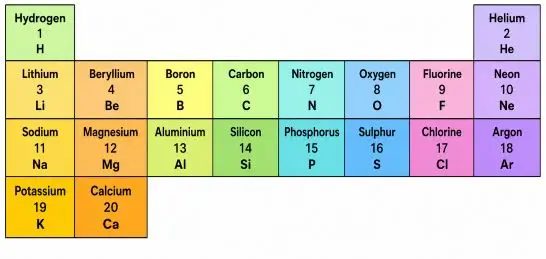
(a) Which element has the largest size ?
(b) Name the most non metallic element.
(c) Name the element with the lowest ionization potential.
(d) Write the formula of the sulphate of the element with atomic no. 13.
(e) What is the electronic configuration of the element in the fourth period that forms a dipositive ion ?
(f) Write the formula of the phosphate of the element in fourth period, second group.
Answer:
(a) Potassium (K).
(b) Fluorine (F).
(c) Potassium (K).
(d) The formula is Al2(SO4)3.
(e) The electronic configuration is 2, 8, 8, 2.
(f) The formula is Ca3(PO4)2.
Download Free Selina Concise Chemistry Class 10 Periodic Table Solutions PDF
Download the free PDF of Selina Concise Chemistry Class 10 Chapter 1 – Periodic Table, Periodic Properties and Variations of Properties Solutions for convenient offline study. These expert-prepared solutions offer clear explanations and accurate answers to help students revise effectively and excel in ICSE exams.
Importance of Selina Solutions
Selina Solutions are designed according to the latest ICSE syllabus and examination pattern. They help students:
- Understand difficult concepts in a simple manner.
- Learn the correct method of answering board exam questions.
- Improve problem-solving skills.
- Revise important topics effectively.
- Prepare confidently for school tests and board examinations.
Conclusion
The chapter Periodic Table, Periodic Properties and Variations of Properties is fundamental for mastering Chemistry. By studying these Selina Solutions regularly, students can build a strong conceptual foundation and perform exceptionally well in their ICSE Class 10 examinations.
You can also visit:
ICSE Class 10 Chemistry Selina Solutions
| ☛ ICSE Class 10 Chemistry Chapter 1 – Periodic Table Selina Solutions |
| ☛ ICSE Class 10 Chemistry Chapter 2 – Chemical Bonding Selina Solutions |
| ☛ ICSE Class 10 Chemistry Chapter 3 – Acids, Bases and Salts Selina Solutions |
| ☛ ICSE Class 10 Chemistry Chapter 4 – Analytical Chemistry Selina Solutions |
| ☛ ICSE Class 10 Chemistry Chapter 5 – Mole Concept and Stoichiometry Selina Solutions |
| ☛ ICSE Class 10 Chemistry Chapter 6 – Electrolysis Selina Solutions |
| ☛ ICSE Class 10 Chemistry Chapter 7 – Metallurgy Selina Solutions |
| ☛ ICSE Class 10 Chemistry Chapter 8 – Hydrogen Chloride Selina Solutions |
| ☛ ICSE Class 10 Chemistry Chapter 9 – Ammonia Selina Solutions |
| ☛ ICSE Class 10 Chemistry Chapter 10 – Nitric Acid Selina Solutions |
| ☛ ICSE Class 10 Chemistry Chapter 11 – Sulphuric Acid Selina Solutions |
| ☛ ICSE Class 10 Chemistry Chapter 12 – Organic Chemistry Selina Solutions |
Official Websites