Introduction
The chapter Periodic Table, Periodic Properties and Variations of Properties is one of the most important chapters in ICSE Class 10 Chemistry. Every year, questions based on periodic trends, electronic configuration, atomic radius, ionization potential, electron affinity, electronegativity, and chemical reactivity appear in the board examination. Practicing previous year questions helps students understand the examination pattern and improve their problem-solving skills.
Study Support by Rohit Academy
Rohit Academy offers expert-curated ICSE Class 10 Chemistry Study Materials including ICSE Periodic Table Previous Year Questions, diagrams, and key formulas for better understanding.
Study materials related to chapter 1 : Periodic Table
| ☛ ICSE Class 10 Chemistry Chapter 1: Periodic Table Notes |
| ☛ ICSE Class 10 Chemistry Chapter 1: Periodic Table Selina Solutions |
ICSE Class 10 Chemistry Periodic Table: Previous Year Questions
Question 1
A group of elements in the Periodic Table are given below (boron is the first member of the group and thallium is the last). [ICSE 2007]
Boron, Aluminium, Gallium, Indium, Thallium
Answer the following questions in relation to the above group of elements:
(a) Which element has the most metallic character?
(b) Which element would be expected to have the highest electronegativity?
(c) If the electronic configuration of aluminium is 2, 8, 3, how many electrons are there in the outer shell of thallium?
(d) The atomic number of boron is 5. Write the chemical formula of the compound formed when boron reacts with chlorine.
(e) Will the elements in the group to the right of this boron group be more metallic or less metallic in character? Justify your answer.
Answer:
(a) Thallium (Tl)
(b) Boron (B)
(c) 3 electrons
(d) BCl3
(e) They will be less metallic because metallic character decreases from left to right across a period due to increasing nuclear charge and decreasing atomic size.
Question 2
With reference to the variation of properties in the Periodic Table, which of the following is generally true?
(a) Atomic size increases from left to right across a period.
(b) Ionization potential increases from left to right across a period.
(c) Electron affinity increases going down a group.
(d) Electro-negativity increases going down a group. [ICSE 2008]
Answer:
(b) Ionization potential increases from left to right across a period.
Explanation:
Across a period, atomic size decreases and nuclear charge increases, making electron removal more difficult.
Question 3
The following questions refer to the Periodic Table:
(a) Name the first and last element in period 2.
(b) What happens to the atomic size of elements moving from top to bottom of a group?
(c) Which of the elements has the greatest electron affinity among the halogens?
(d) What is the common feature of the electronic configurations of the elements in group 17? [ICSE 2008]
Answer:
(a) First and last element in period 2:
- First element: Lithium (Li)
- Last element: Neon (Ne)
(b) Atomic size increases from top to bottom in a group.
Reason: New electron shells are added as we move down the group.
(c) Chlorine (Cl)
Reason: Chlorine has the highest electron affinity among the halogens.
(d) All Group 17 elements have seven electrons in their outermost shell.
Question 4
Supply the missing word from those in the brackets (Do not write out the sentence)
(a) If an element has a low ionization energy then it is likely to be ……………. (metallic/non-metallic).
(b) If an element has seven electrons in its outermost shell then it is likely to have the ……………. (largest/smallest) atomic size among all the elements in the same period. [ICSE 2008]
Answer:
(a) If an element has a low ionization energy then it is likely to be metallic.
(b) If an element has seven electrons in its outermost shell then it is likely to have the smallest atomic size among all the elements in the same period.
Question 5
(a) The metals of Group 2 from top to bottom are: Be, Mg, Ca, Sr, Ba. Which of these metals will form, ions most readily and why?
(b) What property of an element is measured by electronegativity? [ICSE 2008]
Answer:
(a) Barium (Ba)
Reason: It has the largest atomic size and the lowest ionisation energy among the given elements, so it loses electrons most easily.
(b) Electronegativity measures the tendency of an atom to attract the shared pair of electrons towards itself in a chemical bond.
Question 6
Choose the correct option:-
Among the period 2 elements the one which has high electron affinity is: [ICSE 2009]
(a) Lithium (b) Carbon
(c) Fluorine (d) Neon
Answer:
(c) Fluorine
Explanation:
Fluorine readily gains one electron to complete its
octet and therefore has very high electron affinity.
Question 7
In the table below, H does not represent hydrogen. Some elements are given in their own symbol and position in the periodic table while others are shown with a letter. [ICSE 2009]
| 1A 1 | IIA 2 | IIIA 13 | IVA 14 | VA 15 | VIA 16 | VIIA 17 | O 18 |
| Li | D | Si | O | J | Ne | ||
| A | Mg | E | F | H | K | ||
| B | C | G | L |
(a) Which is most electronegative?
(b) How many valence electrons are present in G?
(c) Write the formula of the compound between B and H.
(d) In the compound between F and J, what type of bond will be formed?
(e) Draw the electron dot structure for the compound formed between C and K.
Answer:
(a) J is the most electronegative element.
(b) 5 valence electrons present in G.
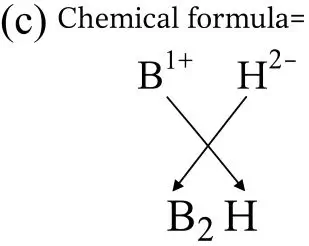
(d) Covalent bond
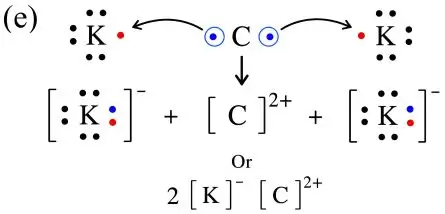
Question 8
Define ionization potential. [ICSE 2009]
Answer:
Ionization potential is the minimum amount of energy required to remove the most loosely bound electron from an isolated gaseous atom to form a positive ion.
Question 9
The number of electrons present in the valence shell of a halogen is: [ICSE 2010]
(A) 1 (B) 3
(C) 5 (D) 7
Answer:
(D) 7
Question 10
Electronegativity across the period ……… [increases/decreases]. [ICSE 2010]
Answer:
Increases
Question 11
Non-metallic character down the group ………… [increases/decreases]. [ICSE 2010]
Answer:
Decreases
Question 12
Define the following terms:
(i) Ionization potential.
(ii) Electron affinity. [ICSE 2010]
Answer:
(i) Ionization potential:
The minimum energy required to remove an electron from an isolated gaseous atom.
(ii) Electron affinity:
The amount of energy released when an electron is added to an isolated gaseous atom to form a negative ion.
Question 13
An element has an atomic number 16. State:
(i) The period to which it belongs.
(ii) The number of valence electrons.
(iii) Whether it is a metal or non-metal. [ICSE 2010]
Answer:
(i) Period: 3
(ii) Valence electrons: 6
(iii) Nature: Non-metal
Question 14
Give reasons:- The oxidising power of elements increases from left to right along a period. [ICSE 2011]
Answer:
Across a period, electronegativity and electron affinity increase. Therefore, elements gain electrons more readily and their oxidising power increases.
Question 15
Choose the correct answer: [ICSE 2011]
(i) Across a period, the ionisation potential ……… [increases, decreases, remains the same]
(ii) Down the group, electron affinity ………… [increases, decreases, remains the same]
Answer:
(i) Increases
(ii) Decreases
Question 16
Choose the correct answer:
(i) In the periodic table, alkali metals are placed in group:
(A) 1 (B) 11
(C) 17 (D) 18
(ii) Which of the following properties do not match with elements of the halogen family?
(a) They have seven electrons in their valence shell.
(b) They are highly reactive chemically.
(c) They are metallic in nature.
(d) They are diatomic in their molecular form. [ICSE 2011]
Answer:
(i) (A) 1
(ii) (c) They are metallic in nature
Question 17
State the group and period of the element having three shells with three electrons in the valence shell. [ICSE 2011]
Answer:
- Period: 3 (because it has 3 shells)
- Group: 13 (IIIA) (because it has 3 valence electrons)
Question 18
Choose the correct answer: [ICSE 2012]
(i) An element in period 3 whose electron affinity is zero.
(A) Neon (C) Sulphur
(B) Sodium (D) Argon
(ii) An alkaline earth metal.
(A) Potassium (B) Calcium
(C) Lead (D) Copper
Answer:
(i) (D) Argon
(ii) (B) Calcium
Question 19
Give reasons:- [ICSE 2012]
(i) Ionisation potential of the element increases across a period.
(ii) Alkali metals are good reducing agents.
Answer:
(i) Across a period, atomic size decreases and nuclear charge increases. As a result, electrons are held more strongly, requiring more energy for removal.
(ii) Alkali metals have one valence electron and very low ionisation energy. They lose electrons easily and thus act as strong reducing agents.
Question 20
Name:- A metal present in period 3, group 1 of the periodic table. [ICSE 2012]
Answer:
Sodium (Na)
Question 21
There are three elements E, F, G with atomic numbers 19, 8, and 17 respectively. Classify the elements as metals and non metals. [ICSE 2012]
Answer:
The electronic configurations of the given elements are:
- E (Atomic Number 19): 2, 8, 8, 1 → Metal
- F (Atomic Number 8): 2, 6 → Non-metals
- G (Atomic Number 17): 2, 8, 7 → Non-metals
Question 22
Identify the underlined substance:-
The element which has the highest ionization potential. [ICSE 2013]
Answer:
Helium (He)
Question 23
Choose the correct answer: [ICSE 2013]
Among the period 2 elements, the element which has high electron affinity is:
(A) Lithium (B) Carbon
(C) Chlorine (D) Fluorine
Answer:
(D) Fluorine
Question 24
In the below table, H does not represent hydrogen. Some elements are given in their own symbol and position in the periodic table while others are shown with a letter. Answer the following questions. [ICSE 2013]
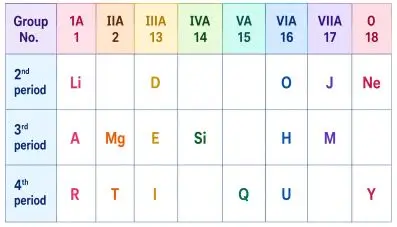
(a) Identify the most electronegative element.
(b) Identify the most reactive element of Group I.
(c) Identify the element from Period 3 with least atomic size.
(d) How many valence electrons are present in Q?
(e) Which element from group 2 would have the least ionisation energy?
(f) Identify the noble gas of the fourth period.
(g) In the compound between A and H, what type of bond would be formed and give its molecular formula?
(h) Identify: The element which has the highest ionisation potential.
Answer:
(a) J (Fluorine) is the most electronegative element.
(b) R (Potassium) is the most reactive element in Group I.
(c) M (Chlorine) has the least atomic size in Period 3.
(d) 5 valence electrons, because Q belongs to Group VA (15).
(e) T (Calcium), since ionisation energy decreases down the group.
(f) Y (Krypton)
(g) Bond formed: Ionic (electrovalent) bond
Formula: A2H
(h) Ne (Neon), because noble gases have the highest ionisation potential in their periods.
Question 25
| X | Y | |
| Normal Electronic Configuration | 2, 8, 7 | 2, 8, 2 |
.………. is the metallic element. [ICSE 2013]
Answer:
Y is the metallic element because it has 2 valence electrons and readily loses them.
Question 26
Choose the correct answer:- [ICSE 2014]
(i) Ionisation Potential increases over a period from left to right because the:
(a) Atomic radius increases and nuclear charge increases
(b) Atomic radius decreases and nuclear charge decreases
(c) Atomic radius increases and nuclear charge decreases
(d) Atomic radius decreases and nuclear charge increases.
(ii) If an element A belongs to Period 3 and Group II then it will have:
(a) 3 shells and 2 valence electrons
(b) 2 shells and 3 valence electrons
(c) 3 shells and 3 valence electrons
(d) 2 shells and 2 valence electrons
Answer:
(i) (d) Atomic radius decreases and nuclear charge increases.
(ii) (a) 3 shells and 2 valence electrons
Question 27
An element Z has atomic number 16. Answer the following questions on Z: [ICSE 2014]
(i) State the period and group to which Z belongs.
(ii) Is Z a metal or a non-metal?
(iii) State the formula between Z and Hydrogen.
(iv) What kind of a compound is this?
Answer:
(i) Period: 3, Group: 16 (VIA)
(ii) Non-metal
(iii) Formula with hydrogen: H2Z
(iv) It is a covalent compound.
Question 28
M is a metal above hydrogen in the activity series and its oxide has the formula M2O. This oxide when dissolved in water forms the corresponding hydroxide which is a good conductor of electricity. In the above context answer the following:
(i) What kind of combination exists between M and O?
(ii) How many electrons are there in the outermost shell of M?
(iii) Name the group to which M belongs. [ICSE 2014]
Answer:
(i) Ionic (electrovalent) bond
(ii) 1 electron in the outermost shell
(iii) Group 1 (Alkali metals)
Question 29
Match the options A and B with the statements (i) and (ii): [ICSE 2014]
| A. metal | (i) The metal that forms two types of ions |
| B. iron | (ii) An element with electronic configuration 2, 8, 8, 3 |
Answer:
(i) The metal that forms two types of ions → B (Iron)
(ii) An element with electronic configuration 2,8,8,3 → A (Metal)
Question 30
Give one word or phrase for:-
The amount of energy released when an atom in the gaseous state accepts an electron to form an anion. [ICSE 2014]
Answer:
Electron affinity
Question 31
Choose the correct answer:-
Among the elements given below, the element with the least electronegativity is: [ICSE 2015]
(A) Lithium (B) Carbon
(C) Boron (D) Fluorine
Answer:
(A) Lithium
Question 32
The metals of Group 2 from top to bottom are Be, Mg, Ca, Sr and Ba. [ICSE 2015]
(i) Which one of these elements will form ions most readily and why?
(ii) State the common feature in the electronic configuration of all these elements.
Answer:
(i) Barium (Ba) because it has the largest atomic size and lowest ionization energy in the group.
(ii) All have 2 electrons in their outermost shell.
Question 33
Arrange the following as per the instructions given in the brackets:
(i) Cs, Na, Li, K, Rb (increasing order of metallic character)
(ii) Mg, Cl, Na, S, Si (decreasing order of atomic size)
(iii) Na, K, Cl, S, Si (increasing order of ionization energy)
(iv) Cl, F, Br, I (increasing order of electron affinity) [ICSE 2015]
Answer:
(i) Li < Na < K < Rb < Cs
(ii) Na > Mg > Si > S > Cl
(iii) K < Na < Si < S < Cl
(iv) I < Br < F < Cl
Question 34
Metals are good ………. (oxidizing agents/reducing agents) because they are electron ……….. (acceptors/donors). [ICSE 2016]
Answer:
Metals are good reducing agents because they are electron donors.
Question 35
An element with the atomic number 19 will most likely combine chemically with the element whose atomic number is: [ICSE 2016]
(A) 17 (B) 11
(C) 18 (D) 20
Answer:
(A) 17
Question 36
Use the letters only written in the Periodic Table given below to answer the questions that follow:
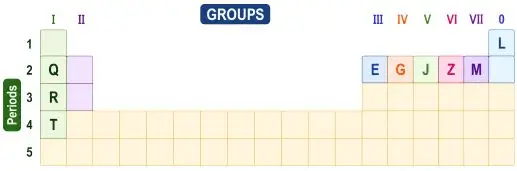
(i) State the number of valence electrons in atom J.
(ii) Which element shown forms ions with a single negative charge?
(iii) Which metallic element is more reactive than R?
(iv) Which element has its electrons arranged in four shells? [ICSE 2016]
Answer:
(i) Atom J has 5 valence electrons because it belongs to Group V (15) of the periodic table.
(ii) M forms ions with a single negative charge (-1) because it has 7 electrons in its outermost shell and gains one electron to attain a stable octet configuration.
(ii) T is more reactive than R because both belong to the same group, and the reactivity of metals increases down the group.
(iv) T has its electrons arranged in four shells because it belongs to the 4th period of the periodic table.
Question 37
Rewrite the following sentences by using the correct symbol > (greater than) or < (less than) in the blanks given:
(i) The ionization potential of Potassium is ………. that of Sodium.
(ii) The electronegativity of Iodine is ………… that of Chlorine. [ICSE 2016]
Answer:
(i) Potassium < Sodium
(ii) Iodine < Chlorine
Question 38
Fill in the blanks by selecting the correct word from the brackets:
(i) If an element has a low ionization energy then it is likely to be …………. (metallic/non metallic).
(ii) If an element has seven electrons in its outermost shell then it is likely to have the ……….. (largest/smallest) atomic size among all the elements in the same period. [ICSE 2016]
Answer:
(i) Metallic
(ii) Smallest
Question 39
Identify the term:- The electrons present in the outermost shell of an atom. [ICSE 2016]
Answer:
Valence electrons
Question 40
The energy required to remove an electron from a neutral isolated gaseous atom and convert it into a positively charged gaseous ion is called ………. (electron affinity, ionisation potential, electronegativity) [ICSE 2017]
Answer:
Ionisation potential
Question 41
Match the atomic number 2,4, 8,15, and 19 with each of the following:
(i) A solid non-metal belonging to the third period.
(ii) A metal of valency 1.
(iii) A gaseous element with valency 2.
(iv) An element belonging to Group 2.
(v) A rare gas. [ICSE 2017]
Answer:
(i) A solid non-metal belonging to the third period: 15
(ii) A metal of valency 1: 19
(iii) A gaseous element with valency 2: 8
(iv) An element belonging to Group 2: 4
(v) A rare gas: 2
Question 42
Arrange the following as per the instruction given in the brackets:
(i) He, Ar, Ne (Increasing order of the number of electron shells)
(ii) Na, Li, K (Increasing Ionisation Energy)
(iii) F, Cl, Br (Increasing electronegativity)
(iv) Na, K, Li (Increasing atomic size) [ICSE 2017]
Answer:
(i) He < Ne < Ar
(ii) K < Na < Li
(iii) Br < Cl < F
(iv) Li < Na < K
Question 43
Give one word or a phrase for:
The energy released when an electron is added to a neutral gaseous isolated atom to form a negatively charged ion. [ICSE 2018]
Answer:
Electron affinity
Question 44
Give a reason for each of the following:
(i) Inert gases do not form ions.
(ii) Ionisation potential increases across a period, from left to right.
(iii) Alkali metals are good reducing agents. [ICSE 2018]
Answer:
(i) They have a completely filled valence shell and are therefore stable.
(ii) Atomic size decreases and nuclear charge increases, making electron removal more difficult.
(iii) They readily lose their single valence electron.
Question 45
In Period 3 of the Periodic Table, element B is placed to the left of element A.
On the basis of this information, choose the correct word from the brackets to complete the following statements:
(i) The element B would have (lower/higher) metallic character than A.
(ii) The element A would probably have (lesser/higher) electron affinity than B.
(iii) The element A would have (greater / smaller) atomic size than B. [ICSE 2018]
Answer:
(i) Higher
(ii) Higher
(iii) Smaller
Question 46
The most electronegative element from the following elements is: [ICSE 2019]
(A) Magnesium (B) Chlorine
(C) Aluminium (D) Sulphur
Answer:
(B) Chlorine
Question 47
In Period 3, the most metallic element is …………….. (sodium / magnesium / aluminium) [ICSE 2019]
Answer:
Sodium
Question 48
Arrange the following according to the instructions given in brackets: [ICSE 2019]
(i) K, Pb, Ca, Zn. (In the increasing order of the reactivity)
(ii) Li, K, Na, H (In the decreasing order of their ionization potential)
(iii) F, B, N, O (In the increasing order of electron affinity)
Answer:
(i) Pb < Zn < Ca < K
(ii) H > Li > Na > K
(iii) Be < N < B < F
Question 49
Study the extract of the Periodic Table given below and answer the questions that follow. Give the alphabet corresponding to the element in question.
DO NOT repeat an element. [ICSE 2019]
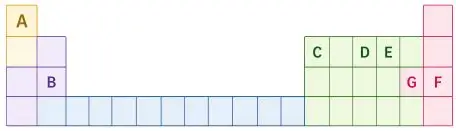
(i) Which element forms electrovalent compound with G?
(ii) The ion of which element will migrate towards the cathode during electrolysis?
(iii) Which non-metallic element has the valency of 2?
(iv) Which is an inert gas? [ICSE 2019]
Answer:
(i) B forms an electrovalent (ionic) compound with G because B is a metal, whereas G is a non-metal.
(ii) A forms positive ions (cations), which migrate towards the cathode during electrolysis.
(iii) E is a non-metal with a valency of 2 because it belongs to Group 16 (VIA) of the periodic table.
(iv) F is an inert gas because it belongs to Group 18 (Zero Group) and has a completely filled outermost shell.
Question 50
Choose the correct answer:
The element with highest ionization potential is :
(A) Hydrogen (B) Caesium
(C) Radon (D) Helium [ICSE 2020]
Answer:
(D) Helium
Question 51
The tendency of an atom to attract electrons to itself when combined in a compound. [Give on word or phrase] [ICSE 2020]
Answer:
Electronegativity
Question 52
The following table represent the element and atomic number. With reference to this, answer the following using only the alphabets given in the table.
| Element | Atomic Number |
| P | 13 |
| Q | 7 |
| R | 10 |
(i) Which element combines with hydrogen to form a basic gas?
(ii) Which element has an electron affinity zero? [ICSE 2020]
Answer:
(i) Q (Nitrogen forms NH3, a basic gas)
(ii) R (Neon has electron affinity zero)
Question 53
Name the elements: an alkaline earth metal present in group 2 and period 3. [ICSE 2020]
Answer:
Magnesium (Mg)
Question 54
In the periodic Table, elements of period 3 are arranged in the increasing order of ionization potential as:
(a) B, N, Cl, Ar (b) Mg, Si, S, Ar
(c) Ar, Si, S, Mg (d) Si, Ar, Cl, Mg [ICSE 2021 Sem 1]
Answer:
(b) Mg, Si, S, Ar
Question 55
The tendency of an atom to attract shared pair of electrons to itself when forming a chemical bond is known as: [ICSE 2021 Sem 1]
(a) Electron affinity (b) Electronegativity
(c) Ionization potential (d) Nuclear charge
Answer:
(b) Electronegativity
Question 56
Elements A and B have electronic configurations 8 and 13 respectively. The chemical formula formed between A and B will be: [ICSE 2021 Sem 1]
(a) AB (b) B3A3
(c) A2B3 (d) B2A3
Answer:
(d) B2A3
Question 57
Alkaline earth metals have the same: [ICSE 2021 Sem 1]
(a) number of valence electrons
(b) number of shells
(c) metallic property
(d) ionization potential
Answer:
(a) Number of valence electrons
Question 58
Element with an atomic number 19 will:
(a) accept an electron and get oxidized
(b) accept an electron and get reduced
(c) lose an electron and get oxidized
(d) lose an electron and get reduced [ICSE 2021 Sem 1]
Answer:
(c) Lose an electron and get oxidized
Question 59
If an element has low ionization potential, then it is likely to be a: [ICSE 2021 Sem 1]
(a) metal (b) metalloid
(c) non metal (d) inert gas
Answer:
(a) Metal
Question 60
Which one of the following Is a non-metallic cation? [ICSE 2021 Sem 1]
(a) K+ (b) NH4+
(c) Cu2+ (d) Na+
Answer:
(b) NH4+
Question 61
The non-metallic properties of elements from left to right In a Periodic Table: [ICSE 2021 Sem 1]
(a) Increases
(b) decreases
(c) remains same
(d) first increases and then decreases
Answer:
(a) Increases
Question 62
The basic oxide which Is an alkali:
(a) Copper oxide (b) Sodium oxide
(c) Ferric oxide (d) Zinc oxide [ICSE 2021 Sem 1]
Answer:
(b) Sodium oxide
Question 63
The table below shows the electronic arrangements of six atoms, A to F.
| Atom | Electronic Configuration |
| A | 2, 5 |
| B | 2 |
| C | 2, 6 |
| D | 2, 8, 6 |
| E | 2, 8, 8 |
| F | 2, 8, 3 |
With respect to the table select the following: [ICSE 2021 Sem 1]
(i) Two atoms from the same group of the periodic table:
(a) D and E (b) C and D
(c) E and F (d) C and E
(ii) Two noble gases:
(a) A and B (b) E and F
(c) B and E (d) D and E
(iii) The atom which is the most electronegative:
(a) A (b) B
(c) C (d) F
(iv) The atom which has the highest ionization potential
(a) A (b) B
(c) E (d) F
Answer:
(i) (b) C and D
(ii) (c) B and E
(iii) (c) C
(iv) (b) B
Question 64
An element in period 3, whose electron affinity is zero: [ICSE 2023]
(a) Neon (b) Sulphur
(c) Sodium (d) Argon
Answer:
(d) Argon
Question 65
An element with the largest atomic radius among the following is: [ICSE 2023]
(a) Carbon (b) Nitrogen
(c) Lithium (d) Beryllium
Answer:
(c) Lithium
Question 66
Metals are good …………… [oxidizing agents/reducing agents] [ICSE 2023]
Answer:
Reducing agents
Question 67
Arrange the following as per the instruction given in the brackets: [ICSE 2023]
(a) Al, K, Mg, Ca (decreasing order of its reactivity)
(b) N, Be, O, C (increasing order of non-metallic character)
(c) P, Si, F, Be (decreasing order of valence electrons)
Answer:
(a) K > Ca > Mg > Al
(b) Be < C < N < O
(c) F > P > Si > Be
Question 68
Define: Electronegativity [ICSE 2023]
Answer:
The tendency of an atom in a molecule to attract the shared pair of electrons towards itself.
Question 69
Give reason: lonisation potential decreases down a group. [ICSE 2023]
Answer:
Ionisation potential decreases down a group because atomic size increases and the outermost electron is farther from the nucleus, making it easier to remove.
Question 70
Choose the correct answer:- [ICSE 2024]
(i) In the 2nd period, Neon has maximum Ionisation Potential because:
(a) It has unstable electronic configuration.
(b) It easily accepts electrons.
(c) It easily loses electrons.
(d) The outer most shell is completely filled.
(ii) Electron Affinity is maximum in:
(a) Mg (b) Ar
(c) Li (d) Br
Answer:
(i) (d) The outermost shell is completely filled
(ii) (d) Br
Question 71
Arrange the following as per the instructions given in the brackets: [ICSE 2024]
(a) Carbon, Fluorine, Beryllium (decreasing order of atomic size)
(b) Potassium, Lithium, Sodium (increasing order of ionisation potential)
Answer:
(a) Be > C > F
(b) K < Na < Li
Question 72
Identify the following: [ICSE 2024]
(a) An element in period 1 which can be placed in both group 1 and group 17 of the periodic Table.
(b) The element having electronic configuration 2, 8, 6.
(c) The most electronegative element of period 3.
Answer:
(a) Hydrogen
(b) Sulphur
(c) Chlorine
Question 73
Assertion (A) : The tendency of losing electrons increases down the Group.
Reason (R) : The most reactive metal is placed at the top of Group 1.
(a) Both (A) and (R) are true, and (R) is the correct explanation of (A).
(b) Both (A) and (R) are true, and (R) is not the correct explanation of (A).
(c) (A) is true but (R) is false.
(d) (A) is false but (R) is true. [ICSE 2025]
Answer:
(c) (A) is true but (R) is false.
Reason: In Group 1, the most reactive metal is at the bottom of the group, not at the top.
Question 74
Given below are four ions: [ICSE 2025]
Cl–, Li+, Al3+, K+
Identify the pair of ions which have the same electronic configuration.
[Atomic number : Cl = 17, Li = 3, Al = 13, K = 19]
(a) Cl– & Li+ (b) Al3+ & K+
(c) Cl– & K+ (d) Li+ & K+
Answer:
(c) Cl– & K+
Question 75
X, Y & Z are three metallic atoms in successive order belonging to the same group such that atomic radii of ‘X’ is the smallest. Which of the three atoms is the best reducing agent? [ICSE 2025]
(a) X
(b) Y
(c) Z
(d) All three have the same reducing power.
Answer:
(c) Z
Reason: Reducing power increases down a group because atoms lose electrons more readily.
Question 76
The atomic number of two atoms ‘X’ and ‘Y’ are 14 and 8 respectively: [ICSE 2025]
State
(a) the period to which ‘X’ belongs.
(b) the formula of the compound formed between ‘X’ and ‘Y’.
(Do not identify X and Y)
Answer:
(a) Period 3
(b) XY2
Question 77
The oxidation of X forms an ion according to the equation: [ICSE 2026]
X → X2+
The atomic number of the atom X is:
(a) 16 (b) 10
(c) 12 (d) 14
Answer:
(c) 12
Question 78
Elements P, Q and R are in the same period of the modern periodic table.
- P readily loses its one valence electron to form a stable ion.
- Q shares its electrons in bonding but does not form ions easily.
- R has high electronegativity.
Answer the following questions based on the above information:
(a) Which element would be most difficult to reduce among P, Q and R?
(b) Which element is expected to have the smallest atomic radius among P, Q and R?
(c) Arrange P, Q and R in order of decreasing ionization potential. [ICSE 2026]
Answer:
(a) P
(b) R
(c) R > Q > P
Question 79
Given below are a few elements:
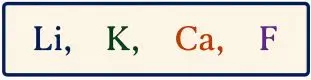
Identify the element which:
(a) has the least atomic radius.
(b) has two valence electrons.
(c) is the most electropositive. [ICSE 2026]
Answer:
(a) Least atomic radius: F (Fluorine)
(b) Two valence electrons: Ca (Calcium)
(c) Most electropositive: K (Potassium)
Download ICSE Class 10 Chemistry Periodic Table Previous Year Questions PDF
Access our free PDF featuring important board exam questions and answers from the Periodic Table chapter. Perfect for revision, self-assessment, and scoring higher marks in ICSE Class 10 Chemistry.
Why Practice Previous Year Questions?
- Understand the ICSE examination pattern.
- Identify frequently asked concepts.
- Improve time management skills.
- Strengthen conceptual understanding of periodic trends.
- Increase confidence for board examinations.
ICSE Examination Tips
- Learn all periodic trends thoroughly.
- Practice reasoning-based questions regularly.
- Memorize the characteristics of Groups 1, 2, 17, and 18.
- Revise definitions of ionization potential, electron affinity, and electronegativity.
- Solve previous 10 years’ board questions before the examination.
Conclusion
Periodic Table and Periodic Properties form the foundation of Chemistry in ICSE Class 10. Regular practice of previous year questions helps students master concepts, improve accuracy, and score high marks in board examinations. Focus on periodic trends, reasoning questions, and group characteristics for effective exam preparation.
You can also visit :
ICSE Class 10 Chemistry Important Previous Year Questions
| ☛ ICSE Class 10 Chemistry Chapter 1 – Periodic Table Previous Year Questions |
| ☛ ICSE Class 10 Chemistry Chapter 2 – Chemical Bonding Previous Year Questions |
| ☛ ICSE Class 10 Chemistry Chapter 3 – Acids, Bases and Salts Previous Year Questions |
| ☛ ICSE Class 10 Chemistry Chapter 4 – Analytical Chemistry Previous Year Questions |
| ☛ ICSE Class 10 Chemistry Chapter 5 – Mole Concept and Stoichiometry Previous Year Questions |
| ☛ ICSE Class 10 Chemistry Chapter 6 – Electrolysis Previous Year Questions |
| ☛ ICSE Class 10 Chemistry Chapter 7 – Metallurgy Previous Year Questions |
| ☛ ICSE Class 10 Chemistry Chapter 8 – Hydrogen Chloride Previous Year Questions |
| ☛ ICSE Class 10 Chemistry Chapter 9 – Ammonia Previous Year Questions |
| ☛ ICSE Class 10 Chemistry Chapter 10 – Nitric Acid Previous Year Questions |
| ☛ ICSE Class 10 Chemistry Chapter 11 – Sulphuric Acid Previous Year Questions |
| ☛ ICSE Class 10 Chemistry Chapter 12 – Organic Chemistry Previous Year Questions |
Official Websites