Introduction
The Periodic Table is one of the most important chapters in ICSE Class 10 Chemistry. It helps students understand the arrangement of elements and the periodic trends in their physical and chemical properties. Knowledge of periodic properties such as atomic size, ionization potential, electron affinity, and electronegativity is essential for scoring well in board examinations.
In this article, you can access comprehensive ICSE Class 10 Chemistry Periodic Table, Periodic Properties and Variations of Properties Notes PDF for quick revision and exam preparation.
Study Support by Rohit Academy
Rohit Academy offers expert-curated ICSE Class 10 Chemistry Study Materials including ICSE Periodic Table Notes, diagrams, and key formulas for better understanding.
Study materials related to chapter 1 : Periodic Table
| ☛ ICSE Class 10 Chemistry Chapter 1: Periodic Table Selina Solutions |
| ☛ ICSE Class 10 Chemistry Chapter 1: Periodic Table Previous Year Questions |
Periodic Table | ICSE Class 10 Chemistry Notes
Döbereiner’s Triads
Dobereiner stated in his law of triads that the atomic mass of the middle element was the arithmetic mean of others two.
Example: \({_{20}^{40}}Ca,\ \ {_{38}^{88}}Sr,\ {_{56}^{137}}Ba\ \ and\ \ {_{17}^{35}}Cl,\ {_{35}^{80}}Br,\ \ {_{53}^{127}}I\).
Newlands’ Law of Octaves
Newlands arranged elements in increasing order of atomic mass and observed that every eighth element had properties similar to the first element.
Mendeleev’s Periodic Table
Mendeleev arranged elements according to increasing atomic masses.
Mendeleev’s Periodic Law
“The properties of elements are periodic functions of their atomic masses.”
Achievements of Mendeleev
- Arranged 63 known elements systematically.
- Left gaps for undiscovered elements.
- Predicted properties of unknown elements.
Limitations
- Position of isotopes could not be explained.
- Position of hydrogen was uncertain.
- Rare earth elements were not properly accommodated.
Modern Periodic Table
- The modern periodic table is arranged according to the increasing order of atomic number.
- It consists of:
- 18 vertical columns called Groups
- 7 horizontal rows called Periods
Periodic Table
A tabular arrangement of elements in groups (vertical columns) and periods (horizontal rows) showing regular trends in their properties is called the Periodic Table.
Salient Features of the Modern Periodic Table
Groups
The modern periodic table contains 18 vertical columns called groups.
Important Characteristics
- Elements in the same group have the same number of valence electrons.
- Therefore, they show similar chemical properties.
Group 1 – Alkali Metals
- Li, Na, K, Rb, Cs, Fr
- Exception: Hydrogen is not an alkali metal.
- They form strong alkalis with water.
- Valency = 1
Group 2 – Alkaline Earth Metals
- Be, Mg, Ca, Sr, Ba, Ra
- Form weaker alkalis than Group 1.
- Valency = 2
Groups 3–12 – Transition Elements
- Metallic elements.
- Two outermost shells are incomplete.
Group 13 – Boron Family
- B, Al, Ga, In, Tl
Group 14 – Carbon Family
- C, Si, Ge, Sn, Pb
Group 15 – Nitrogen Family
- N, P, As, Sb, Bi
Group 16 – Oxygen Family (Chalcogens)
- O, S, Se, Te, Po
Group 17 – Halogens
- F, Cl, Br, I, At
- Salt-forming elements.
- Valency = 1
Group 18 – Noble Gases
- He, Ne, Ar, Kr, Xe, Rn, Og
- Outermost shell completely filled.
- Chemically inert.
Representative Elements
Elements of Groups 1, 2 and 13–18 are called:
- Main Group Elements
- Representative Elements
- Normal Elements
Periods
The modern periodic table contains 7 horizontal rows called periods.
Important Rule
Period Number = Number of Electron Shells
| Period | Number of Elements |
| 1st | 2 |
| 2nd | 8 |
| 3rd | 8 |
| 4th | 18 |
| 5th | 18 |
| 6th | 32 |
| 7th | 32 |
Relation Between Period and Shells
Rule
Number of shells = Period number
Examples
| Element | Electronic Configuration | Shells | Period |
| F | 2,7 | 2 | 2nd |
| Cl | 2,8,7 | 3 | 3rd |
| Br | 2,8,18,7 | 4 | 4th |
| I | 2,8,18,18,7 | 5 | 5th |
| At | 2,8,18,32,18,7 | 6 | 6th |
Periodicity
Definition
The recurrence of similar properties at regular intervals when elements are arranged in increasing order of atomic numbers is called Periodicity.
Cause of Periodicity
Periodicity occurs due to the repetition of similar electronic configurations, especially the same number of valence electrons.
Shells and Valency
Orbits (Shells)
Electrons revolve around the nucleus in definite circular paths called shells or orbits.
Number of Shells
Down a Group
- Number of shells increases.
Across a Period
- Number of shells remains constant.
Valency
Valency is the combining capacity of an atom.
Determination of Valency
| Valence Electrons | Valency |
| 1 | 1 |
| 2 | 2 |
| 3 | 3 |
| 4 | 4 |
| 5 | 3 |
| 6 | 2 |
| 7 | 1 |
| 8 | 0 |
Trends
Down a Group
- Valency remains the same.
Across a Period
- Valency increases from 1 to 4 and then decreases to 0.
Periodic Properties
Periodic properties are properties that show a gradual variation across a period and down a group.
Important periodic properties are:
- Atomic Size (Atomic Radius)
- Metallic Character
- Non-Metallic Character
- Ionisation Potential
- Electron Affinity
- Electronegativity
1. Atomic Size (Atomic Radius)
Atomic size is the distance between the centre of the nucleus and the outermost shell of an atom.
Trend in Atomic Size
(A) Down a Group (↓)
- Atomic size increases from top to bottom.
Reason
- New shells are added.
- Distance between nucleus and outermost shell increases.
Example
- Group 1: H < Li < Na < K < Rb < Cs
- Group 17: F < Cl < Br < I < At
(B) Across a Period (Left → Right)
- Atomic size decreases.
Reason
- Number of shells remains same.
- Nuclear charge increases.
- Electrons are pulled closer to the nucleus.
Example
- 3rd Period: Na > Mg > Al > Si > P > S > Cl
- 2nd Period: Li > Be > B > C > N > O > F
Important Exception
Noble Gases
Atomic size of noble gases is larger than that of the preceding halogens.
Example:
- F < Ne
- Cl < Ar
Reason
Noble gases have completely filled outermost shells causing maximum electron-electron repulsion.
Special Fact
Helium is the smallest atom in the periodic table.
Size of Ions
Cation (Positive Ion)
A cation is always smaller than its parent atom.
Example
Na → Na⁺
2,8,1 → 2,8
- Na+ < Na
- Mg2+ < mg
- Al3+ < Al
Reason
- Electron is lost.
- Nuclear pull on remaining electrons increases.
- Size decreases.
Anion (Negative Ion)
An anion is always larger than its parent atom.
Example
Cl → Cl–
2,8,7 → 2,8,8
- Cl– > Cl
- O2– > O
- F– > F
Reason
- Electron is gained.
- Electron-electron repulsion increases.
- Effective nuclear pull decreases.
- Size increases.
Isoelectronic Ions
Definition
Ions having the same number of electrons are called isoelectronic ions.
Example
Mg2+, Na+, F–, O2–
(All contain 10 electrons)
Rule
Greater nuclear charge → Smaller size
Increasing Order of Size
Mg2+ < Na+ < F– < O2–
2. Metallic Character
Definition
The tendency of an atom to lose electrons and form positive ions is called metallic character.
Metals are:
- Electropositive
- Good reducing agents
Examples
Na → Na⁺ + e⁻
Mg → Mg2+ + 2e⁻
Factors Affecting Metallic Character
(i) Atomic Size
- Larger atomic size → Greater metallic character
- Reason: Valence electrons are farther from nucleus and can be removed easily.
(ii) Nuclear Charge
- Greater nuclear charge → Lower metallic character
- Reason: Electrons are held more strongly.
Trend in Metallic Character
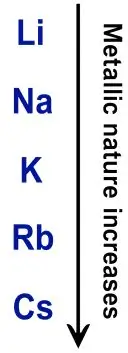
(a) Down a Group (↓)
- Metallic character increases.
Reason
- Atomic size increases.
- Electron loss becomes easier.
Example :
- 1st Group : Li < Na < K < Rb < Cs
- 2nd Group : Be < Mg < Ca < Sr < Ba < Ra
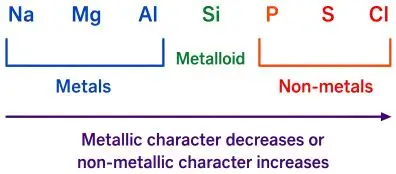
(b) Across a Period (Left → Right)
Metallic character decreases.
Reason
- Atomic size decreases.
- Nuclear charge increases.
- Electron loss becomes difficult.
Example:
- 2nd Period: Li > Be > B > C > N > O > F
- 3rd period : Na > Mg > Al > Si > P > S > Cl
3. Non-Metallic Character
Definition
The tendency of an atom to gain electrons.
Examples:
Cl + e– → Cl–
O + 2e– → O2–
Non-metals are:
- Electronegative
- Oxidising agents
Factors Affecting Non-Metallic Character
(i) Atomic Size
- Smaller atomic size → Greater non-metallic character
(ii) Nuclear Charge
- Greater nuclear charge → Greater non-metallic character
Trends in Non-Metallic Character
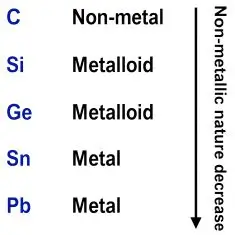
(A) Down a Group (↓)
Non-metallic character decreases.
Reason
- Atomic size increases.
- Attraction for incoming electrons decreases.
Examples:
- 14th Group: C > Si > Ge > Sn > Pb
- 17th Group: F > Cl > Br > I > At
(b) Across a Period (Left → Right)
Non-metallic character increases.
Reason
- Atomic size decreases.
- Nuclear pull increases.
- Tendency to gain electrons increases.
Example :
- 2nd Period: Li < Be < B < C < N < O < F
- 3rd period: Na < Mg < Al < Si < P < S < Cl
Nature of Oxides
(A) Across a Period (Left → Right)
- Basic → Amphoteric → Acidic
Example (3rd Period):
| Oxide | Nature |
| Na2O | Strongly Basic |
| MgO | Basic |
| Al2O3 | Amphoteric |
| SiO2 | Weakly Acidic |
| P2O5 | Acidic |
| SO3 | More Acidic |
| Cl2O7 | Most Acidic |
(B) Down a Group (↓)
- Basic character of metallic oxides increases.
Chemical Reactivity
Definition
Reactivity depends on the tendency of atoms to lose or gain electrons.
(A) Across a Period
- Metals
Reactivity decreases.
Na > Mg > Al > Si - Non-metals
Reactivity increases.
P < S < Cl
- Third Period Trend
Na → Mg → Al → Si → P → S → Cl - Most reactive metal = Na
- Least reactive = Si
- Most reactive non-metal = Cl
(B) Down a Group
- Metals
Reactivity increases.
Example:
Li < Na < K < Rb < Cs - Non-metals
Reactivity decreases.
Example:
F > Cl > Br > I
Gradation in Physical Properties
Melting and Boiling Points of Metals
Down a group:
- Melting point decreases.
- Boiling point decreases.
- Example: Li > Na > K
Melting and Boiling Points of Non-Metals
Down a group:
- Melting point increases.
- Boiling point increases.
- Example: F < Cl < Br < I
4. Ionisation Potential (Ionisation Energy)
Definition
Ionisation Potential (I.P.) is the minimum amount of energy required to remove the most loosely bound electron from an isolated gaseous atom and convert it into a positive ion.
Equation:
M(g) + I.E. → M⁺ (g) + e⁻
Unit
- kJ mol⁻¹
- eV/atom
Factors Affecting Ionisation Energy
1. Atomic Size
- Larger atomic size → Lower ionisation energy.
- Smaller atomic size → Higher ionisation energy.
2. Nuclear Charge
- Greater nuclear charge → Higher ionisation energy.
- Electrons are held more strongly by the nucleus.
Trend in Ionisation Energy
(A) Across a Period (Left → Right)
- Ionisation energy increases.
Reason:
- Atomic size decreases.
- Nuclear charge increases.
(B) Down a Group
- Ionisation energy decreases.
Reason:
- Atomic size increases.
- Valence electrons are farther from the nucleus.
Important Facts
- Helium has the highest ionisation energy.
- Caesium has one of the lowest ionisation energies.
- Metals generally have low ionisation energy.
- Non-metals generally have high ionisation energy.
5. Electron Affinity (E.A.)
Definition
Electron Affinity is the amount of energy released when an isolated gaseous atom gains an electron to form a negative ion.
Equation
X(g) + e⁻ → X⁻(g) + E.A.
Unit
- kJ mol⁻¹
- eV/atom
Factors Affecting Electron Affinity
(A) Atomic Size
- Smaller atomic size → Higher electron affinity.
(B) Nuclear Charge
- Greater nuclear charge → Higher electron affinity.
Trend in Electron Affinity
- Across a Period
Electron affinity generally increases. - Down a Group
Electron affinity generally decreases.
Important Exceptions
Halogens
Chlorine has higher electron affinity than fluorine.
Reason: Fluorine atom is extremely small, causing greater electron-electron repulsion.
Group 16
Sulphur has higher electron affinity than oxygen.
Key Facts
- Highest electron affinity among halogens: Chlorine.
- Noble gases have zero or positive electron affinity.
- Electron affinity is maximum in Group 17 elements.
6. Electronegativity (E.N.)
Definition
Electronegativity is the tendency of an atom in a molecule to attract the shared pair of electrons towards itself.
Factors Affecting Electronegativity
(i) Atomic Size
- Larger size → Lower electronegativity.
- Smaller size → Higher electronegativity.
(ii) Nuclear Charge
- Greater nuclear charge → Higher electronegativity.
Trends in Electronegativity
(A) Across a Period (Left → Right)
Electronegativity increases.
Example:
- 2nd Period: Li < Be < B < C < N < O < F
- 3rd Period: Na < Mg < Al < Si < P < S < Cl
(B) Down a Group (↓)
Electronegativity decreases.
Example:
17th Group : F > Cl > Br > I > At
Important Facts
- Fluorine is the most electronegative element.
- Metals have low electronegativity.
- Non-metals have high electronegativity.
Diagonal Relationship
Certain second-period elements show similarities with third-period elements placed diagonally below them.
Examples
| Period 2 | Period 3 |
| Li | Mg |
| Be | Al |
| B | Si |
These pairs are called Bridge Elements.
Summary of Periodic Trends
| Property | Down a Group (↓) | Across a Period (Left → Right) |
| Atomic Size | Increases | Decreases |
| Metallic Character | Increases | Decreases |
| Non-metallic Character | Decreases | Increases |
| Ionisation Energy | Decreases | Increases |
| Electron Affinity | Decreases | Increases |
| Electronegativity | Decreases | Increases |
| Reactivity of Metals | Increases | Decreases |
| Reactivity of Non-metals | Decreases | Increases |
| Number of Shells | Increases | Same |
| Valence Electrons | Same | Increase |
| Valency | Same | Increases then decreases |
Important fact:
- Group 1 → Alkali Metals
- Group 2 → Alkaline Earth Metals
- Group 17 → Halogens
- Group 18 → Noble Gases
- Most Electronegative Element → Fluorine
- Highest Electron Affinity → Chlorine
- Highest Ionisation Energy → Helium
- Smallest Atom → Helium
- Most Metallic Stable Element → Caesium
- Most Non-metallic Element → Fluorine
- Cation is smaller than parent atom.
- Anion is larger than parent atom.
- Metals are reducing agents.
- Non-metals are oxidising agents.
- Helium is the smallest atom.
- Cation is smaller than parent atom.
- Anion is larger than parent atom.
- Metals are reducing agents.
- Non-metals are oxidising agents.
- Caesium is the most metallic stable element of Group 1.
- Fluorine is the most non-metallic element.
Most Important Definitions
- Periodicity: Recurrence of similar properties at regular intervals.
- Atomic Radius: Distance between nucleus and outermost shell.
- Metallic Character: Tendency to lose electrons.
- Non-metallic Character: Tendency to gain electrons.
- Ionisation Energy: Energy required to remove an electron.
- Electron Affinity: Energy released when an electron is added.
- Electronegativity: Tendency to attract shared pair of electrons.
Atomic Number (Z)
Atomic number is the number of protons present in the nucleus of an atom.
Formula
Atomic Number (Z) = Number of protons
For a neutral atom:
Atomic Number = Number of Protons = Number of Electrons
Importance of Atomic Number
- Identifies an element uniquely.
- Determines electronic configuration.
- Determines position in the periodic table.
Example
Chlorine (Z = 17)
Electronic configuration: 2, 8, 7
Therefore:
- Period = 3
- Group = 17
Mass Number (A)
Mass number is the total number of protons and neutrons present in the nucleus.
Formula
A = p + n
Where:
- p = number of protons
- n = number of neutrons
Comparison Between Alkali Metals and Halogens
| Property | Alkali Metals (Group 1) | Halogens (Group 17) |
| Nature | Metals | Non-metals |
| Valence Electrons | 1 | 7 |
| Ion Formation | Lose 1 electron | Gain 1 electron |
| Ion Formed | M⁺ | X⁻ |
| Metallic Character | High | Very low |
| Reactivity Trend | Increases down group | Decreases down group |
| Electronegativity | Low | High |
| Electron Affinity | Low | High |
| Ionisation Energy | Low | High |
| Oxidation/Reduction | Reducing agents | Oxidising agents |
Download ICSE Class 10 Periodic Table Notes PDF
Download concise ICSE Class 10 Chemistry Periodic Table Notes PDF with important concepts, diagrams, and periodic trends for quick revision. These notes are ideal for last-minute exam preparation and board exam success.
Conclusion
The chapter Periodic Table, Periodic Properties and Variations of Properties forms the foundation of Chemistry. Understanding periodic trends helps students predict the behavior of elements and solve examination questions effectively. These notes are ideal for quick revision before school tests, pre-board examinations, and the ICSE Board Exam.
You can also visit :
ICSE Class 10 Chemistry Notes
| ☛ ICSE Class 10 Chemistry Chapter 1 – Periodic Table Notes |
| ☛ ICSE Class 10 Chemistry Chapter 2 – Chemical Bonding Notes |
| ☛ ICSE Class 10 Chemistry Chapter 3 – Acids, Bases and Salts Notes |
| ☛ ICSE Class 10 Chemistry Chapter 4 – Analytical Chemistry Notes |
| ☛ ICSE Class 10 Chemistry Chapter 5 – Mole Concept and Stoichiometry Notes |
| ☛ ICSE Class 10 Chemistry Chapter 6 – Electrolysis Notes |
| ☛ ICSE Class 10 Chemistry Chapter 7 – Metallurgy Notes |
| ☛ ICSE Class 10 Chemistry Chapter 8 – Hydrogen Chloride Notes |
| ☛ ICSE Class 10 Chemistry Chapter 9 – Ammonia Notes |
| ☛ ICSE Class 10 Chemistry Chapter 10 – Nitric Acid Notes |
| ☛ ICSE Class 10 Chemistry Chapter 11 – Sulphuric Acid Notes |
| ☛ ICSE Class 10 Chemistry Chapter 12 – Organic Chemistry Notes |
Official Websites