
Sound Class 10 Physics PYQs
Are you preparing for the ICSE Class 10 Physics Board Examination? Practising Chapter 7: Sound Previous Year Questions (PYQs) is one of the best ways to improve your understanding of important concepts and score high marks in the exam.
This collection includes board exam questions with detailed solutions, important numerical problems, conceptual questions, and frequently asked topics based on the latest ICSE syllabus. By solving these questions, students can identify important exam patterns, strengthen their concepts, and improve their confidence before the examination.
Why Should You Practice Previous Year Questions?
- Understand the latest ICSE exam pattern
- Identify frequently asked questions
- Improve problem-solving skills
- Revise important formulas and concepts
- Practice board-level numerical questions
- Boost confidence before the examination
- Learn the correct answer-writing technique
Study Support by Rohit Academy
Rohit Academy offers expert-curated ICSE Class 10 Physics Study Materials including ICSE Sound PYQs, diagrams, and key formulas for better understanding.
Study materials related to chapter 7: Sound
To help you prepare the entire chapter thoroughly, explore the following study resources related to Chapter 7 Sound:
| ☛ ICSE Class 10 Chapter 7 Sound Ex 7(A) Solutions |
| ☛ ICSE Class 10 Chapter 7 Sound Ex 7(B) Solutions |
| ☛ ICSE Class 10 Chapter 7 Sound Ex 7(C) Solutions |
| ☛ ICSE Class 10 Physics Chapter 7 – Sound Notes |
ICSE Class 10 Physics – Sound: Previous Year Questions
Question 1
Define the terms:-
(i) Amplitude
(ii) Frequency (as applied to sound waves.) [ICSE 2007]
Answer:
(i) Amplitude:
The maximum displacement of a vibrating particle from its mean position is called amplitude.
(ii) Frequency:
The number of vibrations (or sound waves) produced in one second is called frequency.
Question 2
A man standing in front of a vertical cliff fires a gun. He hears the echo after 3 seconds. On moving closer to the cliff by 82.5 m, he fires again. This time, he hears the echo after 2.5 seconds.
Calculate :
(i) The distance of the cliff from the initial position of the man.
(ii) The velocity of sound. [ICSE 2007]
Answer:
Given:
- First echo time = 3 s
- Second echo time = 2.5 s
- Distance moved = 82.5 m
Let initial distance = x m and speed of sound = v m/s.
Using the formula:
First case:
…….(i)
Second case:
Distance travelled = (x − 82.5) m
…….(ii)
Now, compare equation (i) and (ii)
∴ Distance of cliff = 495 m
Now, put the value of x in equation (i)
∴ Velocity of sound = 330 m/s
Question 3
A radar sends a signal to an aeroplane at a distance 45 km away with a speed of 3 x 10⁸ ms−1. After how long is the signal received back from the aeroplane ? [ICSE 2008]
Answer:
Given,
Distance, d = 45 km = 45 x 103 m
Speed, V = 3 x 10⁸ ms−1
Time taken,
t = 3 × 10⁻⁴ s
Question 4
(i) What is meant by an echo? Mention one important condition that is necessary for an echo to be heard distinctly.
(ii) Mention one important use of echo. [ICSE 2008]
Answer:
(i) Echo is the repetition of a sound due to reflection from a distant surface.
Condition: reflecting surface at least about 17 m away
(ii) Use: SONAR, measuring sea depth, locating underwater objects.
Question 5
(i) Sometimes when a vehicle is driven at a particular speed, a rattling sound is heard. Explain briefly, Why this happens and give the name of the phenomenon taking place.
(ii) Suggest one way by which the rattling sound could be stopped. [ICSE 2008]
Answer:
(i) At a particular speed, the frequency of the engine’s vibrations becomes equal to the natural frequency of a vehicle part. As a result, the part vibrates with a large amplitude and produces a rattling sound. This phenomenon is called resonance.
(ii) Solution to Stop the Sound:
- Change the speed of the vehicle so that resonance does not occur.
- Tighten any loose parts or screws.
- Use rubber pads or other damping materials to reduce vibrations.
Question 6
An ultrasonic wave is sent from a ship towards the bottom of the sea. It is found that the time interval between the sending and the receiving of the wave is 1.5 second. Calculate the depth of the sea if the velocity of sound in sea water is 1400 ms−1. [ICSE 2009]
Answer:
Given:
- Time interval, t = 1.5 s
- Speed of sound in sea water, v = 1400 m s–1
Using the formula:
Substituting the given values:
Therefore, the depth of the sea is 1050 m.
Question 7
A stringed musical instrument, such as the Sitar, is provided with a number of wires of different thicknesses. Explain the reason for this. [ICSE 2009]
Answer:
In stringed musical instruments, the frequency of vibration depends on the thickness (radius) of the string. Therefore, strings of different thicknesses are provided so that they produce different frequencies (pitches).
Question 8
What is meant by noise pollution ? Write the name of one source of sound that causes noise pollution. [ICSE 2009]
Answer:
Noise pollution is the presence of unwanted or excessive sound that causes discomfort or harm.
One source: Vehicle horns.
Question 9
(i) What is the principle on which sonar is based?
(ii) Calculate the minimum distance at which a person should stand in front of a reflecting surface so that he can hear a distinct echo. (Take speed of sound in air = 350 ms–1). [ICSE 2009]
Answer:
(i) SONAR works on the reflection of ultrasonic waves (echo principle).
(ii) Given:
- Speed of sound in air, v = 350 m s–1
- Minimum time interval for hearing an echo, t = 0.1 s
Using the formula:
Substituting the given values:
Therefore, the minimum distance is 17.5 m.
Question 10
(i) Name the characteristic of sound which enables a person to differentiate between two sounds with equal loudness but having different frequencies.
(ii) Define the characteristic named by you in (i).
(iii) Name the characteristic of sound which enables a person to differentiate between two sounds of the same soundness and frequency but produced by different instruments. [ICSE 2009]
Answer:
(i) Pitch
(ii) Pitch is the characteristic by which a sound is judged as high or low and depends on frequency.
(iii) Quality (Timbre)
Question 11
Name the subjective property:-
(i) of sound related to its frequency.
(ii) of light related to its wavelength. [ICSE 2010]
Answer:
(i) Pitch
(ii) Colour
Question 12
State two differences between light waves and sound waves. [ICSE 2010]
Answer:
| Light Waves | Sound Waves |
| Light waves are transverse. | Sound waves are longitudinal. |
| Light can travel through vacuum. | Sound cannot travel through vacuum. |
Question 13
Two waves of the same pitch have their amplitudes in the ratio 2 : 3.
(i) What will be the ratio of their loudness ?
(ii) What will be the ratio of their frequencies? [ICSE 2010]
Answer:
Amplitude ratio = 2 : 3
(i) Loudness ∝ (Amplitude)2
= (2)2 : (3)2 = 4 : 9
(ii) Frequency ratio = 1 : 1 (same pitch)
Question 14
(i) A man stands at a distance of 68 m from a cliff and fires a gun. After what time interval will he hear the echo, if the speed of sound in air is 340 ms–1 ?
(ii) If the man had been standing at a distance of 12 m from the cliff would he have heard a clear echo ? [ICSE 2010]
Answer:
(i) Given:
- Distance from the cliff, d = 68 m
- Speed of sound, v = 340 m/s
Time taken by sound to reach the cliff
Since the sound travels to the cliff and back, the total time taken is:
Echo time = 2 × 0.2 = 0.4 s
∴ The echo is heard after 0.4 s.
(ii) If the man is standing 12 m from the cliff:
Since 0.07 s is less than 0.1 s, the reflected sound merges with the original sound.
Therefore, man will not hear a distinct echo because the echo is received in less than 0.1 s.
Question 15
(i) Three musical instruments give out notes at the frequencies listed below.
Flute: 400 Hz; Guitar: 200 Hz; Trumpet: 500 Hz.
(ii) Which one of these has the highest pitch?
With which of the following frequencies does a tuning fork of 256 Hz resonate ?
288 Hz, 314 Hz, 333 Hz, 512 Hz. [ICSE 2011]
Answer:
(i) Trumpet (500 Hz)
(ii) 512 Hz
Question 16
(i) Name the type of waves which are used for sound ranging.
(ii) Why are these waves mentioned in (i) above, not audible to us ?
(iii) Give one use of sound ranging. [ICSE 2011]
Answer:
(i) Ultrasonic waves
(ii) Their frequency is above 20,000 Hz, beyond human hearing.
(iii) Measuring sea depth using SONAR.
Question 17
A man standing 25 m away from a wall produces a sound and receives the reflected sound.
(i) Calculate the time after which he receives the reflected sound if the speed of sound in air is 350 ms–1.
(ii) Will the man be able to hear a distinct echo ? Give a reason for your answer. [ICSE 2011]
Answer:
(i) Given:
- Distance from wall, d = 25 m
- Speed of sound, v = 350 m s–1
Using the formula:
Substituting the given values:
Therefore, the reflected sound is heard after 0.143 s.
(ii) Since the time interval is 0.143 s, which is greater than 0.1 s, a distinct echo will be heard.
Therefore, the answer is Yes.
Question 18
When acoustic resonance takes place a loud sound is heard. Why does this happen? Explain. [ICSE 2011]
Answer:
At resonance, the frequency of the external force equals the natural frequency of the body. The amplitude becomes maximum, producing a loud sound.
Question 19
Which characteristic of sound will change if there is a change in:
(i) its amplitude.
(ii) its waveform. [ICSE 2012]
Answer:
(i) Loudness
(ii) Quality (Timbre)
Question 20
(i) Name one factor which affects the frequency of sound emitted due to vibrations in an air column.
(ii) Name the unit used for measuring the sound level. [ICSE 2012]
Answer:
(i) Length of the air column.
(ii) Decibel (dB)
Question 21
(i) What is meant by Resonance ?
(ii) State two ways in which Resonance differs from Forced vibrations. [ICSE 2012]
Answer:
(i) Resonance is the phenomenon in which a body vibrates with maximum amplitude when the frequency of the external periodic force equals its natural frequency.
(ii) Two differences:
| Forced Vibrations | Resonant Vibrations |
| Occur due to any external periodic force. | Occur when the external frequency equals the natural frequency. |
| Amplitude is generally small. | Amplitude is maximum. |
Question 22
(i) A man standing between two cliffs produces a sound and hears two successive echoes at intervals of 3s and 4s respectively. Calculate the distance between the two cliffs. The speed of sound in the air is 330 ms-1.
(ii) Why will an echo not be heard when the distance between the source of sound and the reflecting surface is 10 m? [ICSE 2012]
Answer:
(i) Given:
- Time for first echo, t1 = 3 s
- Time for second echo, t2 = 4 s
- Speed of sound, v = 330 m s–1
Using the formula:
Distance of nearer cliff:
Distance of farther cliff:
Distance between the cliffs:
Distance = d1 + d2 = 495 + 660 = 1155 m
Therefore, the distance between the two cliffs is 1155 m.
(ii) If the reflecting surface is only 10 m away,
Since this is less than 0.1 s, the reflected sound merges with the original sound, so no distinct echo is heard.
Question 23
The diagram below shows the displacement-time graph for a vibrating body.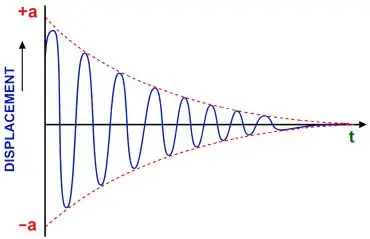
(i) Name the type of vibrations produced by the vibrating body.
(ii) Give one example of a body producing such vibrations.
(iii) Why is the amplitude of the wave gradually decreasing ?
(iv) What will happen to the vibrations of the body after some time ? [ICSE 2012]
Answer:
(i) The vibrations are damped vibrations.
(ii) A tuning fork vibrating in air is an example of damped vibrations.
(iii) The amplitude gradually decreases due to the resistance of the surrounding medium (air) and internal friction, which continuously dissipate the energy of the vibrating body.
(iv) After some time, when the body has lost all its energy, it stops vibrating.
Question 24
A bucket kept under a running tap is getting filled with water. A person sitting at a distance is able to get an idea when the bucket is about to be filled.
(i) What change takes place in the sound to give this idea ?
(ii) What causes the change in the sound ? [ICSE 2013]
Answer:
(i) As the bucket fills with water, the pitch (shrillness) of the sound increases because the length of the air column decreases, causing the frequency to increase.
(ii) This change in sound occurs because the frequency of the vibrating air column increases as the length of the air column decreases.
Question 25
A sound made on the surface of a lake takes 3s to reach a boatman. How much time will it take to reach a diver inside the water at the same depth ?
Velocity of sound in air = 330 m s–1
Velocity of sound in water = 1450 m s–1. [ICSE 2013]
Answer:
Given:
- Time in air = 3 s
- Speed in air = 330 m/s
- Speed in water = 1450 m/s
Distance travelled by sound:
d = vt = 330 × 3 = 990 m
Time taken by sound in water:
∴ The sound will reach the diver in 0.68 s.
Question 26
(i) What is the principle on which SONAR is based ?
(ii) An observer stands at a certain distance away from a cliff and produces a loud sound. He hears the echo of the sound after 1.8s. Calculate the distance between the cliff and the observer if the velocity of sound in air is 340 m s–1. [ICSE 2013]
Answer:
(i) SONAR is based on the reflection (echo) of ultrasonic waves.
(ii) Given:
- Time, t = 1.8 s
- Speed, v = 340 m/s
Distance travelled by sound,
Question 27
A vibrating tuning fork is placed over the mouth of a burette filled with water. The tap of the burette is opened and the water level gradually starts falling. It is found that the sound from the tuning fork becomes very loud for a particular length of the water column.
(i) Name the phenomenon taking place when this happens.
(ii) Why does the sound become very loud for this length of the water column ? [ICSE 2013]
Answer:
(i) Resonance
(ii) The air column’s natural frequency becomes equal to the tuning fork’s frequency, so it vibrates with maximum amplitude, producing a loud sound.
Question 28
(i) What is meant by the terms (1) amplitude (2) frequency, of a wave ?
(ii) Explain why stringed musical instruments, like the guitar, are provided with a hollow box. [ICSE 2013]
Answer:
(i) (1) Amplitude:
The maximum displacement of a vibrating particle from its mean position is called amplitude.
(2) Frequency:
The number of vibrations (or sound waves) produced in one second is called frequency.
(ii) Stringed instruments have a hollow box because the enclosed air resonates with the vibrating strings, increasing the loudness of the sound.
Question 29
(i) What are mechanical waves ?
(ii) Name one property of waves that do not change when the wave passes from one medium to another. [ICSE 2014]
Answer:
(i) Mechanical waves are waves that require a material medium for propagation.
(ii) Frequency remains unchanged when a wave passes from one medium to another.
Question 30
(i) State one important property of waves used for echo depth sounding.
(ii) A radar sends a signal to an aircraft at a distance of 30 km away and receives it back after 2 x 10⁻⁴ second. What is the speed of the signal ? [ICSE 2014]
Answer:
(i) Echo depth sounding is based on the reflection (echo) of ultrasonic waves.
(ii) Given:
- Time taken, t = 2 × 10⁻⁴ s
- Distance of aircraft, d = 30 km = 30 × 103 m
The radar signal travels to the aircraft and back, so the total distance travelled is:
Total distance = 2d = 2 × 30 × 103 = 60 × 103 m
Speed of the signal:
v = 3 × 10⁸ m/s
∴ Speed of the signal = 3 × 10⁸ m/s
Question 31
The adjacent diagram shows three different modes of vibrations P, Q and R of the same string.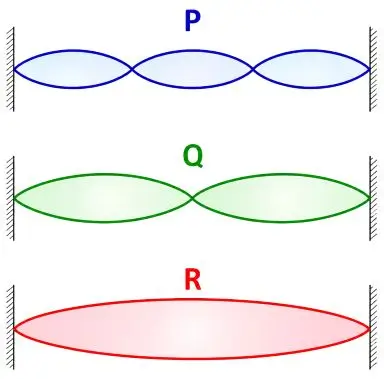
(i) Which vibrations will produce a louder sound and why ?
(ii) The sound of which string will have maximum shrillness ?
(iii) State the ratio of wavelengths of P and R. [ICSE 2014]
Answer:
(i) R will produce the louder sound because it has the maximum amplitude of vibration. Greater amplitude produces greater loudness.
(ii) P will have the maximum shrillness (highest pitch) because it has the highest frequency.
(iii) Let l be the length of the string.
Wavelength of P (λP) =
Wavelength of R (λR) = 2l
Therefore, ratio of λP : λR
Hence, λP : λR = 1 : 3
Question 32
(i) Draw a graph between displacement and the time for a body executing free vibrations.
(ii) Where can a body execute free vibrations? [ICSE 2015]
Answer:
(i) The displacement-time graph for a body executing free vibrations is given below: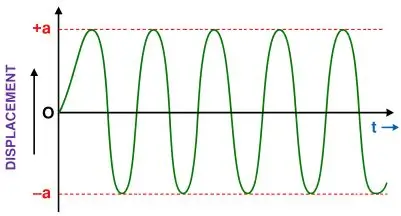
(ii) The natural vibrations can occur only in vacuum.
Question 33
(i) State the safe limit of sound level in terms of decibel for human hearing.
(ii) Name the characteristic of sound in relation to its waveform. [ICSE 2015]
Answer:
(i) 80 dB
(ii) Quality (or Timbre) of sound
Question 34
In the diagram below, A, B, C, D are four pendulums suspended from the same elastic string PQ. The length of A and C are equal to each other while the length of pendulum B is smaller than that of D. Pendulum A is set into a mode of vibrations.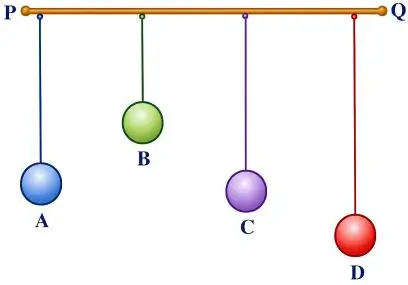
(i) Name the type of vibrations taking place in pendulums B and D ?
(ii) What is the state of pendulum C ?
(iii) State the reason for the type of vibrations in pendulums B and C. [ICSE 2015]
Answer:
(i) Pendulums B and D execute forced vibrations.
(ii) Pendulum C is in resonance and vibrates with maximum amplitude (resonant vibrations).
(iii) Type of vibrations in pendulums B and C:
- Pendulum B: It has a different length from pendulum A, so its natural frequency is different. Hence, it undergoes forced vibrations with small amplitude.
- Pendulum C: It has the same length as pendulum A, so both have the same natural frequency. Therefore, C undergoes resonant vibrations and vibrates with maximum amplitude due to resonance.
Question 35
A person standing between two vertical cliffs and 480 m from the nearest cliff shouts. He hears the first echo after 3s and the second echo 2s later.
Calculate:
(i) The speed of sound.
(ii) The distance of the other cliff from the person. [ICSE 2015]
Answer:
Given:
- Distance from nearest cliff = 480 m
- First echo = 3 s
- Second echo = 3 + 2 s = 5 s
(i) Speed of sound:
∴ Speed of sound = 320 m/s
(ii) Distance of other cliff:
∴ Distance of the other cliff = 800 m
Question 36
The ratio of amplitude of two waves is 3 : 4. What is the ratio of their :
(i) loudness ?
(ii) frequencies ? [ICSE 2016]
Answer:
Amplitude ratio = 3 : 4
(i) Loudness ∝ (Amplitude) 2
Loudness ratio = (3)2 : (4) 2 = 9 : 16
(ii) Frequency is independent of amplitude.
Frequency ratio = 1 : 1
Question 37
State two ways by which the frequency of transverse vibrations of a stretched string can be increased. [ICSE 2016]
Answer:
Frequency can be increased by:
- Decreasing the length of the string.
- Increasing the tension in the string.
Question 38
What is meant by noise pollution ? Name one source of sound causing noise pollution. [ICSE 2016]
Answer:
Noise pollution is the presence of unwanted or excessive sound that causes discomfort or harm.
One source: Loudspeakers. (Also acceptable: vehicle horns, factories, aircraft.)
Question 39
(i) Name the waves used for echo depth sounding.
(ii) Give one reason for their use for the above purpose.
(iii) Why are the waves mentioned by you not audible to us ? [ICSE 2016]
Answer:
(i) Ultrasonic waves
(ii) They have high frequency and short wavelength, so they produce sharp and accurate echoes.
(iii) They are not audible because their frequency is greater than 20,000 Hz, which is beyond the range of human hearing.
Question 40
(i) What is an echo ?
(ii) State two conditions for an echo to take place. [ICSE 2016]
Answer:
(i) Echo: The repetition of a sound due to reflection from a distant surface.
(ii) Conditions for Hearing an Echo:
- Distance between listener and reflector should be at least 17 m in air.
- Reflecting surface should be large.
- Reflected sound must be sufficiently loud.
Question 41
(i) Name the phenomenon involved in tuning a radio set to a particular station.
(ii) Define the phenomenon named by you in part (i) above.
(iii) What do you understand by loudness of sound ?
(iv) In which units is the loudness of sound measured ? [ICSE 2016]
Answer:
(i) Resonance
(ii) Resonance: It is the phenomenon in which a body vibrates with maximum amplitude when the frequency of the external force equals its natural frequency.
(iii) Loudness: The characteristic of sound by which a loud sound can be distinguished from a faint sound.
(iv) Decibel (dB)
Question 42
The human ear can detect continuous sounds in the frequency range from 20 Hz to 20000 Hz. Assuming that the speed of sound in air is 330 ms–1 for all frequencies, calculate the wavelengths corresponding to the given extreme frequencies of the audible range. [ICSE 2017]
Answer:
Given:
- Speed of sound, v = 330 m s–1
- Lowest frequency, f1 = 20 Hz
- Highest frequency, f2 = 20,000 Hz
Using the relation:
∴
For the lowest frequency (20 Hz):
For the highest frequency (20,000 Hz):
- Wavelength corresponding to 20 Hz = 16.5 m
- Wavelength corresponding to 20,000 Hz = 0.0165 m (1.65 cm)
Question 43
An enemy plane is at a distance of 300 km from a radar. In how much time the radar will be able to detect the plane? Take velocity of radio waves as 3 × 10⁸ m s–1. [ICSE 2017]
Answer:
Given:
- Distance of aeroplane, d = 300 km = 300 × 1000 m = 3 × 10⁵ m
- Speed of radar signal, v = 3 × 10⁸ m s–1
Using the formula:
Substituting the given values:
Therefore, the signal is received back after = 2 × 10⁻³ s.
Question 44
How is the frequency of a stretched string related to :
(i) its length?
(ii) its tension? [ICSE 2017]
Answer:
(i) Frequency is inversely proportional to the length of the string i.e.,
(ii) Frequency is directly proportional to the square root of the tension i.e.,
Question 45
Name the factor that determines :
(i) Loudness of the sound heard.
(ii) Quality of the note.
(iii) Pitch of the note. [ICSE 2017]
Answer:
(i) Loudness: Amplitude of vibration
(ii) Quality: Waveform
(iii) Pitch: Frequency of vibration
Question 46
(i) What are damped vibrations ?
(ii) Give one example of damped vibrations.
(iii) Name the phenomenon that causes a loud sound when the stem of a vibrating tuning fork is kept pressed on the surface of a table. [ICSE 2017]
Answer:
(i) Damped vibrations: Vibrations whose amplitude gradually decreases with time due to resistive forces.
(ii) Example: Vibrations of a simple pendulum in air.
(iii) Resonance
Question 47
(i) A wire of length 80 cm has a frequency of 256 Hz. Calculate the length of a similar wire under similar tension, which will have frequency 1024 Hz.
(ii) A certain sound has a frequency of 256 hertz and a wavelength of 1.3 m.
(1) Calculate the speed with which this sound travels.
(2) What difference would be felt by a listener between the above sound and another sound travelling at the same speed, but of wavelength 2.6 m ? [ICSE 2017]
Answer:
(i) Given:
l1 = 80 cm, f1 = 256 Hz, f2 = 1024 Hz, l2 = ?
Since,
Therefore,
(i) (1) Given:
f = 256 Hz, λ = 1.3 m
Using,
v = fλ
v = 256 × 1.3
v = 332.8 m s–1
(2) Given:
v = 332.8 m s–1, λ = 2.6 m
Using,
f = 128 Hz
Since the second sound has a lower frequency, it has a lower pitch.
The second sound will be less shrill (graver) than the first sound.
Question 48
Displacement distance graph of the two sound waves A and B, travelling in a medium, are as shown in the diagram below.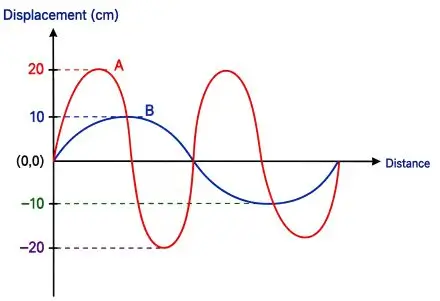
Study the two sound waves and compare their:
(i) Amplitudes (ii) Wavelengths [ICSE 2018]
Answer:
(i) Amplitudes:
Wave A = 20 cm
Wave B = 10 cm
Therefore,
Amplitude of A : Amplitude of B = 20 : 10 = 2 : 1
(ii) Wavelengths:
Wave B has twice the wavelength of wave A.
Therefore,
Wavelength of A : Wavelength of B = 1 : 2
Or
Wavelength of B is double that of A.
Question 49
(i) What do you understand by free vibrations of a body?
(ii) Why does the amplitude of a vibrating body continuously decrease during damped vibrations? [ICSE 2018]
Answer:
(i) Free vibrations: Vibrations performed by a body on its own after being disturbed, without any external periodic force.
(ii) During damped vibrations, the amplitude continuously decreases because energy is lost due to air resistance and friction.
Question 50
The diagram below shows a wire stretched over a sonometer. Stems of two vibrating tuning forks A and B are touched to the wooden box of the sonometer. It is observed that the paper rider (a small piece of paper folded at the centre) present on the wire flies off when the stem of vibrating tuning fork B is touched to the wooden box but the paper just vibrates when the stem of vibrating tuning fork A is touched to the wooden box.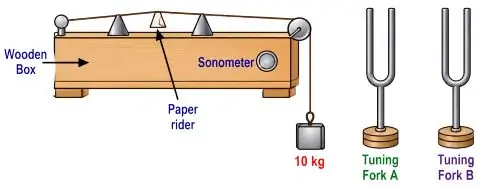
(i) Name the phenomenon when the paper rider just vibrates.
(ii) Name the phenomenon when the paper rider flies off.
(iii) Why does the paper rider fly off when the stem of tuning fork B is touched to the box? [ICSE 2018]
Answer:
(i) When the paper rider just vibrates, the phenomenon is forced vibrations.
(ii) When the paper rider flies off, the phenomenon is resonance (resonant vibrations).
(iii) The frequency of tuning fork B is equal to the natural frequency of the wire. Therefore, resonance occurs, causing the wire to vibrate with maximum amplitude, and the paper rider flies off.
Question 51
A person is standing at the sea shore. An observer on the ship, which is anchored in between a vertical cliff and the person on the shore, fires a gun. The person on the shore hears two sounds, 2 seconds and 3 seconds after seeing the smoke of the fired gun. If the speed of sound in the air is 320 m s–1 then calculate:
(i) the distance between the observer on the ship and the person on the shore.
(ii) the distance between the cliff and the observer on the ship. [ICSE 2018]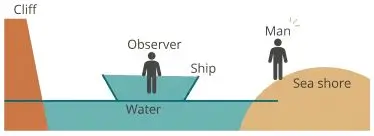
Answer:
Given:
- Speed of sound, v = 320 m s–1
- Time for first sound, t1 = 2 s
- Time for second sound, t2 = 3 s
(i) Let the distance between the observer on the ship and the person on the shore be d1.
The first sound heard is the direct sound.
Using,
∴ Distance between the observer on the ship and the person on the shore = 640 m
(ii) The second sound is the echo reflected from the cliff.
The echo takes 3 − 2 = 1 s to travel from the observer to the cliff and back.
Let the distance between the observer and the cliff be d2.
Using,
∴ Distance between the observer and the cliff = 160 m
Question 52
A man playing a flute is able to produce notes of different frequencies. If he closes the holes near his mouth, will the pitch of the note produced, increase or decrease? Give a reason. [ICSE 2019]
Answer:
The pitch increases.
Reason: Closing the holes near the mouth decreases the length of the vibrating air column, increasing its frequency. Since pitch depends on frequency, the pitch increases.
Question 53
Two waves of the same pitch have amplitudes in the ratio 1 : 3. What will be the ratio of their:
(i) intensities and
(ii) frequencies? [ICSE 2019]
Answer:
Amplitude ratio = 1 : 3
(i) Intensity ∝ (Amplitude)2
Intensity ratio = (1) 2 : (3) 2 = 1 : 9
(ii) Since the pitch is the same, the frequencies are equal.
Frequency ratio = 1 : 1
Question 54
(i) Define resonant vibrations.
(ii) Which characteristic of sound, makes it possible to recognize a person by his voice without seeing him ? [ICSE 2019]
Answer:
(i) Resonant vibrations: It is the phenomenon in which a body vibrates with maximum amplitude when the frequency of the
external force equals its natural frequency.
(ii) Quality (or Timbre) of sound.
Question 55
It is observed that during march-past we hear a base drum distinctly from a distance compared to the side drums.
(i) Name the characteristic of sound associated with the above observation.
(ii) Give a reason for the above observation. [ICSE 2019]
Answer:
(i) Loudness
(ii) The base drum has a larger vibrating surface than the side drums. Therefore, it produces sound with greater amplitude, making it louder. Hence, the sound of the base drum can be heard more distinctly from a distance.
Question 56
A pendulum has a frequency of 4 vibrations per second. An observer starts the pendulum and fires a gun simultaneously. He hears the echo from the cliff after 6 vibrations of the pendulum. If the velocity of sound in air is 340 m s–1, find the distance between the cliff and the observer. [ICSE 2019]
Answer:
Given:
- Frequency = 4 Hz
- Number of vibrations = 6
- Speed of sound = 340 m/s
Time taken:
Distance to cliff:
Distance = 255 m
Question 57
Two pendulums C and D are suspended from a wire as shown in the given figure.
Pendulum C is made to oscillate by displacing it from its mean position. It is seen that D also starts oscillating.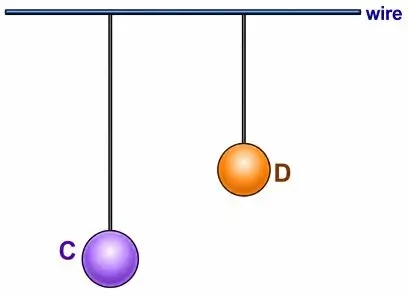
(i) Name the type of oscillation, C will execute.
(ii) Name the type of oscillation, D will execute.
(iii) If the length of D is made equal to C, then what difference will you notice in the oscillations of D?
(iv) What is the name of the phenomenon when the length of D is made equal to C? [ICSE 2019]
Answer:
(i) Pendulum C executes free (natural) oscillations.
(ii) Pendulum D executes forced oscillations.
(iii) If the length of D is made equal to that of C, then D will oscillate with maximum amplitude.
(iv) The phenomenon is called resonance (resonant vibrations).
Question 58
Draw a graph between displacement from mean position and lime for body executing free vibration in a vacuum. [ICSE 2020]
Answer:
The displacement-time graph for a body executing free vibrations is given below:
Question 59
A sound save travelling in water has wavelength 0.4 m. Is this vase audible in air? (The speed of sound in water = 1400 ms–1). [ICSE 2020]
Answer:
Given:
- Speed in water = 1400 m/s
- Wavelength = 0.4 m
Frequency:
Since 3500 Hz lies between 20 Hz and 20,000 Hz, the sound is audible in air.
Question 60
(i) Name the system which enables us to locate underwater objects by transmitting ultrasonic wares and detecting the reflecting impulse.
(ii) What are acoustically measurable quantities related to pitch and loudness? [ICSE 2020]
Answer:
(i) SONAR (Sound Navigation and Ranging)
(ii) • Pitch is measured by frequency.
• Loudness is measured by intensity (or sound intensity level).
Question 61
When a tuning fork [vibrating] is held close to ear, one hears a faint hum. The same [vibrating tuning fork] is held such that it’s stem is in contact with the table surface, then one hears a loud sound. Explain. [ICSE 2020]
Answer:
When the vibrating tuning fork is held near the ear, only a small amount of air vibrates, so a faint sound is heard. When its stem touches the table, the table is forced to vibrate with a much larger surface area. This increases the amplitude of the vibrations of air, producing a loud sound due to forced vibrations (resonance).
Question 62
A man standing in from of a vertical cliff fires a gun He hears the echo after 3.5 seconds. On moving closer to the cliff by 84 m, he hears the echo after 3 seconds. Calculate the distance of the cliff from the initial position of the man. [ICSE 2020]
Answer:
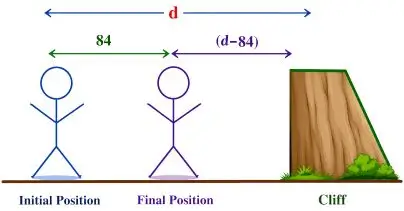
Let the initial distance of the man from the cliff be d m and the speed of sound be v m s–1.
For the first echo:
…(1)
For the second echo:
…(2)
Dividing equation (2) by equation (1):
∴ The distance of the cliff from the initial position of the man is 588 m.
Question 63
Choose the correct answers:-
(i) Free vibrations are:
(a) the vibrations under the influence of a periodic force.
(b) the vibrations with larger amplitude.
(c) the vibrations when the frequency continuously decreases.
(d) the vibrations with a constant frequency and constant amplitude.
(ii) The diagram below shows four sound waves.
Which sound has the highest pitch? [ICSE 2022 Sem 2]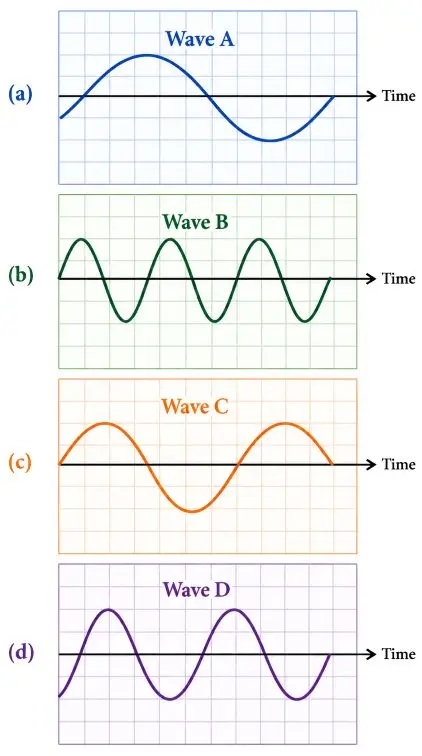
Answer:
(i) (d) the vibrations with a constant frequency and constant amplitude.
Explanation:
Free vibrations are produced when a body vibrates on its own after being disturbed once, without any external periodic force. In ideal conditions, both the frequency and amplitude remain constant.
(ii) (b) Wave B
Explanation:
Pitch depends on the frequency of a sound wave.
- Higher frequency ⇒ Higher pitch (shriller sound).
- Lower frequency ⇒ Lower pitch (deeper sound).
In the given diagram, Wave B completes the maximum number of vibrations (cycles) in the same time interval, so it has the highest frequency.
Therefore, it produces the highest pitch.
Question 64
Rohit playing a flute and Anita playing a piano emit sounds of same pitch and loudness.
(a) Name one characteristic that is different for waves from the two different instruments.
(b) If now the loudness of the sound from flute becomes four times that of the sound from piano, then write the value of the ratio
AF : AP (AF–amplitude of sound wave from flute, AP – amplitude of sound wave from piano)
(c) Define ‘Pitch’ of a sound. [ICSE 2022 Sem 2]
Answer:
(a) Quality (Timbre)
Explanation: Even if two instruments produce sound of the same pitch and loudness, they differ in quality because of their different waveforms.
(b) Loudness is directly proportional to the square of the amplitude.
Loudness (L) ∝ (Amplitude)2
Therefore, AF : AP = 2 : 1.
(c) Pitch is the characteristic of sound by which a sound is identified as shrill or deep. It depends on the frequency of vibration.
Question 65
The diagram below shows a vibrating tuning fork E mounted on a sound box X. When the vibrating tuning forks A, B, C and D are placed on the sound box. Y one by one, it is observed that a louder sound is produced when the tuning fork k. B is place on Y.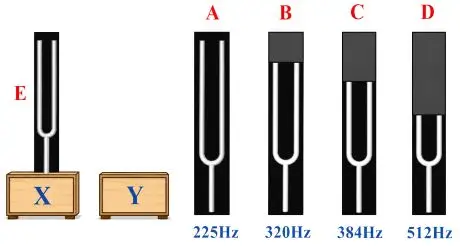
(a) What is the frequency of tuning fork E?
(b) Why does B produce a louder sound? [ICSE 2022 Sem 2]
Answer:
(a) The frequency of tuning fork E is 320 Hz.
Reason: The loudest sound is produced when tuning fork B (320 Hz) is placed on sound box Y. This happens because resonance occurs only when two tuning forks have the same natural frequency. Therefore, tuning fork E also has a frequency of 320 Hz.
(b) Tuning fork B produces a louder sound because its natural frequency is the same as that of tuning fork E. As a result, resonance takes place, causing the amplitude of vibration to increase and producing a louder sound.
Question 66
Study the above figure and answer the following: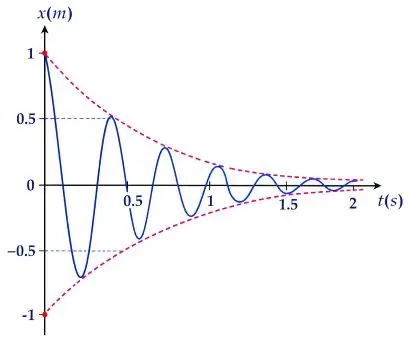
(a) What type of vibration does the above figure represent?
(b) State one reason for which the amplitude of the vibration decreases with time.
(c) Write an example of natural vibrations. [ICSE 2022 Sem 2]
Answer:
(a) The figure represents damped vibrations.
Reason: The amplitude of the vibrations gradually decreases with time.
(b) The amplitude decreases with time because energy is continuously lost due to air resistance (friction) or other resistive forces, which gradually reduce the vibrations.
(c) Example of natural vibrations:
A tuning fork vibrating freely after being struck once.
Question 67
Choose the correct answers:- [ICSE 2023]
(i) When a body vibrates under a periodic force, then vibrations of the body are always:
(a) natural vibrations (b) damped vibrations
(c) forced vibrations (d) resonant vibrations
(ii) Two notes are produced form two different musical instruments, such that they have same loudness and same pitch. The produced notes differ in their.
(a) Waveform (b) Frequency
(c) Wavelength (d) Speed
Answer:
(i) (c) Forced vibrations
Explanation:
A periodic external force makes the body vibrate continuously. These are called forced vibrations.
(ii) (a) Waveform
Explanation:
- Loudness depends on amplitude.
- Pitch depends on frequency.
- Since both are same, the difference is only in waveform, which determines quality.
Question 68
A metal foot ruler is held at the edge of a table.
It is pressed at its free end and then released. It vibrates.
(a) Name the vibrations produced.
(b) State one way to increase the frequency of these vibrations. [ICSE 2023]
Answer:
(a) Free vibrations
(b) Reduce the length of the free vibrating part of the ruler.
Explanation: A shorter vibrating length vibrates faster, increasing the frequency.
Question 69
(a) Which characteristic of sound is affected due to the larger surface of a school bell?
(b) Calculate the distance covered by the Ultrasonic wave having a velocity of 1.5 kms–1 in 14 s, when it is received after reflection by the receiver of the SONAR. [ICSE 2023]
Answer:
(a) Loudness
Explanation:
A larger bell has a larger vibrating surface, producing sound with greater amplitude and hence greater loudness.
(b) Given:
- Velocity of ultrasonic wave = 1.5 km s–1
- Time taken = 14 s
The wave travels to the obstacle and back, so:
Distance to the obstacle
= 10.5 km
Question 70
Choose the correct answers:- [ICSE 2024]
When the stem of vibrating tuning fork is pressed on a table, the tabletop starts vibrating. These vibrations are definitely an example of:
(a) resonance
(b) natural vibrations
(c) forced vibrations
(d) damped vibrations
Answer:
(c) Forced vibrations
Explanation:
The vibrating tuning fork forces the tabletop to vibrate. Hence, the table undergoes forced vibrations.
Question 71
Rohan conducted experiments on echo in different media. He observed that a minimum distance of ‘x’ metres is required for the echo to be heard in oxygen and ‘y’ metres in benzene. Compare ‘x’ and ‘y’. Justify your answer.
Speed of sound in oxygen: 340 ms–1
Speed of sound in benzene: 200 ms–1 [ICSE 2024]
Answer:
Given:
- Speed of sound in oxygen = 340 m s–1
- Speed of sound in benzene = 200 m s–1
- Minimum time to hear an echo = 0.1 s
The minimum distance required to hear an echo is:
Distance
For oxygen:
For benzene:
Therefore,
x > y
∴ The minimum distance required to hear an echo is greater in oxygen than in benzene (x > y) because the speed of sound is higher in oxygen.
Question 72
(a) Name the waves used in SONAR.
(b) In the below diagram Lata stands between two cliffs and claps her hands. Determine the time taken by her to hear the first echo.
Speed of sound in air 320 ms–1. [ICSE 2024]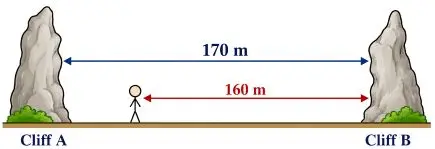
Answer:
(a) The waves used in SONAR are ultrasonic waves.
(b) Given:
- Speed of sound in air = 320 m s–1
- Distance between the cliffs = 170 m
- Distance of Lata from Cliff B = 160 m
- Distance of Lata from Cliff A = 170 − 160 = 10 m
The minimum distance required to hear an echo is:
Minimum distance
Since Lata is only 10 m from Cliff A, the reflected sound returns in less than 0.1 s and cannot be heard as a separate echo.
Therefore, the first audible echo is received from Cliff B.
Distance travelled by sound = 2 × 160 = 320 m
Time taken
∴ The first echo is heard after 1 second.
Question 73
In the given diagram, a vibrating tuning fork is kept near the mouth of a burette filled with water. The length of the air column is adjusted by opening the tap of the burette. At a length of 5 cm of the air column, a loud sound is heard.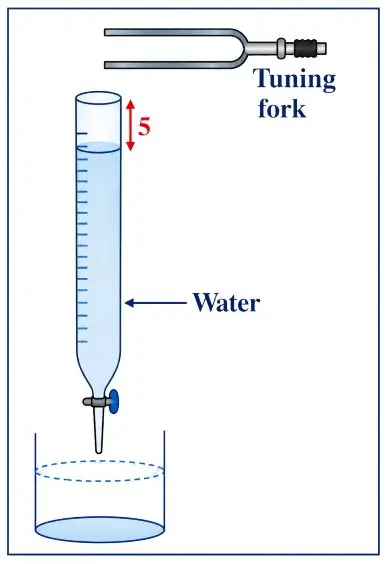
(a) Name the phenomenon illustrated by the above experiment.
(b) Why is a loud sound heard at this particular length?
(c) If the present tuning fork is replaced with a tuning fork of higher frequency, should the length of the air column increase or decrease to produce a loud sound? Give a reason. [ICSE 2024]
Answer:
(a) The phenomenon illustrated by the experiment is resonance.
(b) A loud sound is heard because the natural frequency of the air column becomes equal to the frequency of the vibrating tuning fork. Due to resonance, the amplitude of vibration of the air column becomes maximum, producing a loud sound.
(d) The length of the air column should decrease.
Reason: A tuning fork of higher frequency has a shorter wavelength. Since the resonating length of an air column is directly proportional to the wavelength, a shorter air column is required to produce resonance.
Question 74
Choose the correct answers:- [ICSE 2025]
Assertion (A): As the level of water in a tall measuring cylinder kept under running tap rises, the pitch of sound gradually increases.
Reason (R): Frequency of sound is inversely proportional to the length of the water column.
(a) Both (A) and (R) are true and (R) is correct explanation of (A).
(b) Both (A) and (R) are true and (R) is not the correct explanation of (A).
(c) (A) is true but (R) is false.
(d) (A) is false but (R) is true.
Answer:
(c) (A) is true but (R) is false.
Explanation:
As water level rises, the air column becomes shorter, increasing frequency and pitch.
The reason is incorrect because frequency is inversely proportional to the length of the air column, not the water column.
Question 75
The displacement–time graph of a sound wave produced by a vibrating wire is shown below. 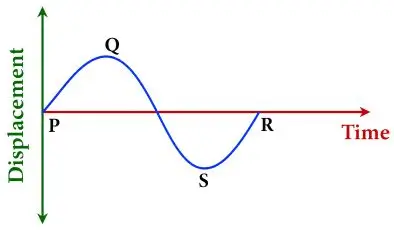
(a) How will you adjust the tension in the wire, to reduce the length of PR?
(b) Which characteristic of sound is affected by the reduction in the length of PR? [ICSE 2025]
Answer:
(a) The length PR represents the time period of the vibration. To reduce the time period, the frequency must increase. This can be done by increasing the tension in the wire.
(b) Reducing the length PR decreases the time period and increases the frequency. Since pitch depends on frequency, the pitch of the sound increases (the sound becomes shriller).
Question 76
A submarine in the sea, sends ultrasonic ping and a stopwatch is started. simultaneously. The stopwatch stops on receiving the reflected wave from an obstacle and reads 1 minute 40 seconds. Calculate the distance of the obstacle from the submarine (Speed of sound in water 1500 ms−1). [ICSE 2025]
Answer:
Given:
- Time taken = 1 minute 40 seconds = 100 s
- Speed of sound in water = 1500 m s−1
The ultrasonic wave travels to the obstacle and back.
Distance of the obstacle
= 75000 m
= 75 km
∴ The distance of the obstacle from the submarine is 75 km.
Question 77
The diagrams given below show two sound boxes A and B with wires of same length (l) and tension (10 kgf) but different cross-sectional areas. Simultaneously, vibrating tuning forks of frequency 300 Hz are placed on the boxes A and B. The paper rider falls off in case of B but not in case of A. [ICSE 2025]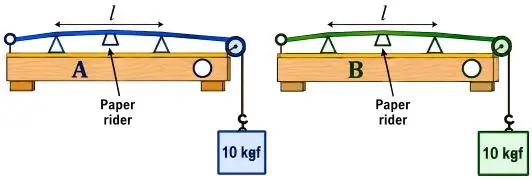
(a) Name and explain the phenomenon responsible for the falling off of the paper rider in B.
(b) The wire A resonates with a tuning fork of frequency ‘f’. Is ‘f’ greater than, less than or equal to 300 Hz? Justify your answer.
Answer:
(a) The phenomenon responsible for the paper rider falling off in B is resonance.
Explanation:
When the frequency of the vibrating tuning fork (300 Hz) becomes equal to the natural frequency of wire B, resonance occurs. As a result, the amplitude of vibration of wire B becomes maximum, causing the paper rider to fall off.
(b) The frequency f of wire A is greater than 300 Hz.
Justification:
Since wire A does not resonate with the 300 Hz tuning fork, its natural frequency is not 300 Hz.
The wires have the same length and tension but different cross-sectional areas. The wire in A is thinner (smaller cross-sectional area), so it has a smaller mass per unit length. The frequency of a stretched wire is inversely proportional to the square root of its mass per unit length.
Therefore, the thinner wire A has a higher natural frequency.
Question 78
Choose the correct answers:- [ICSE 2026]
(i) Equal volumes of water are added to three cylindrical jars A, B and C of same height and radii rA, rB and rC respectively with rB < rA < rC. If you blow air into the mouth of these jars, which tube will produce the shrillest note?
(a) A
(b) B
(c) C
(d) All will produce the notes of same shrillness
(ii) Quality of sound depends on its …………… [amplitude / waveform].
Answer:
(ii) (b) B
Explanation: Pitch increases when the air column becomes shorter.
(ii) Quality of sound depends on its waveform.
Question 79
(a) Define natural vibrations.
(b) How is this vibration different from damped vibrations in terms of their amplitudes? [ICSE 2026]
Answer:
(a) Natural vibrations are the vibrations performed by a body when disturbed and then left free to vibrate at its own natural frequency without any external force.
(b) • Natural vibrations: Amplitude remains constant (ideal conditions).
• Damped vibrations: Amplitude gradually decreases with time due to loss of energy.
Question 80
(a) One end of a plastic foot ruler is held tightly at the edge of a table and the other end is plucked. Name the vibrations produced in the ruler.
(b) Now the ruler is pushed inside partially and plucked again from its freе end. State with a reason whether the frequency of vibration increases or decreases. [ICSE 2026]
Answer:
(a) Natural vibrations
(b) Frequency increases.
Reason:
When the ruler is pushed further inside, the free vibrating length decreases. A shorter vibrating length vibrates faster, so the frequency increases.
Question 81
Two persons A and B are standing in front of a cliff in the same line 170 m apart as shown in the diagram.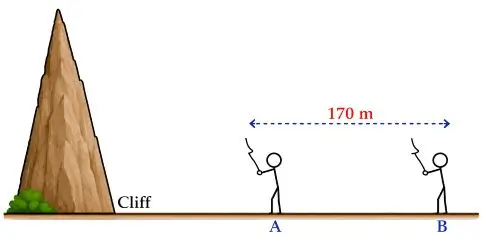
Person B fires the gun and hears the echo in 3 s. Then the person A standing in front of the person B fires the gun.
(Speed of sound in air is 340 m s−1)
(a) Calculate:
- the distance of the person B from the cliff.
- the minimum time in which B hears the gunshot fired by A.
(b) Fill in the blank:-
The echo is softer (less loud) than the original sound due to the decrease in …………… [amplitude / frequency] of the wave. [ICSE 2026]
Answer:
Given:
- Distance between A and B = 170 m
- Time taken by B to hear the echo = 3 s
- Speed of sound in air = 340 m s−1
(a) 1. Let the distance of B from the cliff be d.
Distance
= 510 m
∴ The distance of person B from the cliff is 510 m.
2. B first hears the direct sound from A.
∴ The minimum time in which B hears the gunshot fired by A is 0.5 s.
(b) The echo is softer (less loud) than the original sound due to the decrease in amplitude of the wave.
Download ICSE Class 10 Physics Chapter 7 Sound Previous Year Questions with Answers PDF
Students can download the ICSE Class 10 Physics Chapter 7 Sound Previous Year Questions PDF for free and practice offline anytime.
Benefits of Solving Sound PYQs
- Improves conceptual understanding
- Helps manage time during exams
- Builds confidence for board examinations
- Identifies weak areas for revision
- Increases accuracy in numerical questions
- Enhances answer presentation skills
Who Should Use These Questions?
These previous year questions are useful for:
- ICSE Class 10 students
- Students preparing for school examinations
- Board exam aspirants
- Teachers preparing classroom tests
- Parents helping students with revision
Conclusion
Practising ICSE Class 10 Physics Chapter 7 Sound Previous Year Questions is one of the smartest ways to prepare for the board examination. Solve these questions regularly, revise the important formulas, and analyze the solutions carefully to improve your accuracy and confidence. Download the PDF and start practising today for excellent results.
You can also visit:
ICSE Class 10 Physics Important Previous Year Questions
| ☛ Chapter 1 – Force Previous Year Questions |
| ☛ Chapter 2 – Work, Energy and Power Previous Year Questions |
| ☛ Chapter 3 – Machines Previous Year Questions |
| ☛ Chapter 4 – Refraction of Light at Plane Surfaces Previous Year Questions |
| ☛ Chapter 5 – Refraction through Lens Previous Year Questions |
| ☛ Chapter 6 – Spectrum Previous Year Questions |
| ☛ Chapter 7 – Sound Previous Year Questions |
| ☛ Chapter 8 – Current Electricity Previous Year Questions |
| ☛ Chapter 9 – Electrical Power and Household Circuits Previous Year Questions |
| ☛ Chapter 10 – Electro-magnetism Previous Year Questions |
| ☛ Chapter 11 – Calorimetry Previous Year Questions |
| ☛ Chapter 12 – Radioactivity Previous Year Questions |
Official Websites